
Sherpa Culture in the Everest Region: Traditions, Festivals, and Daily Life
Sherpa Culture in the Everest Region: Traditions, Festivals, and Daily Life
The first thing you notice in the Khumbu is not always the mountains. It is the smell of juniper smoke drifting from a kitchen in Phakding, the soft click of prayer wheels turning under an older woman’s hand, the deep hum of horns from a monastery hidden in the clouds, and a cup of sweet milk tea pressed into your cold hands with a smile. Long before Everest comes into view, you are already walking through a living culture.
That culture belongs to the Sherpa people, the highland community whose homes, monasteries and fields line every step of the Everest Base Camp Trek. Many visitors know the word “Sherpa” only as a job title for a mountain guide. In reality, Sherpa culture is a rich tradition of Tibetan Buddhist faith, festivals, food, family life and deep respect for the mountains, shaped over centuries in one of the harshest environments on Earth.
As a Sherpa-led company, this subject is personal for us. In this guide, our team shares the history and beliefs of our people, the festivals that mark our year and the rhythm of daily life in a Khumbu village, along with practical advice on how to experience it all respectfully when you trek through the Everest region.
The Short Answer: What Is Sherpa Culture?
Sherpa culture is the way of life of the Sherpa people of the Everest region: Nyingma Buddhist faith, monasteries and prayer flags, sacred mountains, festivals such as Losar, Dumje and Mani Rimdu, potato farming and yak herding, family-run lodges, day-of-the-week names and warm hospitality, shaped by centuries of Himalayan trade and mountaineering.
You can see it every day on an Everest trek, but it shines brightest in the monastery villages of Namche, Khumjung, Thame, Tengboche, and Pangboche, and during the great festivals.
Sherpa Culture at a Glance
- Who: A Tibetan-origin Buddhist people whose ancestors crossed the Himalaya from Kham in eastern Tibet and now live mainly in the Solukhumbu district of Nepal.
- Faith: The Nyingma school of Tibetan Buddhism, which honors Guru Rinpoche, blended with reverence for mountain gods such as Khumbila and Chomolungma.
- Language: Sherpa, a Tibetan language traditionally spoken more than written, alongside Nepali and, in the trekking world, English.
- Main festivals: Losar (New Year, late winter), Dumje (early summer) and Mani Rimdu (Thame in May or June, Tengboche in October or November).
- Daily life: Potato farming, yak herding, trade and, today, family-run lodges, guiding and climbing.
- Best places to experience it: Namche Bazaar, Khumjung and Khunde, Thame, Tengboche Monastery, Pangboche and Phortse.
- Our trek: The 14-day Everest Base Camp Trek passes all the main monastery villages of the Khumbu.
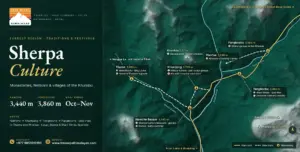
The cultural heartland of the Khumbu: the monastery villages of Namche, Khumjung, Thame, Tengboche, and Pangboche; Phortse’s climbing school; and the sacred peak of Khumbila.
Who Are the Sherpa People?
The Sherpa are an ethnic group of the high Himalaya, living mainly in the Solukhumbu district of north-eastern Nepal, home to Everest and Sagarmatha National Park, with smaller communities in the Rolwaling Valley, the Arun Valley, and other parts of eastern Nepal, as well as in Darjeeling and Sikkim in India. The name comes from Tibetan words meaning “people from the east,” a reference to their ancestral homeland. The Khumbu, the high valley system around Everest, is their heartland, while the lower Solu and Pharak regions hold many more Sherpa villages and monasteries.
Origins and Migration
According to Sherpa oral history, our ancestors came from Kham in eastern Tibet. Over generations, they traveled west across the Tibetan plateau and finally crossed the high Nangpa La pass into the Khumbu, around five centuries ago. They brought their language, their Buddhist faith, and their skills as herders and traders, and they found a valley their lamas described as a beyul, a sacred hidden land of refuge.
Clans and Family Lines
The first settlers are said to have belonged to a handful of original clans, which have since grown into some twenty clan groups, called ru. Clan membership passes down the father’s line, and each clan honors its own protective deities and ancestral mountains. Traditionally, people marry outside their own clan, and elders still track clan relationships carefully when matches are discussed. Clan names such as Salaka, Paldorje, Chawa and Thaktu are known within the community, even though most Sherpas use “Sherpa” as their surname in everyday life.
The Sherpa Language
Sherpas speak their own language, part of the Tibetan language family, though speakers of modern Lhasa Tibetan do not easily understand it. It was traditionally spoken more than written, and religious texts are read in classical Tibetan script, which Sherpas also use today. Most Sherpas also speak Nepali, and many in the trekking industry speak excellent English and other languages.
Learning a few words goes a long way on the trail. “Tashi delek” is a warm greeting and blessing, “thuche che” means thank you, and the familiar “namaste” is understood everywhere.
More Than a Job Title
Because so many Sherpas became famous as high-altitude guides and climbers, the word “sherpa” is now used loosely around the world for anyone who carries loads or guides in the mountains. Inside Nepal, however, Sherpa is an ethnic identity with its own culture, history, and family names. Not every guide or porter on the trail is a Sherpa: you will also meet Rai, Tamang, Gurung, Magar and many other communities working in the mountains, as our team reflects. It is a small detail, but understanding it shows real respect. Whoever leads you, trekking with a licensed guide is now the norm, and our article on the Everest Base Camp trek without a guide explains the rules.
Sherpa Buddhism: The Heart of Sherpa Culture
Faith runs through every part of Sherpa culture. Sherpas follow the Nyingma school, the oldest tradition of Tibetan Buddhism, which traces its teachings to Guru Rinpoche, also known as Padmasambhava. He is believed to have brought Buddhism across the Himalayas, and many caves and sacred sites in Nepal and Tibet are linked to his meditation. Our article on Guru Padmasambhava: Maratika, Pharping and Tibet explores his story, and our guide to Buddhism in Tibet offers a broader introduction to the faith.
Sherpa Buddhism also includes older local beliefs. Mountain gods, protective spirits, sacred springs and powerful lakes are honored alongside the Buddha, and many families keep a small shrine to the local guardian deity on their roof or beside their house.
Lamas, Monks and Nuns
Religious life is led by lamas, who may be celibate monks living in a monastery or married householder lamas who serve their village. They read scriptures for births, weddings, illness, harvests, new houses, and funerals, consult astrological charts to choose auspicious days, and lead the great festivals. Many families have at least one relative who has spent time as a monk or nun, and larger monasteries train young novices in chanting, ritual music, scripture, and making tormas, the sculpted offering cakes of barley flour and butter.
Monasteries of the Khumbu
Monasteries, known as gompas, are the spiritual and social centers of Sherpa villages. On the classic route through the Khumbu, you can visit several of the most important:
- Tengboche Monastery: The largest monastery in the Khumbu, set on a forested ridge facing Ama Dablam and Everest. It has close ties to Rongbuk Monastery on the Tibetan side of Everest, was rebuilt after an earthquake and, decades later, a devastating fire, and hosts the famous Mani Rimdu festival every autumn.
- Pangboche Monastery: Often described as the oldest monastery in the Khumbu and, by legend, linked to the saint Lama Sangwa Dorje, in the upper part of Pangboche village.
- Khumjung Monastery: Home to a famous conical relic said to be a yeti scalp, which scientists on an expedition led by Edmund Hillary concluded was made from the skin of a serow, a Himalayan goat-antelope.
- Thame Monastery: Clinging to a ledge above the quiet Thame valley, roughly three and a half centuries old, and the venue of the spring Mani Rimdu.
- Namche Gompa: The village monastery of Namche Bazaar, close to the Sherpa Culture Museum and the national park headquarters, and the focus of the Dumje festival.
- Deboche Nunnery: A small community of nuns in the rhododendron forest just beyond Tengboche.
Mani Walls, Chortens and Prayer Wheels
The trail itself is a sacred landscape. Long walls of carved stones, called mani walls, bear the mantra “Om Mani Padme Hum,” the prayer of compassion. Whitewashed chortens, or stupas, mark village entrances and bridges, and our article on the Eight Great Stupas explains their meaning. Prayer wheels, some small enough to hold and others huge and water-powered, as in the heart of Namche, send prayers out every time they turn.
The rule is simple: always pass these on your right side, walking clockwise around them, just as Sherpas do. Never sit or step on mani stones, and never take them as souvenirs.
Prayer Flags
Colorful prayer flags, called lungta or “wind horses,” stretch across bridges, passes, and rooftops throughout the Khumbu. Their five colors represent the elements: blue for sky, white for air, red for fire, green for water,r and yellow for Earth. Printed with prayers and mantras, the flags are believed to carry blessings on the wind to all living beings. People hang new flags at Losar, on new homes, and before expeditions, and leave old flags to fade naturally.
Sacred Mountains, Hidden Valleys and the Spirit of the Land
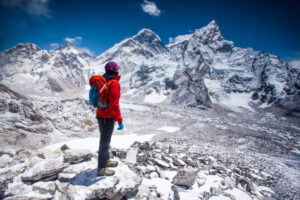
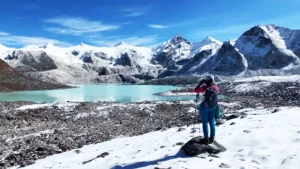
For Sherpas, the mountains are not obstacles to conquer but homes of gods and protectors. Everest itself is Chomolungma, often translated as “Mother Goddess of the World.” Khumbila, the dark rocky peak above Khumjung and Khunde, is home to the Khumbu’s guardian deity, and people do not climb it out of respect. Ama Dablam, whose name refers to a mother’s necklace and the charm box worn by Sherpa women, is another beloved peak, and many families also honor clan mountains linked to their ancestors. The lakes of Gokyo, which you can visit on our Gokyo Lakes trek guide route, are sacred to both Buddhists and Hindus, and the climb to Gokyo Ri and the fifth lake passes prayer flags and cairns all the way.
This belief shapes daily life. Sherpas avoid shouting, fighting, or polluting sacred places, and they make offerings of juniper smoke, rice, and butter lamps to keep the mountain gods content. Before an expedition sets foot on Everest or a trekking peak, a lama leads a puja ceremony at base camp, asking permission from the mountain and blessing climbers, ropes, ice axes and boots. If you climb Island Peak or Lobuche Peak with us, you may take part in a small puja yourself, as our guides to Island Peak climbing and Lobuche East describe; the same blessing opens our Mera Peak Climbing expeditions.
The idea of the beyul, the hidden valley revealed by Guru Rinpoche to faithful people in times of trouble, explains why the Khumbu itself is treated as a protected, holy land. Hunting and killing animals are traditionally frowned upon, and the wildlife you see on the trail, from Himalayan tahr to the colourful danphe pheasant, owes much to this attitude.
Daily Life in a Sherpa Village
Behind the lodges and the trekking season, ordinary Sherpa life follows a rhythm shaped by faith, family, animals and the weather. If you stay in family-run lodges, you will glimpse much of it.
Morning: Juniper Smoke and Butter Tea
The day starts early. In many homes, someone lights juniper on a small incense burner on the roof or by the door, a purifying offering called sang, and fills the row of brass offering bowls on the family shrine with fresh water before lighting a butter lamp. Older family members turn prayer beads or a hand prayer wheel while murmuring mantras. Breakfast is simple and warming: salty butter tea or sweet milk tea, with tsampa, Tibetan bread, porridge or boiled potatoes.
Days of Work
Days are busy. Water is fetched from the spring or tap, animals are fed and taken to graze, yak dung is collected and slapped onto walls to dry as fuel, and the stone-walled fields are dug, planted, weeded or harvested by hand. In the trekking seasons, family lodges become the center of life: cooking for guests, washing, carrying supplies, and welcoming tired trekkers. Many men, and a growing number of women, spend weeks away working as guides, cooks and climbing staff.
Evenings Around the Stove
As the cold sets in, families gather around the stove in the kitchen, often the warmest and most social room in the house. Dinner is usually dal bhat, a potato dish or a hearty stew, followed by more tea and conversation. Children do their homework, elders tell stories, and the phone or television now competes with the old songs. The day ends early, often with a final prayer at the shrine.
Women at the Heart of the Household
Sherpa women have long been known for their independence and business sense. While men traded across the Nangpa La or worked on expeditions, women ran the fields, herds and household affairs, and today many of the Khumbu’s lodges are run by women, often mother and daughter together. Married women traditionally wear the striped apron called pangden, and they play a central role in festivals, hospitality and family decisions. Sherpa women have also made mountaineering history, as you will read below.
Children and School
Education arrived in the Khumbu with Sir Edmund Hillary’s Himalayan Trust, which built the first school in Khumjung, and today children attend village schools before many move to Kathmandu for higher studies. Parents value education highly, and the trekking industry has made it possible for many young Sherpas to become doctors, pilots, teachers and business owners. The flip side is that fewer young people stay in the villages year-round, a theme we return to below.
The Traditional Sherpa House
A traditional Sherpa house is built of stone and timber, usually with two stories. The ground floor sheltered yaks and cattle and stored fodder, and the animals’ warmth helped heat the home above. The upper floor is the family living space: one large room with a central hearth or stove, wooden benches along the walls, and shelves lined with copper pots, brass ladles and painted cups. In many homes, the most beautiful room is the family shrine, filled with statues, scriptures, butter lamps and thangka paintings. Roofs were once weighted with stones and wooden shingles; today, coloured metal roofs, solar panels and glass windows are common.
Many teahouses on the trail grew out of family homes, and some still keep their traditional character. Staying in them is one of the most authentic ways to experience Sherpa hospitality. To see a traditional house laid out as it once was, visit the Sherpa Culture Museum in Namche, described in our guide to things to do in Namche Bazaar.
Potatoes, Yaks and the Herding Year
Life in the Khumbu was historically built on three activities: farming, herding and trade.
Farming at the Edge of Possibility
Sherpas grow hardy crops such as potatoes, barley and buckwheat on stone-walled fields, some as high as 4,000 m and more. Potatoes, introduced to the region in the nineteenth century, transformed life here and remain the staple food today. Planting begins in spring, and the harvest comes in early autumn, when families dig, sort and store potatoes in pits and cellars for the long winter.
Yaks and Naks
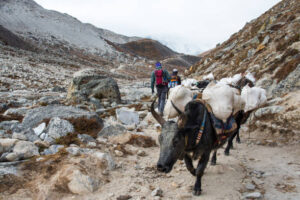
Yaks and yak-cow crossbreeds called dzo and dzomo provide milk, butter, cheese, wool, and dung for fuel and transport. Strictly speaking, the female yak is called a nak, which is why guides like to joke that there is no such thing as yak milk or yak cheese. You will share the trail with yak and dzopkyo trains carrying supplies to lodges and expeditions; always step to the mountainside to let them pass safely.
Summer Pastures
In summer, herders move their animals up to high pastures and live in simple stone huts in seasonal settlements called yersa. Several of today’s high lodge villages, including Dingboche, Pheriche and the settlements of the Gokyo valley, began life as yersa, and their stone-walled fields and herders’ huts still tell that story. Above them, the moraines towards Lobuche and Gorakshep were grazing grounds long before they hosted trekkers.
Trade Across the Himalaya
For centuries, Sherpas traded across the Nangpa La pass with Tibet, carrying grain, butter and paper north and returning with salt, wool and livestock. Namche Bazaar grew as a trading post, and its Saturday market still brings traders and porters from the lower valleys. In the mid-twentieth century, political changes in Tibet curtailed the old trade, and tourism gradually took its place, but the entrepreneurial spirit remains.
The Sherpa Year: A Seasonal Calendar
The Sherpa year follows the Tibetan lunar calendar and the seasons of farming and herding, so festival dates shift each year. As a general guide:
- Late winter (February to early March): Losar, the New Year, brings families home for days of prayer, visiting, and feasting.
- Spring (March to May): Potato planting, the start of the trekking and climbing season, and expedition pujas at base camp.
- May and June: The holy month of Saga Dawa, with fasting retreats called Nyungne in many villages, and the Mani Rimdu festival at Thame, held in the fourth Tibetan month.
- Early summer (around May to July): Dumje, the great village festival, in Namche, Khumjung, Thame, Pangboche and other villages.
- Monsoon (June to September): Herds move up to the yersa pastures, the fields grow green, and very few trekkers visit.
- Autumn (late September to November): The potato harvest, the busiest trekking season, and the Mani Rimdu festival at Tengboche in October or November.
- Winter (December to February): A quieter time when many families move down to Kathmandu or lower villages, and when weddings and family ceremonies are often held.
If you want to plan your trek around a festival, our seasonal guides to the Everest Base Camp trek in October, the Everest Base Camp trek in November, the Everest Base Camp trek in April, and the Everest Base Camp trek in monsoon explain what each season is like on the trail.
Sherpa Festivals: When Sherpa Culture Comes Alive
Festivals are the best time to see Sherpa culture at its most joyful and colorful. Because they follow the lunar calendar, exact dates shift each year, and our team checks them with the monasteries when you plan your trip.
Losar: Sherpa New Year
Losar, the Tibetan and Sherpa New Year, usually falls in February or early March. In the days before, families clean their homes from top to bottom to sweep away the misfortunes of the old year, prepare fried pastries and other festive foods, and hang new prayer flags. On the day itself, people visit the monastery, receive blessings, exchange khata scarves and greetings, and spend the following days visiting relatives and neighbors with songs, dancing, and plenty of chhaang. Many Sherpas working in Kathmandu or abroad return home for it.
Dumje: The Village Festival
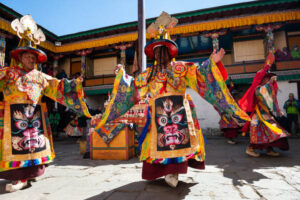
Dumje is held in early summer, usually between May and July, in villages such as Namche, Thame, Khumjung and Pangboche. It honors Guru Rinpoche and celebrates the health and prosperity of the community. Each year a few families take turns as hosts, feeding the whole village over several days, so a household’s turn comes round only every several years and is a great honour. The festival includes raising a tall prayer flagpole, prayers at the monastery, masked dances by monks in some villages, burning effigies to drive away misfortune, a final blessing from the lama, and plenty of feasting, singing, and dancing. Few trekkers see it, because it falls between the main seasons.
Mani Rimdu: Masked Dances and Blessings
Mani Rimdu is the most famous Sherpa festival and a highlight of the trekking year. “Mani” refers to the mantra of Chenrezig, the Buddha of Compassion, and “rimdu” refers to the small red pills blessed during the ceremonies and given to everyone who attends. The tradition came to the Khumbu from Rongbuk Monastery, the “mother monastery” on the Tibetan side of Everest, and it is now celebrated at Tengboche in October or November, at Thame in the fourth Tibetan month, around May or June, and at Chiwong Monastery in the Solu region.
The festival lasts about nineteen days, most of them private rituals inside the monastery. Monks build a sacred mandala of coloured sand, sculpt tormas from barley flour and coloured butter, and chant day and night. The public days come at the end:
- Wang, the blessing day: Villagers arrive in their finest clothes to receive a blessing from the head lama, along with the blessed pills and long-life pills.
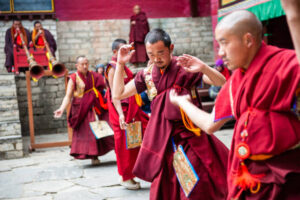
- Cham, the masked dances: Monks in brocade robes and painted masks perform a cycle of around fifteen dances, representing deities and protectors defeating the forces of evil, with comic interludes from a character called Mi Tsering that make the crowd roar with laughter.
- Jinsak, the fire offering: The head lama makes offerings into a sacred fire to remove obstacles, and on the final day the sand mandala is swept up and poured into a spring, so that its blessing flows down the valleys.
Watching the dances in the courtyard of Tengboche, with Ama Dablam and Everest behind the monastery, is unforgettable. Read our full guide to Tengboche Monastery and Mani Rimdu for practical details.
Saga Dawa and Nyungne
Saga Dawa, the fourth month of the Tibetan calendar, marks the Buddha’s birth, enlightenment, and passing, and it is the holiest month of the year. Many Sherpas avoid eating meat, visit monasteries and spin prayer wheels, and villages hold Nyungne, a two-day retreat of fasting, silence and prostrations devoted to Chenrezig.
Other Celebrations
Throughout the year, Sherpa communities also hold house blessings, harvest rites, long-life ceremonies for elders and smaller monastery festivals. Related Tibetan Buddhist festivals fill other Himalayan regions with color, from the masked dances of the Tiji Festival in Upper Mustang to the great tshechu of Bhutan, described in our guide to Bhutan festivals.
How to See a Sherpa Festival on Your Trek
Seeing a festival takes a little planning, but it can turn a great trek into an extraordinary one.
- Mani Rimdu at Tengboche: The easiest festival to combine with the 14-day Everest Base Camp Trek, as it falls in the clear autumn season. Lodges at Tengboche fill up, so our team plans the itinerary and accommodation around the festival days.
- Mani Rimdu at Thame: A quieter, more intimate celebration in spring, ideal on a side trip from Namche or as part of the Everest 3 Pass Trek route through the Thame valley towards the Renjo La pass.
- Losar: Cold but magical, with clear skies and few trekkers. Many lodges close in winter, so plan carefully and pack warm gear from our Everest Base Camp trek packing list.
- Dumje: Visit during the pre-monsoon and early monsoon, when the trails are quiet and green.
At any festival, dress warmly and modestly, arrive early for a good spot, stay out of the dancers’ space, follow the monks’ rules on photography and never use a flash or drone. Remember that festival days are religious occasions first and spectacles second. Our guide to the best time for the Everest Base Camp trek helps you weigh festival timing against weather and crowds.
Sherpa Food and Drink
Food is one of the most enjoyable ways to experience Sherpa culture. Meals in Sherpa homes and lodges are simple, warming, and designed to fuel hard work at altitude.
Traditional Sherpa Dishes
- Shyakpa (Sherpa stew): A thick, hearty stew of hand-pulled dough, potatoes, vegetables and sometimes meat, perfect after a cold day on the trail.
- Riki kur: Grated potato pancakes cooked on a hot stone or pan, served with butter, yak cheese, and chili sauce.
- Rildok: Soft potato dumplings in a warming broth.
- Tsampa: Roasted barley flour mixed with butter tea or water into a dough. Easy to carry and full of energy, it has fed Himalayan travelers for generations.
- Thukpa: A noodle soup with vegetables or meat, common across the Himalaya.
- Momos: Steamed or fried dumplings filled with vegetables, potatoes, yak meat or cheese.
- Dal bhat: Nepal’s national meal of rice, lentil soup and vegetable curry, with endless second helpings. Guides say “dal bhat power, 24 hours.”
Traditional Drinks
- Butter tea (solja): Tea churned with salt and yak butter. Rich and salty, it helps keep you warm and hydrated at altitude.
- Sweet milk tea: The everyday drink of the trail, served in every teahouse.
- Chhaang: A home-brewed barley or millet beer, shared at festivals and celebrations.
- Raksi: A strong distilled spirit often offered at ceremonies.
A Sherpa host will often keep refilling your cup. If you have had enough, leave it full or politely cover it with your hand. While alcohol is part of celebrations, we recommend avoiding it on the way up, as it hinders acclimatization; our altitude sickness guide for Everest Base Camp explains why.
Food and Faith
Many Sherpas avoid killing animals themselves out of Buddhist belief, and slaughter is traditionally discouraged in the Khumbu. Meat on the upper trail is usually carried up from lower valleys, which is one reason our guides recommend vegetarian meals above Namche. During Saga Dawa and on holy days, many families eat no meat at all.
Sherpa Names: A Week in a Word
One of the most charming aspects of Sherpa culture is how people are named. Traditionally, many Sherpas are named after the day of the week they were born on, which is why you might meet several guides with the same first name in one lodge.
- Nima: Sunday
- Dawa: Monday
- Mingma: Tuesday
- Lhakpa: Wednesday
- Phurba: Thursday
- Pasang: Friday
- Pemba: Saturday
Lamas also have other names with religious meanings, such as Tenzing, meaning “holder of the teachings,” Dorje, meaning “thunderbolt,” and Lhamu, meaning “goddess.” Ask your guide about their name; it is a great way to start a conversation.
Family, Marriage and Life Ceremonies
Family and community bonds are central to Sherpa life. Villages work together on festivals, house-building, funerals and the care of monasteries, and neighbors help each other at every stage of life.
Birth and Naming
After a baby is born, a lama is often consulted to choose an auspicious name and perform a blessing, and relatives visit with gifts, butter, and khata scarves. If the lama does not choose a name, the day of the week often does.
Weddings
Traditional Sherpa weddings can unfold in several stages over months or even years, beginning with visits and offerings of chhaang between the families and ending with a grand celebration. Lamas consult astrological charts for auspicious dates, and the ceremony includes prayers, offerings, songs, dancing and many cups of chhaang. Guests offer khata, the white silk scarves that symbolize purity and goodwill. Winter, when the fields are bare and the lodges quiet, is a popular time for weddings.
Funerals and the Cycle of Life
Buddhist belief in rebirth shapes Sherpa funerals. Lamas read prayers to guide the spirit through the intermediate state between death and the next life, and rituals continue for many days, traditionally up to forty-nine. Cremation is the most common practice. Families sponsor prayers, offer butter lamps and later raise prayer flags, carve mani stones or build small chortens in memory of the departed.
The Khata Welcome
When you arrive at a Sherpa home, monastery or celebration, or when you complete a trek, you may be welcomed or farewelled with a khata scarf placed around your neck. Accept it with both hands and a smile. It is a blessing and an expression of respect and friendship.
Sherpa Dress, Arts and Music
Traditional dress, crafts and music are another colorful side of Sherpa culture, and you will see them most clearly at festivals, weddings and in the homes of older Sherpas.
Traditional Clothing
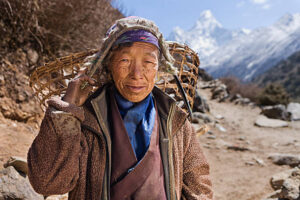
Sherpa women traditionally wear a long, sleeveless wrap dress called an angi over a silk or cotton blouse, with the striped woolen apron, the pangden, worn at the front by married women. Men once wore a long woollen robe called a chuba, tied at the waist with a sash, along with felt boots and fur-lined hats. Coral, turquoise, and silver jewelry is treasured and passed down through generations. Today, most people wear modern clothes in daily life, but proudly wear traditional dress for Losar, Dumje, weddings, and monastery ceremonies.
Thangka Painting and Sacred Arts
Monasteries in the Khumbu are decorated with thangkas, detailed scroll paintings of Buddhas, deities, and mandalas, painted with natural pigments. Murals cover the walls of prayer halls, and skilled artisans carve wooden masks for festival dances and mani stones for village walls. In Namche and Kathmandu, you can buy thangkas and crafts directly from artists; ask your guide to point out genuine local work.
Music and Dance
Sherpa music ranges from the deep, haunting sounds of monastery horns, conch shells, cymbals and drums to joyful folk songs sung at festivals. In celebration evenings, villagers form long lines or circles, linking arms and singing as they step in rhythm, often late into the night. If you are lucky enough to be invited to join, accept with a smile; nobody minds if you miss a step.
Storytelling and Legends
Sherpa culture is rich in stories of saints, hidden valleys, mountain gods and the elusive yeti. Evenings by the lodge stove are the perfect time to ask your guide for a story, whether about the lama who flew to Pangboche, the guardian god of Khumbila, or the first climbers to reach the valley.
Sherpas and Mountaineering
The world came to know the Sherpa people through mountaineering. When foreign expeditions began exploring the Himalaya in the early twentieth century, Sherpas from the Khumbu and Darjeeling quickly proved their strength, endurance and skill at altitude.
Pioneers and Record-Breakers
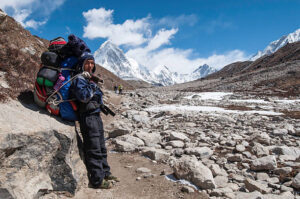
Tenzing Norgay, who grew up in Thame, stood on the summit of Everest with Edmund Hillary on the first ascent and became a hero to Nepal and the world. Since then, Sherpa climbers have set extraordinary records. Apa Sherpa of Thame held the record for the most Everest ascents for many years, and Kami Rita Sherpa, also from Thame, has now climbed the mountain more than thirty times, a world record. Today, Sherpa guides lead expeditions on all of Nepal’s highest peaks, from Everest to the technical ridges described in our Ama Dablam expedition guide, and Sherpa-owned trekking companies, like ours, guide travelers through the mountains they call home.
Women on the Mountain
Pasang Lhamu Sherpa, born in Lukla, became the first Nepali woman to climb Everest, and lost her life on the descent. She was honored with the Nepal Tara; a peak was renamed Pasang Lhamu in her memory, and the local government of the Khumbu, the Khumbu Pasang Lhamu Rural Municipality, bears her name; you will see it on the local entry permit described in our guide to Everest Base Camp trek permits. Lhakpa Sherpa holds the women’s record for Everest ascents, and Dawa Yangzum Sherpa became the first Nepali woman to qualify as an internationally certified mountain guide.
Training the Next Generation
In the village of Phortse, the Khumbu Climbing Center, founded by the Alex Lowe Charitable Foundation and staffed by Sherpa climbers from the village, runs courses each winter in climbing technique, rescue, first aid, and English for young Nepali climbers. It has helped make Himalayan climbing safer for the people who do most of the hard work on the mountain.
Remembering the Fallen
This success has come with great sacrifice. Sherpas face the greatest risks on the mountain, working in places like the Khumbu Icefall, and many families have lost loved ones. The memorials at Thukla, on the trail between Dingboche and Lobuche, honor climbers and Sherpas who never returned. Walking past them in silence is one of the most moving moments of the trek, and our guide to what you see at Everest Base Camp describes the expedition world higher up, while the view from Kala Patthar looks straight down on the icefall where so many Sherpas have worked.
Hillary, Schools and Hospitals
Sir Edmund Hillary returned to the Khumbu many times after the first ascent and, working with Sherpa communities, helped build schools, clinics, bridges and the airstrip at Lukla, today officially named Tenzing-Hillary Airport. Our Lukla airport guide tells that story. The Hillary School in Khumjung, the very first project of his Himalayan Trust, and the Khunde Hospital still serve the region, and our guide to Everest Base Camp trek medical clinics explains how the hospital fits into healthcare on the trail.
Visiting them on an acclimatization day above Namche, as many itineraries, including our Everest View Tre , do, is a powerful reminder of what partnership can achieve. The classic hike via the Hotel Everest View and Syangboche brings you to Khumjung through juniper forest with Everest on the horizon.
Where to Experience Sherpa Culture on the Everest Trail
The whole trail is a cultural journey, but some places offer especially rich experiences, and our Everest Base Camp trek route guide shows how they fit together.
Lukla and Phakding
Your first Sherpa villages, with mani walls, small monasteries and family-run teahouses along the Dudh Koshi River in the Pharak region. Even here, you will see chortens and prayer wheels at every turn; read more in our guide to Phakding, Monjo and the lower Everest trail. If weather delays your flight, our guide to Lukla flight delays and cancellations explains your options, including the Kathmandu to Lukla helicopter.
Namche Bazaar
The Sherpa capital is the best place to learn about Sherpa culture. Visit the Sherpa Culture Museum above the town for its traditional house and summiteers’ gallery, walk around Namche Gompa and the water-powered prayer wheels, browse the Saturday market, and talk with lodge owners whose families have lived here for generations. In early summer, Namche celebrates Dumje.
Khumjung and Khunde
Just above Namche, these twin villages feel peaceful and traditional, with potato fields, green-roofed stone homes, the monastery with its yeti relic, the Hillary School, and Khunde Hospital. They are perfect for an acclimatization walk.
Tengboche and Deboche
The spiritual heart of the Khumbu. Attend afternoon prayers at Tengboche Monastery, sitting quietly at the side of the hall as monks chant and play long horns,d drums, and cymbals, and visit the small nunnery at Deboche in the nearby forest.
Pangboche
Visit the old monastery in upper Pangboche and see one of the most traditional villages on the trail, the home of many famous climbers and the starting point for the side trip to Ama Dablam Base Camp, also offered as our Ama Dablam Base Camp Trek.
Thame and Phortse
For a quieter cultural experience, the Thame valley, birthplace of Everest legends, and the village of Phortse, home of the Khumbu Climbing Center, offer authentic village life with far fewer trekkers. Thame lies on the route to Renjo La, and Phortse on the high trail between Pangboche and the Gokyo Lakes Trek route.
Dingboche and Pheriche
High-summer settlements with stone-walled fields and yak pastures, where you see Sherpas farm and herd at the edge of possibility. In the main seasons, the Pheriche HRA aid post also gives daily talks on altitude, and the side valley to Chhukung Ri leads into the old grazing grounds below Lhotse.
Sherpa Etiquette: How to Be a Respectful Trekker
Sherpas are famously warm and welcoming, and visitors who show respect are rewarded with genuine friendship. These simple customs make a big difference:
- Walk clockwise around stupas, mani walls, and monasteries, keeping them on your right.
- Remove your shoes and hat before entering a monastery prayer hall or a family shrine room.
- Do not point your feet at people, altars, or statues, and do not step over people’s legs or belongings.
- Use your right hand, or both hands, to give and receive things, especially food and gifts.
- Do not touch people’s heads, including children’s, as the head is considered sacred.
- Ask before photographing people, ceremonies,s and the inside of monasteries. Many monasteries do not allow photos during prayers.
- Dress modestly, especially in villages and religious sites.
- Leave a small offering at monasteries if you wish; it helps maintain these important places.
- Avoid public displays of affection and loud behavior near sacred sites.
- Do not hand out sweets or gifts to children, which encourages begging;d supporting schools and community projects helps.
- Accept hospitality graciously, and try at least a sip of what you are offered.
Our responsible tourism page explains how we support local communities and porters on every trek.
Sherpa Culture Today: Change and Continuity
The Khumbu has changed enormously in a few generations. Tourism brought new livelihoods, schools, hospitals, electricity and internet to villages that once relied on farming and trade. Many young Sherpas now study in Kathmandu or abroad; large Sherpa communities have grown up around Boudhanath in Kathmandu and in cities from New York to Europe, and some high villages are quieter in winter than ever before. Nepal’s own heritage records note that fewer local people now attend Mani Rimdu, because so many work or study far away, and that visitors make up a growing share of the audience.
At the same time, Sherpa culture remains strong. Monasteries have been restored and still train young monks and nuns, festivals still draw families home from far away, and Sherpa language, music and dress are proudly maintained. Community organizations protect forests, manage waste through the Sagarmatha Pollution Control Committee and projects such as Sagarmatha Next at Syangboche, and work on new challenges such as retreating glaciers and growing glacial lakes. When you trek with a Sherpa-owned, government-registered company (you can view our legal documents online) and stay in family lodges, your visit directly supports these communities and helps keep their traditions alive.
Experiencing Sherpa Culture on Different Everest Treks
Every trek in the region offers cultural encounters, but you can choose a route that matches your interests, time, and comfort level.
Everest Base Camp Trek
The classic trek passes Namche, Khumjung, Tengboche, Pangboche and Dingboche, covering the most important cultural sites in the Khumbu, and its acclimatization days give you time for monasteries, museums and villages. Our Everest Base Camp trek itinerary and 14-day Everest Base Camp trek guides show how each day unfolds.
Everest View Trek
Short on time? The Everest View Trek focuses on the cultural heart of the lower Khumbu, with Namche, Khumjung and Tengboche, and stays at lower altitude. For a more comfortable version, see our Luxury Everest View Trek guide.
Jiri to Everest Trek
The Jiri to Everest Trek begins in the middle hills and passes through the Sherpa villages of the Solu region, such as Junbesi, near the large monastic community of Thupten Chholing, along with Rai and Tamang villages. Our Jiri to Everest Base Camp trek guide describes this deeper cultural journey, and our Everest Base Camp Trek by Road offers another way in through Solu.
Gokyo and the Three Passes
The Everest Gokyo Lakes Trek visits the sacred lakes and the old yersa of the Gokyo valley, while the route described in our Everest Three Passes trek guide links Thame, Gokyo, Dzongla and Chhukung for the most complete picture of Sherpa village life.
Everest Base Camp Yoga Trek
The Everest Base Camp Yoga Trek combines the classic route with daily yoga and meditation, a natural fit with the peaceful atmosphere of Sherpa monasteries, as our Everest yoga trek guide explains.
Luxury and Helicopter Options
For more comfort, the Everest Base Camp Luxury Lodge Trek stays in the finest Sherpa-run lodges, introduced in our guide to luxury lodges in the Everest region. If time is short, the Everest Heli Sherpa Village Walk combines a scenic flight with a guided walk through a traditional Sherpa village in a single day. You can also see the Khumbu from above on the Everest Helicopter Tour, with the breakfast stop described in our guide to the Everest helicopter tour with breakfast, combine walking and flying on the Everest Base Camp Helicopter Trek, or trek in and fly out on the Luxury Everest Base Camp Trek with Helicopter Return, described in our luxury Everest Base Camp trek guide.
Sherpa Communities and Himalayan Buddhist Cultures Beyond the Khumbu
If Sherpa culture inspires you, Nepal and its neighbors are home to many related Himalayan Buddhist communities.
- Solu and Pharak: Sherpa farming villages, cliff-top Chiwong Monastery with its own Mani Rimdu, and the monasteries around Junbesi, reached on the walk-in from Jiri.
- Tsum Valley: A sacred hidden valley with its own Buddhist traditions and monasteries such as Mu Gompa, explored on the Tsum Valley and Ganesh Himal Trek.
- Manaslu region: Tibetan-influenced Nubhri villages and monasteries along the Manaslu Circuit Trek, including Samdo Village and Pungyen Gompa.
- Upper Mustang and Nar Phu: The ancient Loba kingdom, with cave monasteries and the walled city of Lo Manthang, on the Upper Mustang Trek, described in our guide to trekking in Upper Mustang, and the hidden villages of the Nar Phu Trek.
- Langtang and Helambu: Tamang and Hyolmo villages on the Tamang Heritage Trekking and Langtang Helambu Trek
- Kanchenjunga and Dolpo: Remote Buddhist and Rai villages on the Kanchenjunga Base Camp Trek, and the ancient Bon and Buddhist communities of Lower Dolpo Trekking.
- Annapurna and Langtang: Gurung villages on the Annapurna Base Camp Trek, Manangi and Thakali villages on the Annapurna Circuit Trek, and Tamang villages on the Langtang Valley Trek.
- Tibet and Bhutan: The heartlands of Himalayan Buddhism, explored on our Luxury Nepal Tibet Tour, Lhasa Tibet Tour and Luxury Nepal Bhutan Tour, with highlights such as Tiger’s Nest Monastery, and on our Mount Kailash Tour, with the sacred Kailash kora and Mansarovar Lake. For a tougher Himalayan journey, compare Everest Base Camp v. the Snowman Trek in Bhutan.
You can even visit Rongbuk Monastery, the source of the Mani Rimdu tradition, on the north side of Everest with our Lhasa to Everest Base Camp Overland Tour, described in our Lhasa to Everest Base Camp guide. To learn about the great Himalayan teachers, read our articles on Milarepa, the cotton-clad yogi, gi and the Dalai Lama.
Practical Tips for a Culturally Rich Everest Trek
To make the most of Sherpa culture on your journey, keep these practical tips in mind:
- Plan around festivals: Ask our team about Mani Rimdu, Dumje,mje or Losar if you would like to witness a celebration.
- Use acclimatization days wisely: Visit monasteries, the Sherpa Culture Museum, Khumjung and Khunde instead of staying in your room.
- Arrive at Tengboche in the afternoon: That is when monks usually hold prayers that visitors may observe.
- Talk with your guide: Sherpa guides are full of stories about their families, villages and mountains, so ask questions.
- Stay in family-run lodges: They offer more authentic experiences and keep income in the community.
- Learn a few words: “Tashi delek” and “thuche che” bring smiles everywhere.
- Prepare for the altitude: Feeling well lets you enjoy cultural encounters. Read our page on acute mountain sickness and pack with our trekking equipment. ment
- Choose the right pace: Our guides to the Everest Base Camp trek for beginners, the Everest Base Camp trek with kids , and the Everest Base Camp trek for those over 50 help you plan a trek that leaves time for culture, and our articles on Everest Base Camp trek difficulty and how many days the EBC trek takes help you choose the right length.
Before flying to the mountains, spend a day exploring Kathmandu’s Buddhist heritage. Boudhanath SNepal’sa, Nepal’s largest, is surrounded by Tibetan and Sherpa monasteries and makes a perfect introduction. Our Kathmandu Day Tour and Kathmandu sightseeing guide cover the highlights, and our trekking in Nepal guide helps you prepare for your first Himalayan trek. In contrast, our list of the 50 best treks in Nepal shows where else Himalayan cultures await.
Frequently Asked Questions About Sherpa Culture
What is Sherpa culture?
Sherpa culture is the way of life of the Sherpa people of the Everest region, built on Nyingma Buddhism, reverence for the mountains, festivals such as Losar, Dumje and Mani Rimdu, farming and yak herding, close family ties and famous hospitality.
Who are the Sherpa people?
The Sherpa are an ethnic group of the high Himalaya whose ancestors migrated from Kham in eastern Tibet around five centuries ago. They live mainly in Nepal’s Solukhumbu district, around Mount Everest.
What religion do Sherpas follow?
Sherpas follow the Nyingma school of Tibetan Buddhism, combined with older beliefs in mountain gods and local spirits. Monasteries and village lamas play a central role in their lives.
What are the main Sherpa festivals?
Losar, the New Year in February or early March; Dumje, the village festival in early summer; and Mani Rimdu, held at Thame in May or June, at Tengboche in October or November, and at Chiwong in the Solu region.
When is Mani Rimdu at Tengboche?
Usually in October or November, on dates set by the lunar calendar. The public days come at the end of a ceremony of about nineteen days, with a blessing day, masked dances and a fire offering.
What is daily life like in a Sherpa village?
Days begin with juniper offerings and butter tea, followed by work in the fields, with the animals,s or in the family lodge, and end around the kitchen stove. Many families combine farming and herding with tourism.
Why do so many Sherpas have the same name?
Many Sherpas are named after the day of the week they were born, such as Pasang for Friday or Pemba for Saturday. Others receive names from lamas with religious meanings.
Is every guide in Nepal a Sherpa?
No. Sherpa is an ethnic identity, not a job title. Guides and porters in Nepal come from many communities, including Rai, Tamang, Gurung, and Magar.
Can trekkers visit monasteries in the Everest region?
Yes. Most monasteries welcome respectful visitors. Remove your shoes and hat, dress modestly,y and ask before taking photos.
Which trek is best for experiencing Sherpa culture?
The 14-day Everest Base Camp Trek passes all the main monastery villages. At the same time,l e the Everest View Trek offers a shorter cultural journey, and the Jiri walk-in adds the Sherpa villages of Solu.
Final Thoughts: Walk With the Sherpa People
The Everest trail is famous for its mountains, but the people make it unforgettable. Sherpa culture greets you in every prayer flag, every mani wall, every festival dance, every cup of tea, and every smile from a lodge owner who has watched thousands of trekkers pass through. Understanding these traditions transforms a trek into a meaningful journey into the life of the Himalaya.
As a Sherpa-led company, we would be honored to share our home with you. Join our classic Everest Base Camp Trek, choose the comfort of the Everest Base Camp Luxury Lodge Trek, learn more about Trek Nepal Himalayas, check our Nepal visa information, or contact us today to discover the warmth, faith, and spirit of the Sherpa people for yourself. Tashi delek!
Quick Inquiry
Explore More


