Eastern Bhutan Tour
Our trips are rated 5 out of 5 in more than 950 traveler reviews.
Trip overview
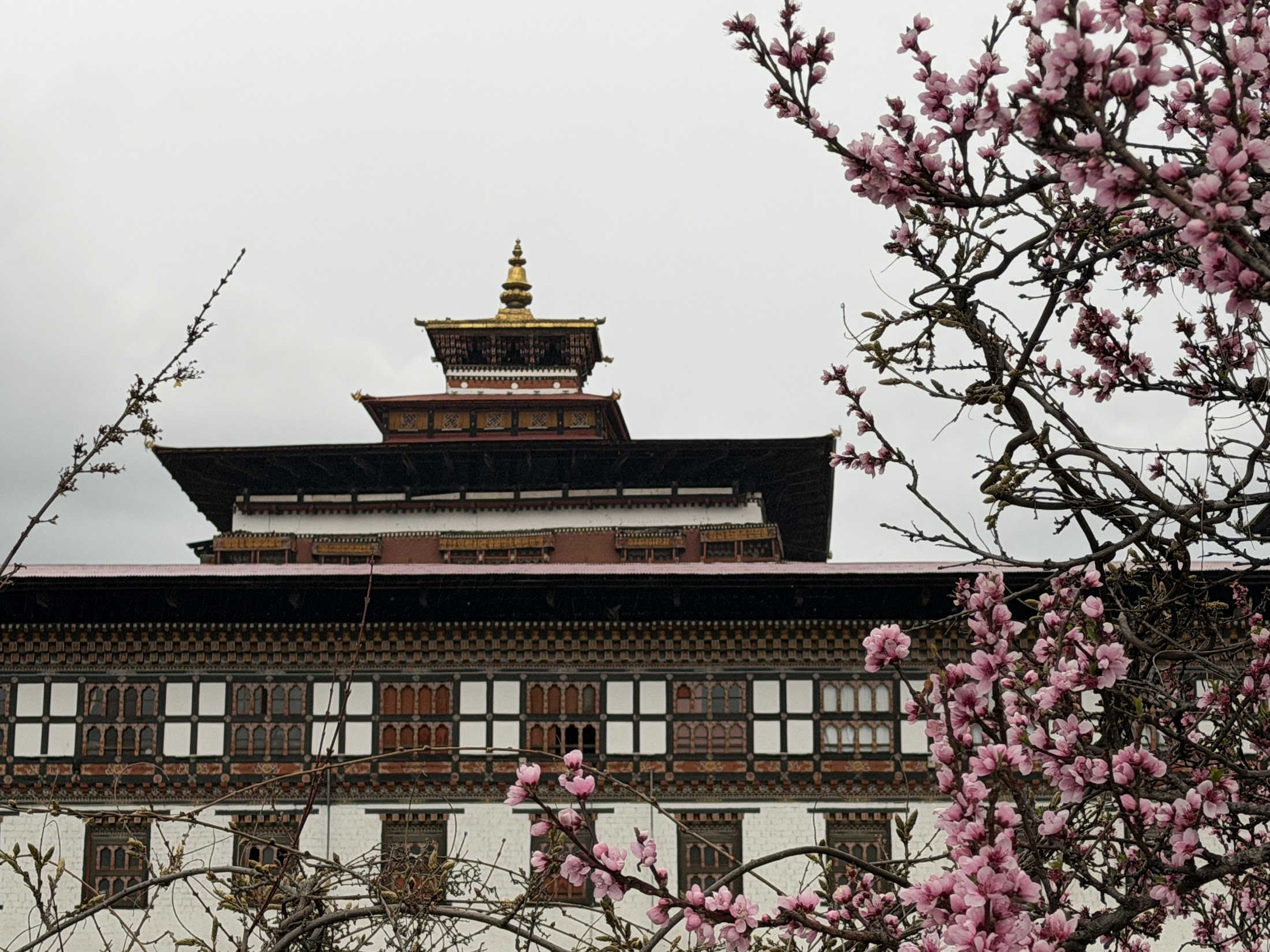
Our Eastern Bhutan Tour enters the country by road from Guwahati in India and crosses the little-visited east, through Trashigang, Trashiyangtse and Mongar, to the temples of Bumthang, before flying back to Paro for Tiger’s Nest. In 10 days it covers a side of Bhutan that most visitors never see, with the visa, Sustainable Development Fee, hotels, guide, car, domestic flight and all meals included.
It suits travellers who have already seen the west, or who want quiet roads, village life and textile traditions over famous sights. The east is where much of Bhutan’s weaving comes from, and where you meet more Bhutanese than foreigners.
The route runs west, from the low, warm border town of Samdrup Jongkhar up into the hills, so you climb gradually and end at Paro rather than retracing your steps. The flight from Bumthang saves two long days on the road.
The honest part is driving. The east has the longest road days in Bhutan: Samdrup Jongkhar to Trashigang takes 7 to 8 hours, and Mongar to Bumthang over the Thrumshing La is a full day. Hotels in the east are simpler than in Paro and Thimphu.
The reward is a different Bhutan: the hilltop dzong of Trashigang, the white stupa of Chorten Kora by the river, villages of weavers, and a pass at about 3,750 m through cloud forest full of birds.
Prices start at US$ 2,295 per person in a group of six or more and US$ 2,755 each for two. For central Bhutan only, see our Bumthang Tour; for the classic west, our 8-Day Bhutan Tour.
Highlights
- Trashigang Dzong, perched on a spur above the Drangme Chhu
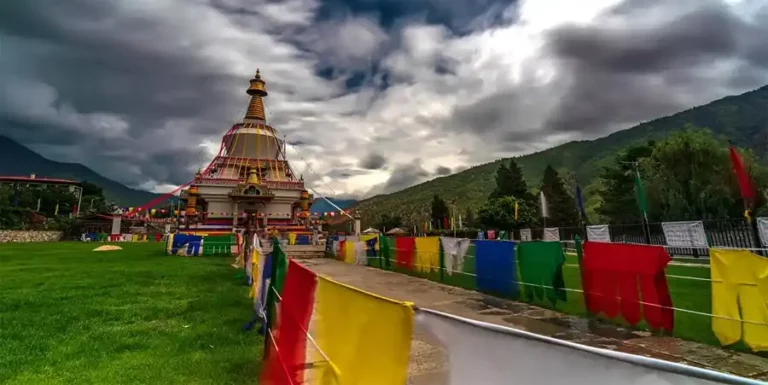
- Chorten Kora in Trashiyangtse, modelled on Boudhanath in Kathmandu
- Gom Kora, a riverside temple around a rock where Guru Rinpoche meditated
- Thrumshing La at about 3,750 m, through rhododendron and cloud forest
- Weaving villages of eastern Bhutan, home of silk kira and raw silk textiles
- Mongar Dzong and the long ridges of the east
- Bumthang temples: Jambay, Kurjey and Tamshing
- Fly back to Paro and finish with Tiger’s Nest
Itinerary
Altitude profile
On footBy roadBy air
The altitude listed for each day, from 200 m to 3,120 m. Select a point to read that day.
The highest point on the route is 3,750 m.How we handle altitude
- Nights
- 5 nights in tourist standard hotels, 4 nights in 3-star hotels
- Meals in the price
- 9 breakfasts, 9 lunches, 9 dinners
- On the move
- 1 day on foot, 6 days by road, 1 day with a flight
Day 1Guwahati to Samdrup Jongkhar200 m
The Eastern Bhutan Tour starts in India. Our driver meets you at Guwahati airport in Assam, and we drive about 3 hours south-east across the plains of the Brahmaputra, past tea gardens and rice paddies, to the Bhutan border.
At Samdrup Jongkhar, at about 200 m, you clear Indian exit formalities and walk through the Bhutan gate. Our Bhutanese guide meets you here with a white khadar scarf and handles your entry with your visa clearance letter.
Samdrup Jongkhar is a busy border town, the main trading post for eastern Bhutan, and it feels very different from the hills ahead. If there is time, we visit the town’s dzong, a modern building in traditional style, and the Zangtho Pelri Lhakhang in the town centre.
Dinner and the night are at the best available hotel in Samdrup Jongkhar, simple but comfortable. The guide explains the drive into the hills tomorrow, the longest of the tour, and suggests an early night so the start can be early too.
- TravelCar, 1-3 hours
- StayTourist Standard Hotel
- MealsLunch, Dinner
Day 2Samdrup Jongkhar to Trashigang1,100 m
Today the Eastern Bhutan Tour climbs from the plains into the eastern hills. The drive to Trashigang covers about 180 km and takes 7 to 8 hours with stops, rising quickly through subtropical forest to ridges above 2,000 m.
The road passes Dewathang, where a memorial recalls a 2003 campaign against militant camps, and then Wamrong and Khaling. In Khaling we stop at the National Handloom Development Centre, where women weave on traditional back-strap and floor looms.
Lunch is at a roadside restaurant in one of the ridge towns. The afternoon descent into the Drangme Chhu valley shows the hills of eastern Bhutan folding away to the horizon, dotted with villages on impossibly steep slopes.
Trashigang sits at about 1,100 m above the river, the largest town in the east. Tonight is in the best available hotel in town. After a long day on the road, dinner is relaxed and early, and the next two days are much shorter.
- TravelCar, 7-9 hours
- StayTourist Standard Hotel
- MealsBreakfast, Lunch, Dinner
Day 3Trashigang and Radhi1,100 m
A slower day on the Eastern Bhutan Tour begins at Trashigang Dzong, built in 1659 on a spur above the meeting of two rivers. It still houses the district administration and the monk body, and its position gave it a clear view of any army coming from the east.
After the dzong we drive about an hour to Radhi, known as the rice bowl of the east. Terraced paddies cover the hillsides, and the village is famous for its raw silk weaving, called bura.
We visit a weaving household where women work on traditional looms, and the guide explains the dyes, patterns and the long hours behind each piece. If you wish to buy, prices are fair and the money goes straight to the weaver.
On the way back, we stop at Rangjung Woesel Choeling Monastery, a large Nyingma monastery on a hill above the valley. The afternoon is free to walk around Trashigang’s small market. Tonight is the second night in the same Trashigang hotel.
- TravelSightseeing, 1-3 hours
- StayTourist Standard Hotel
- MealsBreakfast, Lunch, Dinner
Day 4Trashigang to Trashiyangtse1,850 m
The Eastern Bhutan Tour heads north today to Trashiyangtse, about 2 hours from Trashigang. On the way we stop at Gom Kora, a temple beside the river built around a black rock where Guru Rinpoche is said to have meditated and subdued a demon.
Pilgrims walk around the temple and through a narrow passage in the rock, believed to test the purity of those who squeeze through. In spring, Gom Kora hosts a festival that draws families from across the east and from Arunachal Pradesh in India.
Trashiyangtse sits in a green valley at about 1,850 m. We visit Chorten Kora, a large white stupa built in 1740 and modelled on Boudhanath in Kathmandu, and the Institute for Zorig Chusum, where students carve the wooden bowls called dapa for which the valley is known.
The valley is also a winter roost for black-necked cranes at Bumdeling, a short drive north. Tonight is in a guesthouse or hotel in Trashiyangtse, quiet and surrounded by fields.
- TravelCar, 1-3 hours
- StayTourist Standard Hotel
- MealsBreakfast, Lunch, Dinner
Day 5Trashiyangtse to Mongar1,600 m
Today the Eastern Bhutan Tour turns west towards Mongar, about 4 to 5 hours with stops. We drive back past Gom Kora and Trashigang, then over the Kori La at about 2,400 m, a pass hung with prayer flags and surrounded by forest.
Before Mongar we can make a detour to Drametse Lhakhang, one of the most important monasteries in the east, founded in the 16th century by a granddaughter of Pema Lingpa. It is the home of the Drametse drum dance, recognised by UNESCO as intangible cultural heritage.
Mongar town sits on a ridge at about 1,600 m, unusual in Bhutan where most towns lie in valleys. We visit Mongar Dzong, rebuilt in the 1950s without drawings or nails, in the traditional manner.
The afternoon is free to walk through town. Tonight is in the best available hotel in Mongar. The guide explains tomorrow’s crossing of the Thrumshing La, the highest point of the tour.
- TravelCar, 4-6 hours
- StayTourist Standard Hotel
- MealsBreakfast, Lunch, Dinner
Day 6Mongar to Bumthang2,600 m
This is the most dramatic drive of the Eastern Bhutan Tour. From Mongar the road drops to the Kuri Chhu and then climbs for hours to the Thrumshing La at about 3,750 m, the second-highest road pass in Bhutan, before descending to Ura and Jakar. Allow about 7 hours with stops.
The climb runs through Thrumshingla National Park, a belt of oak, rhododendron and fir forest that is one of the best birding areas in the Himalaya. Waterfalls spill over the road in places, and cloud often drifts through the trees.
From the pass, on clear days, Gangkhar Puensum appears to the north. The road then descends past the village of Ura, a cluster of stone houses with cobbled lanes, where we stop for tea.
By late afternoon we reach Jakar in the Bumthang valley, at about 2,600 m. Tonight is the first of two nights in a 3-star hotel in Jakar, a step up in comfort after the eastern guesthouses.
- TravelCar, 7-9 hours
- Stay3-Star Hotel
- MealsBreakfast, Lunch, Dinner
Day 7Bumthang Temples2,600 m
The Eastern Bhutan Tour reaches the spiritual heartland of the country today. We visit Jambay Lhakhang, said to have been founded in 659 by the Tibetan king Songtsen Gampo, and Kurjey Lhakhang, where Guru Rinpoche left the print of his body in a rock.
After lunch we cross the river on a footbridge to Tamshing Lhakhang, founded in 1501 by the saint Pema Lingpa, whose descendants include the royal family and the founders of many eastern temples you have seen.
Tamshing’s wall paintings are among the oldest in Bhutan, and visitors can lift a heavy chain-mail coat said to have been made by Pema Lingpa himself. Walking around it three times is believed to bring merit.
In the late afternoon we visit Jakar Dzong on a ridge above town, and the Membartsho, the Burning Lake, if time allows. Dinner may feature buckwheat noodles and Bumthang cheese. Tonight is in the same Jakar hotel, and the guide confirms tomorrow’s flight time.
- TravelSightseeing, 4-6 hours
- Stay3-Star Hotel
- MealsBreakfast, Lunch, Dinner
Day 8Fly to Paro2,250 m
The Eastern Bhutan Tour flies west this morning. The Drukair flight from Bathpalathang airport near Jakar to Paro takes about 30 minutes, crossing the ranges you drove in five days, with views of the northern peaks on a clear morning.
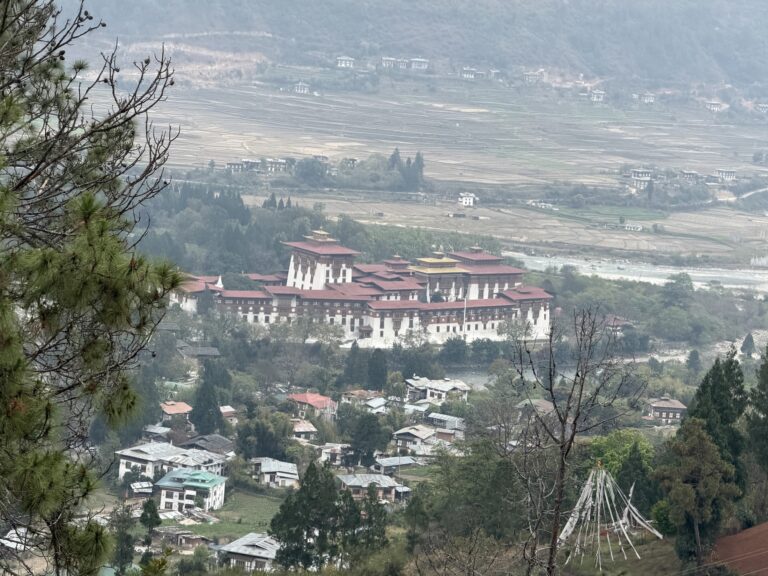
In Paro, after lunch, we visit Rinpung Dzong across its covered wooden bridge, and the National Museum in the round watchtower above it. After the remote east, Paro’s farmhouses and rice fields feel prosperous and close together.
Later we visit Kyichu Lhakhang, a 7th-century temple said to be a twin of Jambay Lhakhang in Bumthang, which you saw yesterday. The guide explains how the two were built to pin down a giant demoness lying across the Himalaya.
If the flight cannot operate, we drive from Bumthang towards Paro over two days instead, with a night in Punakha, and any extra night is charged at cost. Tonight is in a 3-star hotel in Paro.
- TravelFlight, 1-3 hours
- Stay3-Star Hotel
- MealsBreakfast, Lunch, Dinner
Day 9Tiger's Nest Hike3,120 m
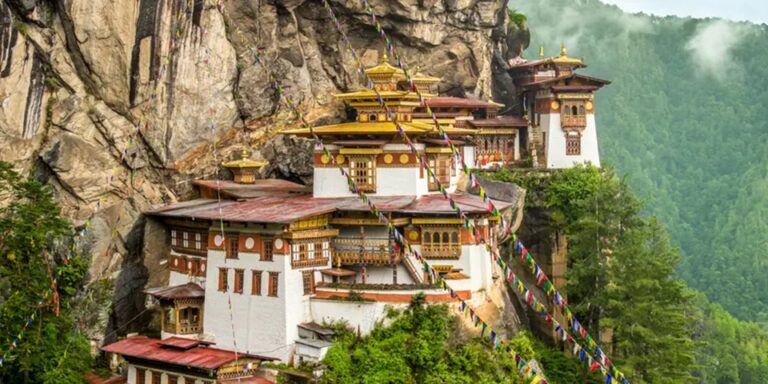
The last full day of the Eastern Bhutan Tour is the hike to Taktsang, the Tiger’s Nest. We start walking by about 8 am, when the air is cool and the trail is quieter.
The path climbs about 900 m through blue pine to the monastery at roughly 3,120 m, which takes 2 to 3 hours. The halfway teahouse frames the monastery against its cliff, and the final section crosses a gorge by stone steps past a waterfall.
Inside, the guide tells the story of Guru Rinpoche flying here on a tigress, the same figure whose presence you met at Gom Kora and Kurjey. Bags and cameras stay in lockers, and the descent takes about 1.5 hours.
The afternoon is free for a hot stone bath at a farmhouse, at extra cost, or a last walk through Paro town. Tonight is a farewell dinner, a good time to look back over a journey across the whole width of the country.
- TravelHiking, 4-6 hours
- Stay3-Star Hotel
- MealsBreakfast, Lunch, Dinner
Day 10Depart from Paro2,250 m
The Eastern Bhutan Tour ends with a short drive to Paro airport. Most international flights leave in the morning, and the guide confirms your pickup time the evening before.
If your flight is later, we can drive up the valley to the ruins of Drukgyel Dzong, which once guarded the route to Tibet, or shop for textiles in town. You will now recognise the eastern weaves in the Paro shops.
Your guide helps with check-in and says goodbye at the terminal door. Keep your visa letter with your passport for the exit check, and allow two hours before departure.
Many travellers fly on to Kathmandu, where we are based, and we can arrange your hotel and sightseeing there. Because this tour includes a domestic flight and long drives, we recommend a buffer night before a long-haul connection; tell us when you book and we will add it.
Thank you for travelling the long road across Bhutan with us.
- TravelCar, 30-60 minutes
- MealsBreakfast
What's included
Included in the price
- Bhutan visa: the visa application and US$ 40 fee
- Sustainable Development Fee: US$ 100 per person for each of the 9 nights
- Guwahati pickup: transfer from Guwahati airport to the Samdrup Jongkhar border
- Domestic flight: Bumthang to Paro on Drukair, subject to schedule
- Hotels: the best available 3-star or tourist-standard rooms, twin share, throughout
- All meals: from lunch on day one to breakfast on departure
- Guide: a licensed English-speaking Bhutanese guide from the border onward
- Vehicle: a private car or van with driver for all road travel in Bhutan
- Route permits: permits for eastern and central Bhutan
- Entrance fees: every site on the itinerary, including Tiger’s Nest
- Drinking water: bottled water in the vehicle
- Paro airport drop: transfer to the airport on departure
- Taxes: all government taxes and service charges
- Support: 24-hour contact with our team during the tour
- Backup plan: road transfer to Paro if the domestic flight cannot operate
Not included
- Flight to Guwahati and the flight out of Paro
- Indian visa, needed by most nationalities to land in Guwahati
- Travel insurance with medical cover and evacuation
- Single supplement for your own room
- Drinks other than water, tea and coffee
- Extra nights if roads close or the domestic flight is cancelled
- Excess baggage on the domestic flight
- Laundry, phone and internet charges
- Tips for the guide and driver
- Personal costs such as textiles and souvenirs
Dates and price
These are our fixed group dates. Prices change with the season, so each date shows its own price. Please book at least 30 days ahead, so we have time to arrange your Bhutan visa.
US$ 2,755per person
| Starts | Ends | Status | Price | Book |
|---|---|---|---|---|
| Departs: Fixed group dates. Book your date | ||||
Trip information
Price by Group Size
| Group size | Price per person |
|---|---|
| 1 traveller (private) | US$ 3,440 |
| 2 travellers | US$ 2,755 |
| 3 to 5 travellers | US$ 2,480 |
| 6 to 12 travellers | US$ 2,295 |
To book: choose a departure below and pay a 20% deposit. The balance is due before we lodge your Bhutan visa, about 30 days before you travel.
Joining alone: solo travellers can join any date and pay the rate for the group that travels; once six or more are booked, we refund the difference.
Private tour: the Eastern Bhutan Tour runs privately on any date, at the one or two traveller rate, and can run in reverse from Paro to Guwahati.
Not in the price: flights to Guwahati and from Paro, your Indian visa, insurance, drinks and tips. Nine nights of SDF, US$ 900 per person, and the Bumthang to Paro flight are included.
Best Time to Visit
We run group departures of the Eastern Bhutan Tour on the 1st, 11th and 21st from October to May, which is the best time to travel. The east is lower and warmer than the west, and its roads suffer most in the monsoon.
October and November bring clear skies and dry roads, and many eastern dzongs hold their tshechu festivals around this time. Trashigang’s festival usually falls in November or December, following the lunar calendar.
December to February is mild in the eastern valleys and cold on the Thrumshing La, which can hold snow and close for short periods. March to May brings rhododendrons on the pass and good birding in the forests around it.
June to September is the monsoon, with heavy rain and landslides that can block the road for hours. We run the tour then only privately and with flexible dates.
Difficulty and Fitness
The Eastern Bhutan Tour is easy on foot but demanding on the road. Walks are short at most sites, and the longest is the Tiger’s Nest hike at the end, about 5 hours there and back with about 900 m of climbing.
The drives are the effort. Samdrup Jongkhar to Trashigang takes 7 to 8 hours, Mongar to Bumthang over the Thrumshing La about 7 hours, and the other days 2 to 4 hours. Roads are narrow, winding and sometimes under repair.
We stop often for tea, views and short walks, and the guide paces each day so you arrive before dark. Travel sickness tablets help on the passes.
Anyone who prefers to skip the full Tiger’s Nest climb can stop at the halfway teahouse, or hire a horse for the first half at extra cost.
Food, Water and Dietary Needs
All meals are included on the Eastern Bhutan Tour, at hotels and local restaurants. Menus in the east are simpler than in the capital, built around rice, vegetables, dal and meat or cheese curries.
Eastern food has its own character. Look for kharang, maize rice, and the dried meats and chillies that hang outside village houses. In Bumthang, buckwheat noodles and pancakes take over from rice.
Vegetarian meals are easy everywhere, and vegan and gluten-free diets can be arranged with notice, though choice is narrower in the east. Bring snacks you rely on.
Tap water is not safe to drink. Bottled water is in the vehicle, and we refill it in each town.
On the long drive days, lunch is at a roadside restaurant and the guide carries snacks for the gaps.
Altitude, Health and Safety
The Eastern Bhutan Tour starts at about 200 m in Samdrup Jongkhar and climbs gradually, peaking at about 3,750 m on the Thrumshing La by road. Overnight stops range from about 1,000 m in Trashigang to about 2,600 m in Bumthang.
This slow rise means altitude illness is very unlikely. Some people feel a light headache on the high pass; drink plenty of water and take it easy on alcohol.
Bhutan is very safe for visitors, and your guide is with you throughout. There are hospitals in Samdrup Jongkhar, Trashigang, Mongar, Jakar and Paro, with the main regional referral hospital in Mongar.
Your insurance should include medical cover and evacuation. Check with your doctor about malaria advice for the Indian side of the border, since Guwahati and the plains have different health risks from the hills.
Local Etiquette
The east is more traditional than the west, and on the Eastern Bhutan Tour you meet villagers who see few foreigners. Smile, greet people with “kuzuzangpo la”, and ask before taking photographs.
In dzongs and temples, wear long sleeves and long trousers or skirts, remove hats and shoes in shrine rooms, and do not photograph inside. Walk clockwise around Chorten Kora and other stupas.
When visiting weaving households, remember that a single kira can take months to weave. Ask before handling textiles, and buy only if you want to; the guide can explain fair prices.
Tipping the guide and driver is customary at the end but never required. Smoking in public places is restricted in Bhutan.
If invited into a home, remove your shoes and accept tea with both hands.
Visa, Permits and Documents
You need two sets of documents for the Eastern Bhutan Tour. First, most nationalities need an Indian visa, usually an e-visa, to land in Guwahati and cross to the border; please arrange it yourself before travel.
Second, everyone except Indian, Bangladeshi and Maldivian nationals needs a Bhutan visa, which we apply for once your balance is paid. The visa costs US$ 40 and the SDF is US$ 100 per person per night until 31 December 2029; both are in our price.
At Samdrup Jongkhar you exit India and enter Bhutan on foot through the border gate, with your visa clearance letter and passport. Route permits for the east and Bumthang are arranged by us.
Carry printed copies of both visas. Indian nationals need only a Bhutan permit and pay a lower SDF. Official rules are on bhutan.travel.
Transport, Money and Connectivity
You fly into Guwahati, which has connections from Delhi, Kolkata, Bangkok and other hubs. Our driver meets you at the airport for the 3 hour drive to Samdrup Jongkhar, and you leave Bhutan by air from Paro.
Within Bhutan, a private car and driver cover the road from the border to Bumthang, and the domestic flight brings you back to Paro. If the flight cannot operate, we drive west over two days.
Bring US dollars in clean notes and some Indian rupees, which are accepted in Bhutan at par with the ngultrum. Cards work in few places in the east, so carry enough cash for drinks, tips and textiles.
B-Mobile and TashiCell SIMs work in eastern towns, but signal fades on long stretches of road. Hotel Wi-Fi in the east is basic.
Questions about this trip
What does the Eastern Bhutan Tour cover?
The Eastern Bhutan Tour enters Bhutan by road from Guwahati at Samdrup Jongkhar, then visits Trashigang, Radhi, Trashiyangtse, Mongar and Bumthang before flying to Paro for Tiger’s Nest. It covers the little-visited east and the central temples in 10 days.
How much does the Eastern Bhutan Tour cost?
The Eastern Bhutan Tour costs from US$ 2,295 per person in a group of six or more, US$ 2,480 for three to five, US$ 2,755 each for two and US$ 3,440 for one. Prices include the visa, nine nights of SDF, hotels, all meals, guide, car and the Bumthang to Paro flight.
How do I get to the start of the Eastern Bhutan Tour?
Fly to Guwahati in Assam, India, which has flights from Delhi, Kolkata, Bangkok and other hubs. Our driver meets you at the airport and drives about 3 hours to Samdrup Jongkhar, where the Eastern Bhutan Tour enters Bhutan on foot through the border gate.
Do I need an Indian visa for the Eastern Bhutan Tour?
Yes, most nationalities need an Indian visa, usually an e-visa, to land in Guwahati and travel to the border. Please arrange it yourself before the Eastern Bhutan Tour. Indian, Bangladeshi and Maldivian nationals do not need a Bhutan visa but still need a permit.
Why visit eastern Bhutan?
Eastern Bhutan sees only a small share of visitors, so the Eastern Bhutan Tour shows village life, weaving traditions and dzongs without crowds. Highlights include Trashigang Dzong, Chorten Kora, Gom Kora and the forested Thrumshing La. Few tour groups go there.
How long are the drives on the Eastern Bhutan Tour?
The Eastern Bhutan Tour has the longest drives in Bhutan. Samdrup Jongkhar to Trashigang takes 7 to 8 hours and Mongar to Bumthang about 7 hours, while other days are 2 to 4 hours. The flight from Bumthang to Paro saves two more long days.
When is the best time for the Eastern Bhutan Tour?
The best time for the Eastern Bhutan Tour is October to May, when roads are dry and skies clear. Many eastern tshechu festivals fall in autumn and winter. We run it only privately in the June to September monsoon, when landslides can block roads.
What are the hotels like in eastern Bhutan?
Hotels in eastern Bhutan are simpler than in Paro and Thimphu. On the Eastern Bhutan Tour we use the best available tourist-standard hotels and guesthouses in Samdrup Jongkhar, Trashigang, Trashiyangtse and Mongar, and 3-star hotels in Bumthang and Paro. Rooms have private bathrooms and hot water.
What is Chorten Kora?
Chorten Kora is a large white stupa in Trashiyangtse, built in 1740 and modelled on Boudhanath in Kathmandu. On the Eastern Bhutan Tour we walk around it with local pilgrims, and in spring it hosts a festival that draws people from across the border.
Is the Eastern Bhutan Tour hard?
The Eastern Bhutan Tour is easy on foot, with short walks at most sites and an optional Tiger’s Nest hike at the end. The challenge is the long drives on winding mountain roads, so it suits travellers comfortable with several full days in a vehicle.
How high is the Eastern Bhutan Tour?
The highest point of the Eastern Bhutan Tour is the Thrumshing La at about 3,750 m, crossed by road. You sleep between about 200 m and 2,600 m, and the slow climb from the plains makes altitude problems very unlikely.
How much is the SDF on the Eastern Bhutan Tour?
The SDF on the Eastern Bhutan Tour is US$ 900 per person, since Bhutan charges US$ 100 per person for each of the nine nights. The rate is confirmed until 31 December 2029 and is already included in every price on this page.
Can I buy textiles on the Eastern Bhutan Tour?
Yes. Eastern Bhutan is the home of much of the country’s weaving, and the Eastern Bhutan Tour visits weaving households in Radhi and the handloom centre in Khaling. Prices are fair, and buying direct supports the weavers. Bring cash, as cards are rarely accepted.
What food is served on the Eastern Bhutan Tour?
All meals are included on the Eastern Bhutan Tour, at hotels and local restaurants. Eastern food includes maize rice called kharang and dried meats, and Bumthang serves buckwheat dishes. Vegetarian meals are easy; other diets need notice, as choice is narrower.
Can the Eastern Bhutan Tour run in reverse?
Yes. A private Eastern Bhutan Tour can start in Paro and end by road at Samdrup Jongkhar and Guwahati, or start and end in Paro using domestic flights where schedules allow. Group departures run from Guwahati to Paro. Ask us for a quote.
What happens if the Bumthang flight is cancelled?
If weather or schedule stops the Bumthang to Paro flight, the Eastern Bhutan Tour drives west instead, over two days with a night in Punakha. Any extra night is charged at cost, so we recommend a buffer day before your international flight.
Is the Eastern Bhutan Tour safe?
Yes. Eastern Bhutan is safe and welcoming, and your guide is with you throughout the Eastern Bhutan Tour. There are hospitals in every district town on the route, with the eastern regional referral hospital in Mongar. Roads are slow but well maintained.
Can I see black-necked cranes on the Eastern Bhutan Tour?
Possibly. Black-necked cranes winter at Bumdeling near Trashiyangtse from about November to February. On a winter Eastern Bhutan Tour we can add a short visit to their roosting area, depending on time and road conditions. Winter dates are best for this.
Is the Eastern Bhutan Tour private or a group?
The Eastern Bhutan Tour runs as a small group of up to 12 on fixed dates from October to May, or privately on any date. The one and two traveller prices on this page are the private prices. Solo travellers can join group dates.
What money should I bring on the Eastern Bhutan Tour?
Bring US dollars in clean notes and some Indian rupees, which are accepted in Bhutan at par with the ngultrum. Cards rarely work in the east, so on the Eastern Bhutan Tour carry enough cash for drinks, tips and textiles.
Do I need travel insurance for the Eastern Bhutan Tour?
Yes. Insurance for the Eastern Bhutan Tour should cover medical treatment in India and Bhutan, evacuation, cancellation and flight delays. Send us your policy details before travel and carry a copy with both visas. The guide carries a copy of the policy.
What makes your Eastern Bhutan Tour different?
Our Eastern Bhutan Tour runs west from the plains, so you climb gradually and never retrace the route, then flies from Bumthang to Paro to avoid two days of backtracking. We include weaving visits, two nights in Trashigang and the Tiger’s Nest hike.
Reading for this trip
Ask us about the Eastern Bhutan Tour
We reply from Kathmandu within 24 hours with available dates, your exact price and answers to your questions.
- 16 years guiding in the Himalaya
- Registered in Nepal, Reg. 187391
- Group departures of 12 travelers at most
- Private dates on any day
Call, WhatsApp or Viber
Eastern Bhutan Tour, from US$ 2,295 per person. Dates and booking at treknepalhimalayas.com/trip/eastern-bhutan-tour/
Trek Nepal Himalayas Pvt Ltd, Reg. 187391. Bhagawatisthan, Thamel, Kathmandu, Nepal. Call or WhatsApp +977 98510 13196. [email protected]