Everest Base Camp Trek
Based on 2100 reviews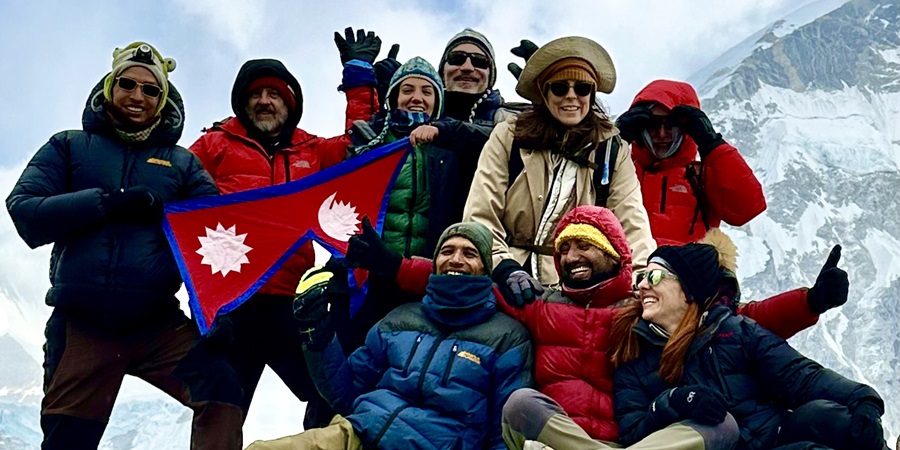
Trip Overview
Kerosene. Juniper smoke. The metallic taste of thin air.
That is the smell of the Khumbu. It hits you the moment the Twin Otter engines cut out at Lukla. This isn’t a vacation. It’s a pilgrimage. You aren’t here to be pampered. You are here to push. To sweat. To stand at the foot of the Mother of the World.
The Everest Base Camp Trek is 130 kilometers of grit. It demands respect. In 2024, we watched fit marathon runners crumble because they rushed.
In 2025, we saw grandmothers conquer Kala Patthar because they respected the rhythm. The mountains don’t care about your resume. They care about your lungs and your will.
We don’t sell “sightseeing.” We sell the shiver down your spine when you hear the Khumbu Glacier crack in the middle of the night. We sell the burning in your legs on the Namche Hill. We sell the silence.
Absolute. Glacial. Silence.
Ready? Let’s move.
Trip Highlights
- Lukla Flight: 30 minutes of pure adrenaline. Landing on a tilted runway carved into a cliff.
- Namche Bazaar: The Sherpa capital. The last bastion of comfort. Coffee. Gear. The pulse of the Khumbu.
- Tengboche Monastery: Chanting monks. The smell of butter lamps. Ama Dablam towering behind the gompa.
- Everest Base Camp: 5,364m. The Khumbu Icefall is right in your face. The holy grail of trekking.
- Kala Patthar: 5,545m. The highest point. The best view of Everest. Sunrise here changes you.
Short Itinerary
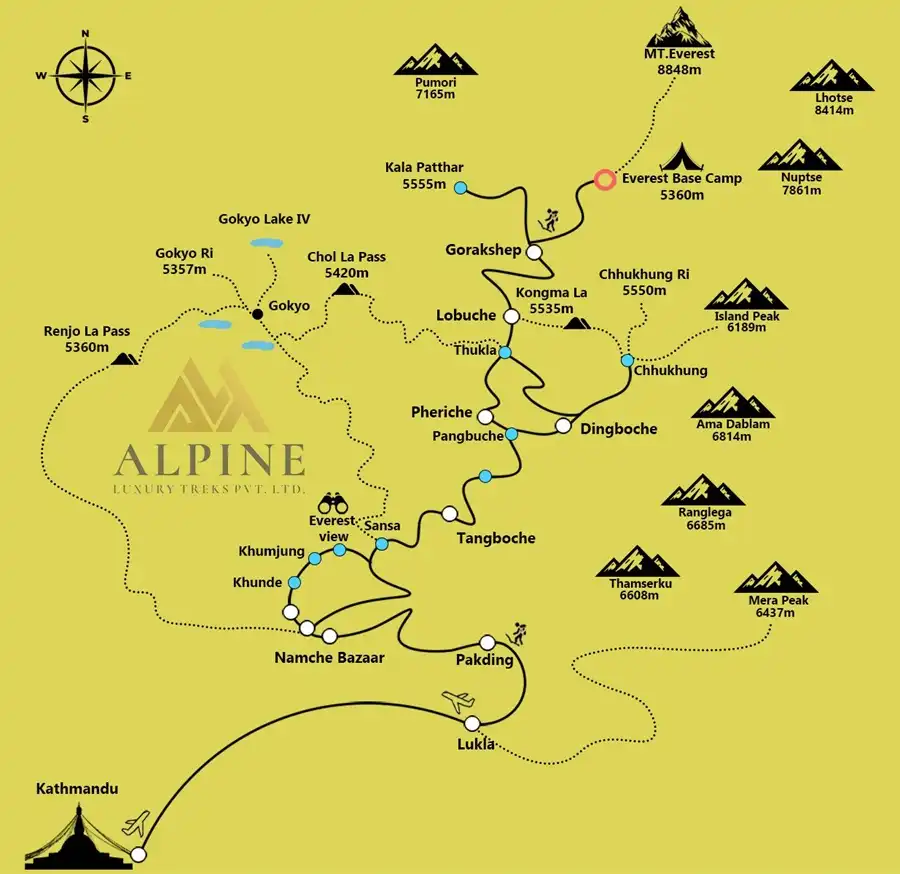
Kathmandu
Phakding
Namche Bazaar
Acclimatization & The Everest View
Deboche
Dingboche
Acclimatization Day
Lobuche
Everest Base Camp
Pheriche
Namche Bazaar
Lukla
Kathmandu
Departure from Kathmandu
Full Itinerary
Chaos. Color. Noise. You step out of Tribhuvan International Airport, and Kathmandu grabs you by the collar. The air is thick with dust and incense — welcome to the roof of the world.
Our team meets you at arrivals. Look for the Trek Nepal Himalayas sign. We drive into Thamel — rickshaws threading through honking traffic, shopkeepers calling out, trekking gear spilling onto every sidewalk. It is a sensory overload, and this is still the easy part.
Check in. Dump the bags. Now we get serious.
Gear check. Do your boots fit with thick socks? Is your down jacket rated for -20°C? If anything is missing, we walk to Shona’s Alpine on Amrit Marg for quality handmade down gear, or Kala Patthar Trekking Store for rentals — sleeping bags, boots, trekking poles. Real gear. No knock-offs.
Then the briefing. We check your permits, your insurance, and your pulse.
Eat well tonight. Momos. Dal Bhat. Both will fuel you better than anything you will find above 4,000 metres. Sleep early. The luxury ends tomorrow.
Local Secret: Skip the hotel bar. Head to Purple Haze Rock Bar in Thamel — four floors of live rock, free entry, open until 1:30 AM. Stay one hour. Enjoy the music. Then drink water. Hydration starts tonight
2:00 AM. The wake-up call is painful. It is also non-negotiable.
We drive to Manthali Airport in Ramechhap — 133 km from Kathmandu, roughly four to five hours on a winding, dark, dusty road.
This is the reality of Everest trekking in 2026. During peak season, all Lukla flights are routed through Manthali to avoid congestion and catch stable early-morning weather windows. We arrive at dawn. The airport is small, frantic, and entirely weather-dependent. We wait.
Then, we fly.
The Twin Otter roars down the runway. Within minutes, the Himalayas rise like a white wall outside your window. Twenty minutes later, you land at Lukla (2,860m) — Tenzing-Hillary Airport, one of the most dramatic landings on Earth. Short runway. One shot. Bam. You are in the Khumbu.
We meet the porters here. These are the true heroes of every Everest expedition — remember that.
The trek to Phakding (2,610m) is a gentle descent of 250 metres over 7.5 km, taking around three hours. The valley opens up lush and green.
The air is still rich with oxygen — enjoy it while it lasts. You cross the first suspension bridge over the thundering Dudh Koshi River and pass your first carved Mani stones. One rule, always: keep them on your right, passing to the left — clockwise, as Buddhist tradition demands. Never step over them. Never sit on them.
Tonight, Phakding. The river runs alongside the teahouse. It will lull you to sleep.
Local Secret: Do not buy the “Yak Cheese” in Lukla. Wait until you hit the trail near Benkar. The fierce ladies selling it roadside — that cheese is fresher, cheaper, and worth every rupee.
Today, you earn your stripes.
The morning is deceptive. Easy walking through pine and rhododendron forests, the Dudh Koshi rushing beside you. You pass through Monjo — the gateway to Sagarmatha National Park. Permits out. This is where the Khumbu truly begins.
Lunch at Jorsalle. Eat well. Dal Bhat, if possible. Load the engine. What comes next demands it.
After lunch, the trail crosses the legendary Hillary Suspension Bridge — one of the highest suspension bridges on the Everest route, strung high above the Dudh Koshi gorge, prayer flags whipping in the wind. Do not look down if you have vertigo. Keep moving.
Then, the climb begins.
Namche Hill. Steep. Dusty. Relentless. There is no shortcut, and there is no flat section — just 600 metres of vertical gain that separates casual hikers from serious trekkers. You will sweat.
You will breathe hard. Your legs will question your life choices. Halfway up, if the weather gods are kind, turn around — a white pyramid floats above the ridgeline in the distance. Your first glimpse of Everest. Keep pushing.
The trees thin. The trail curves. Then suddenly, a horseshoe-shaped bowl of stone buildings, colourful facades, and prayer flags appears against the mountain sky. Namche Bazaar (3,440m) — the Sherpa Capital of the World. You made it.
Local Secret: Walk past the checkpoint and find Sherpa Barista. Order the chocolate cake. You burned roughly 3,000 calories on that hill. This is not a treat — it is a medical requirement.
Do not sleep in. Acclimatization doesn’t mean rest. It means “Climb High, Sleep Low.” We hike up above the town. The lungs burn, but the view rewards you. We head to the Hotel Everest View. It sits at 3,880m. Order a tea. Sit on the terrace.
There she is. Everest. Lhotse. Ama Dablam. It feels close enough to touch. This is why you came. We don’t just sit; we hike to Khumjung Village.
We visit the Hillary School. We see the “Yeti Scalp” at the monastery (skepticism allowed, respect mandatory).
We descend back to Namche. The thick air feels good now. Explore the market. Last chance for an ATM. Last chance for reliable 4G.
Local Secret: Visit the Sagarmatha Next center near Syangboche. They turn trash from the mountain into art. It’s powerful.
The trail contours around the ridge. Easy walking. Epic views. Ama Dablam dominates the skyline. It’s sharp. Beautiful. Intimidating. We drop down to the river at Phunki Tenga. Lunch by the water.
Then, the climb. Another steep ascent through rhododendron forests. Dust and sweat. But then, the gate. Tengboche. The monastery sits on a saddle with one of the greatest views on Earth.
Everest is peeking over the Nuptse-Lhotse wall. We witness the monks chanting in the afternoon. The vibration of the drums goes right through you.
Strategy Shift: Most stay here. It’s crowded. Noisy. We push 20 minutes further down to Deboche. It’s sheltered. Warmer. The lodges like Rivendell are superior. Silence returns.
Local Secret: In Deboche, the rhododendrons bloom later than in the lower valleys. In spring, it’s a tunnel of pink and red.
We cross the Imja Khola. The trees are gone. Scrub juniper. Rock. Wind. The landscape turns harsh. We pass Pangboche.
The oldest monastery in the Khumbu is here. The air is noticeably thinner now. You breathe faster. Your pace slows.
We enter the Imja Valley. To your right, Ama Dablam shows a different face. To your left, the Taboche and Cholatse peaks rise like shark fins.
We reach Dingboche. A patchwork of stone walls protects barley fields from the wind. This is the highest permanent settlement. We check into the lodge. The stove is lit. The warmth is life.
Local Secret: Cafe 4410 in Dingboche shows movies at 3 PM. Watching “Everest” while on the way to Everest is a meta-experience you shouldn’t miss.
Rest day? No. We climb Nangkartshang Peak. It sits directly behind the village. It is steep. It is a gravel grind. There is no trail, just a line in the dirt.
We push past 5,000m for the first time. The view from the top is superior to Kala Patthar in many ways.
You see Makalu (the 5th-highest mountain). You see the spine of the Himalayas. You feel the altitude. Headache? Maybe. Drink water. Descent is fast. The afternoon is for recovery. Read a book. Play cards. Hydrate.
Local Secret: If Nangkartshang is too much, walk towards Chhukung. It’s flatter, but still gets you the altitude gain needed for your blood cells to adapt.
We climb the ridge above Pheriche. Then we reach Thukla. Lunch. Then, the Thukla Pass. This is a heavy place. The Memorials.
Stone chortens for Scott Fischer, Rob Hall, and hundreds of others who stayed on the mountain. The wind always seems to howl here.
It’s a stark reminder of the stakes. We walk in silence. We reach the Khumbu Glacier moraine. It’s chaos. Rock and ice. We arrive in Lobuche. It’s bleak. It’s cold. The accommodation is basic. Eat garlic soup. Stay warm.
Local Secret: Walk to the edge of the ridge at sunset in Lobuche. You can look down directly onto the Khumbu Glacier. It groans. It moves. It’s alive.
This is it. The big push. We leave Lobuche early. The trail is rocky and loose, following the glacier’s edge. Up and down. It’s tiring. We reach Gorakshep (5,160m). A frozen lakebed. Sand and dust. We drop bags, eat a quick soup, and go.
The trail to Base Camp is deceptive. It looks close. It isn’t. You walk on the spine of the glacier. Finally, you see the yellow tents (in spring). The prayer flags. Everest Base Camp. You are standing on moving ice.
The Khumbu Icefall looms above you—a frozen waterfall of death and beauty. You made it. Take the photo. Cry. Laugh. We trek back to Gorakshep to sleep. The altitude here is brutal. Sleep is fitful.
Local Secret: Charging a phone at Gorakshep costs $10 (approx. 1200 NPR). Keep your power bank warm in your sleeping bag to save juice.
4:00 AM. Pitch black. Freezing. We climb Kala Patthar. It’s steep. The air is 50% of sea level. Every step is a battle. But then, the sun hits the summit of Everest.
It turns gold. Then pink. Then white. The full pyramid of Everest is right there. Nuptse. Pumori. It is the greatest mountain view on the planet. Period.
We descend. Back to Gorakshep. Pack up. We fly down the trail now. Past Lobuche. Past Thukla. Down to Pheriche (4,240m). The air feels thick here. You will sleep like a baby tonight.
Local Secret: Visit the Himalayan Rescue Association clinic in Pheriche. They give a talk at 3 PM about altitude sickness. It’s fascinating and saves lives.
We drop altitude fast. The landscape changes. Grey rock turns to brown scrub, then green forest. We cross the river. We climb the hill to Tengboche again, then drop to the river, and climb back to Sanasa.
It’s a long day, but your lungs are supercharged now. You feel strong. We arrive in Namche. Hot shower. Real coffee. A burger. The joy of civilization returns.
Local Secret: Celebrate at Liquid Bar. They play documentaries about Everest. Watch “Sherpa” while drinking a beer in the place where the Sherpas live.
The final day on the trail. We descend the Namche Hill. Crossing the Hillary Bridge one last time. We walk through Phakding. The legs are tired, but the spirit is high.
The final climb into Lukla is a cruel joke, but you power through. We check into the lodge. Tonight is the party.
We buy the porters a drink (or two). We tip them. We dance. It’s emotional. You came as strangers; you leave as a team.
Local Secret: Don’t promise to mail gear to your porter. Give it to them now. Boots, fleece, sunglasses. It changes their lives immediately.
Early morning flight. We say goodbye to the mountains. The takeoff is just as scary as the landing. We land. If it’s Ramechhap, we drive back. If Kathmandu, we transfer to the hotel.
The shower at the hotel will be the best shower of your life. Scrub the Khumbu dust off. The afternoon is yours. Thamel shopping. Massage. Rest.
Local Secret: For a celebratory dinner, go to Le Sherpa. It’s quiet, upscale, and the food is safe and delicious.
Breakfast. Coffee. We drive you to the airport. You look at the tourists arriving—clean, fresh, naive. You smile. You know what awaits them. You have the dust in your boots and the Himalayas in your blood.
Safe travels.
Price Includes
- 3 Nights Hotel Stay in Kathmandu: Start and finish your Everest Base Camp Trek with a comfortable stay in Kathmandu.
- Tea House Accommodations: Experience cozy, twin-sharing rooms throughout your trek to Everest Base Camp. Upgrades are available, subject to limitations in Lobuche and Gorakshep.
- Four Airport Transfers: Enjoy seamless pick-up and drop-off via private vehicle for your Everest Base Camp Trek.
- Round-Trip Domestic Flights: Travel conveniently between Kathmandu and Lukla, with all airport taxes included. Transportation changes to Ramechap Airport are also covered.
- Daily Meals: Savour three nutritious meals daily during your trek in Nepal.
- Seasonal Fruits: Relish fresh fruit servings each evening post-dinner.
- Licensed English-speaking Trek Leader: Be guided by an expert, catering up to 8 trekkers on the Everest Base Camp Trek.
- Assistant Guides and Porters: Benefit from additional support for larger groups, with all expenses included.
- Sagarmatha National Park Entrance Fee: Access the stunning natural beauty of Everest.
- Khumbu Pasang Lhamu Rural Municipality Entry Permit: Trek legally and responsibly.
- Rescue Operations Assistance: Receive support in case of health issues, funded by travel insurance.
- Trek Completion Certificate: Get a special souvenir marking your accomplishment at Everest Base Camp.
- All Government Taxes and Fees: Enjoy a transparent pricing structure with no hidden costs.
Price Excludes
- International Flight Costs: Travel to and from Nepal is not included in the Everest Base Camp Trek package.
- Nepal Entry Visa Fees: These fees are payable upon arrival at Tribhuvan International Airport.
- Excess Baggage Charges: Any baggage over the 10 kg per person limit on the Everest Base Camp Trek will incur additional charges.
- Kathmandu Stay: Extra food and accommodation in Kathmandu are not covered by the Everest Base Camp Trek package.
- Extra Night Accommodation: Additional costs for early arrival, late departure, or early return from the trek are not included.
- Personal Shopping and Snacks: Traveller will bear expenses for bottled water, hot showers, and cold/hot drinks during the Everest Base Camp Trek.
- Communication Costs: Charges for Wi-Fi, telephone calls, and gadget charging are not included.
- Alcohol: Any alcoholic beverages consumed during the Everest trek are not covered.
- Travel Insurance: It’s mandatory for travelers to have insurance covering emergency high-altitude rescue and evacuation.
- Tipping: Tips for guides, assistant guides, and porters are not included in the Everest Base Camp Trek package.
- Unplanned Costs: Additional expenses due to landslides, weather conditions, and itinerary changes for safety reasons are not included.
- Government Policy Changes and Strikes: Any extra costs incurred due to factors beyond our control are not covered.
- Anything Not Mentioned in the Inclusion List: If it’s not listed in the included section, it’s not part of the Everest Base Camp Trek package.
Trip Information
2026 Vital Intel (What Others Won’t Tell You)
- The Ramechhap Reality: The drive is brutal. 4-6 hours. 2:00 AM start. The BP Highway is still recovering from the 2024/2025 floods. Expect dust. Expect bumps. Sleep in the van.
- Connectivity: Starlink is unauthorized. Don’t count on it. You are reliant on “Everest Link” cards. They are expensive. They are spotty. Embrace the disconnect.
- The Meat Rule: Stop eating meat after Namche Bazaar. It’s carried up on porters’ backs, unrefrigerated, for days. Go veg. Stay healthy.
- Cash is King: ATMs in Namche are unreliable. Bring USD or NPR from Kathmandu. You need more than you think.
Best Season to Visit
- Timing is everything. Spring (March to May) is the climbing season. Base Camp is full of tents and climbers.
- The vibe is electric. Rhododendrons are blooming. It is warmer, but hazier in the afternoons.
- Autumn (Late Sept to Nov) offers the best clarity. The sky is a piercing blue.
- The mountains look sharp. It is colder, especially in November. Winter (Dec/Jan) is for the hardcore.
Empty trails, brutal cold (-25°C), but crystal clear. Avoid Monsoon (June-Aug) unless you like leeches and zero views.
Accommodation & Meals
You sleep in teahouses. These are simple stone lodges.
- The Room: Twin beds. Foam mattress. Unheated. Inside temp can drop below freezing. You need a -20°C sleeping bag.
- The Dining Hall: The only warm place. Heated by a yak-dung stove. This is where community happens.
- The Food: “Dal Bhat Power 24 Hour.” Rice and lentils. It’s safe. It’s filling. Also available: Momos, fried rice, pizza (not Italian), and garlic soup (good for altitude).
- Water: Tap water is unsafe. Buy boiled water ($2-$4/liter) or use purification tablets/Steripen.
Physical Fitness & Difficulty
This is not a walk in the park. It is a hike in the stratosphere.
- Cardio: You need it. Run, swim, cycle. 3-4 times a week for 3 months prior.
- Strength: Legs and core. Squats. Lunges. Stairs with a weighted pack.
- Mental: The hardest part. When your head throbs and it’s -10°C, you need grit.
- AMS: Acute Mountain Sickness is real. We follow a slow itinerary. Drink 4L of water daily. Listen to your guide. If they say go down, you go down.
Permits & Visa Info
- Visa: On arrival at Kathmandu Airport. $50 USD for 30 days. Bring cash (crisp bills) and a passport photo.
- Permits: We handle these. You need the Khumbu Pasang Lhamu Rural Municipality Permit (approx. $23) and the Sagarmatha National Park Permit (approx. $23). Note: The TIMS card is no longer used in Everest; the local permit replaced it.
Transportation
The weak link. Flights to Lukla are weather-dependent. Delays happen. Always have 1-2 buffer days at the end of your trip before your international flight.
The drive to Ramechhap is a necessary evil in peak season. It’s bumpy. It’s long. Bring motion sickness pills and noise-canceling headphones.
Frequently Asked Questions
Statistically, yes. Thousands fly it annually. However, it is weather-dependent. We only fly with top-tier airlines (Tara, Summit, Sita) and experienced pilots. If it’s unsafe, we don’t fly.
No. The Nepal Tourism Board banned solo trekking. You must have a guide. It’s safer, and it supports the local economy.
Bring approx. $300-$400 USD worth of Nepali Rupees (NPR) for the trek. This covers hot showers ($5-$8), charging ($3-$10), Wi-Fi ($5-$10/day), chocolate, and tips.
A dry, hacking cough caused by cold, dry air and dust. Wear a Buff over your mouth. Suck on throat lozenges. Stay hydrated.
Officially, no. Relied on Everest Link Wi-Fi cards.
Consult your doctor. Many trekkers take 125mg twice daily as a preventative. It helps. It makes your fingers tingle and makes you pee, but it helps breathing.
Yes, but it costs money. Cost increases with altitude. Solar chargers work but are slow. Power banks are best.
Minor illness: We treat and rest. Severe AMS: We descend immediately. Emergency: Helicopter evacuation. Insurance is mandatory.
Yes. Lower down: Western flush (sometimes). Higher up: Squat toilets or pit latrines. Bring your own toilet paper and hand sanitizer.
Yes. Thamel has everything. From fake North Face (cheap, okay quality) to authentic Mountain Hardwear/Sherpa Adventure Gear.
Porter bag: 15kg (33lbs). Daypack: 5-7kg. Do not overload the porters. It’s unethical.
Yes, if you stick to cooked food. Avoid salads. Eat fresh meat only in Lukla/Namche. Go veg after that.
Base Camp in Oct/Nov can be as low as -15°C to -20°C at night. Inside the room, it might be -5°C.
With our itinerary (2 acclimatization days), 95%+ make it. Rushing is the main cause of failure.
Yes. It is cultural. Plan 10-15% of the trek cost. Usually $150-$200 per trekker given to the guide/porter team at Lukla.
Grace Educational Organisation
The Grace Educational Organisation is a government-registered charity dedicated to empowering students in Nepal through education.
With a 100% donation policy, every contribution directly supports the children and schools, providing essential resources like supplies, infrastructure, and extracurricular programs.
This initiative fosters a transparent connection between donors and students, ensuring every action leaves a lasting impact.
The Nuwakot School, located in a picturesque rural setting, is one of the beneficiaries of this mission.
By visiting, you witness these students’ educational journey and become part of a transformative effort to uplift the community.
Trip Reviews

Based on 2
Reviews
Awe-Inspiring Journey of a Lifetime
The Everest Base Camp trek was an absolute dream come true! From the moment we landed in Lukla, the breathtaking scenery and warm hospitality of the Sherpa people captivated us. The trek itself was challenging but incredibly rewarding.
Each step brought us closer to the majestic Everest, and the views from Kala Patthar were simply awe-inspiring. Our guide was knowledgeable and supportive, ensuring our safety and sharing fascinating insights about the region’s culture and natural wonders.
The tea houses along the way provided comfortable lodging and delicious meals, making each day’s end a welcome respite. Reaching Everest Base Camp was an emotional and unforgettable experience, a testament to the resilience of the human spirit and the power of nature.
I highly recommend this trek to anyone seeking adventure, natural beauty, and a profound connection with the Himalayas.

Mark G
AustraliaChallenging Yet Rewarding Trek
Trekking to Everest Base Camp was a challenging but ultimately rewarding experience. The high altitude and demanding terrain pushed me to my limits, but the stunning scenery and sense of accomplishment made it all worthwhile.
The trek was well-organized, with comfortable accommodations and knowledgeable guides. However, I would advise future trekkers to be prepared for the physical demands and potential effects of altitude sickness.
Acclimatization is crucial, and it’s important to listen to your body and take rest days when needed. Overall, the Everest Base Camp trek is an incredible adventure that I would recommend to anyone seeking a once-in-a-lifetime experience in the Himalayas.

Marcus R
USA
More Trips