Everest Base Camp Yoga Trek
Based on 2100 reviews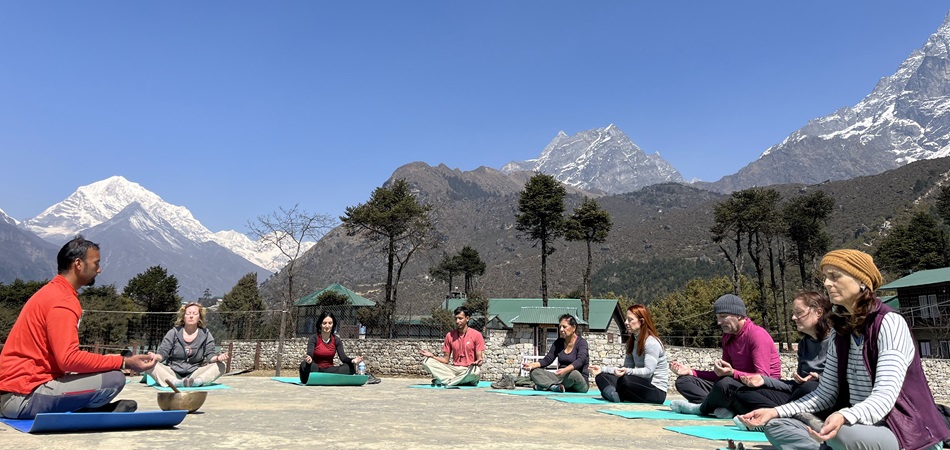
Trip Overview
The Everest Base Camp Yoga Trek challenges you to push your limits on the world’s most famous trail while grounding your spirit through daily yoga practice.
Imagine battling thin air to reach 5,364 meters (17,598 feet), your legs burning from the ascent. Then find deep restoration in a guided yoga session surrounded by 8,000-meter giants.
This trip is designed for the bold. It balances the raw adrenaline of the Himalayas with the focused discipline of yoga. You don’t need to be a Himalayan expert or a master yogi to join. We have guided a 72-year-old adventurer and an 8-year-old child to the base of the world’s tallest peak.
Whether you seek to conquer the Khumbu Icefall views or find inner silence among the turbulent beauty of the mountains, this 13-day odyssey is your proving ground.
Trip Highlights
- Stand at the Foot of the World: Reach Everest Base Camp (5,364m) and witness the Khumbu Icefall up close, a chaotic river of frozen ice that guards the summit.
- High-Altitude Yoga: Daily guided yoga and meditation sessions designed to aid acclimatization, stretch tired muscles, and center your mind against the backdrop of Ama Dablam and Lhotse.
- The Kala Patthar Sunrise: Push through a pre-dawn climb to 5,643m for the single best panoramic view of Mount Everest, Nuptse, and Pumori bathed in golden light.
- Cultural Immersion: Explore the spiritual heart of the Khumbu at Tengboche Monastery, where the chanting of monks echoes off the canyon walls.
- Adrenaline Arrival: Experience the legendary flight into Lukla Airport, often called the world’s most thrilling landing, to kickstart your adventure.
Short Itinerary
Phakding
Namche Bazaar
Everest View Hike and Rest
Tengboche
Dingboche
Dingboche Rest
Lobuche
Everest Base Camp
Pheriche
Namche Bazaar
Phakding
Lukla
Kathmandu
Full Itinerary
The adventure kicks off with a massive shot of adrenaline. You’ll board a small Twin Otter aircraft for the flight from Kathmandu (or Ramechhap) to Lukla (2,860m).
As the plane navigates the valleys and touches down on the inclined runway, you’ll understand why this is the gateway to the top of the world.
After meeting your trekking crew—including your certified yoga instructor—the physical work begins.
The trek to Phakding is a deceptive descent, easing you into the rhythm of the trail. You will follow the roaring Dudh Koshi River, passing through small Sherpa hamlets like Chheplung and Thado Koshi.
The trail is lined with mani stones (carved prayer rocks) and prayer wheels. Upon reaching Phakding, your instructor will lead a gentle evening yoga session.
This isn’t just stretching; it’s a crucial practice for oxygenating your blood and preparing your joints for the vertical days ahead.
Today is where the real challenge begins. After a hearty breakfast, you head north. The trail crisscrosses the river over high suspension bridges, including the famous Hillary Suspension Bridge, draped in fluttering prayer flags. The wind here is fierce, and the drop below is dizzying.
The final push to Namche Bazaar is a steep, relentless ascent through pine forests. This is your first true test of endurance. Keep a steady pace and focus on your breath—a skill your yoga practice will reinforce.
Halfway up, if the weather cooperates, you’ll get your first glimpse of Everest peering over the Lhotse-Nuptse ridge. Arriving in Namche, the amphitheater-shaped Sherpa capital, feels like a victory.
We end the day with a restorative yoga session to flush the lactic acid from your legs and calm the nervous system after the intense climb.
“Acclimatization” does not mean sleeping in. To adapt to the thinning air, we follow the rule: “Climb High, Sleep Low.”
We start the day with a morning yoga flow focused on chest opening and breathwork (Pranayama) to maximize lung capacity.
Afterward, we hike up to the Everest View Hotel (3,880m). The panoramic view here is legendary—Everest, Lhotse, and the stunning Ama Dablam dominate the skyline.
You can also visit the Sherpa Culture Museum or hike to the Khumjung village to see the “Yeti Skull” at the monastery.
The afternoon is yours to explore the cafes and gear shops of Namche. We reconvene for an evening meditation session, focusing on mental resilience.
The air is thinner here, and your body is working hard even at rest; this downtime is vital to your success in the days ahead.
The trail from Namche cuts across the valley side, offering uninterrupted views of Everest and Lhotse. It looks flat, but the “Nepali Flat” reality soon sets in—a little bit up, a little bit down.
You descend deep into the valley to cross the river at Phunki Tenga, where we stop for lunch to fuel up for the massive climb ahead.
The ascent to Tengboche is a grueling, dusty zig-zag through rhododendron forests. It demands mental grit. But the reward is spiritual gold.
Tengboche Monastery is the largest in the Khumbu region. If the timing aligns, we will witness the monks performing their afternoon puja (prayer rituals).
The energy here is palpable. Surrounded by high peaks, we will engage in a yoga session focused on grounding energy, connecting the physical exertion of the climb with the location’s spiritual serenity.
Wake up early to catch the sunrise striking the summit of Ama Dablam—it towers directly above you. Today, the landscape changes dramatically.
We leave the tree line behind and enter the alpine scrub zone. The air is noticeably thinner, drier, and crisper.
The trail descends to Deboche and crosses a suspension bridge over the Imja Khola before climbing past Pangboche.
You are now walking in the shadow of giants. As we approach Dingboche, the valley widens into a patchwork of stone-walled fields used to grow barley and potatoes.
The wind picks up here. Your evening yoga practice will be indoors, focusing on warmth and gentle stretching to keep the circulation moving in your extremities.
Hydration is key today; the dry air sucks moisture from your body with every breath.
This is a critical day for your summit push. We tackle a steep hike up Nangkartsang Hill (5,083m).
This ridge offers one of the best views of Makalu (the world’s 5th highest mountain) and gives you a taste of the 5,000-meter altitude.
It is a tough, breathless climb, but essential for your body to produce more red blood cells.
Spend the afternoon recovering. This is the perfect time for a deep, guided meditation session or Yoga Nidra (yogic sleep) to help your body repair at a cellular level.
Dingboche is the last village with a semblance of permanent settlement before the rugged wilderness of the high camps. Eat well, drink liters of water, and prepare your mind. The next two days are the hardest of the trip.
The trek starts with a gentle incline, but the environment becomes increasingly hostile and beautiful. You are entering the domain of rock and ice.
We climb steeply up to the Thukla Pass, a somber memorial site filled with stone chortens dedicated to climbers who lost their lives on Everest. It is a humbling place that demands respect and reflection.
Moving forward, we walk along the lateral moraine of the Khumbu Glacier. The ground is rough, and the air is thin.
You will feel the altitude with every step. Upon reaching Lobuche, the temperature drops significantly.
Our yoga session today is brief and gentle, focused solely on breathing techniques to maintain high oxygen saturation. Rest is the priority tonight.
Today is the day. We start early to reach Gorakshep (5,164m), the final outpost. After a quick lunch, we drop our heavy packs and begin the final push to Everest Base Camp.
The trail weaves through the erratic ice and rock of the glacier. It’s slippery, rocky, and technically demanding.
Standing at Base Camp (5,364m) is a surreal experience. You are standing at the foot of the mother of all mountains.
You can see the bright yellow tents of expeditions (in spring) and stare directly into the treacherous Khumbu Icefall. We will take a moment here—not for a full yoga class, but for a powerful standing meditation to absorb the energy of this place.
After celebrating and snapping photos, we trek back to Gorakshep for the night. The accommodation here is basic, and the night will be cold, but the sense of achievement keeps you warm.
We wake up before dawn. It’s freezing, dark, and the air is thin, but we have one last giant to conquer: Kala Patthar.
This steep ascent is physically draining, but as you reach the top, the sun rises over the Himalayas, turning Everest (which is not fully visible from Base Camp) a burning shade of orange. This is the postcard shot. This is the top of your world.
After soaking up the 360-degree panorama, we descend rapidly back to Gorakshep for breakfast, then continue down to Pheriche.
The drop in altitude feels miraculous. Your lungs expand, your headache fades, and your energy returns.
In Pheriche, we will hold a celebratory yoga session—a flow of gratitude for the body’s ability to endure and adapt.
The return journey is not just walking back; it’s a victory lap. We retrace our steps through Pangboche and Tengboche.
The descent can be hard on the knees, so use your trekking poles. As you drop back into the tree line, the smell of pine and juniper is intoxicating after days in the barren alpine zone.
Arriving back in Namche Bazaar, the town feels like a metropolis compared to the high camps. You can enjoy a hot shower, real coffee, and perhaps a slice of chocolate cake.
The evening yoga practice focuses on hip openers and hamstring stretches to alleviate the impact of the long descent.
The trail descends steeply from Namche, crossing the high bridges one last time. The walk to Phakding is pleasant and warm.
You’ll notice how much stronger you feel compared to Day 1. The altitude that once left you breathless now feels rich with oxygen. We take our time today, enjoying the lush greenery and the sound of the river.
This is the final leg. The walk back to Lukla is a time for reflection. You have walked in the footsteps of legends. Upon arrival in Lukla, the mood is festive.
It’s time to celebrate with your guides and porters. We conclude the physical journey with a final group yoga circle, sealing the experience and acknowledging the transformation you have undergone over the last two weeks. Tonight, we party Sherpa-style!
We take an early morning flight back to Kathmandu. Seeing the mountains recede from the plane window is a bittersweet moment.
Upon landing, you’ll be transferred to your hotel. You have the rest of the day to shop in Thamel or simply relax.
In the evening, we host a farewell dinner to hand out trek completion certificates and say our goodbyes. You came as a guest, but you leave as a member of the mountain family.
Price Includes
- Logistics: Airport transfers (private vehicle) and round-trip flights (Kathmandu-Lukla or Ramechhap-Lukla) including taxes.
- Accommodation: 12 nights in local teahouses (twin sharing). Note: Rooms are basic; attached bathrooms are rare in higher altitudes.
- Meals: Full board (Breakfast, Lunch, Dinner) during the trek. Seasonal fresh fruits are provided every evening.
- Expert Team: Certified English-speaking Trek Leader and a Dedicated Certified Yoga Instructor.
- Support: Porters (1 porter for every 2 trekkers, max 20kg total), assistant guides for groups over 8.
- Permits: Sagarmatha National Park Fee and Khumbu Pasang Lhamu Rural Municipality Permit.
- Safety: 24/7 ground support and arrangement of rescue operations (funded by your insurance).
- Gear: Duffel bag for porter use (to be returned).
Price Excludes
- International Travel: Flights to/from Nepal and Nepal Entry Visa fees ($ 30 for 15 days, $ 50 for 30 days).
- Kathmandu Expenses: Hotels and meals in Kathmandu are not included.
- Personal Costs: Hot showers, battery charging, Wi-Fi, boiled water, bottled drinks, snacks, and alcohol.
- Insurance: Mandatory travel insurance covering high-altitude rescue (up to 6,000m) and medical evacuation.
- Tips: Gratuities for the guide, yoga instructor, and porters (customary in Nepal).
Trip Information
Best Seasons
The Everest region has two distinct trekking windows. Spring (March to May) is warmer, with blooming rhododendrons adding color to the lower valleys. Temperatures range from 15°C in the day to -10°C at night at Base Camp.
Autumn (September to November) offers the clearest skies and sharpest mountain views, though it is colder and dustier. Winter (Dec-Feb) is brutally cold but empty, and Monsoon (June-Aug) brings rain and leeches. For a Yoga trek, Spring is often preferred for the slightly warmer temperatures, which make stretching more comfortable.
Accommodation Standards
Understanding “Teahouse Trekking” is vital. These are not hotels; they are rustic mountain lodges run by local families. In lower altitudes (Lukla, Namche), you may find rooms with attached bathrooms and electric blankets.
However, past Tengboche, facilities become basic. Expect plywood walls, twin beds with foam mattresses, and shared squat toilets. The communal dining hall is the only heated room (by a yak dung stove). We provide sleeping bags, but bringing a liner is recommended for hygiene and extra warmth.
Food & Water
You will burn 3,000+ calories a day. The menu is surprisingly extensive: pizza, pasta, and pancakes are available, but the best fuel is Dal Bhat (lentil soup, rice, veg curry), which is all-you-can-eat. Garlic soup is highly recommended for altitude acclimatization.
Meat is not recommended beyond Namche Bazaar, as it is carried up by porters without refrigeration. For water, plastic bottles are expensive and bad for the environment. We strongly recommend bringing Nalgene bottles and using sterilization tablets or a UV filter stick.
Visa Requirements & Money
You can obtain a Nepal visa on arrival at Tribhuvan International Airport. You will need a passport valid for 6 months and a passport-sized photo. Costs are $30 for 15 days or $50 for 30 days (payable in cash USD/EUR/GBP). On the trek, Cash is King. While Namche has ATMs, they are frequently out of order.
You must carry enough Nepali Rupees (approximately $25-$30 per day) to cover hot showers ($5), charging ($3), Wi-Fi ($5), and snacks. Credit cards are rarely accepted past Lukla.
Safety & Emergency Protocols
We take safety seriously. Our guides carry oximeters to measure your oxygen saturation daily. If you experience severe Acute Mountain Sickness (AMS), we have a rapid response protocol. For minor issues, we use horses to descend.
For critical emergencies, we coordinate immediate helicopter evacuation. This is why your insurance must cover a helicopter rescue up to 6,000m. We have successfully guided clients aged 8 to 72, proving that with the right support, this trek is achievable.
Equipment List
Yoga Specifics
- Travel Yoga Mat: Lightweight, foldable mat (teahouse floors can be cold/dirty).
- Comfortable Layers: Stretchy thermal leggings/pants that work for both hiking and yoga.
Head & Upper Body
- Sun hat and warm wool/fleece beanie (essential for mornings).
- Buff/Neck gaiter (prevents “Khumbu Cough” from dry dust).
- High-quality sunglasses (UV protection is critical at altitude).
- Base layers: Moisture-wicking synthetic or merino wool (2 tops).
- Insulating layer: Heavy fleece or down jacket.
- Outer shell: Waterproof/windproof jacket (Gore-Tex recommended).
- Down Jacket: Rated for -20°C (can be rented in Kathmandu).
Lower Body
- Trekking trousers: 2 pairs (zip-offs are great).
- Thermal underwear/bottoms.
- Waterproof over-trousers (for wind/snow).
Feet & Hands
- Boots: Broken-in, waterproof hiking boots with ankle support.
- Camp shoes: Light sneakers or down booties for the teahouse.
- Socks: 4 pairs of merino wool trekking socks, 2 pairs of liners.
- Gloves: Lightweight liner gloves + heavy waterproof summit gloves.
Essentials & Toiletries
- Sleeping bag rated to -15°C or -20°C (can be rented).
- Headlamp with spare batteries.
- Water bottles (2x 1 Liter Nalgene).
- Water purification (Tablets or Steripen).
- First Aid: Diamox (for altitude), Ibuprofen, Blister plasters, Lip balm with SPF.
- Wet wipes (showers are scarce) and hand sanitizer.
- Power bank (20,000mAh recommended) and solar charger.
Frequently Asked Questions
Absolutely not. Our certified yoga instructor tailors the sessions to the group’s ability. The focus is on stretching, breathing, and mindfulness rather than advanced acrobatics. Beginners are welcome!
It depends on the weather and location. In lower altitudes, we may practice on hotel lawns with mountain views. In higher, colder villages like Lobuche or Gorekshep, we will practice indoors in the teahouse dining halls (usually cleared before dinner) or in your room if space permits.
Physically, the route is identical. However, adding yoga makes the trek easier on your body. Daily stretching helps prevent muscle stiffness, and the breathwork (Pranayama) significantly aids in acclimatization and lung efficiency.
Mild symptoms (headache, nausea) are common. Your guide will monitor you closely. If symptoms worsen, we descend immediately.
Our team is trained in wilderness first aid, and for severe cases, we will coordinate a helicopter rescue (covered by your insurance).
Yes, most teahouses charge for charging (approx. $2-$5 per device). However, electricity is unreliable. We highly recommend bringing a high-capacity power bank or a portable solar panel.
Yes, “Everest Link” Wi-Fi cards are available to buy at most lodges. It is relatively fast in Namche but becomes slower and more expensive ($5-$10 for 1GB) as you go higher. We suggest taking a digital detox to fully immerse in the experience.
We provide one porter for every two trekkers. The weight limit is 10kg (22lbs) per person. You will carry your own daypack with water, snacks, a camera, and rain gear.
We recommend bringing a “travel mat” that is thin and foldable. Standard mats are too bulky to strap to your daypack.
Gas-heated showers are available in Namche, Lukla, and Phakding. Higher up, you may get a “bucket shower” (warm water in a bucket). Beyond Dingboche, most trekkers rely on wet wipes because it is too cold to shower comfortably.
You can book as a solo traveler, but you will be trekking in a group. This is a great way to meet like-minded people. If you want a strictly private trek, we can arrange that for an additional cost.
Aviation safety in Nepal has improved significantly. Flights only operate in good visibility. However, delays are common due to the weather. We recommend adding 1-2 “buffer days” at the end of your trip in case of flight cancellations.
“Bistari, Bistari” (Slowly, Slowly). This is not a race. Walking slowly helps your body adjust to the low oxygen levels and ensures you have the energy to enjoy the yoga sessions.
Many trekkers use Diamox (Acetazolamide) as a preventative measure for altitude sickness. It is not mandatory, but highly recommended. Please consult your doctor before the trip.
Yes! In fact, a vegetarian diet is recommended on the trek to avoid stomach issues from old meat. Vegan options are also available (Dal Bhat is usually vegan), though variety may be limited at high altitudes.
Grace Educational Organisation
The Grace Educational Organisation is a government-registered charity dedicated to empowering students in Nepal through education.
With a 100% donation policy, every contribution directly supports the children and schools, providing essential resources like supplies, infrastructure, and extracurricular programs.
This initiative fosters a transparent connection between donors and students, ensuring every action leaves a lasting impact.
The Nuwakot School, located in a picturesque rural setting, is one of the beneficiaries of this mission.
By visiting, you witness these students’ educational journey and become part of a transformative effort to uplift the community.
Trip Reviews
Be first to post a review in this trip.

More Trips