8 Days
Easy
Guru Padmasambhava Maratika Pharping – known as Guru Rinpoche- is revered as the “Second Buddha” who spread Vajrayana Buddhism in the Himalayas.
Among the many places sanctified by his presence, Maratika (Halesi) in eastern Nepal and Pharping (Yangleshö) near Kathmandu stand out for their profound spiritual and historical significance.
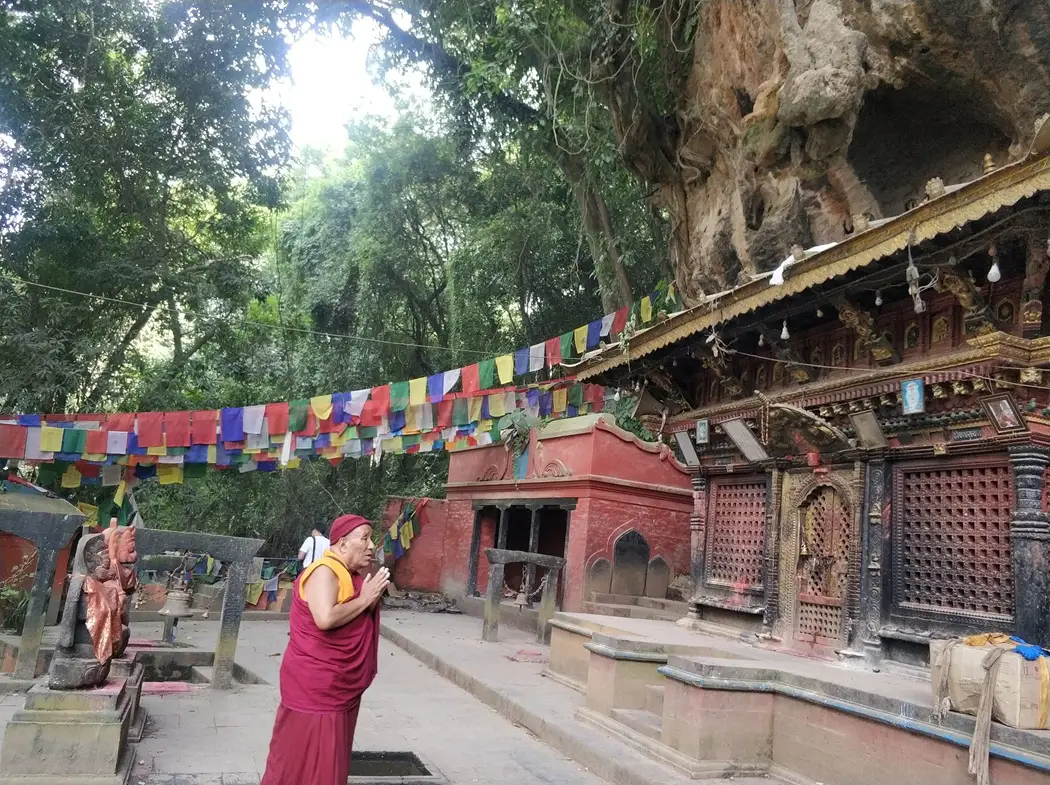
These two sites mark pivotal chapters in Padmasambhava’s life – one where he attained the siddhi of immortality, and another where he achieved the highest realization (mahamudra) – before he continued his journey to establish Buddhism in Tibet.
This blog explores the legends, spiritual milestones, and local lore associated with Maratika and Pharping, and traces Guru Rinpoche’s subsequent route from Nepal to Tibet.
Maratika, known to locals as Halesi, is venerated where Padmasambhava and his consort Princess Mandarava attained a state of deathless awareness.
According to sacred biographies, after Padmasambhava met Mandarava in the kingdom of Zahor, the two journeyed to the Maratika cave in eastern Nepal to engage in an intensive meditation retreat.
Inside this cavern, they practiced the sadhana of longevity for three months, invoking Amitayus, the Buddha of Infinite Life.
Their devotion bore fruit – Amitayus appeared in a vision and placed a nectar vase on their heads, blessing them with long life.
Through this blessing, Padmasambhava and Mandarava attained the level of “vidyadhara with mastery over life,” essentially the immortal awareness-holder state beyond the reach of death.
This epic event at Maratika enabled Guru Rinpoche to live on for centuries, continuing his enlightened activities in India, Nepal, Tibet, and beyond.
In fact, Buddhist chronicles note that by the time he later traveled to Tibet (8th century CE), Guru Padmasambhava was already over a thousand years old, a testament to the longevity siddhi achieved at Maratika.
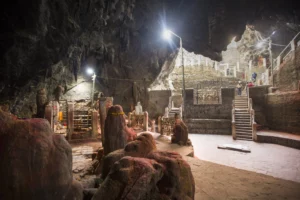
Maratika is counted among the six holiest pilgrimage sites in the world for Tibetan Buddhists. In the Tibetan language, it is called Chi ba mthar byed, meaning “that which eliminates death”.
Here, the very landscape is inseparable from the mandala of Amitayus – the cave is regarded as the living abode of the Buddha of Longevity, perpetually charged with the energy of Padmasambhava’s accomplishment.
Pilgrims across the Himalayas come to Maratika to practice long-life rituals and seek blessings for health and lifespan. It is believed that simply visiting the cave and praying here can help extend one’s life and remove obstacles to longevity.
Maratika is also unique as a joint pilgrimage site for Buddhists and Hindus. While Buddhists revere it for Guru Rinpoche’s immortality attainment, Hindus consider Halesi a sacred power-place of Lord Shiva – a dual sanctity that adds to the cave’s mystique.
The Maratika cave complex sits amid forested hills (named after the bodhisattvas Manjushri, Avalokiteshvara, and Vajrapani). The main cave – tucked into Avalokiteshvara Hill – is where Padmasambhava and Mandarava’s retreat occurred.
Inside this cavern, pilgrims encounter several miraculous formations. Most famous is a large natural rock shaped like a vase, said to be the very “long-life vase” (Tsebum) that Amitayus manifested and placed upon the heads of the Guru and his consort.
This vase-shaped stalagmite is revered as a source of blessings; many pilgrims crawl under or around it, symbolically receiving the nectar of immortality.
The cave walls are also studded with naturally arisen sacred syllables and symbols – holy letters spontaneously imprinted in the rock over centuries. Devotees circumambulate inside, discovering these hidden letters and making prayers.
According to local caretakers, Maratika also contains “Four Gates to Liberation” – four specific passageways or gaps in the cave rock corresponding to the purification of different karmic obstacles.
For example, one narrow passage is believed to cleanse the karma of rebirth in hell realms, while another tunnel purifies transgressions of spiritual vows.
Pilgrims try to squeeze through these rocky gateways as a physical act of renewal. Additionally, visitors are shown a faint body imprint of Amitayus near the vase and an imprint of Guru Rinpoche’s form on a cave wall – visible to those “with eyes of faith”.
Another treasure of Maratika is a self-arisen “prosperity casket” (Yang g’ö) – a casket-shaped rock formation believed to grant wishes and abundance to devotees.
With fluttering prayer flags, butter lamps flickering in alcoves, and the flutter of bats overhead, the atmosphere inside Maratika is otherworldly.
Every year around the Tibetan New Year, pilgrims flock to Maratika to honor the anniversary of Guru Padmasambhava’s long-life accomplishment.
They light hundreds of butter lamps in the cave, recite longevity prayers, and meditate in the same spot where the Guru once transcended death.
After his exploits in India and eastern Nepal, Padmasambhava eventually came to the Kathmandu Valley and retreated to Yanglesho (Pharping).
In the 8th century, Pharping was a secluded forested area south of Kathmandu – ideal for intensive practice. Guru Rinpoche settled into two caves here: the lower Yanglesho cave and the upper Asura cave, alternating between them by season.
According to his biographies, “In the rock cave of Yanglesho in Nepal, you accomplish the practice of Yangdak, essence of Great Bliss. Through Vajrakilaya, you liberate all obstacles in this sacred place, you attain the siddhi of Mahamudra.”
These lines from an old prayer encapsulate what happened at Pharping. With his Nepalese consort Shakyadevi (a princess of Nepal), Padmasambhava undertook the sadhana of Yangdak Heruka, a wrathful meditational deity embodying the wisdom-mind of all Buddhas. He began this practice in the Yanglesho (lower) cave.
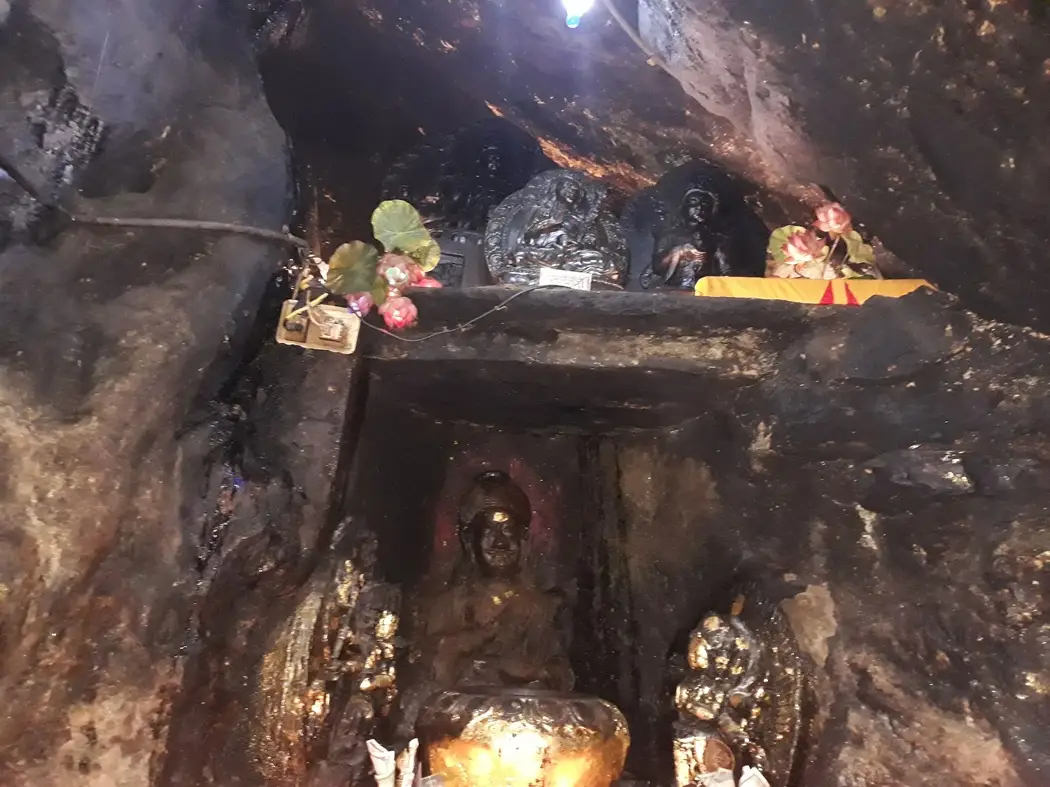
However, as legend tells, the power of his meditation stirred local spirits: the region was struck by a terrible drought lasting three years, causing famine and disease. Recognizing that obstructive forces were at play, Guru Rinpoche halted his retreat and sent word to India for assistance.
In response, two of his Indian teachers arrived bearing the tantras and commentaries of Vajrakilaya, the deity renowned for removing obstacles. When these texts entered the valley, the obstacles were pacified – rain fell and the calamities ended.
Empowered with Vajrakilaya’s methods, Padmasambhava moved uphill to the sunnier Asura Cave for the winter months. There, he combined the practice of Yangdak Heruka with Vajrakilaya in an intensive meditation marathon.
The result was extraordinary: Guru Rinpoche attained the ultimate realization of Mahamudra (the “Great Seal”), a level of awakening equated with complete enlightenment. In terms of spiritual accomplishment, this was on par with Buddha Shakyamuni attaining enlightenment at Bodh Gaya.
Hence, later masters declared Pharping sacred to Vajrayana Buddhists as Bodh Gaya is to general Buddhists. Both Padmasambhava and Shakyadevi are said to have reached the vidyadhara level of “Great Seal” (third of four levels of realization) here at Yanglesho.
To ensure the teachings would benefit future practitioners, Guru Rinpoche then composed new sadhanas blending the Yangdak and Vajrakilaya practices and bound the Vajrakilaya spirits as Dharma protectors sworn to guard these teachings.
For this scholarly and yogic feat, he is acclaimed in prayer verses as “Padmasambhava, the Pandita of Yanglesho, Guru Mawé Sengé (Lion of Speech)”, considered an emanation of Manjushri (Buddha of wisdom).
In other words, at Pharping, the Lotus-Born not only vanquished outer obstacles but also established a new lineage of practices, marrying wisdom and method to overcome hindrances on the path swiftly.
The area features two main cave shrines linked to Padmasambhava’s retreat. The Yanglesho Cave (lower cave) is adjacent to the Sheshnarayan temple and a spring-fed pond.
The Asura Cave (upper cave) is higher on a forested hillside. Today, monasteries flank both sites – Chatral Rinpoche’s retreat center by the lower cave, and a Tibetan monastery (Guru Drubné Pema Ösel Ling, founded by Tulku Urgyen Rinpoche) by the upper cave.

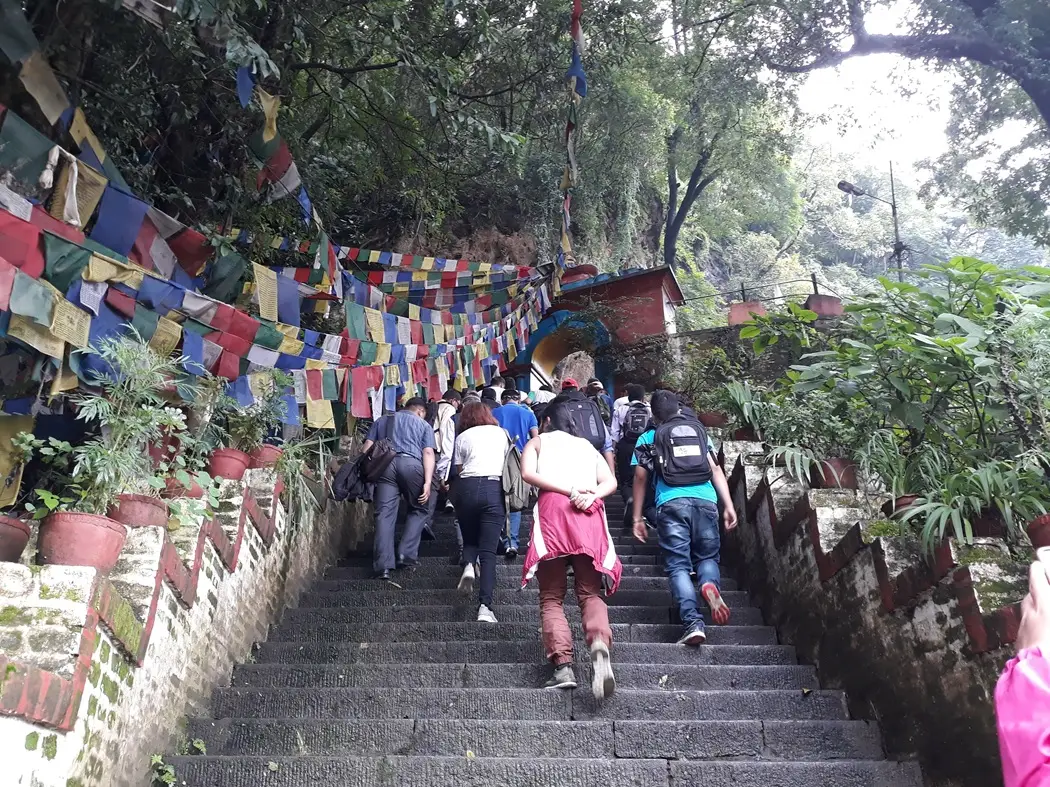
Pilgrims visiting Pharping typically pay respects at both caves, often starting at Yanglesho below and hiking up to Asura through the woods. The two caves are connected by a footpath and, as locals like to say, by a secret underground tunnel.
A narrow passage in the depths of Asura is believed to run all the way to the Yanglesho cave, which is half a mile away. Legend has it that Guru Rinpoche, with his attained powers, could travel through solid rock – but he kindly used this tunnel to go between caves to leave a passage for future pilgrims!
Indeed, meditators sitting near the crevice in the Asura cave feel a cool draft of air, as if the two caves breathe as one.
Pharping is a pilgrimage site where one can tangibly sense Guru Rinpoche’s legacy. A notable feature at the entrance of the Asura Cave is a hand-shaped indentation in the rock. Devotees revere this handprint in stone as Padmasambhava’s own – a miraculous mark he left to bless the site.
(Some modern lamas note it may have been carved later by devotees, but this does not diminish pilgrims’ faith; visitors earnestly press their palms into the ancient handprint, feeling Guru Rinpoche’s energy flow through the rock.)
Inside the dimly lit Asura cave, butter lamps illuminate three principal statues on the shrine: Guru Rinpoche in the center, flanked by Yangdak Heruka on the right and Vajrakilaya on the left, representing the very practices he accomplished here.
On the cave’s left wall, just below an old lightbulb fixture, pilgrims point out a naturally formed Tibetan letter “ༀ” (the sacred syllable A) on the rock – considered a self-arisen symbol of the primordial truth. In the ceiling of the Yanglesho cave below, one can see a curious protrusion that is said to be the imprint of Guru Padmasambhava’s head.
Local lore tells that when the Guru finally broke through to complete enlightenment, his body momentarily dissolved into pure light – and as it resounded through the cave, even the rock became malleable, capturing an impression of his form.
Pharping is also a fine example of syncretic worship, where Hindu and Buddhist reverence intertwine. The lower cave area is shared with the Shesh Narayan temple, one of the four famous Narayan (Vishnu) shrines of the Kathmandu Valley.
Hindus flock here to honor Lord Vishnu, especially on certain festival days. They believe the water dripping from the cave and the stalactite formations above are cow’s udders (Kamadhenu) that drip sacred milk on auspicious occasions. This enchanting belief mirrors the Buddhist sense of the cave oozing blessings – be it amrita or dairy – from the spiritual realm.
Thus, one may find Hindu devotees and Buddhist monks side by side at Pharping, each praying in their own way but acknowledging the site’s numinosity. Traditional pilgrims often circumambulate the entire hill, visit the nearby Vajrayogini temple (another important tantric site), and offer lamps at the small shrine to Ganesh at the trailhead.
For practitioners of Vajrayana, doing a retreat in the Asura cave (even if just a few hours of meditation) or performing Guru Rinpoche prayers on the spot is a profoundly moving experience.
It is said that in all the caves and rocks where Guru Rinpoche meditated, he left a spiritual imprint so that future pilgrims could receive his blessing as if meeting him in person.
Pharping certainly lives up to that promise – even today, visitors often describe a sense of peace and inspiration washing over them in these caves, as though the Lotus-Born were still meditating just behind the rock walls.
With his spiritual training complete and obstacles removed, Guru Padmasambhava’s destiny turned north to Tibet. The Tibetan Dharma King, Trisong Detsen, had heard of Padmasambhava’s great powers and invited him to help establish Buddhism in Tibet, which was being hampered by fierce local spirits.
According to the accounts of the great Nyingma master Dudjom Rinpoche, Padmasambhava foresaw the Tibetan emissaries coming and met them at Mangyul, a border region between Nepal and Tibet.
He finally entered Tibet in the Iron Tiger year (810 CE). En route to central Tibet, Guru Rinpoche began taming the land – subjugating each valley’s resident gods and demons and binding them by oath to serve as protectors of Buddhism.
In Tibetan oral tradition, every footprint of the Guru’s journey is marked by some miraculous exploit: he is said to have flung his vajra to sanctify the highest peaks, pressed his feet into rocks, and buried hidden treasures (terma) for future discovery along the way.

There are several routes by which Padmasambhava is believed to have traveled from Nepal into Tibet. One popular legend in Nepal holds that Guru Rinpoche passed through the Himalayas via the Mustang region in northwestern Nepal. This route follows the ancient salt trade caravan trails.
Locals of Mustang recount that in the 8th century, Padmasambhava came through their area, crossing the Himalaya into Tibet. The medieval fortress-village of Kagbeni – a gateway between Nepal’s Kali Gandaki valley and the Tibetan Plateau – is pointed out as one of the places where the Guru stopped to bless the land.
Even today, Kagbeni’s monastery houses relics. It has stories of Guru Rinpoche’s visit, and the town’s role as the “gate to Upper Mustang” is reminiscent of its fabled role as “gate to Tibet.” Another holy site on this route is Muktinath (Chumig Gyatsa), the “Hundred Springs” sacred to Buddhists and Hindus.
Tibetan texts say Guru Rinpoche visited Muktinath and consecrated it as a holy ground of the 21 Taras and dakinis. In the Narsingh Gompa at Muktinath, there is a remarkable clay statue of Padmasambhava, which, according to local belief, was crafted by the Guru himself as a gift for the people of that region.
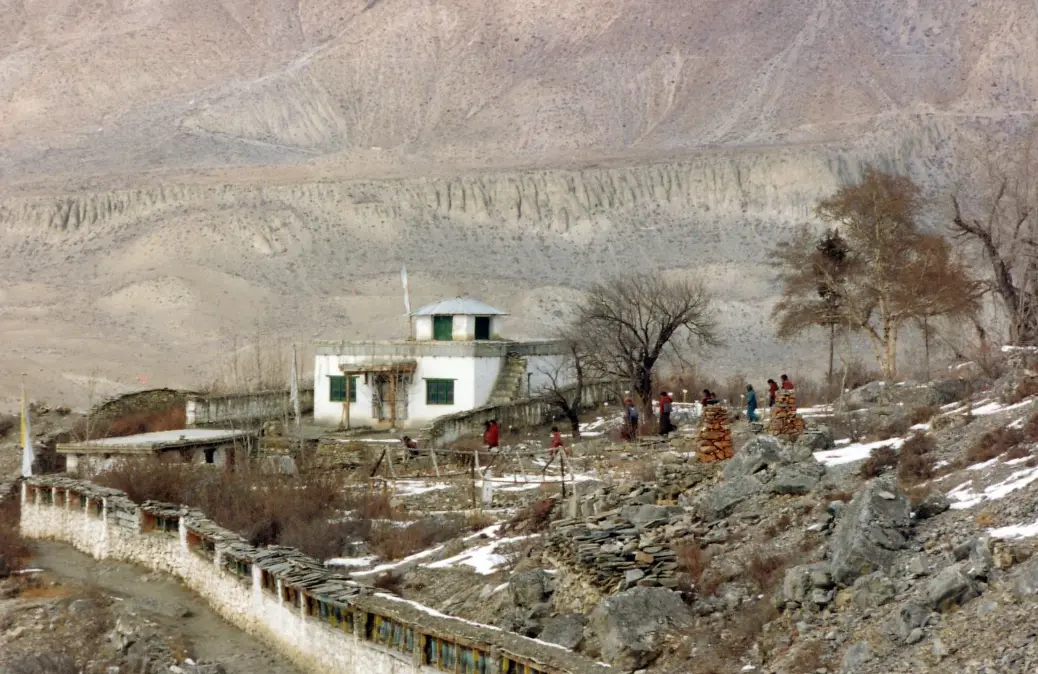
He declared that this statue “looks exactly like me, and whoever beholds it will experience my presence”. Such is the personal legacy Padmasambhava left along the way for future generations. You can learn more about this revered pilgrimage by visiting our Jomsom Muktinath Trek page.
Other historical sources suggest Padmasambhava may have traveled northward via the Kathmandu Valley, entering Tibet near Kyirong or Helambu. The Testament of Ba (an early Tibetan chronicle) implies that he came from India through Nepal and was awaited at the border.
In any case, once inside Tibet, King Trisong Detsen received Padmasambhava with great honor at Samye. The Guru’s fame had preceded him: Shantarakshita (the Indian abbot already in Tibet) hailed Padmasambhava as the only one capable of pacifying the turbulent gods of Tibet.
Fulfilling that promise, Padmasambhava climbed to the top of Hepo Ri (a hill overlooking Samye). He subdued and bound all the local deities under oath in a grand spiritual battle.
With the obstructing forces tamed, Tibet’s first monastery – Samye – was completed without further hindrance and consecrated in a magical ceremony led by Padmasambhava in 814 CE.
Having thus secured the foundation for Dharma in Tibet, Guru Rinpoche spent the next several years teaching tantra to hundreds of disciples, including the famous 25 chief disciples of the first generation of Tibetan Vajrayana.
He, along with Shantarakshita and the king, oversaw the colossal project of translating Buddhist scriptures into Tibetan – a legacy that still endures.
Traveling across Tibet’s length and breadth, Padmasambhava visited and blessed a multitude of sites – from the caves of Chimphu and Yerpa to the lakes of Tsang and the mountains of Ngari.
He hid spiritual treasures in secret places (to be revealed in future eras) and tamed countless spirits, converting even the fiercest into guardians of the Dharma.

By the time Guru Padmasambhava left Tibet (to subdue more demons in the southwest and eventually journey to the land of the rakshasa demons, according to myth), Tibet had been irrevocably transformed.
It was as if his sojourn in Nepal – meditating in Maratika and Pharping – had been the indispensable prelude to illuminating Tibet.
From the immortal caves of Maratika to the power caves of Pharping, Nepal cradles some of the most critical milestones in Guru Padmasambhava’s epic life.
These sacred sites are not mere relics of a legendary past; they remain vibrant centers of pilgrimage and practice. Maratika inspires us with the possibility of transcending death and touching the infinite, as Guru Rinpoche and Mandarava did through profound devotion and unity.
Pharping instills awe for the Guru’s peerless attainment and reminds practitioners that full awakening is within reach with perseverance and skillful means, even in the face of significant obstacles.
The local legends, whether of spontaneous handprints in rock or wish-fulfilling springs, add a rich tapestry of faith and wonder that continues to draw pilgrims year after year.
For spiritual seekers today, a journey to Maratika and Pharping is an opportunity to walk in Padmasambhava’s footsteps – to meditate in the same caves, to feel the energy that lingers in those hallowed grounds, and to connect with the living heritage of the Guru’s blessings.
And as one traces his path to Tibet, one appreciates how Nepal was a vital launch pad for the Dharma’s spread to the Land of Snow. Ultimately, the story of Guru Padmasambhava at these sites underscores a beautiful synergy of history and myth, geography and spirituality.
It teaches us that places themselves can become powerful catalysts on the path. When sanctified by the realization of great masters, caves and rocks transform into treasures of inspiration and blessings for all who come after.
Thus, the caves of Maratika and Pharping stand not only as monuments of Padmasambhava’s accomplishments, but also as beacons lighting the way for pilgrims seeking immortality of wisdom and the great seal of enlightenment, in Guru Rinpoche’s words: “In the future, people who connect with me at these sacred sites will receive my blessing as if we had met face to face.”
Thus, for practitioners seeking to connect with Guru Padmasambhava Maratika Pharping, these caves offer a tangible link to his enlightened presence.