12-Day Kailash Mansarovar Yatra 2026
Based on 2100 reviews
Trip Overview
Begin your transformative spiritual journey to Lord Shiva’s sacred realm with our skillfully curated Kailash Mansarovar Yatra Package from Gorakhpur 2026. This 12-day pilgrimage commences in Gorakhpur, providing a convenient and budget-friendly option for Indian devotees.
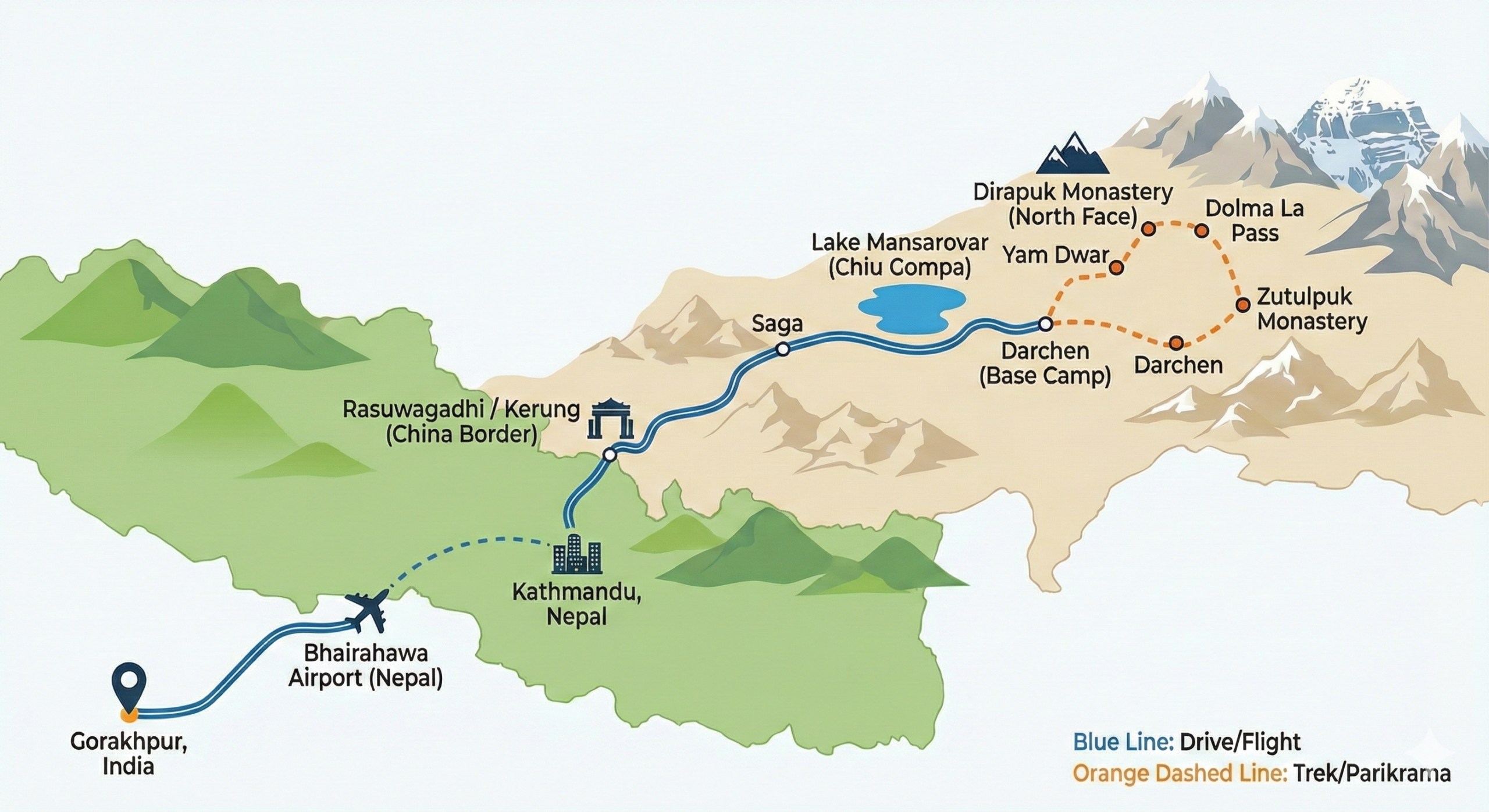
Unlike standard packages, this route takes you via Bhairahawa to Kathmandu, ensuring smooth connectivity before we begin the overland drive to the mystical land of Tibet.
You will cross the Nepal-China border at Kerung, then drive across the vast Tibetan Plateau to the holy Lake Mansarovar and the majestic Mount Kailash. This itinerary is designed for optimal acclimatization, ensuring you are physically prepared for the challenging 3-day parikrama (circumambulation) around the holy mountain.
From the sacred dip in Mansarovar to crossing the Dolma La Pass, every step of this Kailash Yatra brings you closer to the divine. Join us for a safe, comfortable, and transformative experience in 2026.
Trip Highlights
- Easy starts from Gorakhpur, followed by a short flight to Kathmandu.
- Special prayers at Pashupatinath and Doleshwor Mahadev.
- Holy dip and Hawan at Lake Mansarovar.
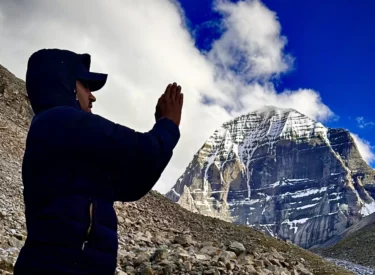
- Close Darshan of Kailash North Face.
- Cross the Dolma La Pass and see Gauri Kund.
Short Itinerary
Gorakhpur to Kathmandu
Pashupatinath, Budhanilkantha & Doleshwor Mahadev Darshan
Kerung
Saga
Lake Mansarovar
Darchen
Dirapuk
Dolma La Pass and Zutulpuk
Saga Return
Kerung
Kathmandu
Gorakhpur
Full Itinerary
Your spiritual odyssey begins when you arrive in Gorakhpur, a key transit hub in Uttar Pradesh. Our team will welcome you at the railway station or airport. We will assist with your transfer to our private vehicles.
From there, we embark on a smooth 3- to 4-hour drive (approx. 100 km) across the Indian border into Nepal to reach Bhairahawa.
Instead of a long, exhausting drive to Nepal’s capital, we have arranged a short, scenic 35-minute flight. You will fly from Gautam Buddha International Airport in Bhairahawa directly to Kathmandu.
Upon landing at Tribhuvan International Airport, you will be transferred to your hotel. The rest of the evening is yours to relax and soak in the city’s spiritual atmosphere as we prepare for the yatra ahead.
After breakfast, we start our day by asking for blessings for a safe trip. Our first stop is the famous Pashupatinath Temple, a UNESCO World Heritage Site on the banks of the Bagmati River. This important temple for Lord Shiva is where we pray as we begin our journey.
After our prayers at Pashupatinath, we continue to Budhanilkantha, where you will see the large stone statue of Lord Vishnu lying on a bed of serpents in a water tank.
The tour concludes at Doleshwor Mahadev Temple in Bhaktapur, which many believe is the ‘head’ of the Kedarnath temple in India, completing your pilgrimage.
In the evening, the tour leader will hold a required briefing to review the itinerary for the next day, distribute duffel bags and down jackets, and explain the final steps for crossing into Tibet, including necessary documentation and procedures.
Today marks a thrilling transition as we leave the lush valleys of Nepal to approach the “Roof of the World.” We depart Kathmandu early in the morning. The day brings a scenic 7- to 8-hour drive along the Pasang Lhamu Highway.
The journey winds along the banks of the roaring Trishuli River. We pass through the verdant landscapes of the Langtang National Park. Waterfalls, terraced fields, and mist-covered hills accompany us on our way to the border town of Timure.
After completing the Nepal immigration and customs formalities at Rasuwagadhi, we walked across the “Friendship Bridge” into China. Here, you will be greeted by our Tibetan guides. A short drive brings us to Kerung (Kyirong) Town.
This beautiful valley sits at a comfortable altitude of 2,700m. This lush region is often called the “Valley of Happiness.” It provides the perfect environment for your body to begin acclimatizing before we ascend to the high Tibetan plateau.
Today promises awe-inspiring landscapes as we conquer the “Roof of the World.” After breakfast, we ascend from Kerung, rapidly gaining altitude.
The journey takes us over Thong La Pass (5,150m), where we marvel at panoramic Himalaya views, including towering Mt. Shishapangma (8,027m) and the turquoise waters of Peiku Tso Lake.
As we cross the pass, Nepal’s greenery yields to the vast, rugged, and barren beauty of the Tibetan Plateau. Once we descend toward the sandy plains, we arrive at Saga, a crucial transit town lining the banks of the majestic Brahmaputra River (Yarlung Tsangpo).
This high-altitude location (4,450m) serves as an essential overnight stop, helping your body adapt to the thin air before we continue to Mansarovar.
Today marks an important point in your pilgrimage. We will leave Saga and travel across wide plains, passing small Tibetan villages and open grazing lands.
As we get closer to the holy lake, watch the horizon. This is where you will first see Mount Kailash, rising alone against the blue sky. For many devotees, this moment is very moving.
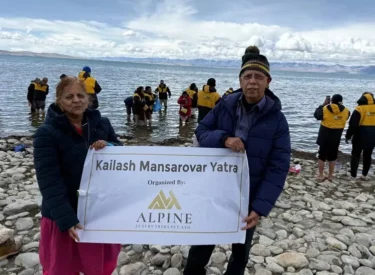
When we arrive at our guest house near the shore, usually close to Chiu Gompa, you will have time to take a ritual bath (Snan), perform a prayer ritual (Puja), or make a fire offering (Hawan) by the banks.
Please bring any items you need for these rituals. We will give you instructions on how to do them properly. All of these rituals are done in the presence of Shiva’s sacred mountain.
We begin the day with a serene morning on the banks of Lake Mansarovar. The sunrise paints the waters with gold and blue, illuminating them.
This morning is free for you to perform your personal Puja, Hawan, or meditation if you wish. Take this time to absorb the profound silence and energy of the sacred site. If you want to collect holy water, you may do so during this time to take home.
After lunch, we take a short 40 km drive to Darchen (4,575m). This village, at the foot of Mount Kailash, is the gateway and base camp for the Parikrama.
Upon arrival, check into the hotel. Spend the afternoon resting and preparing for the trek; if needed, arrange ponies or porters through our guide (payment direct to the guide required).
In the evening, pack your trekking gear and ensure you are physically and mentally prepared for the circumambulation that begins tomorrow.
This day marks the start of the Kailash Parikrama (Kora). After a light breakfast, we drive briefly to Yam Dwar (Tarboche), the “Gateway of the God of Death.”
Passing through this gate symbolizes leaving earthly attachments and entering Shiva’s realm. Our 12 km trek begins here.
Today’s trail is gradual, winding through the stunning “Valley of the God” along the Lha Chu River. Towering cliffs and waterfalls flank the path, with the west face of the mountain guiding us.
By late afternoon, we reach Dirapuk Monastery (4,760m). On arrival, exhaustion fades as the majestic North Face of Mount Kailash looms close. Watching the sunset’s golden glow on the snow-clad peak is a divine experience to cherish.
Today is the toughest and most challenging day of the pilgrimage, but also the most transformative. We begin our trek early (around 4:00 AM) to cross the highest point of the journey: the Dolma La Pass at 5,630m (18,471 ft). The ascent is steep and tests your endurance, but the chant of “Om Namah Shivaya” keeps the spirit high.
At the summit of the pass, devotees hang prayer flags and offer prayers to Dolma (Tara Devi). As we begin our descent, we are rewarded with a view of the emerald-green Gauri Kund (Lake of Compassion) on the right, legendary as the bathing place of Goddess Parvati.
From here, the trail descends steeply and rocky into the valley floor. Eventually, the path flattens as we trek along the river, leading us to Zutulpuk Monastery (4,800m), famous for the meditation cave of Milarepa, a Tibetan saint.
We awake with a deep sense of accomplishment—we are on the final stretch of the sacred Kora. After breakfast, we set out on the concluding section from Zutulpuk to Darchen.
The path is gentle and level, meandering through the valley beside the river. It is a tranquil 3-hour walk (approx. 8 km) to the end point near the private vehicle pickup area.
At Darchen, we reunite with other group members and share stories. After lunch, we board our bus and begin the return drive to Saga, carrying the energy and memories of the pilgrimage with us.
After a restful night in Saga, we begin our return journey toward the Nepal border. Today’s drive is a scenic descent. Leaving behind the arid, high-altitude desert of the Tibetan Plateau, we head back toward the greenery of the Himalayas.
Our path retraces past the stunning Peiku Tso Lake. As we cross Thong La Pass one last time, you are offered a final, sweeping view of the majestic snow-capped peaks, including Mt. Shishapangma.
As we descend into the Kerung Valley, you will notice a distinct change in the landscape—barren rocks give way to lush forests and flowing waterfalls. The air becomes richer in oxygen, making breathing easier and the climate warmer.
We arrive in Kerung late in the afternoon, where you can enjoy a relaxed evening reflecting not only on the successful completion of your spiritual mission but also on the transformative experiences, challenges overcome, and deeper understanding gained throughout your journey.
We start our day early to head towards the Rasuwagadhi border. After completing the Chinese immigration formalities, we crossed the “Friendship Bridge” back into Nepal, bidding a warm farewell to our Tibetan guides and drivers. On the Nepal side, our local team will be waiting to receive you and assist with entry formalities.
The drive back to Kathmandu takes us once again along the scenic Pasang Lhamu Highway. As we wind through the hills, you return with a transformed spirit, carrying the blessings of Lord Shiva.
Upon reaching the capital, we check into our hotel. The evening is reserved for rest and a Farewell Dinner, where we celebrate the successful completion of this once-in-a-lifetime yatra and share stories with fellow pilgrims.
Today is the final leg of our trip. After breakfast, we transfer you to Kathmandu’s domestic airport, where you will board the short flight back to Bhairahawa.
As you fly over the Himalayan foothills, take a moment to say goodbye to Nepal. You will return with memories and a spirit renewed by the Himalayas.
Price Includes
- Transport: Private AC coach in Nepal, including Gorakhpur to Bhairahawa section; Bus/Coach in Tibet.
- Flights: Bhairahawa – Kathmandu – Bhairahawa return flight tickets.
- Accommodation: 3-Star hotels in Kathmandu (Twin share); Best available Guest Houses/Hotels in Tibet (Dormitory style during Parikrama).
- Meals: All pure vegetarian meals (Breakfast, Lunch, Dinner) throughout the trip.
- Permits & Visas: Tibet Group Visa, Alien Travel Permit, and trekking permits.
- Support: Sherpa staff, a Tibetan Guide, and Yaks to carry kitchen/camping equipment.
- Medical: First-aid kit and an Oxygen cylinder for emergencies.
- Apparel: Complimentary Duffel bag and Down Jacket (returnable).
Price Excludes
- Personal Horse/Porter: Pony for personal riding during Parikrama (approx. 2500-3000 Yuan).
- Travel Insurance: Mandatory insurance covering high-altitude evacuation.
- Tips: Gratuities for staff, guides, and drivers.
- Personal Expenses: Laundry, phone calls, extra snacks/drinks.
- Rescue: Emergency evacuation costs (Helicopter/Ambulance).
- GST/TCS: Applicable Government Taxes (5% GST + TCS as per norms).
Trip Information
Package Cost & Payment Structure
We’re delighted to share our package details with you. The total cost is split into two parts: an advance booking amount payable to our Indian bank account, and a portion in USD payable upon arrival in Kathmandu.
Total Package Price Split:
- Part A (Booking & Logistics): INR 1,45,000
- Mode of Payment: Online Bank Transfer (NEFT/RTGS/IMPS)
- This advance covers your flight tickets (Bhairahawa-Kathmandu), Nepal logistics, hotel bookings, and the first step of permit processing—helping you get started comfortably.
Part B (Tibet Ground Cost): USD 1,600
- Mode of Payment: Cash Carry (to be handed over in Kathmandu)
- With this, we’ll handle your Tibet Group Visa fee, royalties to the Chinese Government (FEC), transportation, and your accommodation in China—so you can relax and look forward to your travels.
Best Time to Visit
The ideal time for the Kailash Mansarovar Yatra is May to September. During these months, high-altitude weather is most favorable.
June to August are considered the best, with stable weather, warm temperatures, and high visibility. This ensures clear views of Mount Kailash and a safe parikrama experience.
Full Moon Dates for 2026 (Purnima)
Seeing Mount Kailash bathed in the full moonlight is highly auspicious and believed to increase the spiritual merit of your pilgrimage.
For 2026, the key Full Moon dates are May 31 (Saga Dawa Festival), June 29, July 28 (Guru Purnima), August 27 (Janai Purnima), and September 26.
These dates are popular for viewing the night sky over Lake Mansarovar. Book your package soon—spaces fill up quickly.
Visa & Permit Process
For the Kailash Mansarovar Yatra, Indian citizens must travel on a Tibet Group Visa, as individual tourist visas are not permitted for this pilgrimage. We handle the entire arrangement of this group visa for the batch to ensure a seamless entry.
Please ensure you hold a valid passport with at least 6 months’ validity from your date of travel. To facilitate the official processing, we require your original passport in Delhi at least 7 working days before your scheduled departure, as it must be physically submitted to the Chinese Embassy.
Fitness & Health
The Chinese authorities enforce strict health and age protocols for the yatra. Only pilgrims aged 18 to 69 are currently permitted. The pilgrimage involves challenging high-altitude trekking, with elevations of up to 18,600 ft. Adequate physical preparation is mandatory.
We strongly recommend starting a consistent cardiovascular routine at least 3 months before the trip. Brisk walking (5 km daily), jogging, or swimming will help build endurance for the rugged terrain.
Altitude Sickness (AMS)
The Kailash Yatra route ascends quickly from Kathmandu (1,400m) to the Tibetan Plateau (4,500m+), making acclimatization important. If you notice symptoms such as headache, nausea, or dizziness, let our team know—you are not alone.
Drinking 3–4 liters of water daily, avoiding alcohol, and walking at a slow, steady pace can help you feel more comfortable. Our support team is always nearby with oxygen cylinders and Diamox to provide prompt assistance if needed.
Currency & Money
Managing finances across borders is key to a smooth trip. In Nepal, Indian Rupees (INR) are widely accepted, though high-denomination notes may be restricted. In Tibet, only Chinese Yuan (RMB) is accepted; INR is not valid.
Bring enough USD or INR to Kathmandu to exchange easily. Budget 3,000–4,000 Yuan for personal expenses—primarily hiring a pony or porter for the parikrama (about 2,800 Yuan for 3 days), snacks, and incidentals.
Food & Accommodation
We care about your comfort every step of the way. In Kathmandu, you will stay in 3-star hotels. In Tibet’s remote, high places, and during the Parikrama, you will stay in basic guesthouses or traditional mud homes with shared rooms and common areas.
Our kitchen team serves fresh, safe vegetarian meals three times daily at 8 am, 1 pm, and 7 pm—featuring rice, dal, seasonal vegetables, and bread. Every dish is prepared to keep pilgrims healthy and strong.
Communication
Staying connected during the Yatra—a trip or journey—requires planning, as mobile rules vary from country to country. In Nepal, use your Indian SIM with roaming on, or buy a local Ncell or NTC SIM for better service.
When you reach Tibet (China), popular apps like WhatsApp, Facebook, and Google won’t work due to internet blocks. To use them, get an international roaming plan (which often allows access) or install a trusted VPN before you go.
Make sure your VPN works on your phone while in India, since you usually can’t download VPN apps once in Tibet. You can also use WeChat, which works there and is suggested for local chat.
Equipment List
Clothing
- Base Layers (3-4 sets): Thermal inners (top and bottom). Merino wool or synthetic fabrics are best at trapping body heat.
- Mid Layers (2 items): Warm fleece jackets or heavy woolen sweaters.
- Outer Shell (1 item): A windproof and waterproof jacket (Gore-Tex recommended) to protect against harsh winds and snow.
- Trek Pants (2-3 pairs): Waterproof/windproof trekking trousers. Avoid denim/jeans as they freeze and are uncomfortable.
- Head & Neck: 1 woolen cap (monkey cap) to cover ears, 1 wide-brimmed sun hat, and a scarf/muffler.
- Gloves: 1 pair of thin inner gloves and 1 pair of thick, waterproof outer gloves.
Footwear Essentials
- Trekking Boots: High-ankle, waterproof boots with good grip. Critical: Break them in for 2-3 weeks before the trip to prevent blisters.
- Camp Shoes: Lightweight sneakers or sandals (with back straps) to wear at the guest house after long days.
- Socks: 4-5 pairs of warm woolen socks (for cold) and 3-4 pairs of cotton socks (for travel).
Toiletries & Personal Hygiene
- Wet Wipes: Large packs are essential (bathing is difficult during Parikrama).
- Sun Protection: Sunscreen (SPF 50+), moisturizing lip balm, and UV-protected sunglasses (vital for snow glare).
- Basics: Toothbrush, toothpaste, biodegradable soap, and small hand sanitizer bottles.
- Toilet Paper: 2-3 rolls (toilet facilities are basic in remote areas).
Medical & First Aid Kit
- Altitude Meds: Diamox (Acetazolamide) – Consult your doctor before use.
- Pain Relief: Paracetamol, Combiflam, and Volini spray/balm for muscle aches.
- Digestion: Pudin Hara, Digene, and anti-diarrhea tablets.
- Wound Care: Band-aids, crepe bandage, cotton, and antiseptic liquid (Dettol/Savlon).
- Personal Meds: Carry double your prescription dosage in separate bags.
Electronics & Gadgets
- Power Bank: High-capacity (20,000 mAh+) is mandatory, as electricity is irregular.
- Adapter: Universal travel adapter (China uses Type A, C, & I plugs).
- Lighting: Headlamp or a small LED torch with extra batteries (for early-morning treks).
- Camera: Extra memory cards and batteries (cold drains batteries faster).
Food & Hydration
- Energy Boosters: Dry fruits (almonds, walnuts, dates), chocolates, and energy bars.
- Comfort Food: Instant noodles (Maggi/Cup-o-Noodles), biscuits, or khakhra.
- Hydration: 1 sturdy water bottle + 1 Thermos flask (1-liter) for hot water.
Documents & Miscellaneous
- Documents: Waterproof pouch for Passport, Visa/Permit copies, and 4 passport-size photos.
- Trekking Poles: 1 pair of lightweight walking sticks (Highly recommended for Dolma La Pass).
- Money: Cash belt/pouch for safely carrying Yuan and INR.
Frequently Asked Questions
The cost varies by route, but our Gorakhpur-Nepal overland package is designed to be budget-friendly, and it is INR 235000 per person.
Yes, a valid Indian Passport with at least 6 months of validity is mandatory. We will obtain the special Tibet Group Visa/Permit on your behalf.
Generally, the Chinese authorities permit pilgrims aged 18 to 69. Those aged 70 are restricted under current regulations.
The 3-day Parikrama is challenging due to high altitude (up to 5,630m) and cold weather. However, you can hire a pony/porter if you cannot walk. Physical preparation is highly recommended.
The best time is from mid-May to September. The weather is relatively warmer, and the lake is not frozen. The full moon dates (Purnima) are particularly popular.
While traditional “dips” were common, recent regulations restrict full bathing to protect the lake’s ecosystem. You can usually take water in a bucket for a ritual bath on the banks.
In Kathmandu, Indian Rupees (INR) are accepted (except 500 notes). In Tibet, you must use Chinese Yuan (RMB). We recommend exchanging currency in Kathmandu before crossing the border.
If you feel unwell or cannot trek, you can stay back at Darchen or Saga. You will wait for the group to return from the trek.
This overland route allows for better acclimatization than helicopter routes, making it safer for seniors. However, a medical check-up is strictly advised.
You can book directly through our website by submitting your passport copies and an advance deposit. We handle the permit registration with the Tibet Tourism Bureau (TTB).
Grace Educational Organisation
The Grace Educational Organisation is a government-registered charity dedicated to empowering students in Nepal through education.
With a 100% donation policy, every contribution directly supports the children and schools, providing essential resources like supplies, infrastructure, and extracurricular programs.
This initiative fosters a transparent connection between donors and students, ensuring every action leaves a lasting impact.
The Nuwakot School, located in a picturesque rural setting, is one of the beneficiaries of this mission.
By visiting, you witness these students’ educational journey and become part of a transformative effort to uplift the community.
Trip Reviews
Be first to post a review in this trip.

More Trips