Southern Bhutan Tour
Our trips are rated 5 out of 5 in more than 950 traveler reviews.
Trip overview
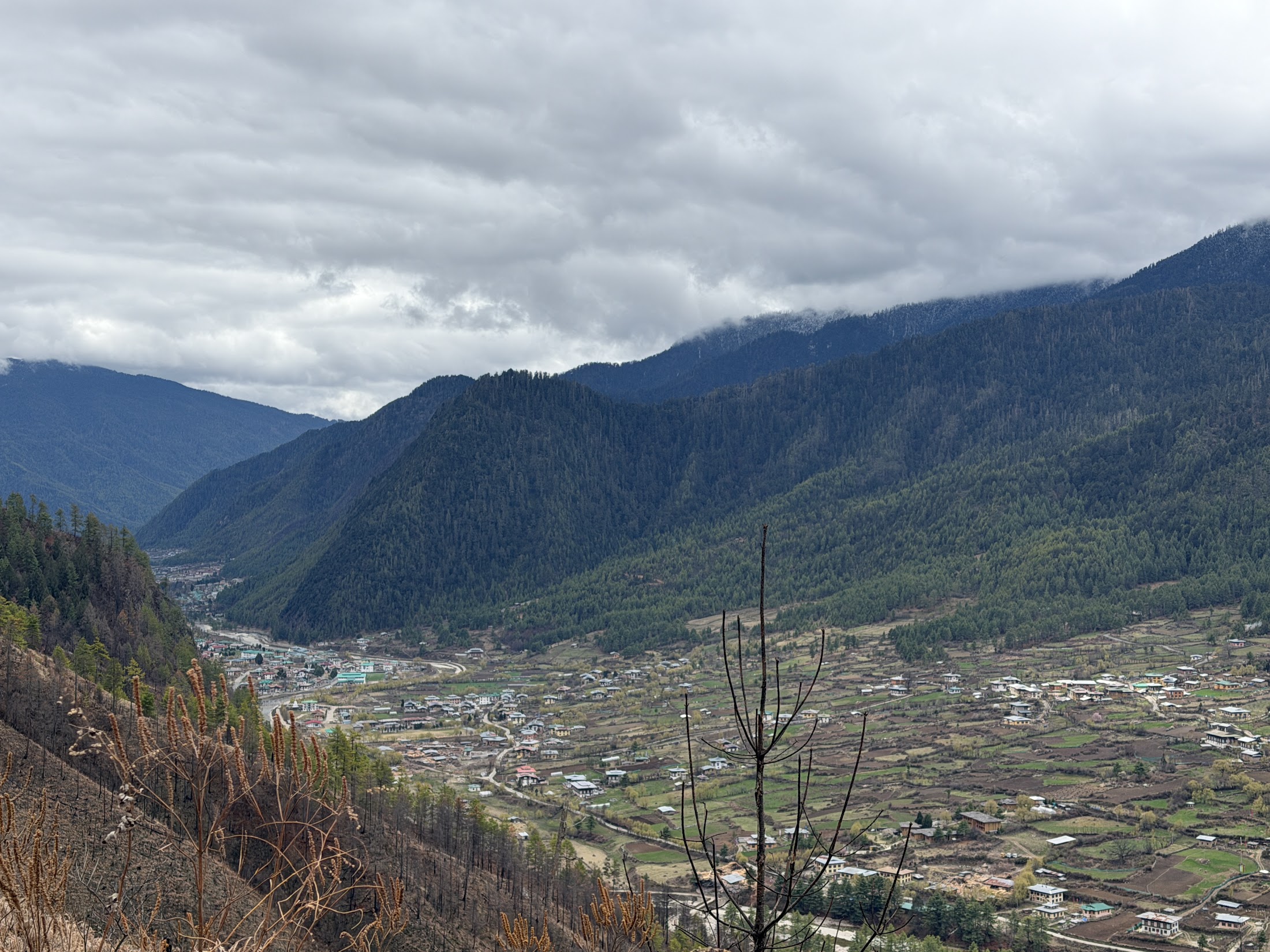
Our Southern Bhutan Tour enters the country by road at Phuentsholing, climbs to Thimphu and Punakha, and then follows the new southern highway down through Tsirang to Gelephu on the Assam border. In 8 days it shows a side of Bhutan most visitors never see, with the visa, Sustainable Development Fee, hotels, guide, car and all meals included.
It suits travellers coming overland from India, or anyone curious about the lowland south: orange orchards, cardamom fields, Lhotshampa villages of Nepali-speaking Bhutanese, and towns where Hindu temples stand beside Buddhist ones.
The route is a loop through the heart of the country rather than a dead end. You see the capital and Punakha Dzong on the way, so first-time visitors still meet the classic sights, then drop into warm, green hills that feel nothing like the high valleys.
The honest caveats are road time and comfort. The climb from Phuentsholing to Thimphu takes 5 to 6 hours, the southern towns have simpler hotels, and the trip ends in India, so most nationalities need an Indian visa.
The reward is breadth. In one week you go from the Himalayan foothills at about 300 m to the Dochula Pass at about 3,100 m and back down, seeing how Bhutan’s people, crops and faiths change with altitude.
Prices start at US$ 1,585 per person in a group of six or more and US$ 1,900 each for two. For the classic western loop, see our 8-Day Bhutan Tour; for the far east, our Eastern Bhutan Tour.
Highlights
- Enter by road at Phuentsholing, through the gate between India and Bhutan
- Thimphu, with Tashichho Dzong and the Buddha Dordenma
- Punakha Dzong and the Dochula Pass
- Tsirang, a southern district of orange orchards and Lhotshampa villages
- Gelephu, the warm border town in the south-central plains
- Kharbandi Goenpa above Phuentsholing, with views over the plains
- From 300 m to 3,100 m, through every climate zone in a week
- Few other tourists on the southern highway
Itinerary
Altitude profile
By road
The altitude listed for each day, from 50 m to 2,320 m. Select a point to read that day.
The highest point on the route is 3,100 m.
- Nights
- 4 nights in tourist standard hotels, 3 nights in 3-star hotels
- Meals in the price
- 7 breakfasts, 7 lunches, 7 dinners
- On the move
- 6 days by road
Day 1Bagdogra to Phuentsholing300 m
The Southern Bhutan Tour begins in India. Our driver meets you at Bagdogra airport near Siliguri in West Bengal, and we drive about 4 hours east across the plains, past tea estates and the edge of the Jaldapara forests, to the border town of Jaigaon.
You clear Indian exit formalities in Jaigaon and walk through the ornate Bhutan Gate into Phuentsholing, at about 300 m. Our Bhutanese guide meets you here with a white khadar scarf and helps with immigration, using your visa clearance letter.
The change at the gate is striking: from the crowded, noisy streets of Jaigaon to the calmer, cleaner town of Phuentsholing, with traditional painted buildings and a clear sense of a different country.
In the late afternoon we visit the Zangtho Pelri Lhakhang in the town centre and the crocodile breeding centre by the river. Tonight is in the best available hotel in Phuentsholing. The guide explains tomorrow’s long climb into the hills over dinner.
- TravelCar, 4-6 hours
- StayTourist Standard Hotel
- MealsLunch, Dinner
Day 2Phuentsholing to Thimphu2,320 m
Today the Southern Bhutan Tour climbs more than 2,000 m into the mountains. The drive to Thimphu takes 5 to 6 hours with stops, along a road that winds up through subtropical forest and waterfalls into cooler pine country.
Just above Phuentsholing we stop at Kharbandi Goenpa, a monastery built in 1967 by the Royal Grandmother, with a garden of chortens and a wide view over the Indian plains you have just left behind.
The road passes Gedu, a ridge town often in cloud, and Chukha, where one of Bhutan’s first hydropower plants sends electricity to India. The guide explains how hydropower funds much of the country’s development.
By late afternoon we reach Chhuzom, where the Paro and Thimphu rivers meet, and continue to the capital at about 2,320 m. Tonight is in a 3-star hotel in Thimphu, the first of two nights, so you can rest after the climb.
- TravelCar, 4-6 hours
- Stay3-Star Hotel
- MealsBreakfast, Lunch, Dinner
Day 3Thimphu Sightseeing2,320 m
A full day in the capital on the Southern Bhutan Tour starts at the Memorial Chorten, where older residents walk circuits and spin prayer wheels from early morning. It is one of the best places to watch daily life in Thimphu.
We then drive up to the Buddha Dordenma, a 51 m bronze and gold statue on a ridge above the city, and visit the National Institute for Zorig Chusum, where students learn Bhutan’s 13 traditional arts.
After lunch we visit the Takin Preserve to see the national animal, and Changangkha Lhakhang, a 12th-century temple on a ridge where parents bring newborns to be named and blessed. From Friday to Sunday we add the Centenary Farmers’ Market.
In the late afternoon, when offices close, we enter Tashichho Dzong, the seat of government and summer home of the central monk body. Dinner is in town, and tonight is the second night in the same Thimphu hotel.
- TravelSightseeing, 4-6 hours
- Stay3-Star Hotel
- MealsBreakfast, Lunch, Dinner
Day 4Thimphu to Punakha1,250 m
Today the Southern Bhutan Tour crosses the Dochula Pass at about 3,100 m, the highest point of the trip, and descends to Punakha, about 3 hours with stops. On clear mornings from October to February the northern snow peaks line the horizon behind the pass’s 108 chortens.
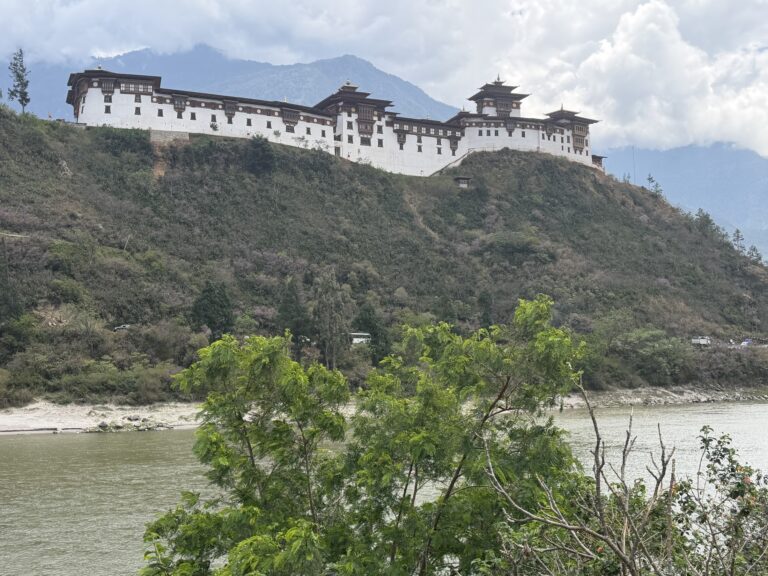
In Punakha we visit Punakha Dzong, built in 1637 at the meeting of the Pho Chhu and Mo Chhu rivers. Bhutan’s kings are crowned here, and in winter the central monk body moves here from Thimphu.
After lunch we walk about 20 minutes through rice fields to Chimi Lhakhang, the temple of the Divine Madman, a 15th-century saint known for unusual teaching methods. The village is known for the protective phallus symbols painted on its houses.
If time allows, we cross the long suspension bridge over the Pho Chhu. Tonight is in a 3-star hotel in the Punakha valley, warm and quiet, and the guide explains the southern road that begins tomorrow.
- TravelCar, 1-3 hours
- Stay3-Star Hotel
- MealsBreakfast, Lunch, Dinner
Day 5Punakha to Tsirang1,500 m
From Punakha the Southern Bhutan Tour turns south. We drive past Wangdue Phodrang and down the Punatsangchhu valley to Tsirang, about 3.5 hours with stops, on the highway that links central Bhutan with the southern lowlands.
As the road descends, the vegetation changes from pine to broadleaf forest, and the houses change too. Tsirang is home to many Lhotshampa families, Bhutanese of Nepali descent, whose villages sit among orange orchards, cardamom fields and terraced paddies.
Damphu, the district town, sits on a ridge at about 1,500 m. In the afternoon we visit Tsirang Dzong and a local farm where the family grows oranges and cardamom, and the guide explains the history of southern Bhutan.
From about November the orange harvest is in full swing, and the hillsides glow with fruit. Tonight is in the best available hotel or guesthouse in Damphu, simple but clean, with a dinner of local southern food.
- TravelCar, 1-3 hours
- StayTourist Standard Hotel
- MealsBreakfast, Lunch, Dinner
Day 6Tsirang to Gelephu300 m
The Southern Bhutan Tour descends to the plains today. The road from Tsirang to Gelephu takes about 3 hours, winding down forested ridges through Sarpang district to the border town at about 300 m.
Along the way we stop at villages and viewpoints over the foothills. The forest here is subtropical, with bamboo, banana and tall sal trees, and the air grows warmer with every bend.
Gelephu is a growing town on the Assam border, chosen by the government as the site of a planned new city. In the afternoon we visit the town’s temples and market, where traders from both sides of the border meet.
If time and conditions allow, we visit the Gelephu hot springs on the outskirts, used by local people for healing baths; entry is at your own cost. Tonight is in the best available hotel in Gelephu, the last night in Bhutan.
The heat in Gelephu is a surprise after Thimphu, so keep water and a hat handy.
- TravelCar, 1-3 hours
- StayTourist Standard Hotel
- MealsBreakfast, Lunch, Dinner
Day 7Gelephu Day300 m
A slower day on the Southern Bhutan Tour lets you see the lowland south at its own pace. In the morning we drive out to farming villages near Gelephu, where families grow rice, maize and areca nut, and keep cattle and goats.
The guide arranges a visit to a family home, where you can see daily life in a southern village and taste local snacks. Life here moves with the heat: early starts, long afternoon rests and busy evenings.
In the afternoon we visit a nearby Hindu temple and a Buddhist lhakhang, a reminder that both faiths are part of Bhutan’s national life. The guide explains how Bhutan’s south differs in language, food and festivals from the north.
The rest of the afternoon is free to rest at the hotel or walk the town’s market. Dinner tonight is a farewell meal with your guide and driver. Tonight is the second night in the same Gelephu hotel.
- TravelSightseeing, 1-3 hours
- StayTourist Standard Hotel
- MealsBreakfast, Lunch, Dinner
Day 8Gelephu to Guwahati50 m
The Southern Bhutan Tour ends with a land crossing into India. After breakfast, the guide takes you through Bhutanese exit formalities at Gelephu and across the border into Assam.
On the Indian side, our driver takes over for the drive to Guwahati, about 5 hours across the Brahmaputra plains, past rice fields, villages and tea gardens.
We aim to reach Guwahati airport by mid-afternoon, so an evening flight works well. If your flight is the next day, we can book a hotel in Guwahati at extra cost.
Guwahati has flights to Delhi, Kolkata and Bangkok, and onward connections to Kathmandu, where we are based. If you would like to continue to Nepal, we can arrange your Kathmandu hotel and sightseeing.
Breakfast is included today, and the guide says goodbye at the border. Thank you for travelling the quiet south of Bhutan with us, and for seeing a side of the country few visitors reach.
- TravelCar, 4-6 hours
- MealsBreakfast
What's included
Included in the price
- Bhutan visa: the visa application and US$ 40 fee
- Sustainable Development Fee: US$ 100 per person for each of the 7 nights
- Bagdogra pickup: transfer from Bagdogra airport to the Phuentsholing border
- Guwahati drop: transfer from the Gelephu border to Guwahati airport
- Hotels: 3-star rooms in Thimphu and Punakha, best available tourist-standard rooms in the south
- All meals: from lunch on arrival to breakfast on the last day
- Guide: a licensed English-speaking Bhutanese guide within Bhutan
- Vehicle: a private car or van with driver for all road travel in Bhutan
- Route permits: permits for travel beyond Thimphu and Paro
- Entrance fees: every site on the itinerary
- Drinking water: bottled water in the vehicle
- Border help: our guide assists with immigration at both land crossings
- Taxes: all government taxes and service charges
- Support: 24-hour contact with our team during the tour
- Flexible order: days reordered if roads or weather require
Not included
- Flights into Bagdogra and out of Guwahati
- Indian visa, needed by most nationalities for both land crossings
- Travel insurance with medical cover and evacuation
- Single supplement for your own room
- Drinks other than water, tea and coffee
- Extra nights caused by road closures
- Hot spring entry and private bathing fees
- Laundry, phone and internet charges
- Tips for the guide and drivers
- Personal costs such as souvenirs
Dates and price
These are our fixed group dates. Prices change with the season, so each date shows its own price. Please book at least 30 days ahead, so we have time to arrange your Bhutan visa.
US$ 1,900per person
| Starts | Ends | Status | Price | Book |
|---|---|---|---|---|
| Departs: Fixed group dates. Book your date | ||||
Trip information
Price by Group Size
| Group size | Price per person |
|---|---|
| 1 traveller (private) | US$ 2,380 |
| 2 travellers | US$ 1,900 |
| 3 to 5 travellers | US$ 1,710 |
| 6 to 12 travellers | US$ 1,585 |
To book: choose a departure below and pay a 20% deposit. The balance is due before we lodge your Bhutan visa, about 30 days before you travel.
Joining alone: solo travellers can join any group date and pay the rate for the group that travels; when six or more are booked, we refund the difference to everyone.
Private tour: the Southern Bhutan Tour runs privately on any date, at the one or two traveller rate, and can run in either direction.
Not in the price: flights into Bagdogra and out of Guwahati, your Indian visa, insurance, drinks and tips. Seven nights of Bhutan’s SDF, US$ 700 per person, are already included.
Best Time to Visit
Group departures of the Southern Bhutan Tour leave on the 1st, 11th and 21st from October to April. These are the dry months, when southern roads are clear and the lowland heat is bearable.
November to February is the most pleasant time in the south, with warm days, cool nights and orange harvests in Tsirang from about November. The Dochula Pass on the way to Punakha often shows the northern snow peaks in these months.
March and April are warmer in the lowlands, approaching 30 degrees C in Gelephu and Phuentsholing, and the rhododendrons bloom on the higher passes. Haze from the plains can reduce views.
From May to September the south is hot, humid and very wet. Landslides often block the Phuentsholing highway and the southern road, so we run the tour then only privately and with flexible dates.
Difficulty and Fitness
The Southern Bhutan Tour is easy on foot. Walks are short and gentle, mostly around temples, dzongs, markets and villages, with no long hikes.
The effort is the driving. Bagdogra to Phuentsholing takes about 4 hours on Indian roads, Phuentsholing to Thimphu 5 to 6 hours, Punakha to Tsirang about 3.5 hours, and Gelephu to Guwahati about 5 hours. Other days are shorter.
Bhutan’s roads are winding and climb or drop steeply, especially between Phuentsholing and Thimphu, which rises more than 2,000 m. Travel sickness tablets help some people, and we stop regularly.
The tour suits most ages and fitness levels. Tell us about any mobility needs at booking, and the guide will adjust the walking at each site.
Children usually enjoy the trip.
Food, Water and Dietary Needs
All meals are included on the Southern Bhutan Tour, at hotels and local restaurants. In the north, menus mix Bhutanese food with milder dishes; in the south, the influence of Nepali and Indian cooking is strong.
In Tsirang and Gelephu, expect dal bhat, vegetable curries, local greens and, in season, fresh oranges. Thimphu and Punakha offer ema datshi, red rice and momos.
Vegetarian meals are easy throughout, and vegan and gluten-free diets can be arranged with notice. Chilli comes on the side if you ask, and the guide will brief each kitchen about allergies.
Tap water is not safe to drink. Bottled water is kept in the vehicle, and in the hot lowlands we carry extra.
Tropical fruit is sold at roadside stalls in season, and the guide will tell you which are safe to eat.
Altitude, Health and Safety
The Southern Bhutan Tour ranges from about 300 m in Phuentsholing and Gelephu to about 3,100 m on the Dochula Pass, which you cross by road. Overnight stops are between about 300 m and 2,320 m.
Altitude problems are very unlikely. The bigger health issues in the south are heat and mosquitoes, so drink plenty of water, use repellent and ask your doctor about malaria advice for the lowlands and Assam.
Bhutan is very safe for visitors, and your guide is with you throughout. There are hospitals in Phuentsholing, Thimphu, Punakha, Tsirang and Gelephu.
Your insurance should cover medical treatment in both India and Bhutan, and evacuation. Carry any regular medicines with you, since pharmacies in the southern towns stock only basic items.
Local Etiquette
The south is home to many Lhotshampa people, Bhutanese of Nepali descent, and on the Southern Bhutan Tour you visit Hindu temples as well as Buddhist ones. In Hindu temples, remove shoes and leather items and follow the guide’s lead.
In dzongs and Buddhist temples, wear long sleeves and long trousers or skirts, remove hats and shoes in shrine rooms, and do not photograph inside. Walk clockwise around chortens and prayer wheels.
Greet people with “kuzuzangpo la” in the north and “namaste” in Lhotshampa villages. Ask before photographing people, especially women and children.
Tipping the guide and drivers is customary but never expected. Smoking in public places is restricted in Bhutan.
Hindu festivals such as Dashain and Tihar are celebrated in the south in autumn, and visitors are welcome to watch.
Visa, Permits and Documents
The Southern Bhutan Tour crosses two land borders, so most travellers need two visas. You need an Indian visa, usually an e-visa, to land at Bagdogra, enter Bhutan at Phuentsholing and leave through Gelephu to Guwahati; please arrange it yourself.
You also need a Bhutan visa unless you are Indian, Bangladeshi or Maldivian. We apply once your balance is paid. The visa costs US$ 40 and the SDF is US$ 100 per person per night until 31 December 2029; both are in our price.
At Phuentsholing you clear Indian exit at Jaigaon and enter Bhutan through the gate, and at Gelephu you exit Bhutan into Assam. Our guide helps with both crossings, and route permits for the interior are arranged by us.
Carry printed copies of both visas. Indian nationals need only a Bhutan permit and pay a lower SDF. Official rules are on bhutan.travel.
Transport, Money and Connectivity
You fly into Bagdogra in West Bengal, with flights from Delhi, Kolkata and other Indian cities, and out of Guwahati in Assam. Our Indian drivers handle the transfers to and from the borders.
Within Bhutan, a private car and driver cover all travel, and the same guide stays with you from Phuentsholing to Gelephu.
Indian rupees are accepted in Bhutan at par with the ngultrum, which makes the south easy for cash. Bring some US dollars as well, and carry cash for drinks and tips, since cards rarely work in the southern towns.
A B-Mobile or TashiCell SIM works along the route, and an Indian SIM often picks up signal near the borders. Hotels have Wi-Fi, which is basic in Tsirang and Gelephu.
Questions about this trip
What does the Southern Bhutan Tour cover?
The Southern Bhutan Tour enters Bhutan at Phuentsholing, visits Thimphu and Punakha, then follows the southern highway through Tsirang to Gelephu and exits to Guwahati. In 8 days you see the capital, Punakha Dzong, the Dochula Pass and the lowland south.
How much does the Southern Bhutan Tour cost?
The Southern Bhutan Tour costs from US$ 1,585 per person in a group of six or more, US$ 1,710 for three to five, US$ 1,900 each for two and US$ 2,380 for one. Prices include the visa, seven nights of SDF, hotels, all meals, guide, car and border transfers.
Where does the Southern Bhutan Tour start and end?
The Southern Bhutan Tour starts at Bagdogra airport in West Bengal, India, with a 4 hour drive to Phuentsholing, and ends at Guwahati airport in Assam, about 5 hours from Gelephu. Both airports have flights to Delhi and Kolkata, and Guwahati also connects with Bangkok.
Do I need an Indian visa for the Southern Bhutan Tour?
Yes, most nationalities need an Indian visa, usually an e-visa, for the Southern Bhutan Tour, since you land in India, enter Bhutan by road and leave through Assam. Please arrange it yourself before travel, and choose a visa that allows the entries you need.
Why visit southern Bhutan?
Southern Bhutan is warm, green and rarely visited. On the Southern Bhutan Tour you see orange orchards, cardamom fields and Lhotshampa villages, where Hindu and Buddhist traditions live side by side, as well as the classic sights of Thimphu and Punakha.
When is the best time for the Southern Bhutan Tour?
The best time for the Southern Bhutan Tour is October to April, when the lowlands are dry and pleasant. November to February is ideal, with orange harvests in Tsirang. From May to September the south is hot and wet, and we run the tour only privately.
How long are the drives on the Southern Bhutan Tour?
On the Southern Bhutan Tour, Bagdogra to Phuentsholing takes about 4 hours, Phuentsholing to Thimphu 5 to 6 hours, Punakha to Tsirang about 3.5 hours and Gelephu to Guwahati about 5 hours. The other days have shorter drives. We stop often for tea and views.
Is the Southern Bhutan Tour hard?
No. The Southern Bhutan Tour is easy, with short walks at temples, dzongs and villages and no long hikes. The main effort is the driving on winding mountain roads, especially the climb from Phuentsholing to Thimphu. It suits most ages.
Does the Southern Bhutan Tour include Tiger's Nest?
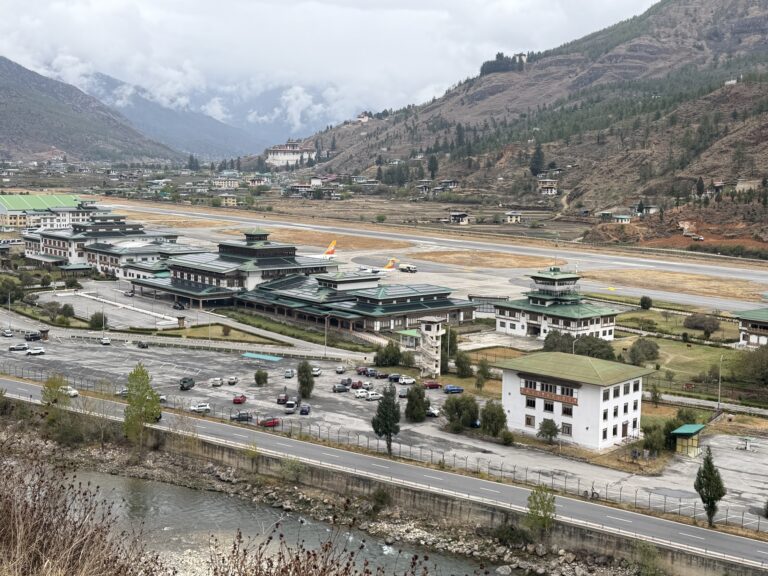
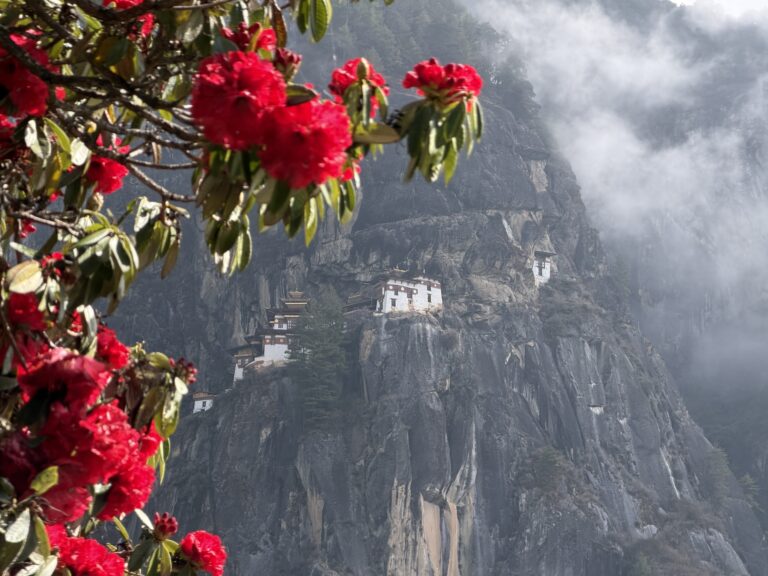
No. The Southern Bhutan Tour does not visit Paro or Tiger’s Nest, because it exits through the south. If Tiger’s Nest is a priority, we can add two days in Paro privately, or you can choose our 6-Day Bhutan Tour.
How much is the SDF on the Southern Bhutan Tour?
The SDF on the Southern Bhutan Tour is US$ 700 per person, since Bhutan charges US$ 100 per person for each of the seven nights. The rate is confirmed until 31 December 2029 and is already included in every price on this page.
What are the hotels like on the Southern Bhutan Tour?
On the Southern Bhutan Tour we use 3-star hotels in Thimphu and Punakha and the best available tourist-standard hotels in Phuentsholing, Tsirang and Gelephu. Southern hotels are simpler but clean, with private bathrooms and air conditioning or fans in the warm months.
What food is served on the Southern Bhutan Tour?
All meals are included on the Southern Bhutan Tour. In Thimphu and Punakha, try ema datshi and red rice; in Tsirang and Gelephu, dal bhat and Nepali-style curries. Vegetarian meals are easy, and other diets can be arranged with notice.
Who are the Lhotshampa?
The Lhotshampa are Bhutanese people of Nepali descent who live mainly in the southern districts. On the Southern Bhutan Tour you visit their villages in Tsirang and Sarpang, where Nepali is widely spoken and Hindu temples and festivals are part of daily life.
Is southern Bhutan safe?
Yes. Southern Bhutan is safe for visitors, and your guide is with you throughout the Southern Bhutan Tour. The main health concerns are heat and mosquitoes, so use repellent and ask your doctor about malaria advice for the lowlands and Assam.
How do the land border crossings work?
On the Southern Bhutan Tour you exit India at Jaigaon and walk through the Bhutan Gate into Phuentsholing, then exit Bhutan at Gelephu into Assam. Our guide helps with Bhutanese immigration at both, and you need valid Indian and Bhutan visas.
Can the Southern Bhutan Tour run in reverse?
Yes. A private Southern Bhutan Tour can start at Guwahati and Gelephu and end at Phuentsholing and Bagdogra, or combine with Paro by adding days and a flight. Group dates run from Bagdogra to Guwahati. Ask us for a private quote.
Is the Southern Bhutan Tour private or a group?
The Southern Bhutan Tour runs as a small group of up to 12 on fixed dates from October to April, or privately on any date. The one and two traveller prices on this page are the private prices. Solo travellers can join group dates.
What money should I bring on the Southern Bhutan Tour?
Bring Indian rupees, which are accepted in Bhutan at par with the ngultrum, plus some US dollars. Cards rarely work in the southern towns, so on the Southern Bhutan Tour carry cash for drinks, tips and small purchases. ATMs exist but are unreliable.
Can I combine the Southern Bhutan Tour with Nepal?
Yes. From Guwahati or Bagdogra you can fly on to Kathmandu, usually via Delhi or Kolkata, and Bagdogra is also close to Nepal’s eastern border. We are based in Kathmandu and can arrange your Nepal travel with the Southern Bhutan Tour.
What should I pack for the Southern Bhutan Tour?
For the Southern Bhutan Tour, pack light clothes for the warm south and warm layers for Thimphu and the Dochula Pass. Bring insect repellent, sun protection, comfortable shoes and long sleeves and long trousers or skirts for temples. A light rain jacket helps too.
Do I need travel insurance for the Southern Bhutan Tour?
Yes. Insurance for the Southern Bhutan Tour should cover medical treatment in India and Bhutan, evacuation and cancellation. Send us your policy details before travel, and carry a copy with your visas. Bhutan also expects visitors to hold health cover for their stay.
What makes your Southern Bhutan Tour different?
Our Southern Bhutan Tour loops through the heart of the country instead of doubling back, linking Phuentsholing, Thimphu, Punakha and the new southern highway to Gelephu. We include farm and village visits, both border transfers and two nights in Gelephu.
Reading for this trip
Ask us about the Southern Bhutan Tour
We reply from Kathmandu within 24 hours with available dates, your exact price and answers to your questions.
- 16 years guiding in the Himalaya
- Registered in Nepal, Reg. 187391
- Group departures of 12 travelers at most
- Private dates on any day
Call, WhatsApp or Viber
Southern Bhutan Tour, from US$ 1,585 per person. Dates and booking at treknepalhimalayas.com/trip/southern-bhutan-tour/
Trek Nepal Himalayas Pvt Ltd, Reg. 187391. Bhagawatisthan, Thamel, Kathmandu, Nepal. Call or WhatsApp +977 98510 13196. [email protected]