Thimphu Tshechu Festival Tour
Our trips are rated 5 out of 5 in more than 950 traveler reviews.
Trip overview
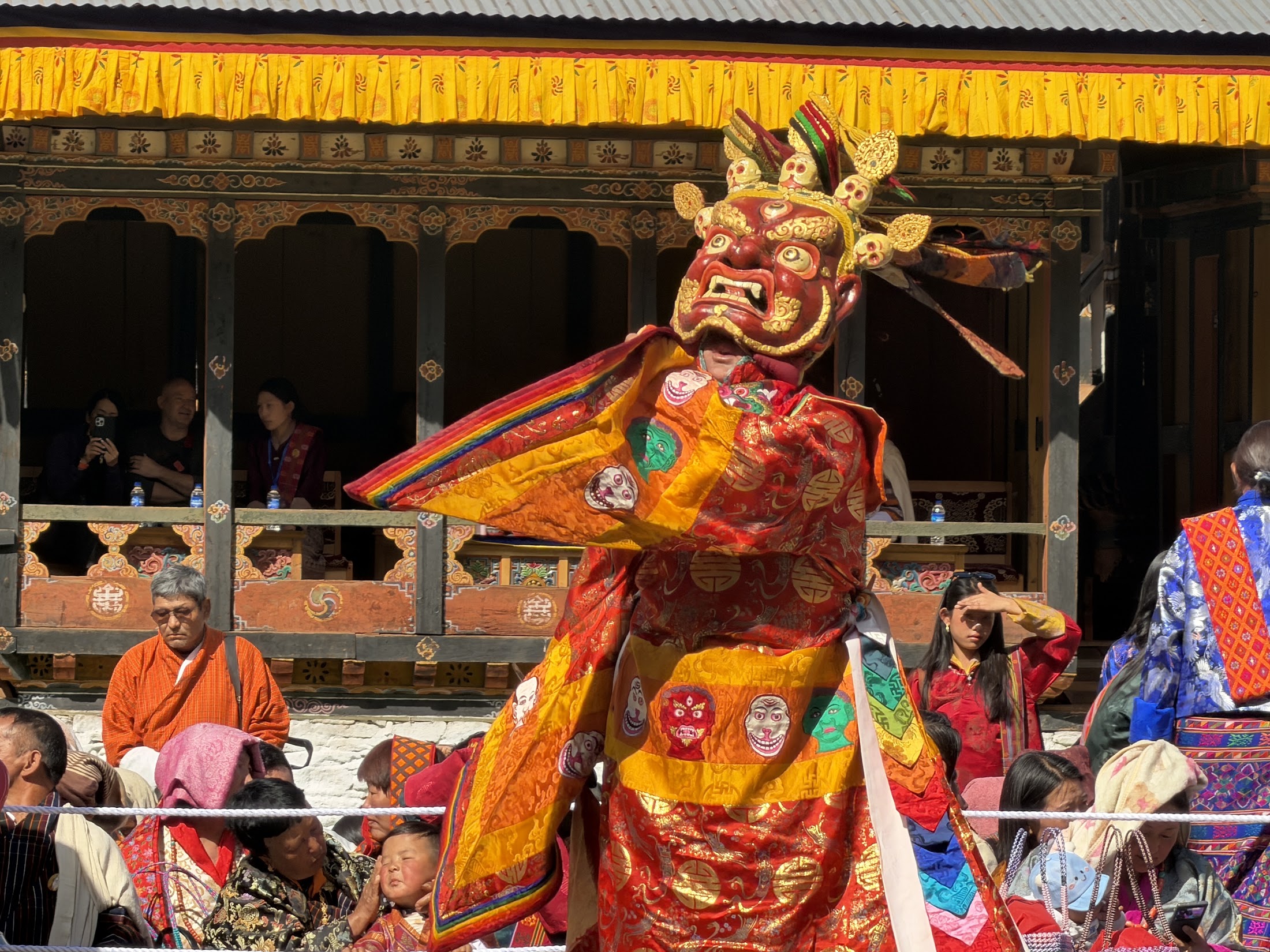
Our Thimphu Tshechu Festival Tour is built around the capital’s great autumn festival, held each year in the courtyard of Tashichho Dzong, the seat of Bhutan’s government. In 8 days you spend three days at the tshechu, including the dawn thongdrol, hike to Tiger’s Nest before the crowds arrive, and finish with Punakha, with the visa, Sustainable Development Fee, hotels, guide, car and all meals included.
It suits travellers who want a festival with the best weather of the year. Autumn in Bhutan brings clear skies, harvest colours and mild days, and Thimphu’s tshechu is the country’s largest, drawing families from across the western districts.
We start in Paro, not Thimphu, so you acclimatise and see Tiger’s Nest while the capital fills. Then we move to Thimphu for the festival itself, and end in Punakha when the crowds go home.
The honest part: Thimphu is busy and hotels cost more in festival week, and the main courtyard is packed on the busiest day. Festival dates follow the lunar calendar and can move, so we confirm them with you when you enquire.
The reward is the energy of Bhutan’s capital celebrating: masked monks spinning in the dzong courtyard, atsara clowns working the crowd, and a giant thangka of Guru Rinpoche unrolled at first light on the final morning.
Prices start at US$ 1,795 per person in a group of six or more and US$ 2,155 each for two. Prefer spring? See our Paro Tshechu Festival Tour, or our 8-Day Bhutan Tour on any date.
Highlights
- Three days at the Thimphu Tshechu in the courtyard of Tashichho Dzong
- The dawn thongdrol, a giant thangka of Guru Rinpoche, on the final morning
- Cham dances by monks and laymen, explained by your guide as they happen
- Autumn weather, usually the clearest of the year
- Tiger’s Nest, hiked before the festival crowds
- Punakha Dzong and the Dochula Pass after the festival
- Paro valley sights: Rinpung Dzong and Kyichu Lhakhang
- Festival-week hotels reserved in advance
Itinerary
Altitude profile
On footBy road
The altitude listed for each day, from 1,250 m to 3,120 m. Select a point to read that day.
The highest point on the route is 3,120 m.
- Nights
- 7 nights in 3-star hotels
- Meals in the price
- 7 breakfasts, 7 lunches, 7 dinners
- On the move
- 1 day on foot, 4 days by road, 1 day with a flight
Day 1Arrive in Paro2,250 m
The Thimphu Tshechu Festival Tour begins in Paro, which is quieter than the capital during festival week. The plane threads between ridges into the valley at about 2,250 m, and autumn skies usually give a clear view on the way in.
Your guide meets you with a white khadar scarf and drives you a few minutes to the hotel. After lunch we keep the afternoon gentle, which helps the body adjust to the height before the busy days ahead.
In the late afternoon we visit Rinpung Dzong, crossing its covered wooden bridge, and Kyichu Lhakhang, a 7th-century temple with orange trees in the courtyard. Around the valley, the rice harvest is usually under way, and the fields are gold.
At dinner the guide introduces the tshechu: what it celebrates, who dances and what the main masks mean. If you want to wear national dress at the festival, the guide can arrange a gho or kira. Tonight is the first of two nights in a 3-star hotel in Paro.
- TravelFlight, 1-3 hours
- Stay3-Star Hotel
- MealsLunch, Dinner
Day 2Tiger's Nest Hike3,120 m
Before the festival, the Thimphu Tshechu Festival Tour climbs to Taktsang, the Tiger’s Nest. Autumn is the best season for this hike, with cool air and clear views across the Paro valley.
We start by about 8 am. The path climbs about 900 m through blue pine to the monastery at roughly 3,120 m, which takes 2 to 3 hours. At the halfway teahouse, you see Taktsang clinging to its cliff, and the last section crosses a gorge by stone steps beside a waterfall.
Inside, the guide tells the story of Guru Rinpoche, who is said to have flown here on a tigress to meditate in the cave. The tshechu you will see in Thimphu honours the same teacher, and the guide links the two as you go.
The descent takes about 1.5 hours. The afternoon is free for a hot stone bath at a farmhouse, at extra cost, or a walk through Paro town. Tonight is the second night in the same Paro hotel.
- TravelHiking, 4-6 hours
- Stay3-Star Hotel
- MealsBreakfast, Lunch, Dinner
Day 3Paro to Thimphu and the Tshechu2,320 m
Today the Thimphu Tshechu Festival Tour moves to the capital, about 1.5 hours by road. On the way we stop at Tamchog Lhakhang, with its iron chain bridge, and at Chhuzom, where the Paro and Thimphu rivers meet.
After checking in, we walk to Tashichho Dzong for the first day of the tshechu. The courtyard is filled with families in their finest gho and kira, and the dances begin with the Black Hat dancers, who purify the ground for what follows.
Your guide explains each dance as it happens. Some show deities subduing demons, others the judgement of the dead, and the dance of the stags and hounds tells how a hunter was turned from killing by the poet-saint Milarepa.
In the late afternoon we visit the Memorial Chorten, where elders walk circuits in the evening light, and the Buddha Dordenma above the city. Tonight is the first of three nights in a 3-star hotel in Thimphu, reserved for festival week.
- TravelCar, 1-3 hours
- Stay3-Star Hotel
- MealsBreakfast, Lunch, Dinner
Day 4Thimphu Tshechu Festival Day2,320 m
This is the main festival day of the Thimphu Tshechu Festival Tour. We arrive at Tashichho Dzong mid-morning and find a place in the courtyard with the guide, where the dances run through the day.
The cham can last from half an hour to more than an hour each. Brocade costumes swirl, cymbals and long horns sound, and the dancers move in slow spins that are meant to bless everyone who watches.
Atsaras, the masked clowns, move through the crowd, teasing people, keeping order and offering blessings. Outside the dzong, the streets are full of stalls, games and families picnicking on the lawns.
Lunch is a packed meal or a restaurant nearby, and you can come and go as you like. In the late afternoon there is time for the National Institute for Zorig Chusum or the Takin Preserve if you want a break. Dinner is early, as tomorrow starts before dawn.
- TravelSightseeing, 4-6 hours
- Stay3-Star Hotel
- MealsBreakfast, Lunch, Dinner
Day 5Thongdrol at Dawn2,320 m
The final day of the tshechu begins in the dark. On the Thimphu Tshechu Festival Tour we leave the hotel around 4 am and walk to Tashichho Dzong, where thousands of people gather for the thongdrol.
Before sunrise, a giant thangka of Guru Rinpoche is unrolled down the face of the dzong. Seeing it is believed to free people from the cycle of rebirth, and many come forward to touch their heads to its edge for a blessing.
The thangka stays up only until the sun reaches it, and the dances continue in front of it until mid-morning. We return to the hotel for a late breakfast and a rest.
In the afternoon you can return to the festival for the closing dances, or visit Changangkha Lhakhang and the weekend market if it falls on these dates. Tonight is the last night in Thimphu, with dinner at a local restaurant.
- TravelSightseeing, 4-6 hours
- Stay3-Star Hotel
- MealsBreakfast, Lunch, Dinner
Day 6Thimphu to Punakha1,250 m
After the festival, the Thimphu Tshechu Festival Tour heads east over the Dochula Pass at about 3,100 m. Autumn is often clear here, and the 108 chortens frame the snow peaks along the northern border.
We descend to the warm Punakha valley, about 3 hours from Thimphu in all. The rice terraces are at harvest, and farmers cut and stack the sheaves by hand.
In Punakha we visit Punakha Dzong, built in 1637 at the meeting of the Pho Chhu and Mo Chhu rivers, and walk about 20 minutes through rice fields to Chimi Lhakhang, the temple of the Divine Madman.
The atsaras you saw at the festival trace their humour back to this saint, and the guide explains the link. Tonight is in a 3-star hotel in the Punakha valley, quiet after the crowds of Thimphu.
If time allows, we also cross the long suspension bridge over the Pho Chhu, hung with prayer flags, and walk a little way along the riverbank before dinner.
- TravelCar, 1-3 hours
- Stay3-Star Hotel
- MealsBreakfast, Lunch, Dinner
Day 7Punakha to Paro2,250 m
The morning of the Thimphu Tshechu Festival Tour starts with an easy walk through the rice fields of upper Punakha to Khamsum Yulley Namgyal Chorten, a three-storey temple on a hill, about 2 hours there and back.
From its rooftop you look up and down the valley, and the paintings inside are some of the most vivid in Bhutan. The trail crosses the river on a suspension bridge hung with prayer flags.
After lunch we drive about 4 hours back over the Dochula to Paro, stopping at the pass if the views are clear. The road winds through forest turning to autumn colours.
Tonight is a farewell dinner in Paro, a good time to look through your festival photos with the guide and ask any last questions about what you have seen. The hotel is close to the airport for tomorrow’s flight.
Pack tonight, as the flight is usually in the morning.
- TravelCar, 4-6 hours
- Stay3-Star Hotel
- MealsBreakfast, Lunch, Dinner
Day 8Depart from Paro2,250 m
The Thimphu Tshechu Festival Tour ends with a short drive to Paro airport. Flights after festival week are busy, so the guide confirms your pickup time the evening before and makes sure you arrive in good time.
If your flight leaves later in the day, we can drive up the valley to the ruins of Drukgyel Dzong or visit the National Museum in the round watchtower above Rinpung Dzong.
Your guide helps with check-in and says goodbye at the terminal door. Keep your visa letter with your passport for the exit check, and allow two hours before departure.
Autumn is also Nepal’s best trekking season, and we are based in Kathmandu. We can arrange your Nepal sightseeing or a trek after the festival on the same booking. For long-haul connections, a buffer night in Paro or Kathmandu protects your onward plans if a flight is delayed.
Thank you for celebrating the tshechu with us.
- TravelCar, 30-60 minutes
- MealsBreakfast
What's included
Included in the price
- Bhutan visa: the visa application and US$ 40 fee
- Sustainable Development Fee: US$ 100 per person for each of the 7 nights
- Airport transfers: pickup and drop at Paro airport
- Hotels: 3-star rooms, twin share, in Paro, Thimphu and Punakha, reserved for festival week
- All meals: from lunch on arrival to breakfast on departure
- Guide: a licensed English-speaking guide who explains the dances
- Vehicle: a private car or van with driver throughout
- Festival days: three days at the tshechu, including the thongdrol
- Route permits: permits for Punakha
- Entrance fees: every site on the itinerary, including Tiger’s Nest
- Drinking water: bottled water in the vehicle and at the festival
- Welcome scarf: a khadar greeting at the airport
- Taxes: all government taxes and service charges
- Support: 24-hour contact with our team during the tour
- Date check: festival dates confirmed with you before your visa is lodged
Not included
- Flights to and from Paro, best booked early for festival week
- International airfare to your connecting city
- Travel insurance with medical cover
- Single supplement for your own room
- Gho or kira if you want to wear national dress
- Drinks other than water, tea and coffee
- Extra nights caused by flight delays
- Laundry, phone and internet charges
- Tips for the guide and driver
- Personal costs such as souvenirs and festival snacks
Dates and price
This trip runs once a year, timed to the festival. Festival dates follow the lunar calendar, so ask us for this year's dates.
Trip information
Price by Group Size
| Group size | Price per person |
|---|---|
| 1 traveller (private) | US$ 2,690 |
| 2 travellers | US$ 2,155 |
| 3 to 5 travellers | US$ 1,940 |
| 6 to 12 travellers | US$ 1,795 |
To book: ask us for the confirmed festival date, then pay a 20% deposit. The balance is due before we lodge your Bhutan visa, about 30 days before you fly. Book early, as Thimphu and Paro hotels fill months ahead.
Joining alone: solo travellers can join the group departure and pay the rate for the group that travels; once six or more are booked, we refund the difference to everyone.
Private tour: a private Thimphu Tshechu Festival Tour can add days in Phobjikha, Bumthang or on a short trek, before or after the festival.
Not in the price: Paro flights, insurance, national dress, drinks and tips. Seven nights of Bhutan’s SDF, US$ 700 per person, are already included in every price.
Best Time to Visit
The Thimphu Tshechu Festival Tour runs once a year, on the dates of the festival. The tshechu is held in autumn, usually in September or October, on dates set by the Bhutanese lunar calendar, and lasts three days after a day of preparatory rituals.
The official calendar is published as tentative and can shift by a day or two. We send you the confirmed dates when you enquire and check them again before we lodge your visa.
Autumn is the finest season in Bhutan. Skies are usually clear after the monsoon, days are warm, nights are cool and the rice fields around Paro and Punakha turn gold for the harvest.
If autumn does not suit you, the Paro Tshechu in spring, the Punakha festival in late winter and the Black-Necked Crane Festival in November are other options. Ask us which fits your dates.
Difficulty and Fitness
The Thimphu Tshechu Festival Tour is easy. Festival days involve standing or sitting on the courtyard steps for several hours, so bring a cushion or a small folding seat.
The one demanding day is Tiger’s Nest, which climbs about 900 m to roughly 3,120 m, about 5 hours there and back. Horses can carry you up the first half at extra cost.
The thongdrol morning starts very early, around 4 am, to reach the dzong before the crowds. The walk is short, but in the cold and the dark.
Drives are moderate: about 1.5 hours from Paro to Thimphu, about 3 hours to Punakha and about 4 hours back to Paro. Tell us about mobility needs, and we will plan seating and walking around them.
Food, Water and Dietary Needs
All meals are included on the Thimphu Tshechu Festival Tour, at hotels and local restaurants. On festival days, lunch is a packed meal or a restaurant near the dzong, so you do not lose your place for long.
The streets around the dzong fill with stalls selling momos, puffed rice, roasted maize and tea, and families picnic on the lawns. The guide will tell you which stalls are good to try.
Vegetarian meals are easy, and vegan and gluten-free diets can be arranged with notice. Tell us about allergies at booking, so the guide can brief every kitchen.
Tap water is not safe to drink. Bottled water is in the vehicle, and we carry extra on festival days, when the autumn sun can be strong.
Altitude, Health and Safety
The Thimphu Tshechu Festival Tour stays at moderate heights: Paro at about 2,250 m, Thimphu at about 2,320 m and Punakha at about 1,250 m, with Tiger’s Nest and the Dochula at about 3,100 m.
Altitude illness is rare at these levels. The bigger health issue at the festival is sun: wear a hat and sunscreen, and drink plenty of water on long days in the courtyard.
The crowds are good-natured, and Bhutan is very safe. Keep valuables close in the busiest moments, and agree a meeting point with your guide in case you get separated.
Thimphu has the national referral hospital, and Paro and Punakha have district hospitals. Your insurance should include medical cover, and anyone with heart or lung conditions should ask a doctor about Tiger’s Nest.
Local Etiquette
The tshechu is a religious festival, and the Thimphu Tshechu Festival Tour asks you to behave as a guest at a ceremony. Dress modestly in long sleeves and long trousers or skirts, or wear a gho or kira, which locals appreciate.
Never walk across the dance area while the cham is performed, and follow the guide’s lead on where to stand or sit. Keep to the edges of the courtyard.
Photography is allowed at most dances, but no flash, drones or tripods in the crowd. At the thongdrol, many people come to receive a blessing; let them reach the front and keep phones low.
The atsaras, masked clowns, may tease you or bless you with a wooden phallus; it is meant kindly and brings good luck. Laugh along. Smoking in public places is restricted in Bhutan.
Visa, Permits and Documents
Everyone except Indian, Bangladeshi and Maldivian nationals needs a Bhutan visa, arranged by a licensed operator. We apply for your Thimphu Tshechu Festival Tour visa once the balance is paid.
We need a passport scan, valid six months beyond arrival, and a passport photo. The visa costs US$ 40 and the SDF is US$ 100 per person per night until 31 December 2029; both are included.
Travel to Punakha needs a route permit, which we arrange. The festival itself needs no ticket, but security at Tashichho Dzong may check bags at the gate.
Print the visa clearance letter for check-in and arrival. Indian nationals need a permit instead and pay a lower SDF. Official rules and the festival calendar are on bhutan.travel.
Transport, Money and Connectivity
You fly in and out of Paro on Drukair or Bhutan Airlines. Festival-week flights sell out early, so book as soon as your dates are confirmed; we can book them for you at cost.
Your private car and driver cover all transfers. Roads around Tashichho Dzong close to traffic at busy times, so we sometimes walk the last part.
The ngultrum is Bhutan’s currency, tied to the Indian rupee. Bring small notes for stalls and offerings; cards are not accepted at the festival.
Mobile networks slow down in the festival crowds, so agree meeting points rather than relying on calls. Hotels have Wi-Fi, though it slows when the city is full. Your driver waits nearby on festival days, so you can return to the car for layers or a rest.
Questions about this trip
When is the Thimphu Tshechu?
The Thimphu Tshechu is held each autumn, usually in September or October, on dates set by the Bhutanese lunar calendar. It runs for three days at Tashichho Dzong, with the thongdrol at dawn on the final day. We send you the confirmed dates for the Thimphu Tshechu Festival Tour when you enquire.
How much does the Thimphu Tshechu Festival Tour cost?
The Thimphu Tshechu Festival Tour costs from US$ 1,795 per person in a group of six or more, US$ 1,940 for three to five, US$ 2,155 each for two and US$ 2,690 for one. Prices include the visa, seven nights of SDF, festival-week hotels, all meals, guide and car.
How many festival days are included?
The Thimphu Tshechu Festival Tour includes three festival days at Tashichho Dzong: the opening afternoon, a full main day, and the dawn thongdrol on the final morning. Paro, Tiger’s Nest and Punakha fill the rest of the week. Each day has a different mood.
What is the Thimphu Tshechu?
The Thimphu Tshechu is a religious festival honouring Guru Rinpoche, held in the courtyard of Tashichho Dzong. Monks and laymen perform masked cham dances that teach Buddhist values, and families come in their finest clothes. It is the largest tshechu in Bhutan.
What is the thongdrol at the Thimphu Tshechu?
The thongdrol is a giant thangka of Guru Rinpoche unrolled down the face of Tashichho Dzong at dawn on the last day of the Thimphu Tshechu. Seeing it is believed to bring liberation, and our Thimphu Tshechu Festival Tour is timed to include it.
Are the Thimphu Tshechu dates fixed?
No. Bhutan publishes festival dates as tentative, and they can move by a day or two. For the Thimphu Tshechu Festival Tour we confirm the dates with you when you enquire and again before lodging your visa, adjusting the tour if needed.
Do I need a ticket for the Thimphu Tshechu?
No ticket is needed for the Thimphu Tshechu, which is a public religious festival. Security may check bags at the dzong gate. On the Thimphu Tshechu Festival Tour your guide plans arrival times so you find a good place to watch.
Can I take photos at the Thimphu Tshechu?
Yes, photos are allowed at most dances of the Thimphu Tshechu, but no flash, drones or tripods, and never walk across the dance area. On the Thimphu Tshechu Festival Tour the guide tells you where photos are welcome and where to keep the camera down.
What should I wear to the Thimphu Tshechu?
Wear modest clothes with long sleeves and long trousers or skirts, or a gho or kira, which locals appreciate. On the Thimphu Tshechu Festival Tour the guide can help you hire or buy national dress. Bring a hat, sunscreen and a warm layer for the cold dawn.
Does the Thimphu Tshechu Festival Tour include Tiger's Nest?
Yes. The Thimphu Tshechu Festival Tour includes the Tiger’s Nest hike on the second day, before the festival, when autumn air is cool and clear. The climb takes 2 to 3 hours up and about 1.5 hours down. Start time is about 8 am.
Is the Thimphu Tshechu crowded?
Yes, the Thimphu Tshechu is Bhutan’s largest festival, and the courtyard fills on the main day and at the thongdrol. The crowds are friendly. On the Thimphu Tshechu Festival Tour we arrive early and agree meeting points in case anyone gets separated.
Do I need a visa for the Thimphu Tshechu Festival Tour?
Yes, unless you are Indian, Bangladeshi or Maldivian. We arrange the Bhutan visa for the Thimphu Tshechu Festival Tour once your balance is paid, and you only send a passport scan and photo. The visa fee, SDF and route permits are included.
How much is the SDF on the Thimphu Tshechu Festival Tour?
The SDF on the Thimphu Tshechu Festival Tour is US$ 700 per person, since Bhutan charges US$ 100 per person for each of the seven nights. The rate is confirmed until 31 December 2029 and is already included in every price.
When should I book the Thimphu Tshechu Festival Tour?
Book the Thimphu Tshechu Festival Tour six months or more ahead if you can. Festival-week hotels in Thimphu and Paro and the Paro flights fill early. A 20% deposit holds your place, and the balance is due before we lodge your visa.
Is the weather good during the Thimphu Tshechu?
Usually, yes. The Thimphu Tshechu falls in autumn, after the monsoon, when skies are mostly clear, days are warm and nights are cool. A rain shower is still possible early in the season, so bring a light rain jacket for the Thimphu Tshechu Festival Tour.
Can children join the Thimphu Tshechu Festival Tour?
Yes. Children usually love the colour and the atsara clowns at the Thimphu Tshechu. Under-sixes pay no SDF and children aged 6 to 11 pay half. The dawn thongdrol is a long morning, so plan an early night before it.
Is the Thimphu Tshechu Festival Tour private or a group?
The Thimphu Tshechu Festival Tour runs as one small group departure of up to 12 travellers each year, or privately. The one and two traveller prices on this page are the private prices, and private tours can add days. Solo travellers are welcome.
Can I combine the Thimphu Tshechu with a Nepal trek?
Yes. Autumn is Nepal’s best trekking season, and we are based in Kathmandu. Many travellers add a Nepal trek or sightseeing before or after the Thimphu Tshechu Festival Tour, with the flights and every transfer on one booking. Ask us for a combined quote.
What food is available at the Thimphu Tshechu?
All meals are included on the Thimphu Tshechu Festival Tour. On festival days, lunch is packed or at a nearby restaurant, and the streets around the dzong have stalls selling momos, roasted maize and tea. Vegetarian food is easy throughout.
Is there phone signal at the Thimphu Tshechu?
Mobile networks work in Thimphu but slow down in the festival crowds. On the Thimphu Tshechu Festival Tour we agree meeting points rather than relying on calls. Hotels have Wi-Fi, though it can be slow during festival week. Download offline maps before you go.
Do I need travel insurance for the Thimphu Tshechu Festival Tour?
Yes. Insurance for the Thimphu Tshechu Festival Tour should include medical cover, evacuation and cancellation, ideally with cover for flight delays in the busy festival week. Send us your policy details before you travel. The guide keeps a copy during the tour.
What makes your Thimphu Tshechu Festival Tour different?
Our Thimphu Tshechu Festival Tour starts in quieter Paro and hikes Tiger’s Nest before the festival, then spends three days at the tshechu including the dawn thongdrol, and ends in Punakha at harvest time. We reserve festival-week hotels early. Groups stay at 12 or fewer.
Ask us about the Thimphu Tshechu Festival Tour
We reply from Kathmandu within 24 hours with available dates, your exact price and answers to your questions.
- 16 years guiding in the Himalaya
- Registered in Nepal, Reg. 187391
- Private dates on any day
Call, WhatsApp or Viber
Thimphu Tshechu Festival Tour, from US$ 1,795 per person. Dates and booking at treknepalhimalayas.com/trip/thimphu-tshechu-festival-tour/
Trek Nepal Himalayas Pvt Ltd, Reg. 187391. Bhagawatisthan, Thamel, Kathmandu, Nepal. Call or WhatsApp +977 98510 13196. [email protected]