Kailash and Guge Kingdom Tour
Our trips are rated 5 out of 5 in more than 950 traveler reviews.
Trip overview
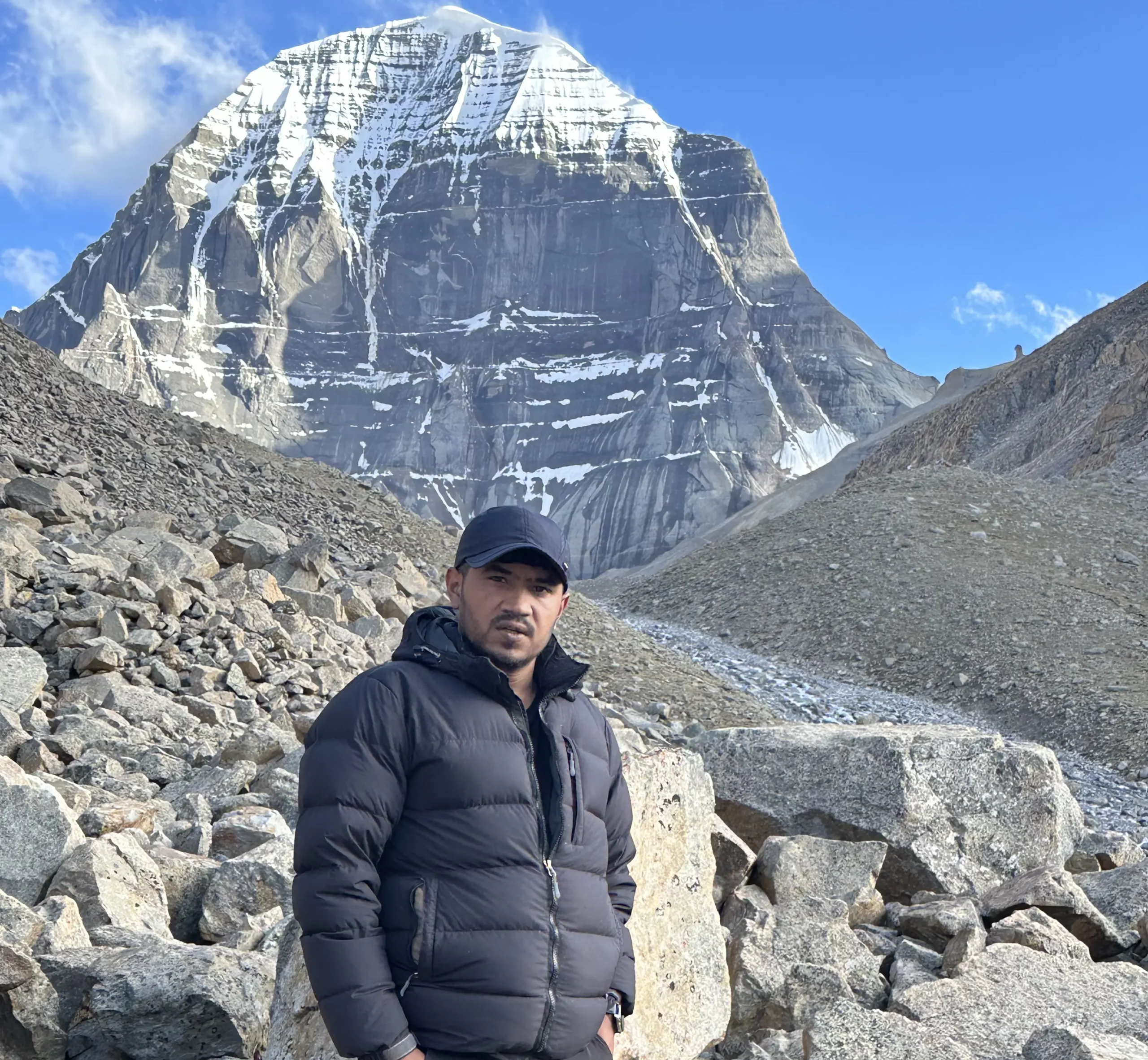
Our Kailash and Guge Kingdom tour is a 17-day small group journey from Lhasa to the far west of Tibet that adds the lost kingdom of Guge to the full Kailash kora. Along with the mountain and Lake Manasarovar, you see the ruined citadel of Tsaparang, the clay canyons of Zanda and the painted caves of Dungkar, then return to Lhasa by the southern road.
It suits travellers who want the whole of western Tibet rather than Kailash alone, and pilgrims with time to spare. You join a fixed group of four to 12, with a licensed Tibetan guide, all permits, hotels and entrance fees arranged.
The Guge days come before the kora on purpose. Two extra days in the west at 3,700 m to 4,600 m give your body more time at height before the Drolma La.
The honest hard part is the length and the kora. The tour spends more than two weeks on the road, and the middle kora day crosses about 5,630 m in ten to twelve hours. Hotels in Zanda and on the kora are simple.
The reward is a part of Tibet few travellers reach: palaces and temples cut into eroded hills, murals untouched for centuries, and Kailash rising over the plain when you come back from Guge.
Prices are US$ 2,499 per person in May and US$ 2,699 from June to early October, and each date shows its own price. For the shorter version, see our Lhasa to Kailash Mansarovar Yatra, and read our guide to altitude sickness.
Highlights
- Tsaparang, the ruined citadel of the Guge kingdom
- Red and White chapels with some of the finest murals in Tibet
- Zanda earth forest, a maze of eroded clay canyons
- Dungkar and Piyang caves with thousand-year-old paintings
- The full Kailash kora over the Drolma La at about 5,630 m
- Lake Manasarovar below Gurla Mandhata
- Everest north face with a night at the base camp area
- Potala Palace and Jokhang Temple in Lhasa
Itinerary
Altitude profile
On footBy road
The altitude listed for each day, from 3,650 m to 5,000 m. Select a point to read that day.
The highest point on the route is 5,630 m.How we handle altitude
- Nights
- 8 nights in tourist standard hotels, 5 nights in 3-star hotels, 3 nights in teahouses
- Meals in the price
- 14 breakfasts, 1 lunch, 1 dinner
- On the move
- 3 days on foot, 12 days by road
Day 1Arrive in Lhasa3,650 m
Your yatra starts at Lhasa Gonggar airport or the railway station, where your Tibetan guide meets you with a khata scarf. The drive into the city takes about an hour along the Yarlung Tsangpo and the Kyichu rivers. We check you into a 3-star hotel near the old town at 3,650 m.
From this moment, the most useful thing you can do for the kora two weeks away is to rest. Keep today slow and flat. Drink two to three litres of water, skip alcohol and eat a light dinner, which is at your own cost tonight.
Your guide meets the group in the evening to explain the route west, the permit checks and how the kora days will work. They also check that everyone has the right clothing and boots for the high pass, and suggest where to buy anything missing in Lhasa. If you feel well, a short walk to the Barkhor shows you the pilgrims who will soon be your companions on the road to Kailash.
- TravelVan, 30-60 minutes
- Stay3-Star Hotel
Day 2Lhasa: Drepung and Sera Monasteries3,650 m
We begin at Drepung, a hillside town of whitewashed colleges on the western edge of Lhasa that once housed thousands of monks. The lanes climb gently, and we walk them at an easy pace, visiting the assembly hall, the old kitchens and chapels lit by butter lamps. After a lunch at your own cost, we cross the city to Sera.
On most afternoons from about 3 pm, its monks debate philosophy in a shaded courtyard, each challenge sealed with a clap and a stamp. Your guide explains what the monks argue about and how the debate shapes their training. Visitors watch quietly from the side.
In the evening the group shares a welcome dinner of Tibetan food. Walking today adds up to about 4 km with stairs, a gentle first test at this height. It is also a chance to get to know the people you will walk around Kailash with, and to ask your guide anything about the road ahead.
- TravelSightseeing, 4-6 hours
- Stay3-Star Hotel
- MealsBreakfast, Dinner
Day 3Lhasa: Potala Palace and Jokhang Temple3,650 m
The Potala Palace takes the morning. Your guide books a timed entry, and we climb the outer stairways slowly, about 100 m of height gain, with stops on the landings to catch your breath. Inside are the chapels, assembly halls and golden tombs of past Dalai Lamas.
The visit inside is limited to about an hour, and photos are only allowed outside. In the afternoon we walk to the Jokhang Temple, the spiritual centre of Tibet. Pilgrims who have walked for weeks prostrate at its gate, and inside the Jowo Shakyamuni statue sits in a glow of butter lamps.
We end on the Barkhor, walking clockwise around the temple with the crowd. It is a good warm-up for the kora, which pilgrims walk in the same direction. The evening is free for dinner at your own cost, and this is the last chance to buy trekking poles, snacks or warm gloves before we head west tomorrow.
- TravelSightseeing, 4-6 hours
- Stay3-Star Hotel
- MealsBreakfast
Day 4Lhasa to Shigatse via Gyantse3,840 m
We leave Lhasa early and climb to the Kamba La at about 4,790 m, where Yamdrok Lake lies below in a long turquoise curve. The road then follows the shore and crosses the Karo La at about 5,000 m, beside a glacier that almost touches the road. Today’s lunch is with a Tibetan farming family in a village on the way.
You sit in their kitchen, eat home cooking and see how families live on the high plains. In Gyantse we visit Pelkor Chode monastery and its Kumbum, a stupa of many tiers lined with small painted chapels. The last stretch to Shigatse runs about 90 minutes across a farming valley.
We reach Shigatse, Tibet’s second city, in the evening and sleep at about 3,840 m. The day covers about 360 km and eight hours with stops. Your guide checks how everyone is coping, because tomorrow we climb to the Everest area at about 5,000 m.
- TravelVan, 7-9 hours
- Stay3-Star Hotel
- MealsBreakfast, Lunch
Day 5Shigatse to Everest Base Camp5,000 m
The road west from Shigatse passes Lhatse and climbs over the Gyatso La at about 5,200 m, the gateway to the Everest nature reserve. After the checkpoint at Shegar we turn south over the Gawu La, where a line of 8,000 m peaks appears on a clear day. The road then drops in tight bends into the Rongbuk valley.
In the afternoon we take the eco-bus to the viewpoint at about 5,200 m, with the north face of Everest at the head of the valley. We sleep at about 5,000 m in a tent guesthouse in season, or at the Rongbuk guesthouse. Rooms are simple and heated by stoves, and the night is cold.
This is the highest night of the yatra before the kora, and it is a useful test. If you sleep badly or wake with a headache, tell your guide; it helps us plan the days ahead. Only breakfast is included today, and the guesthouse kitchen serves noodles, rice and tea.
- TravelVan, 7-9 hours
- StayLocal Teahouse
- MealsBreakfast
Day 6Everest to Saga via Pelku Tso4,600 m
Get up early for sunrise on Everest if the sky is clear, then drive back out of the Rongbuk valley. We turn west onto the road toward Ngari, the remote far west of Tibet, and the country empties out. The highlight of the day is Pelku Tso, a wide blue lake at about 4,600 m with the long snow wall of Shishapangma rising behind it.
Wild asses and nomad tents dot the grassland, and we stop by the shore for photos. Beyond the lake the road crosses open plains and low passes to Saga, a small town on the Yarlung Tsangpo. We spend the night in Saga at about 4,600 m in the best available hotel, simple but warm.
The drive is long, about 400 km and eight to nine hours with stops. Saga has a few Tibetan, Sichuan and Nepali restaurants, and dinner is at your own cost. Your guide keeps an eye on how everyone feels after the night at Everest.
- TravelVan, 7-9 hours
- StayTourist Standard Hotel
- MealsBreakfast
Day 7Saga to Darchen via Lake Manasarovar4,600 m
Today we drive the last long stretch west, following the upper Yarlung Tsangpo through Zhongba and Paryang over the Mayum La. The plateau here is wide and empty, with sand dunes, nomad camps and herds of yak and sheep. In the afternoon Lake Manasarovar appears, deep blue below the snow dome of Gurla Mandhata, and soon after the white cone of Kailash rises to the north.
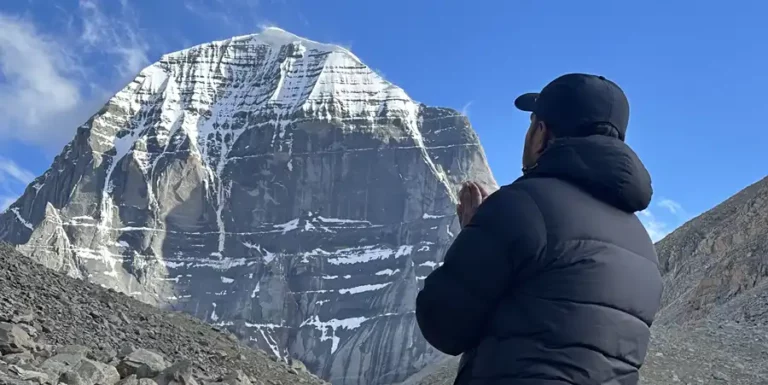
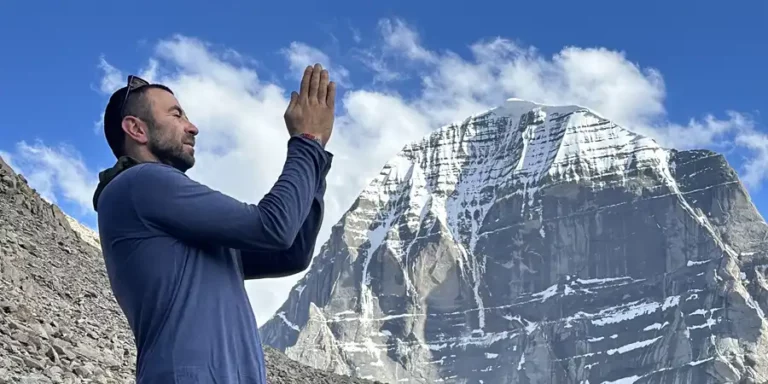
Many pilgrims cry at their first sight of the mountain, and we stop to let you take it in. We continue to Darchen at about 4,600 m, the small town at the start of the kora. The day covers about 480 km and eight to nine hours with stops.
Tomorrow we head further west to the old kingdom of Guge, and we return here for the kora in two days. Your guide explains the plan over tea in Darchen tonight.
From Darchen, the turn-off to Guge lies a short way west along the plain.
- TravelVan, 7-9 hours
- StayTourist Standard Hotel
- MealsBreakfast
Day 8Darchen to Zanda and the Guge Kingdom3,700 m
Today we drive west from Darchen across the Barga plain and over the Ayi La, a high pass with views back to Kailash and south to the Himalaya. Beyond it the land changes completely, dropping into the Sutlej valley through a maze of eroded clay cliffs known as the Zanda earth forest.
In the afternoon we reach Tsaparang, the ruined capital of the Guge kingdom, which ruled this corner of Tibet for about 700 years. Its palaces, temples and cave dwellings climb a single eroded hill, and stairs and tunnels lead up to the summit fortress.
Inside the surviving temples, the Red and White chapels hold some of the finest murals in Tibet, painted centuries ago in bright reds, blues and gold.
The climb to the top takes about an hour and is steep in places, so go slowly. We sleep in Zanda town at about 3,700 m in the best available hotel. The drive is about 250 km and six to seven hours with stops, and dinner is at your own cost.
- TravelVan, 7-9 hours
- StayTourist Standard Hotel
- MealsBreakfast
Day 9Dungkar and Piyang Caves to Darchen4,600 m
This morning we drive north of Zanda to the cave complexes of Dungkar and Piyang, among the largest Buddhist cave sites in Tibet. Hundreds of caves are cut into the cliffs above two small villages, once home to monks and meditators.
At Dungkar, a few caves still hold painted ceilings and walls from about a thousand years ago, with mandalas, flying figures and scenes of court life. Your guide brings a torch, and the paths up to the caves are short but steep.
Piyang, a short drive away, has a hillside honeycombed with caves and a ruined temple above the village.
In the afternoon we drive back over the Ayi La to Darchen at about 4,600 m. The day is about seven to eight hours with stops.
Tonight your guide holds the kora briefing: what to carry, how to pace the pass and where to rest, and porters or yaks can be booked in Darchen, paid locally. Dinner is at your own cost.
- TravelVan, 7-9 hours
- StayTourist Standard Hotel
- MealsBreakfast
Day 10Kailash Kora: Darchen to Dirapuk4,900 m
After the days at Guge, the kora begins with a short drive to the start of the trail near Darchen and a stop at the prayer flag pole at Tarboche. From here we walk north up the Lha Chu valley, a wide valley with red cliffs on both sides and the river beside the trail. The walk is about 20 km and six to seven hours, rising about 300 m on a mostly gentle path.
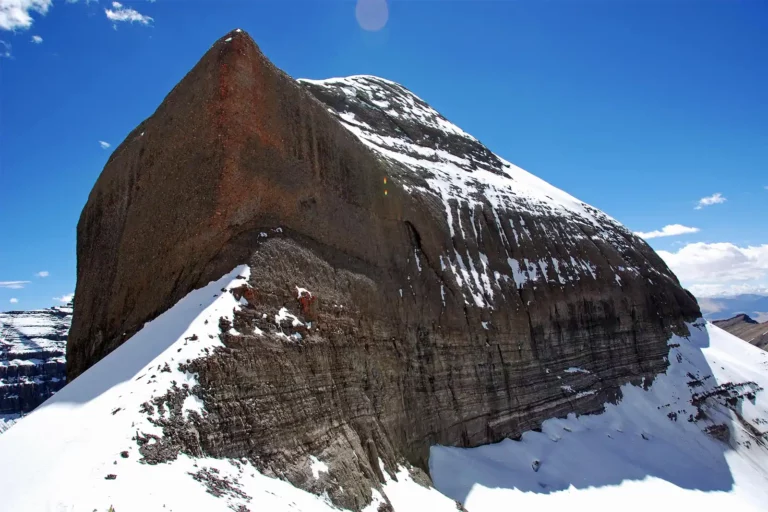
Pilgrims pass in both directions, and some prostrate the whole way round. Chuku Gompa sits on the cliffs across the river, and later the west face of Kailash appears above the valley. We reach Dirapuk at about 4,900 m in the afternoon.
The guesthouse looks straight at the north face of Kailash, often lit gold at sunset. Rooms are shared and basic, with no heating and outside toilets. Breakfast is included, and lunch and dinner are bought along the way, with hot noodles and tea at teahouse tents.
- TravelTrekking, 7-9 hours
- StayLocal Teahouse
- MealsBreakfast
Day 11Kailash Kora: Drolma La to Zutulpuk4,790 m
This is the hardest and most important day of the yatra. We start early in the dark, with headlamps, and climb about 700 m on rough rock and boulders to the Drolma La at about 5,630 m. The climb takes three to five hours at a slow, steady pace.
Your guide walks with the group, and we rest often and drink before we feel thirsty. Prayer flags cover the pass, and pilgrims leave offerings at its rock. Below the far side lies Gauri Kund, a small green lake that Hindu pilgrims hold sacred.
The descent is steep and rocky for the first hour, then eases into a long valley walk to Zutulpuk at about 4,790 m. The whole day is about 22 km and ten to twelve hours.
No meals are included today; we buy noodles and tea at teahouse tents. The guesthouse near Milarepa’s cave is basic, and most people sleep very well tonight.
- TravelTrekking, 7-9 hours
- StayLocal Teahouse
Day 12Kailash Kora to Darchen and Lake Manasarovar4,600 m
The last part of the kora is the easiest, about 10 km and three to four hours along a gentle valley path. Before leaving, many pilgrims visit Zutulpuk monastery, built around the cave where the poet saint Milarepa meditated. The trail follows the river past mani stones and drops onto the plain, where our vehicle waits near Darchen.
The circle around the mountain is complete. After a short rest we drive to Lake Manasarovar for a visit to its shore and the monastery at Chiu on its north-west corner. Here pilgrims bathe, collect water and make offerings, and your guide gives you time to do the same in your own way.
Gurla Mandhata rises across the water and Kailash stands behind you. We return to Darchen at about 4,600 m for the night, with hot showers available in town.
No meals are included today. Tonight you can finally rest your legs in a warmer room.
- TravelTrekking, 4-6 hours
- StayTourist Standard Hotel
Day 13Darchen to Saga4,600 m
After breakfast we take a last look at Kailash and Manasarovar from the road and begin the long drive east. The route retraces the way we came, over the Mayum La and along the upper Yarlung Tsangpo past nomad camps. This is a quieter day, and most travellers feel the weight of the kora in their legs.
The vehicle gives you time to rest, and we stop for photos, tea and lunch at your own cost. The drive is about 480 km and eight to nine hours with stops. We reach Saga in the evening and sleep at about 4,600 m in the same simple hotel as before.
Your guide talks through the route home, which goes south through Nyalam and Tingri rather than back past Everest. Dinner is at your own cost, and an early night helps after the long days on the kora. Saga also has small shops for snacks and water.
- TravelVan, 7-9 hours
- StayTourist Standard Hotel
- MealsBreakfast
Day 14Saga to Nyalam3,750 m
Today the road heads south-east from Saga back toward Pelku Tso, giving you a second look at the lake and Shishapangma in the morning light. Beyond the lake we cross the Lalung La and Tong La, with wide views of the main Himalayan range. The road then drops toward Nyalam, the first town on the Tibetan side of the Nepal border road.
The air thickens noticeably, and many travellers sleep far better tonight. We stay in Nyalam at about 3,750 m in a heated guesthouse. The drive is about 240 km and five to six hours with stops, a shorter day after the long run from Darchen.
Nyalam sits in a narrow valley, and an evening walk along its main street shows a busy trading town. Dinner is at your own cost, with Tibetan, Sichuan and Nepali food on offer in the small restaurants. Your guide checks that everyone is recovering well from the kora.
- TravelVan, 4-6 hours
- StayTourist Standard Hotel
- MealsBreakfast
Day 15Nyalam to Tingri4,300 m
A short drive today takes us back north over the passes to the wide Tingri plain. On a clear morning, Cho Oyu and Everest line the southern skyline, and the view across the grassland is one of the finest on the whole road. The drive is about 150 km and three to four hours, so there is time to stop at viewpoints and in small villages along the way.
Tingri itself is a quiet town of whitewashed houses and a ruined hilltop fort. We sleep at about 4,300 m in a simple guesthouse. This lighter day lets you rest before tomorrow’s long run to Lhasa.
Your guide can lead a short walk up to the old fort for the evening light on the mountains, if you feel like it. Dinner is at your own cost in the guesthouse or a small restaurant on the main street. The thicker air here helps tired bodies recover.
- TravelVan, 4-6 hours
- StayTourist Standard Hotel
- MealsBreakfast
Day 16Tingri to Lhasa3,650 m
Today is the longest drive of the yatra, east along the main highway through Shegar, Lhatse and Shigatse to Lhasa. We set off early after breakfast, and the road crosses the Gyatso La one last time before dropping into the greener valleys of central Tibet. We stop for lunch at your own cost, for tea and for photos, and the driver takes regular breaks.
The road is paved and good all the way. After Shigatse we follow the Yarlung Tsangpo valley through Nyemo, past willow groves and barley fields, to reach Lhasa in the evening. Back at 3,650 m, the city feels warm and easy after two weeks on the high plateau.
We check into a 3-star hotel near the old town. Your guide confirms tomorrow’s transfer time, and many groups share a last dinner together in the old town to celebrate the kora, paid separately. It is the end of the long road across Tibet.
- TravelVan, 7-9 hours
- Stay3-Star Hotel
- MealsBreakfast
Day 17Depart Lhasa3,650 m
After breakfast your guide and driver take you to Lhasa Gonggar airport or the railway station for your journey home. The airport is about an hour from the city, so we leave the hotel around three hours before a flight. Flights to Kathmandu cross the Himalaya, and on a clear day the right side of the aircraft shows Everest once more.
Trains and flights also connect Lhasa with Chengdu, Xining and Beijing. Keep your permits and visa papers with you until you leave Tibet, since officials check them at the airport and station. Your guide returns any group documents and says goodbye at the terminal, after two weeks and one full circle of Kailash together.
If you are returning to Nepal, our Kathmandu team can book your hotel and arrange a rest day or a short tour before your flight home. Many pilgrims also add a visit to Pashupatinath or Muktinath to complete their yatra.
- TravelVan, 30-60 minutes
- MealsBreakfast
What's included
Included in the price
- All permits: Tibet Travel Permit, Alien’s Travel Permit, military permit and frontier pass
- Arrival and departure: transfers between Lhasa airport or station and your hotel
- Hotels: 3-star or the best available rooms in Lhasa, Shigatse, Saga, Darchen, Zanda, Nyalam and Tingri
- Everest night: a tent guesthouse at base camp in season, or the Rongbuk guesthouse
- Kora guesthouses: two nights at Dirapuk and Zutulpuk
- Breakfast: every morning except the two days walking from Dirapuk to Darchen
- Welcome dinner in Lhasa and a village lunch near Shigatse
- Guide: a licensed English-speaking Tibetan guide who walks the kora with the group
- Vehicle: a vehicle sized to the group, with an experienced driver
- Guge fees: entrance to Tsaparang, the Zanda earth forest and the Dungkar and Piyang caves
- Kailash fees: the Kailash scenic area ticket, eco-bus and Manasarovar entry
- Everest fees: the nature reserve entry and the eco-bus to the viewpoint
- Monastery tickets: Potala, Jokhang, Drepung, Sera, Pelkor Chode and Rongbuk
- Accident insurance: the tourist accident cover that comes with the tour in Tibet
- Small group: four to about 12 travellers on a departure
- China visa help: if you come through Kathmandu, we take your passport to the embassy for the group visa
- Taxes: service charges and government taxes
Not included
- China visa fee: the group visa fee in Kathmandu, or your own visa if you start in China
- Getting to Lhasa: the flight or train to and from Lhasa
- International flights to Nepal or China
- Travel insurance: your own policy, with trekking and evacuation cover to 6,000 m
- Porters, yaks and horses on the kora, booked and paid in Darchen
- Other meals: lunches and dinners not listed, and meals on the kora days
- Single room: a supplement where single rooms exist, never on the kora
- Tips: for guide and driver, we suggest about US$ 7 per person per day
- Camera fees: charges in some Guge chapels and caves, where photos may be banned
- Personal costs: drinks, laundry, hot showers, phone and donations
- Delays: costs from closed roads, weather, permit changes or cancelled flights
Dates and price
These are our fixed group dates. Prices change with the season, so each date shows its own price. Please book at least 30 days ahead, so we have time to arrange your Tibet permit.
| Starts | Ends | Status | Price | Book |
|---|---|---|---|---|
| Departs: Fixed group dates. Book your date | ||||
Trip information
Price by Group Size
| Price per person | Group departures at this price |
|---|---|
| US$ 2,499 | 15 May and 30 May 2027 |
| US$ 2,699 | 11 Jun to 8 Oct 2027 |
Everyone on a date pays the same price, because you join a fixed group. This tour runs on only nine dates a year and needs at least four travellers, so we confirm each date as soon as it fills.
- To book: a 20% deposit confirms your place. You pay the balance when you arrive in Kathmandu.
- Book early: please book at least 30 days before the date, so the Tibet, Kailash and Ngari permits can be issued.
- Joining alone: solo travellers are welcome. You share a twin room, or pay the single supplement where rooms allow.
- Porter or yak: you can hire one in Darchen to carry your bag on the kora, paid locally.
- Not in the price: the flight or train to Lhasa, visa fees, insurance, kora meals, porters and tips.
Best Time to Visit
The Kailash season runs from late April to mid-October, when the Drolma La is usually free of deep snow. Our Guge dates fall in that window, from mid-May to early October.
May and June bring dry trails, long days and clear views of Kailash, though nights at Dirapuk still drop below freezing. Late May and June are also when many pilgrims arrive for the Saga Dawa festival, so the kora is at its busiest.
July and August are the warmest months on the plateau, with green grass by Manasarovar and short afternoon showers. Cloud can hide the peak for hours, and our prices are highest in these weeks.
September and early October give the clearest skies and the most settled weather, with crisp mornings and fewer pilgrims. After mid-October, snow on the pass and closing guesthouses end the season until spring.
Difficulty and Fitness
We grade this tour Difficult because of the kora and the length of the journey. You walk about 52 km over three days at 4,600 m to 5,630 m, and the middle day over the Drolma La takes ten to twelve hours for most people.
The first kora day is about 20 km to Dirapuk on a gentle valley trail, rising about 300 m. The second climbs about 700 m to the pass on rough rock, then drops steeply to Zutulpuk. The third is about 10 km of easy walking back to the road.
Train for three months before you go, with long hill walks of five to six hours and stairs with a light pack. Good walking boots that you have worn in are essential.
The rest of the yatra is by vehicle, with long road days of six to ten hours. If the kora is too much on the day, you can hire a horse for part of the route, or wait in Darchen while the group walks.
Food, Water and Dietary Needs
Breakfast is included on most mornings, plus a welcome dinner in Lhasa and a lunch with a Tibetan farming family near Shigatse. On the two kora days from Dirapuk, no meals are included, and you buy food at the guesthouses as you go.
Food in far western Tibet is simple: noodle soups, fried rice, potatoes, eggs, bread and butter tea. Kora guesthouses offer instant noodles and basic dishes at higher prices, so carry energy bars, nuts and dried fruit from Lhasa.
Vegetarian meals are easy, and many Indian pilgrims eat vegetarian on this route. Vegan and gluten-free travellers should tell us early and pack enough snacks for the kora.
Drink only boiled or bottled water. On the kora, carry two litres and purification tablets, because the guesthouses sell water but supplies can run short late in the day.
Altitude, Health and Safety
Altitude is the main risk on this tour. The plan gives you a week of steady gain before the kora, with nights at 3,650 m, 3,840 m and about 5,000 m before Saga and Darchen at about 4,600 m.
Your guide checks every traveller each morning, and on the kora they walk with the group. Anyone who shows serious signs of altitude illness turns back to Darchen; there is no shame in it, and many pilgrims do the same.
There is no helicopter rescue in Tibet, and the nearest hospital is in Darchen or Purang. Your insurance must cover medical care and road evacuation to 6,000 m, and you should have a medical check before you book.
Ask your doctor about acetazolamide and bring your own first aid, sunscreen and lip balm. Read our guide to altitude sickness for the warning signs before you travel.
At Tsaparang the stairs and tunnels are steep and uneven, and the citadel sits at about 3,900 m at the top, so climb slowly and carry water.
Local Etiquette
Buddhists and Hindus walk the kora clockwise, while Bon followers walk it the other way, and you will meet both. Walk clockwise with our group, let prostrating pilgrims pass and never step over their offerings.
At the Drolma La, pilgrims leave clothes, hair and prayer flags as offerings. Do not touch or take anything, and add a flag of your own if you wish.
In monasteries along the route, dress modestly, remove hats and ask before taking photos. The rules change from hall to hall, and your guide tells you at each door.
Many pilgrims bathe in or take water from Manasarovar. Do it quietly, away from the main crowd, and keep plastic away from the shore. Avoid political talk in public and do not carry images of the Dalai Lama, which officials look for at checkpoints.
At Tsaparang and the Dungkar caves, follow the guards’ rules on photos; many chapels ban cameras to protect the murals.
Visa, Permits and Documents
Foreign travellers need a China visa, the Tibet Travel Permit and, for the Kailash area, an Alien’s Travel Permit, a military permit and a frontier pass. All of these permits are in our price, and the visa fee is not.
Book at least 30 days before your date so the permits can be issued from your passport and visa details. Coming through Kathmandu, you travel on a China group visa, which we apply for at the Chinese embassy there.
Flying to Lhasa from mainland China, you need a normal China visa. If you transit a Chinese airport, you collect the permit at the airport meeting area. Starting in China, we can deliver the permit to your hotel for an extra US$ 200.
Your passport must be valid for six months after the tour. Indian passport holders follow a different process with their own timing and age rules, so please contact us before booking. Nepal visa rules are on the Department of Immigration site.
Transport, Money and Connectivity
You travel in a vehicle sized to the group, with the same driver for the whole yatra. Roads across western Tibet are paved and good, but days are long, with stretches of 300 to 600 km between towns.
The kora is on foot. You carry a daypack with water, snacks and layers, and either carry your overnight bag or hire a porter or yak in Darchen. Horses can be hired for parts of the route, paid locally.
China uses the yuan, or RMB. Change money in Lhasa, carry enough cash for the far west and the kora, and set up a Chinese mobile wallet if you can, since cards rarely work outside Lhasa.
Mobile data works in towns and along most of the highway, and patchily on the kora. Many Western apps are blocked, so download offline maps and a working messaging app before you arrive.
Questions about this trip
How much does the Kailash and Guge Kingdom tour cost?
The Kailash and Guge Kingdom tour costs US$ 2,499 per person on the two May dates and US$ 2,699 from June to early October. The price covers all permits, Tibet hotels and guesthouses, the guide, the vehicle, Guge, Kailash and Everest fees, most breakfasts, a welcome dinner and a village lunch.
What is included in the Kailash and Guge Kingdom tour?
The Kailash and Guge Kingdom tour includes all Tibet, Kailash and Ngari permits, Lhasa transfers, 16 nights of hotels and guesthouses, a Tibetan guide who walks the kora with you, the vehicle, and entrance fees for Tsaparang, the Dungkar caves, Kailash, Manasarovar, Everest and the Lhasa monasteries.
What is the Guge Kingdom on the Kailash and Guge Kingdom tour?
Guge, visited on the Kailash and Guge Kingdom tour, was a Buddhist kingdom that ruled far western Tibet for about 700 years until the 17th century. Its capital, Tsaparang, survives as a ruined citadel of palaces, temples and caves on an eroded hill above the Sutlej valley, with remarkable murals.
What are the Dungkar caves on the Kailash and Guge Kingdom tour?
The Dungkar and Piyang caves, visited on the Kailash and Guge Kingdom tour, are hundreds of caves cut into cliffs north of Zanda. A few still hold painted walls and ceilings around a thousand years old, with mandalas and court scenes. The paths up are short but steep.
How hard is the kora on the Kailash and Guge Kingdom tour?
The kora on the Kailash and Guge Kingdom tour is demanding. You walk about 52 km in three days, and the middle day crosses the Drolma La at about 5,630 m in ten to twelve hours. The two Guge days before it help your body adjust to the height.
How high does the Kailash and Guge Kingdom tour go?
The highest point of the Kailash and Guge Kingdom tour is the Drolma La at about 5,630 m. The highest nights are about 5,000 m below Everest and about 4,900 m at Dirapuk. Zanda, the base for Guge, is lower at about 3,700 m.
When does the Kailash and Guge Kingdom tour run?
The Kailash and Guge Kingdom tour runs on nine fixed dates from mid-May to early October 2027, when the Drolma La and the roads to Guge are usually open. May dates are the cheapest, and September and early October give the clearest weather.
How long are the drives on the Kailash and Guge Kingdom tour?
Several days on the Kailash and Guge Kingdom tour involve drives of 250 to 600 km, taking seven to ten hours with stops, such as Saga to Darchen, Darchen to Zanda and Tingri to Lhasa. Roads are paved, and we stop often for photos, meals and rest.
Can I take photos at Tsaparang on the Kailash and Guge Kingdom tour?
Outdoor photos are allowed at Tsaparang on the Kailash and Guge Kingdom tour, and the views from the citadel are superb. Inside the chapels and many Dungkar caves, cameras are often banned to protect the murals, and guards enforce this. Your guide tells you the rule at each site.
Can I ride a horse on the Kailash and Guge Kingdom tour?
Yes, on the Kailash and Guge Kingdom tour you can hire a horse with a handler in Darchen for parts of the kora, paid locally. Riders usually walk the steepest descent from the Drolma La. Your guide books the horse the evening before.
Can I hire a porter on the Kailash and Guge Kingdom tour?
Yes, you can hire a porter or yak in Darchen to carry your overnight bag on the Kailash and Guge Kingdom tour kora. It is paid locally and not in the tour price. You still carry a daypack with water, snacks and warm layers.
What if I cannot finish the kora on the Kailash and Guge Kingdom tour?
If you cannot finish the kora on the Kailash and Guge Kingdom tour, you can turn back to Darchen on the first day and wait while the group walks. Your guide arranges this safely. You still see Manasarovar, Guge and the rest of the route.
Where do we sleep on the Kailash and Guge Kingdom tour?
On the Kailash and Guge Kingdom tour you sleep in 3-star hotels in Lhasa and Shigatse, the best available hotels in Saga, Darchen, Zanda, Nyalam and Tingri, a tent guesthouse or the Rongbuk guesthouse at Everest, and basic guesthouses at Dirapuk and Zutulpuk.
What food is on the Kailash and Guge Kingdom tour?
Breakfast is included on most days of the Kailash and Guge Kingdom tour, plus a welcome dinner in Lhasa and a village lunch near Shigatse. Food in the far west is simple Tibetan and Sichuan cooking, and noodles and tea on the kora. Vegetarian meals are easy to find.
How many people join the Kailash and Guge Kingdom tour?
A Kailash and Guge Kingdom tour departure needs at least four travellers and takes up to about 12. You share one vehicle and one Tibetan guide for all 17 days. With only nine dates a year, groups often fill early.
How far ahead should I book the Kailash and Guge Kingdom tour?
Book the Kailash and Guge Kingdom tour at least 30 days before your date so the Tibet, Kailash and Ngari permits can be issued. With only nine departures, we suggest booking two to three months ahead, especially for September. We confirm your place as soon as the permits are under way.
Do I need a visa for the Kailash and Guge Kingdom tour?
Yes, the Kailash and Guge Kingdom tour needs a China visa plus Tibet, Kailash and border area permits, which we arrange. From Kathmandu you fly to Lhasa on a China group visa that we apply for at the embassy there. From mainland China you need a normal visa.
Can Indian passport holders join the Kailash and Guge Kingdom tour?
Indian passport holders follow a different process for Kailash and the western border areas, so the Kailash and Guge Kingdom tour is arranged differently for them. Please contact us before booking, and we will explain what is possible for your passport and dates.
How do I avoid altitude sickness on the Kailash and Guge Kingdom tour?
The Kailash and Guge Kingdom tour climbs over nine days before the kora, including two days at Guge. Drink three to four litres a day, avoid alcohol, walk slowly and report symptoms to your guide early. Ask your doctor about acetazolamide.
What should I pack for the Kailash and Guge Kingdom tour?
For the Kailash and Guge Kingdom tour pack worn-in boots, a down jacket, thermals, a warm hat and gloves, a sleeping bag liner, a headlamp and a torch for the caves, trekking poles, sunglasses and sunscreen. Bring kora snacks and your own medicines.
Is travel insurance needed for the Kailash and Guge Kingdom tour?
Yes, you need your own travel insurance for the Kailash and Guge Kingdom tour. It must cover trekking and road evacuation to 6,000 m, plus cancellation and delays. There is no helicopter rescue in Tibet, and western Tibet is far from big hospitals.
What happens if roads close on the Kailash and Guge Kingdom tour?
If a road closes or permit rules change on the Kailash and Guge Kingdom tour, your guide adjusts the route or timing and keeps the group informed. The Guge roads and the Drolma La are usually open in our season. Extra costs from such events are not in the price.
Ask us about the Kailash and Guge Kingdom Tour
We reply from Kathmandu within 24 hours with available dates, your exact price and answers to your questions.
- 16 years guiding in the Himalaya
- Registered in Nepal, Reg. 187391
- Group departures of 12 travelers at most
- Private dates on any day
Call, WhatsApp or Viber
Kailash and Guge Kingdom Tour, from US$ 2,499 per person. Dates and booking at treknepalhimalayas.com/trip/kailash-guge-kingdom-tour/
Trek Nepal Himalayas Pvt Ltd, Reg. 187391. Bhagawatisthan, Thamel, Kathmandu, Nepal. Call or WhatsApp +977 98510 13196. [email protected]