Across Bhutan Tour
Our trips are rated 5 out of 5 in more than 950 traveler reviews.
Trip overview
Our Across Bhutan Tour is a 15-day road journey from Paro in the far west to Samdrup Jongkhar on the southeastern border, crossing the whole kingdom on the lateral road and finishing in Guwahati in India. It includes the Bhutan visa, Sustainable Development Fee, guide, private vehicle, hotels, all meals in Bhutan and a night in Guwahati.
It suits travellers who want to see the whole country rather than the western valleys most visitors stop at. Very few tourists reach eastern Bhutan, and the villages around Mongar, Trashigang and Trashiyangtse keep crafts, dress and festivals that have changed little.
We cross seven high passes on the way, from the Chele La at about 3,988 m to the Thrumshing La at about 3,750 m, and drop as low as 250 m at the Indian border. Each day ends in a different valley, so the journey itself is the point.
The honest part is the driving. Several days have six to seven hours on winding mountain roads, roadworks can cause delays, and the eastern hotels are simpler than those in Paro and Thimphu.
The reward is the full picture of Bhutan: Tiger’s Nest, the great dzongs of Punakha and Trongsa, the cranes of Phobjikha, the temples of Bumthang and the weaving villages of the east, with no flight back to cut the story short.
Prices start at US$ 3,195 per person in a group of six or more and US$ 3,835 each for two. For a shorter loop, see our Eastern Bhutan Tour, or our 8 Day Bhutan Tour for the west only.
Highlights
- West to east across all of Bhutan by road, from Paro to Samdrup Jongkhar
- Tiger’s Nest hike to the cliffside monastery above Paro
- Chele La and Haa, the highest road pass and a quiet western valley
- Punakha Dzong at the meeting of two rivers
- Phobjikha valley, winter home of black-necked cranes
- Bumthang temples, including Jambay Lhakhang and Kurjey Lhakhang
- Thrumshing La crossing into the rarely visited east
- Trashigang and Trashiyangtse, with the Chorten Kora stupa and craft villages
Itinerary
Altitude profile
On footBy road
The altitude listed for each day, from 55 m to 3,988 m. Select a point to read that day.
The highest point on the route is 3,988 m.How we handle altitude
- Nights
- 10 nights in 3-star hotels, 4 nights in tourist standard hotels
- Meals in the price
- 14 breakfasts, 13 lunches, 13 dinners
- On the move
- 1 day on foot, 14 days by road
Day 1Arrive in Paro2,250 m
The Across Bhutan Tour begins with one of the most dramatic landings in Asia, as the plane drops between forested ridges into the Paro valley. On a clear day from Kathmandu, a seat on the left side gives views of Everest and Kangchenjunga on the way in.
Our guide meets you outside the terminal at about 2,250 m and drives you the short distance to the hotel. After lunch, we keep the afternoon gentle so your body can settle to the height before the hike tomorrow.
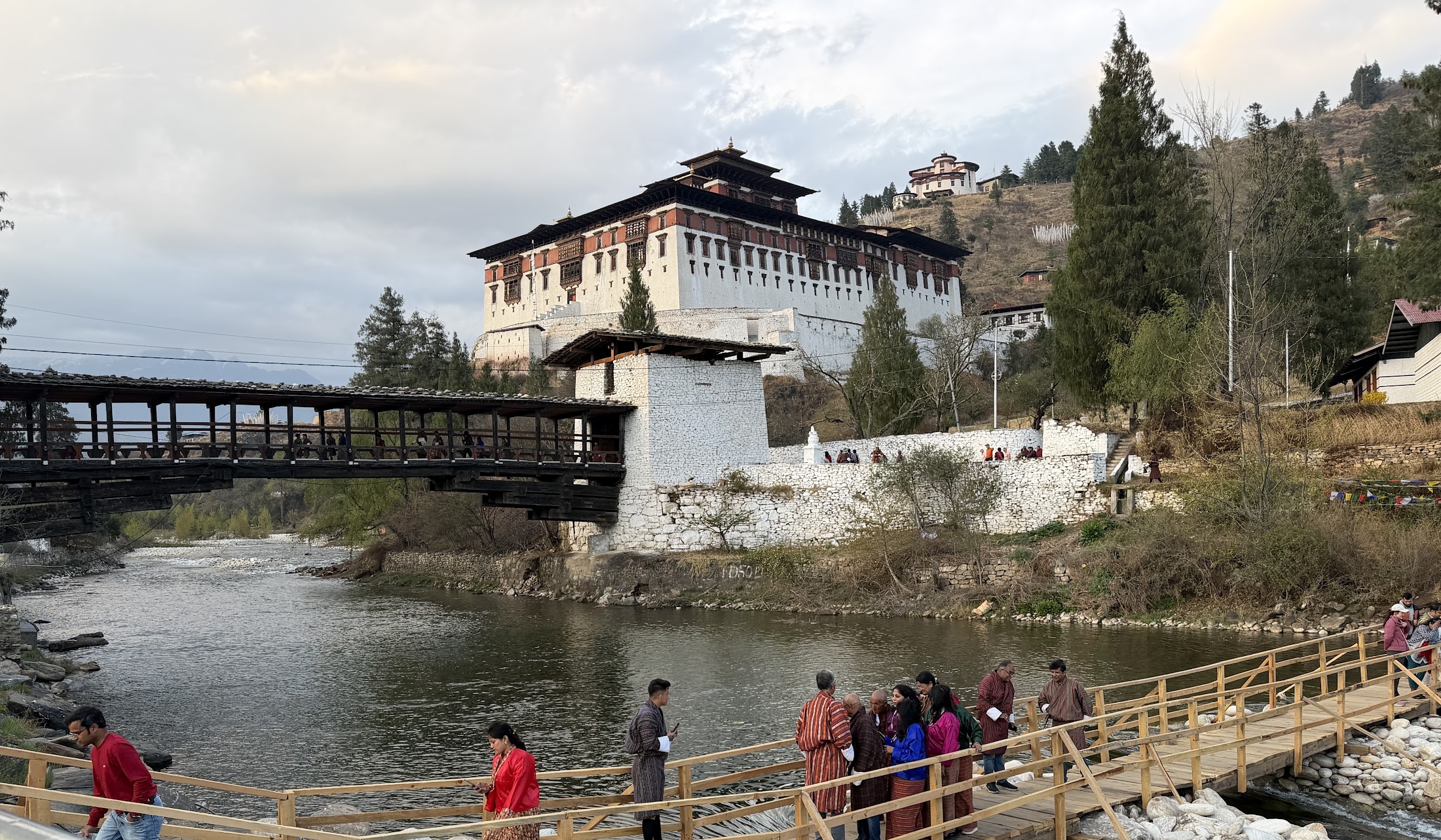
In the late afternoon, we walk across the covered cantilever bridge to the Rinpung Dzong, the fortress that guards the valley, and then climb a short path to the Ta Dzong watchtower, now the National Museum. The walk is about two kilometres with a gentle climb of about 100 m.
The guide briefs you on the full journey east, the long driving days and the Indian visa needed for the exit, and checks your documents. Dinner is at the hotel, a 3-star in the Paro valley, and the night is at about 2,250 m.
- TravelCar, 30-60 minutes
- Stay3-Star Hotel
- MealsLunch, Dinner
Day 2Tiger's Nest hike3,120 m
Today is the one real hike of the Across Bhutan Tour, to Paro Taktsang, the Tiger’s Nest monastery clinging to a cliff about 900 m above the valley floor. We drive twenty minutes to the trailhead at about 2,600 m and start walking early to beat the heat and the crowds.
The trail climbs steadily through blue pine and oak forest hung with prayer flags, about 500 m of height gain to the viewpoint and cafeteria. From there, a path with around 700 steps drops into a gorge, passes a waterfall and climbs again to the monastery gate at about 3,120 m.
Inside, the guide explains the story of Guru Rinpoche, who is said to have flown here on the back of a tigress in the eighth century. Bags and cameras are left at the gate, and the shrine rooms are quiet and dim.
The return takes about two hours, with lunch at the cafeteria on the way down. Total walking time is four to five hours over about eight kilometres; ponies are available for the uphill to the cafeteria.
In the evening we visit Kyichu Lhakhang, one of Bhutan’s oldest temples. The night is at the same hotel in Paro.
- TravelHiking, 4-6 hours
- Stay3-Star Hotel
- MealsBreakfast, Lunch, Dinner
Day 3Chele La and Haa valley3,988 m
We leave Paro after breakfast and climb for about an hour on a winding road to the Chele La, at about 3,988 m the highest point reached by road on the Across Bhutan Tour. On a clear morning, Jomolhari and Jichu Drake stand to the north above a sea of prayer flags.
A short walk along the ridge from the pass, about 30 minutes, gives wider views and the chance of seeing monal pheasants in the fir forest. The air is thin here, so walk slowly and drink plenty of water.
The road then drops into the Haa valley at about 2,700 m, one of the least visited corners of western Bhutan, opened to tourists only in 2002. We visit Lhakhang Karpo and Lhakhang Nagpo, the white and black temples said to date from the seventh century.
Lunch may be at a farmhouse, with buckwheat dishes typical of Haa, before a walk through the village and the return over the pass. The day has about four and a half hours of driving in total. Dinner and the night are at the same 3-star hotel in Paro, at about 2,250 m.
- TravelCar, 4-6 hours
- Stay3-Star Hotel
- MealsBreakfast, Lunch, Dinner
Day 4Paro to Thimphu2,350 m
The drive from Paro to Thimphu takes about an hour and a half along the Paro Chhu, past the iron chain bridge at Tamchog Lhakhang and the river confluence at Chuzom. Thimphu, at about 2,350 m, is the only capital in the world without traffic lights.
We spend the rest of the day on the city’s main sights. The giant Buddha Dordenma sits on a ridge above the valley, and the National Memorial Chorten draws older residents who walk its circuit with prayer wheels each day.
After lunch, the guide takes you to the Folk Heritage Museum, the School of Arts and Crafts, where students learn the thirteen traditional arts, and the takin preserve, home to Bhutan’s odd-looking national animal. Walking is light, about four kilometres spread across the day.
In the late afternoon, we visit Tashichho Dzong, the seat of government and the main monk body, when its courtyards open to visitors. The guide also collects the route permits for central and eastern Bhutan while we are in the capital. Dinner and the night are at a 3-star hotel in Thimphu.
- TravelCar, 1-3 hours
- Stay3-Star Hotel
- MealsBreakfast, Lunch, Dinner
Day 5Thimphu to Punakha1,250 m
We cross the Dochula at about 3,100 m on the way to Punakha, a drive of about three hours with stops. The pass has 108 chortens built in memory of soldiers, and on a clear morning the eastern Himalaya, including Gangkhar Puensum, lines the horizon.
From the pass, the road drops more than 1,800 m through oak and rhododendron forest into the warm Punakha valley at about 1,250 m. Rice terraces, orange trees and cactus replace the pine forest, and the air feels softer.
Before lunch, we walk about 30 minutes across rice fields to Chimi Lhakhang, the fertility temple of the Divine Madman, Drukpa Kunley. The village houses nearby are painted with his bold protective symbols, which our guide explains with good humour.
In the afternoon we visit Punakha Dzong, built in 1637 at the meeting of the Pho Chhu and Mo Chhu and the winter home of the monk body. A walk across the long suspension bridge nearby ends the day. Dinner and the night are at a 3-star hotel near Punakha.
- TravelCar, 1-3 hours
- Stay3-Star Hotel
- MealsBreakfast, Lunch, Dinner
Day 6Punakha to Phobjikha2,900 m
The road from Punakha climbs through Wangdue Phodrang and up into the Black Mountains to the Phobjikha valley, a drive of about three and a half hours. On the way, we stop at the new Wangdue Phodrang Dzong, rebuilt after a fire in 2012 above the river junction.
Phobjikha, at about 2,900 m, is a wide glacial valley of marsh, pine forest and potato fields. From late October to February it is the winter home of several hundred black-necked cranes from the Tibetan plateau, which local people hold sacred.
In the afternoon we visit Gangtey Monastery on its ridge above the valley, then walk the Gangtey nature trail, a gentle two-hour descent of about five kilometres through forest and open meadows to the valley floor. The Crane Information Centre has spotting scopes and a short film.
Phobjikha is colder than most stops on the tour, so pack a warm layer for the evening. Dinner and the night are at a 3-star hotel in the valley, with wood stoves or heaters in many rooms.
- TravelCar, 4-6 hours
- Stay3-Star Hotel
- MealsBreakfast, Lunch, Dinner
Day 7Phobjikha to Trongsa2,200 m
We leave Phobjikha over the Lawa La and join the lateral road east, climbing to the Pele La at about 3,420 m, the traditional border between western and central Bhutan. Yaks graze the dwarf bamboo slopes here, and the black mountains fall away on both sides.
Below the pass, the road follows a long valley past the village of Rukubji and its old monastery. We stop at Chendebji Chorten, a large white stupa built in the Nepali style in the eighteenth century, for a picnic or a roadside lunch.
The first view of Trongsa Dzong, across the deep gorge of the Mangde Chhu, is one of the great sights of the journey. The dzong, Bhutan’s largest, was the seat of the first two kings, and every crown prince still serves as Trongsa Penlop before taking the throne.
We visit the dzong and the Taa Dzong watchtower above it, now the Royal Heritage Museum. The drive is about four hours in total, at around 2,200 m in Trongsa. Dinner and the night are at a 3-star hotel facing the dzong.
- TravelCar, 4-6 hours
- Stay3-Star Hotel
- MealsBreakfast, Lunch, Dinner
Day 8Trongsa to Bumthang2,800 m
A shorter drive today, about two and a half hours over the Yotong La at about 3,425 m into Bumthang, the spiritual heartland of Bhutan. The district is made of four broad valleys, and their pine forests, buckwheat fields and old temples feel different from the steep west.
We stop at Chumey, the first valley, to watch weavers at the Zungney yathra workshops, where wool from local sheep becomes the striped textiles Bumthang is known for. The guide explains the patterns and the dyes, and there is no pressure to buy.
In the afternoon, we reach Jakar, the main town, at about 2,800 m, and walk up to Jakar Dzong, the castle of the white bird, which overlooks the Chamkhar valley. The walk is about 20 minutes each way on a gentle slope.
The evening is free to stroll the main street or visit a small local brewery, which makes Bhutan’s own beer, and a cheese factory with Swiss roots. Dinner and the night are at a 3-star hotel in Jakar, with wood stoves in many rooms, at about 2,800 m.
- TravelCar, 1-3 hours
- Stay3-Star Hotel
- MealsBreakfast, Lunch, Dinner
Day 9Bumthang temples2,800 m
The day is spent among the temples of the Chokhor valley, all within a short drive or walk of Jakar. We start at Jambay Lhakhang, believed to date from the seventh century and one of 108 temples said to have been built in a single day by the Tibetan king Songtsen Gampo.
Next is Kurjey Lhakhang, where Guru Rinpoche is said to have meditated and left his body print in the rock. Three temples stand together here, and the cypress tree beside them is said to have grown from his walking stick.
From Kurjey, we cross the Chamkhar Chhu on a suspension bridge and walk about 30 minutes to Tamshing Lhakhang, founded by the treasure revealer Pema Lingpa in 1501, which holds some of the oldest wall paintings in the country.
In the afternoon, we drive into the Tang valley to Mebar Tsho, the Burning Lake, a pool in the river gorge where Pema Lingpa is said to have found sacred treasures. The day has about six kilometres of easy walking. Dinner and the night are at the same 3-star hotel in Jakar.
- TravelCar, 30-60 minutes
- Stay3-Star Hotel
- MealsBreakfast, Lunch, Dinner
Day 10Bumthang to Mongar1,600 m
Today the Across Bhutan Tour crosses into the east, on one of the most spectacular roads in the Himalaya. We leave Jakar early and climb through the Ura valley to the Thrumshing La at about 3,750 m, the highest pass on the lateral road and the gateway to eastern Bhutan.
The forest of the Thrumshing La National Park is thick with fir, rhododendron and bamboo, and mist often hangs on the pass. On a clear day, Gangkhar Puensum, the highest unclimbed mountain in the world, can be seen to the north.
Beyond the pass, the road drops nearly 3,000 m to the Kuri Chhu at about 650 m, cut into steep cliffs above the gorge. It is a long, winding descent with sharp bends, and we stop often for views, tea and to stretch our legs.
From the river, we climb again to Mongar at about 1,600 m, a hillside town and the first in Bhutan built on a ridge rather than a valley floor. The drive takes seven to eight hours. Dinner and the night are at the best available hotel in Mongar.
- TravelCar, 7-9 hours
- StayTourist Standard Hotel
- MealsBreakfast, Lunch, Dinner
Day 11Mongar to Trashigang1,100 m
After the long day, the drive to Trashigang is shorter, about three hours over the Kori La at about 2,400 m. In the morning, we visit Mongar Dzong, built in the 1950s without drawings or nails in the traditional way, which our guide points out in its joints and beams.
The Kori La has a small chorten and prayer flags, and the forest here is good for a short walk among rhododendron and oak. Beyond it, the road drops through maize and rice fields toward the Drangme Chhu, the largest river in eastern Bhutan.
We pass the village of Yadi and its famous zigzag road before reaching the river at Chazam, where a bridge crosses near the site of an older one built in the fifteenth century. Trashigang then appears on its hillside, at about 1,100 m.
In the afternoon, we visit Trashigang Dzong, perched on a spur above the confluence of two rivers, and walk through the small town where Brokpa herders from Merak and Sakteng sometimes trade in their red felt dress. Dinner and the night are at the best available hotel in Trashigang.
- TravelCar, 1-3 hours
- StayTourist Standard Hotel
- MealsBreakfast, Lunch, Dinner
Day 12Trashiyangtse day trip1,100 m
Today we drive north for about two hours into the Trashiyangtse valley, one of the quietest and greenest corners of Bhutan. On the way, we stop at Gom Kora, a temple on the bank of the Drangme Chhu where Guru Rinpoche is said to have subdued a demon trapped in a black rock.
In Trashiyangtse, at about 1,850 m, we visit Chorten Kora, a large white stupa built in the eighteenth century in the style of Boudhanath in Kathmandu. Pilgrims from Bhutan and the Indian state of Arunachal Pradesh walk its circuit, especially at the spring festival.
The valley is known for its craft schools. We stop at the Institute for Zorig Chusum, where students learn painting, carving and lacquer work, and see the wooden bowls, called dapa, that local families turn from maple and walnut burls.
After a picnic or village lunch, we drive back to Trashigang by late afternoon. The day has about four hours of driving and light walking. Dinner and a second night are at the same hotel in Trashigang, at about 1,100 m.
- TravelCar, 1-3 hours
- StayTourist Standard Hotel
- MealsBreakfast, Lunch, Dinner
Day 13Trashigang to Samdrup Jongkhar250 m
The last long drive of the Across Bhutan Tour runs south for about 180 km, from Trashigang down to Samdrup Jongkhar on the Indian border. We leave after breakfast and climb first to Kanglung, home of Sherubtse College, the oldest college in Bhutan.
Further on, at Khaling, we stop at the weaving centre, where women produce the fine silk and cotton textiles eastern Bhutan is famous for. The road then crosses a ridge at about 2,400 m before dropping through dense subtropical forest toward the plains.
The descent is long and winding, and the air grows warmer with every bend. Bananas, betel palms and bamboo take over from the pine of the hills, and the views open south over the Brahmaputra plain.
Samdrup Jongkhar, at about 250 m, is a busy border town with a small dzong and a Zangdopelri temple. The drive takes seven to eight hours with stops. This is our last night in Bhutan, so we share a farewell dinner with the guide and driver at the best available hotel in town.
- TravelCar, 7-9 hours
- StayTourist Standard Hotel
- MealsBreakfast, Lunch, Dinner
Day 14Samdrup Jongkhar to Guwahati55 m
After breakfast, the guide helps with the Bhutan exit formalities at the border gate, and you complete Indian immigration with your Indian visa. This usually takes under an hour, depending on queues, and the guide stays with you until you are cleared.
From the border, the vehicle continues for about three hours across the flat Assam plain to Guwahati, the largest city in northeast India, on the banks of the Brahmaputra. Tea gardens, rice paddies and busy market towns line the road.
The guide hands you over at the hotel in Guwahati, at about 55 m. The rest of the day is free; many travellers visit the Kamakhya Temple on Nilachal Hill or take an evening walk along the river.
Breakfast is included today, and lunch and dinner in Guwahati are at your own choice and cost. The night is at a 3-star hotel in Guwahati. If you would rather fly onward on the same day, tell us when you book so we can plan the timing around your flight.
- TravelCar, 1-3 hours
- Stay3-Star Hotel
- MealsBreakfast
Day 15Depart Guwahati55 m
The Across Bhutan Tour ends in Guwahati after breakfast. Our driver takes you to Lokpriya Gopinath Bordoloi International Airport, about an hour from the city centre depending on traffic, in good time for your flight.
Guwahati has direct flights to Delhi, Kolkata, Mumbai, Bangkok and other cities, so most onward connections are easy. Allow at least three hours for domestic and four for international departures, since city traffic can be slow.
If you have a late flight, the hotel can usually hold your bags after checkout, and there is time for a short visit to Umananda, a temple on a small island in the Brahmaputra reached by ferry.
Across fifteen days, you will have crossed Bhutan from its western airport to its southeastern border, over seven high passes and through almost every district on the lateral road. Thank you for travelling with us. We would be glad to plan your next trip, whether a trek in Bhutan or a journey in Nepal or Tibet.
- TravelCar, 30-60 minutes
- MealsBreakfast
What's included
Included in the price
- Bhutan visa: the visa application and US$ 40 fee
- Sustainable Development Fee: US$ 100 per person for each of the 13 nights in Bhutan
- Guide: a licensed English-speaking Bhutanese guide for the whole journey
- Vehicle: a private vehicle with driver from Paro to Guwahati
- Arrival transfer: Paro airport to the hotel
- Border exit: help with exit formalities at Samdrup Jongkhar
- Guwahati: the drive to Guwahati, one hotel night and the airport transfer
- Hotels: 3-star rooms in the west and the best available hotels in the east, twin share
- All meals in Bhutan: breakfast, lunch and dinner
- Breakfast in Guwahati
- Route permits: permits for central and eastern Bhutan
- Entrance fees: dzongs, temples and museums on the itinerary
- Haa day trip: over the Chele La
- Drinking water: bottled water in the vehicle
- Support: 24-hour contact with our team during the tour
Not included
- International flights into Paro and out of Guwahati
- Indian visa, needed to exit through Samdrup Jongkhar to Guwahati
- Travel insurance with medical cover and evacuation
- Single supplement for your own room
- Lunch and dinner in Guwahati
- Drinks other than water, tea and coffee
- Extra nights from road closures or flight changes
- Camera fees where a site charges them
- Tips for the guide and driver
- Personal costs such as souvenirs, laundry and phone cards
Dates and price
These are our fixed group dates. Prices change with the season, so each date shows its own price. Please book at least 30 days ahead, so we have time to arrange your Bhutan visa.
US$ 3,835per person
| Starts | Ends | Status | Price | Book |
|---|---|---|---|---|
| Departs: Fixed group dates. Book your date | ||||
Trip information
Price by Group Size
| Group size | Price per person |
|---|---|
| 1 traveller (private) | US$ 4,790 |
| 2 travellers | US$ 3,835 |
| 3 to 5 travellers | US$ 3,450 |
| 6 to 12 travellers | US$ 3,195 |
To book: choose a departure below and pay a 20% deposit. The balance is due before we lodge your Bhutan visa, about 30 days before you fly. Apply for your Indian visa early, since you need it to exit by road.
Joining alone: solo travellers can join any group date and pay the rate for the group that travels; once six or more are booked, we refund the difference.
Private tour: the Across Bhutan Tour runs privately on any date in the season, and it can be reversed to start in Guwahati and finish in Paro.
Not in the price: international flights, the Indian visa, insurance, drinks and tips. Thirteen nights of Bhutan’s SDF, US$ 1,300 per person, are already included.
Best Time to Visit
We run group departures of the Across Bhutan Tour on the 1st, 11th and 21st from March to May and from September to November. These are the clearest and driest months for a long road journey.
Spring brings rhododendrons on the passes, warm days in the valleys and the Paro and Ura festivals around April and May. Haze can soften the mountain views in late spring, but the forests are at their greenest.
Autumn, from late September to November, gives the sharpest views and the main festival season, with tshechus in Thimphu, Jakar, Mongar and Trashigang. Cranes arrive in Phobjikha from late October.
We avoid the monsoon, when landslides can close the lateral road for hours or days, and midwinter, when snow sometimes blocks the Thrumshing La. Private dates outside our seasons can be discussed.
Difficulty and Fitness
The Across Bhutan Tour is easy in walking terms, with one harder day: the Tiger’s Nest hike, a climb of about 500 m that takes four to five hours return. Every other walk is short and gentle.
The challenge is time in the vehicle. The longest days, Bumthang to Mongar and Trashigang to Samdrup Jongkhar, have six to seven hours of driving on winding roads with frequent bends.
If you suffer from motion sickness, bring tablets and sit at the front. We stop every hour or so for tea, views and short walks, and the guide adjusts the pace for the group.
Several passes are high, the highest being the Chele La at about 3,988 m, but we only stop there briefly. The tour suits most adults in reasonable health and older travellers who are comfortable with long drives.
Food, Water and Dietary Needs
All meals in Bhutan are included on the Across Bhutan Tour. Breakfast and dinner are at the hotels, and lunch is often at a roadside restaurant chosen for its kitchen, since towns in the east are far apart.
Food mixes Bhutanese dishes such as red rice, ema datshi and kewa datshi with milder Indian, Chinese and continental options. In the east, look for buckwheat noodles in Bumthang and local cheese dishes in Trashigang.
Vegetarian, vegan and gluten-free meals can be arranged with notice. Tell us about allergies at booking, so the guide can brief each kitchen ahead of time.
Tap water is not safe to drink. Bottled water is in the vehicle, and the guide can refill a flask with boiled water at the hotels. In Guwahati, only breakfast is included.
Altitude, Health and Safety
Nights on the Across Bhutan Tour range from about 250 m at Samdrup Jongkhar to about 2,900 m in Phobjikha, so altitude sickness is rare. The high passes are crossed by vehicle, with only short stops.
The southern border town and Guwahati are hot and humid, especially in late spring, and mosquitoes are common. Bring repellent and light clothing, and ask your doctor about advice for travel in Assam.
Roads are narrow and winding, and roadworks and landslides can cause delays. Our drivers know the lateral road well, and the guide checks road reports each evening before the long days.
There are hospitals in Paro, Thimphu, Punakha, Trongsa, Jakar, Mongar and Trashigang. Your insurance should include medical cover and evacuation.
Local Etiquette
The Across Bhutan Tour visits many active dzongs and temples. Wear long sleeves and long trousers or skirts, remove hats and shoes in shrine rooms, and do not photograph inside.
Walk around chortens, prayer wheels and mani walls clockwise, and do not point your feet at altars or monks. At Chorten Kora and Gom Kora, local pilgrims walk the circuit; join them quietly if you like.
Eastern Bhutan sees few visitors, and people are curious and friendly. Ask before photographing villagers, especially weavers at work, and accept tea when it is offered.
Greet people with “kuzuzangpo la”. Smoking in public places is restricted, and tipping the guide and driver at the end is customary but never expected.
Offer and receive gifts or money with your right hand, or with both hands for respect.
Visa, Permits and Documents
Everyone except Indian, Bangladeshi and Maldivian nationals needs a Bhutan visa, arranged by a licensed operator. We apply for your Across Bhutan Tour visa once the balance is paid.
We need a passport scan, valid six months beyond arrival, and a passport photo. The visa costs US$ 40 and the SDF is US$ 100 per person per night until 31 December 2029; both are included.
Because the tour exits by road into Assam, most nationalities also need an Indian visa, usually an e-visa, which you arrange yourself. The guide helps with the Bhutan exit and the Indian immigration check at the border.
Route permits for central and eastern Bhutan are arranged by us in Thimphu. Print the visa clearance letter and your Indian visa. Official Bhutan rules are on bhutan.travel.
Transport, Money and Connectivity
You fly into Paro on Drukair or Bhutan Airlines and fly out of Guwahati, which has direct flights to Delhi, Kolkata, Bangkok and other cities. Within Bhutan, a private vehicle and driver take you the whole way.
The lateral road runs about 550 km from Thimphu to Trashigang, and a further 180 km south to Samdrup Jongkhar. Most driving days are four to seven hours, with regular stops.
The ngultrum is Bhutan’s currency, tied to the Indian rupee, and rupees are accepted in Bhutan. Bring clean US dollar notes to change at Paro, since cards rarely work in the east. ATMs are in the main towns.
Mobile signal covers most towns but fades on passes. Hotel Wi-Fi is basic in the east. A local SIM card from Paro is the most reliable option for the journey.
Questions about this trip
How much does the Across Bhutan Tour cost?
The Across Bhutan Tour costs from US$ 3,195 per person in a group of six to twelve, US$ 3,450 for three to five, US$ 3,835 for two and US$ 4,790 for a private solo traveller. The price includes the Bhutan visa, thirteen nights of SDF, guide, vehicle, hotels, meals in Bhutan and a night in Guwahati.
How long is the Across Bhutan Tour?
The Across Bhutan Tour is 15 days and 14 nights, with thirteen nights in Bhutan and one in Guwahati. It starts with the flight into Paro and ends with a flight out of Guwahati in Assam, after crossing the whole country by road from west to east and then south to the Indian border.
What is the route of the Across Bhutan Tour?
The Across Bhutan Tour runs from Paro and Haa through Thimphu, Punakha, Phobjikha, Trongsa and Bumthang, then over the Thrumshing La to Mongar, Trashigang and Trashiyangtse. From Trashigang it turns south to Samdrup Jongkhar on the border and crosses into India for the drive to Guwahati.
What is the best time for the Across Bhutan Tour?
The best time for the Across Bhutan Tour is March to May and September to November. These months bring the clearest roads, mild weather and the main festival seasons. We avoid the monsoon, when landslides can close the lateral road, and midwinter, when snow sometimes blocks the Thrumshing La.
Do I need an Indian visa for the Across Bhutan Tour?
Yes, most travellers need an Indian visa for the Across Bhutan Tour, because it exits Bhutan by road at Samdrup Jongkhar into Assam and finishes in Guwahati. Many nationalities can apply for an Indian e-visa online. The Indian visa is not included, so apply well before you travel.
Is the Bhutan visa included in the Across Bhutan Tour?
Yes, the Across Bhutan Tour includes the Bhutan visa and its US$ 40 fee. We apply once the balance is paid, about 30 days before travel, using a scan of your passport and a photo. The visa clearance letter comes by email, and the visa is stamped when you land in Paro.
Is the SDF included in the Across Bhutan Tour price?
Yes, the Sustainable Development Fee is included in the Across Bhutan Tour price. It is US$ 100 per person per night until 31 December 2029, and the tour spends thirteen nights in Bhutan, so US$ 1,300 per person is already counted in every tier of the price table. The Guwahati night has no SDF.
How much driving is there on the Across Bhutan Tour?
The Across Bhutan Tour covers roughly 900 km by road. Most days have three to five hours of driving with stops, and the longest, Bumthang to Mongar and Trashigang to Samdrup Jongkhar, take seven to eight hours. Roads are winding but scenic, and we stop every hour or so for tea and views.
Is the Across Bhutan Tour physically hard?
The Across Bhutan Tour is easy, with short walks at most stops. The one demanding day is the Tiger’s Nest hike, a climb of about 500 m that takes four to five hours return, with ponies available for part of the way up. The main challenge is the long time spent in the vehicle.
Is the Across Bhutan Tour good for older travellers?
Yes, the Across Bhutan Tour suits older travellers who are comfortable with long drives. Walking is light, nights are below 3,000 m, and the guide sets a relaxed pace. The Tiger’s Nest hike is optional; anyone who prefers can view the monastery from the cafeteria or spend the morning in Paro instead.
What hotels are used on the Across Bhutan Tour?
The Across Bhutan Tour uses 3-star hotels in Paro, Thimphu, Punakha, Phobjikha, Trongsa and Bumthang, and the best available hotels in Mongar, Trashigang and Samdrup Jongkhar, where choices are simpler. The Guwahati night is at a 3-star hotel. Rooms are twin share with private bathrooms.
What food is included on the Across Bhutan Tour?
All meals in Bhutan are included on the Across Bhutan Tour: breakfast and dinner at the hotels and lunch at restaurants on the road. Food mixes Bhutanese dishes such as ema datshi and red rice with Indian, Chinese and continental options. In Guwahati, breakfast is included and other meals are your own.
Why does the Across Bhutan Tour end in Guwahati?
The Across Bhutan Tour ends in Guwahati because driving back to Paro from the far east would take three or four extra days on the same road. Guwahati is about three hours from the Samdrup Jongkhar border and has direct flights to Delhi, Kolkata, Bangkok and other cities.
Can the Across Bhutan Tour start in Guwahati instead?
Yes, a private Across Bhutan Tour can run in reverse, starting in Guwahati and entering Bhutan at Samdrup Jongkhar, then finishing with a flight out of Paro. The reverse route works well for travellers already in northeast India. Group departures run from Paro, as shown on this page.
Which festivals can I see on the Across Bhutan Tour?
Some Across Bhutan Tour departures can meet a festival, such as Paro Tshechu or Ura Yakchoe in spring and Thimphu, Jakar, Mongar or Trashigang Tshechu in autumn. Festival dates follow the lunar calendar and change each year, so ask us which departures overlap one before you book.
How many travellers join the Across Bhutan Tour?
The Across Bhutan Tour runs for two to twelve travellers, and groups are usually small since few people cross the whole country. Larger groups use two vehicles so everyone has a window seat. A private tour for one traveller is also possible at the solo rate in the price table.
Can I join the Across Bhutan Tour on my own?
Yes, solo travellers can join any group date of the Across Bhutan Tour. You pay the rate for the group size that travels, and once six or more are booked we refund the difference. A single room supplement applies if you want your own room, otherwise we pair you with a traveller of the same sex.
How do I book the Across Bhutan Tour?
To book the Across Bhutan Tour, choose a departure on this page and pay a 20% deposit through our secure booking checkout. The balance is due before we lodge your Bhutan visa, about 30 days before travel. Apply for your Indian visa as soon as your dates are confirmed.
What should I pack for the Across Bhutan Tour?
For the Across Bhutan Tour, pack layers for a wide range of temperatures, from cold passes near 4,000 m to the humid plains at the border. Bring a warm jacket, fleece, light shirts, a rain shell, comfortable shoes for the Tiger’s Nest hike, sun protection, repellent and modest clothing for temples.
Is there mobile signal on the Across Bhutan Tour?
Mobile signal covers most towns on the Across Bhutan Tour but drops on the passes and in remote stretches of the lateral road. Hotel Wi-Fi works in Paro and Thimphu but is basic in the east. A local SIM card bought in Paro is the most reliable way to stay connected on the road.
What money should I bring on the Across Bhutan Tour?
On the Across Bhutan Tour, bring clean US dollar notes to change into ngultrum at Paro, plus some Indian rupees, which are accepted in Bhutan and needed in Guwahati. Cards work in some Paro and Thimphu shops but rarely in the east. ATMs are found in the main towns.
Is eastern Bhutan safe on the Across Bhutan Tour?
Yes, eastern Bhutan is safe on the Across Bhutan Tour, with very low crime and friendly people who see few visitors. The main risks are road delays from landslides or roadworks. Our guide checks road reports each evening and adjusts the start time to keep the long days on schedule.
What makes the Across Bhutan Tour different from shorter tours?
The Across Bhutan Tour goes far beyond the western valleys most visitors see, crossing the Thrumshing La into the east, where weaving villages, Chorten Kora and the Trashigang dzong receive few tourists. It shows the whole country in one continuous journey, without flying back over the ground just covered.
Can I add a trek or Nepal to the Across Bhutan Tour?
Yes, the Across Bhutan Tour can be combined with a short trek, such as the Bumdra or Druk Path, at the start in Paro, or with Nepal by flying from Kathmandu to Paro. From Guwahati, you can also connect to Kathmandu via Delhi or Kolkata. Ask us and we will plan the dates and buffer nights.
Reading for this trip
Ask us about the Across Bhutan Tour
We reply from Kathmandu within 24 hours with available dates, your exact price and answers to your questions.
- 16 years guiding in the Himalaya
- Registered in Nepal, Reg. 187391
- Group departures of 12 travelers at most
- Private dates on any day
Call, WhatsApp or Viber
Across Bhutan Tour, from US$ 3,195 per person. Dates and booking at treknepalhimalayas.com/trip/across-bhutan-tour/
Trek Nepal Himalayas Pvt Ltd, Reg. 187391. Bhagawatisthan, Thamel, Kathmandu, Nepal. Call or WhatsApp +977 98510 13196. [email protected]