Royal Manas Wildlife Tour
Our trips are rated 5 out of 5 in more than 950 traveler reviews.
Trip overview
Our Royal Manas Wildlife Tour is a 10-day journey from Paro across central Bhutan and south to Royal Manas National Park, the country’s oldest protected area, finishing in Guwahati in India. It includes the Bhutan visa, Sustainable Development Fee, guide, private vehicle, hotels, all meals in Bhutan and the drive to Guwahati.
It suits nature lovers who want to see a side of Bhutan most visitors never reach: the warm subtropical forest of the south, where the Himalayan foothills meet the plains of Assam. Royal Manas borders Manas National Park in India, and together they form one of the largest protected forest areas in the eastern Himalaya.
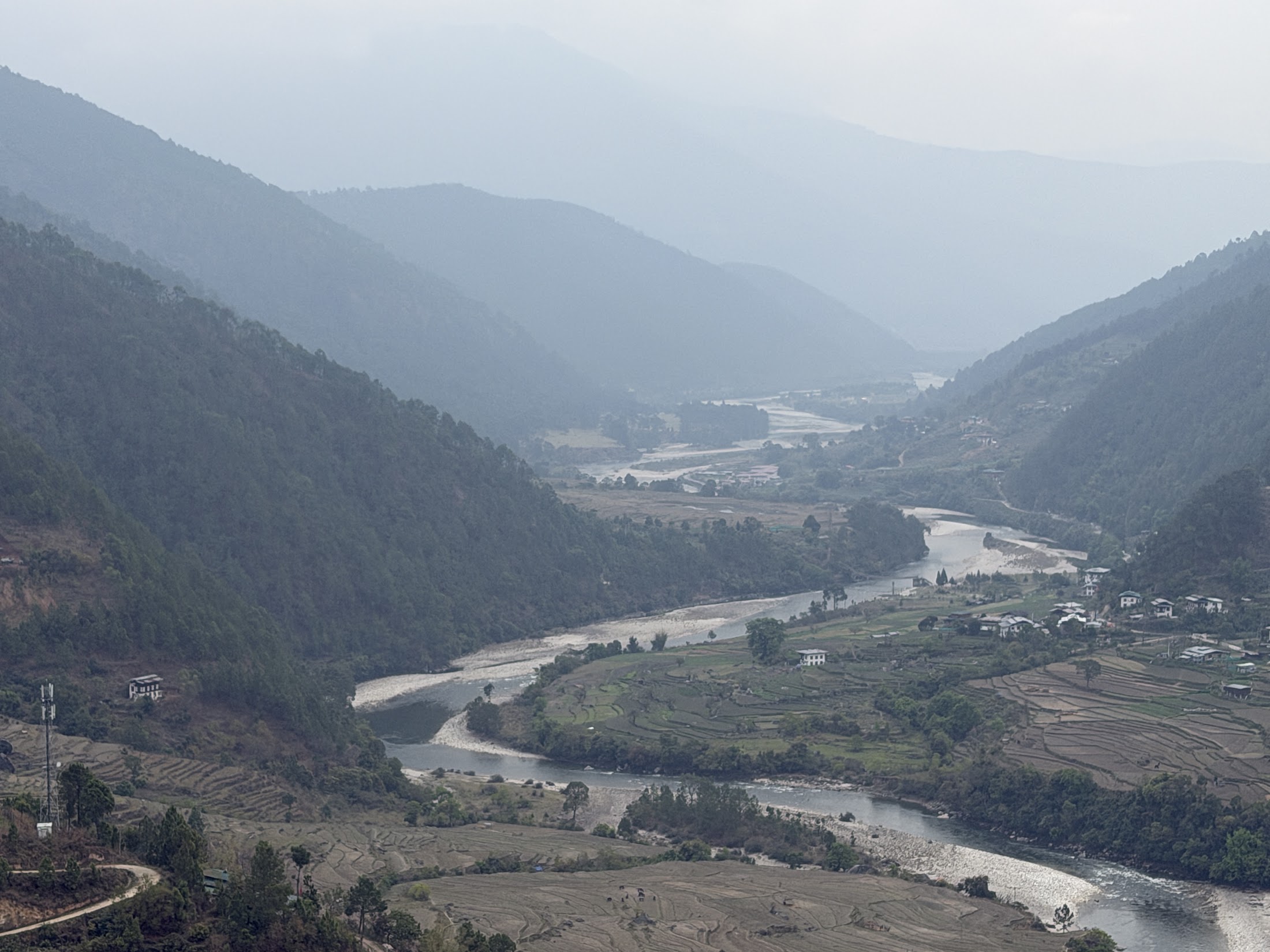
We travel by road through Punakha and Trongsa, then drop through the Mangde Chhu gorge to Tingtibi, where golden langur live in the roadside forest. Two nights at Panbang, on the Manas river, give a full day and two mornings for the park.
The honest part: Royal Manas is a forest park, not an open savannah. Tigers, elephants and clouded leopards live here but are rarely seen, roads are long and winding, and the lodges in the south are simple.
The reward is a quiet, wild corner of Bhutan with golden langur, hornbills, river birds and the chance of elephant or gaur, plus the great dzongs and passes of the centre on the way.
Prices start at US$ 2,250 per person in a group of six or more and US$ 2,700 each for two. For more birds, see our Bhutan Birdwatching Tour, or our Southern Bhutan Tour for the border towns.
Highlights
- Royal Manas National Park, Bhutan’s oldest protected area
- Two nights at Panbang on the Manas river
- Golden langur in the forests around Tingtibi and Zhemgang
- Hornbills and river birds in the subtropical south
- Punakha Dzong at the meeting of two rivers
- Trongsa Dzong, the largest fortress in Bhutan
- The Dochula and Pele La passes on the way east
- Exit through Gelephu to Guwahati, with no backtracking
Itinerary
Altitude profile
By road
The altitude listed for each day, from 55 m to 2,250 m. Select a point to read that day.
The highest point on the route is 3,420 m.
- Nights
- 6 nights in tourist standard hotels, 3 nights in 3-star hotels
- Meals in the price
- 9 breakfasts, 8 lunches, 8 dinners
- On the move
- 10 days by road
Day 1Arrive in Paro2,250 m
The Royal Manas Wildlife Tour begins with the flight into Paro, one of the most dramatic landings in Asia between steep, forested ridges. Our guide meets you outside the terminal at about 2,250 m and drives you the short distance to the hotel.
After lunch, the afternoon is gentle so your body can settle to the height. We walk across the covered cantilever bridge to the Rinpung Dzong, the fortress that guards the valley, and then up to the National Museum in the old Ta Dzong watchtower.
The walk is about two kilometres with a climb of about 100 m. On the way, the guide points out the valley’s farmhouses, painted with traditional symbols, and the river birds along the Paro Chhu, which give a first taste of the wildlife to come.
In the evening, the guide briefs you on the route south, the long driving days, the park and the Indian visa needed for the exit at Gelephu, and checks your documents. Dinner is at the hotel, a 3-star in the Paro valley, and the night is at about 2,250 m.
- TravelCar, 30-60 minutes
- Stay3-Star Hotel
- MealsLunch, Dinner
Day 2Paro to Punakha via Thimphu1,250 m
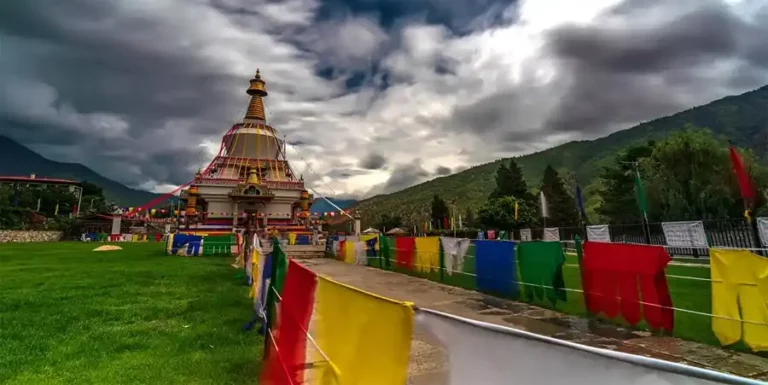
Today we drive east from Paro to Thimphu, about an hour and a half along the Paro Chhu and Wang Chhu, and stop in the capital for the National Memorial Chorten and the giant Buddha Dordenma on its ridge above the city.
From Thimphu, the road climbs to the Dochula at about 3,100 m, where 108 chortens stand on the pass. On a clear winter morning, the eastern Himalaya lines the horizon, and the oak and rhododendron forest is good for birds such as laughingthrushes and fulvettas.
The road then drops more than 1,800 m into the warm Punakha valley at about 1,250 m. On the Pho Chhu, the guide watches for the white-bellied heron, one of the rarest birds in the world, which feeds on this river in small numbers.
In the afternoon, we visit Punakha Dzong, built in 1637 at the meeting of the Pho Chhu and Mo Chhu, and walk across the long suspension bridge nearby. The drive totals about four and a half hours. Dinner and the night are at a 3-star hotel near Punakha.
- TravelCar, 4-6 hours
- Stay3-Star Hotel
- MealsBreakfast, Lunch, Dinner
Day 3Punakha to Trongsa2,200 m
The Royal Manas Wildlife Tour heads east into central Bhutan today, a drive of about five hours with stops. We pass Wangdue Phodrang and climb through oak and rhododendron forest to the Pele La at about 3,420 m, the highest point of the journey.
The dwarf bamboo slopes around the pass are home to yaks in summer and, in the forest below, to Himalayan monal and other pheasants. The guide stops for a short walk if the weather is clear and the birds are active.
Below the pass, the road follows a long valley past Rukubji village to Chendebji Chorten, a white stupa built in the Nepali style, where we stop for lunch. The forest here holds macaques and, sometimes, grey langurs.
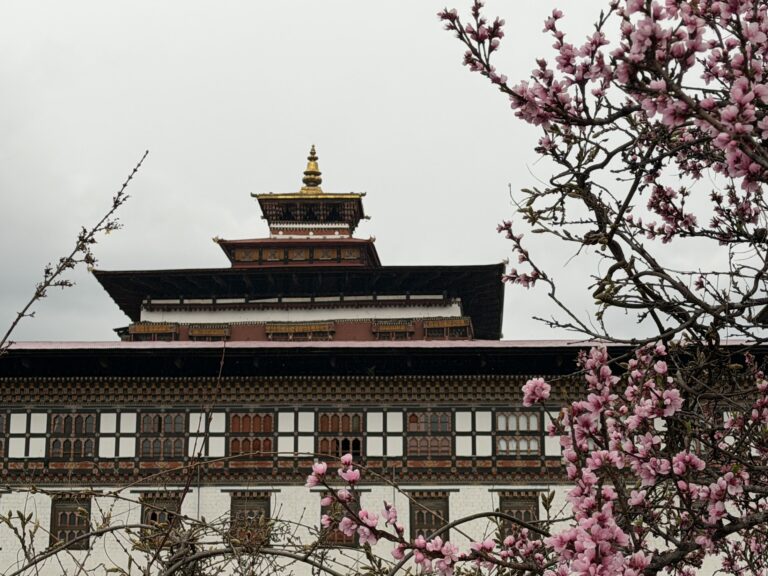
The first view of Trongsa Dzong across the Mangde Chhu gorge is a highlight of the day. We visit the dzong, Bhutan’s largest, and the watchtower museum above it.
Trongsa sits at about 2,200 m. Dinner and the night are at the best available hotel facing the dzong.
- TravelCar, 4-6 hours
- StayTourist Standard Hotel
- MealsBreakfast, Lunch, Dinner
Day 4Trongsa to Tingtibi650 m
Today the Royal Manas Wildlife Tour turns south, and the change is dramatic. From Trongsa at about 2,200 m, the road follows the Mangde Chhu gorge down through Zhemgang to Tingtibi at about 650 m, a descent of more than 1,500 m in about four to five hours.
The forests along this road are among the richest in Bhutan for primates. Golden langur, a pale golden monkey found only in Bhutan and a small part of Assam, lives in the trees here, and the guide watches the canopy closely for troops feeding by the road.
Capped langur and Assamese macaque also live in these forests, and the birds change with the altitude, from laughingthrushes higher up to hornbills, barbets and green pigeons lower down. We stop wherever the canopy is active.
The air grows warmer and more humid as we descend, so swap your fleece for a light shirt. Tingtibi is a small roadside town on the river, and the night is at the best available lodge, simple but clean, with home-style dinner.
- TravelCar, 4-6 hours
- StayTourist Standard Hotel
- MealsBreakfast, Lunch, Dinner
Day 5Tingtibi to Panbang200 m
We continue south toward Royal Manas today, a drive of about four hours on a quieter road through the subtropical forest of Zhemgang district. The road follows ridges and valleys with long views over unbroken forest toward the plains of Assam.
The guide stops for wildlife on the way, especially golden langur, which are often seen along this road, and birds such as hornbills, drongos and sunbirds. Small Kheng villages with bamboo houses and orange trees appear between the forest stretches.
Panbang, at about 200 m, sits near the Manas river, close to the edge of Royal Manas National Park. It is a small, friendly settlement and the base for visits to the park from the Bhutan side.
We arrive in time for a walk along the river in the late afternoon, when birds are active and the light is soft. The guide meets our local park guide and plans the next two days. Dinner and the night are at the best available lodge in Panbang.
- TravelCar, 4-6 hours
- StayTourist Standard Hotel
- MealsBreakfast, Lunch, Dinner
Day 6Royal Manas National Park200 m
This is the main wildlife day of the Royal Manas Wildlife Tour. We start at dawn, when the forest is coolest and animals are most active, and head into Royal Manas National Park with our local park guide.
Royal Manas covers about 1,000 square km of subtropical and broadleaf forest, grassland and river, and is home to tiger, Asian elephant, gaur, clouded leopard, golden langur and several hundred recorded bird species. Most large animals are shy, so sightings are a matter of patience and luck.
Depending on the season, water levels and park rules, the day combines forest walks, time by the river and a boat crossing or drive to viewpoints. Rufous-necked and great hornbills are among the birds the guide looks for, along with kingfishers and river terns.
We return to the lodge for lunch and a rest in the heat of the day, then go out again in the late afternoon until dusk. The day includes about three to four hours of easy walking. Dinner and the night are at the same lodge in Panbang.
- TravelCar, 1-3 hours
- StayTourist Standard Hotel
- MealsBreakfast, Lunch, Dinner
Day 7Second day at Royal Manas200 m
A second day at Royal Manas gives more chances for wildlife and a slower pace. We go out again at dawn, often to a different part of the park or riverbank, since animals move with the season and the guide adjusts to recent sightings.
The Manas river is wide and fast here, and the opposite bank is Manas National Park in Assam, part of the same forest. Elephants sometimes cross between the two parks, and the guide scans the riverbanks for tracks and movement.
Later in the morning, we visit Panbang village to meet local families and see how they live alongside the park, farming, fishing and running small community tourism projects. Rafting on the Manas is sometimes offered locally as an optional extra.
The afternoon is free for a last walk, birding by the river or rest. In the evening, we share a farewell dinner with the park guide at the lodge. The night is our second at Panbang, at about 200 m.
- TravelCar, 1-3 hours
- StayTourist Standard Hotel
- MealsBreakfast, Lunch, Dinner
Day 8Panbang to Gelephu250 m
After a last early walk by the river, we leave Panbang and drive back north to Tingtibi, then south on the main road to Gelephu on the Indian border. The drive takes about five to six hours with stops for wildlife and lunch.
The road from Tingtibi to Gelephu runs through more lowland forest, with another good chance of golden langur and hornbills. The guide stops wherever there is movement in the canopy, so this is a wildlife day as much as a travel day.
Gelephu, at about 250 m, is one of Bhutan’s main border towns, set on the plains below the foothills. It is warm, flat and busy, and a planned special economic zone around the town means building work is under way in places.
In the late afternoon, we visit the local market and, if time allows, the hot springs area outside town. This is our last night in Bhutan, so we share a farewell dinner with the guide and driver. The night is at the best available hotel in Gelephu.
- TravelCar, 4-6 hours
- StayTourist Standard Hotel
- MealsBreakfast, Lunch, Dinner
Day 9Gelephu to Guwahati55 m
After breakfast, the guide helps with the Bhutan exit formalities at the Gelephu border gate, and you complete Indian immigration with your Indian visa. This usually takes under an hour, and the guide stays with you until you are cleared.
From the border, the vehicle continues across the flat Assam plain to Guwahati, the largest city in northeast India, on the banks of the Brahmaputra. The drive takes about five hours through rice fields, tea gardens and busy market towns.
The guide hands you over at the hotel in Guwahati, at about 55 m. The rest of the day is free; many travellers visit the Kamakhya Temple on Nilachal Hill or take an evening walk along the river.
Breakfast is included today, and lunch and dinner in Guwahati are at your own choice and cost. The night is at a 3-star hotel in Guwahati. If you plan to add Kaziranga or another Assam park, tell us when you book, and we can suggest how to connect.
- TravelCar, 4-6 hours
- Stay3-Star Hotel
- MealsBreakfast
Day 10Depart Guwahati55 m
The Royal Manas Wildlife Tour ends in Guwahati after breakfast. Our driver takes you to Lokpriya Gopinath Bordoloi International Airport, about an hour from the city centre depending on traffic, in good time for your flight.
Guwahati has direct flights to Delhi, Kolkata, Mumbai, Bangkok and other cities, so most onward connections are easy. Allow at least three hours for domestic and four for international departures, since city traffic can be slow.
If you have a late flight, the hotel can usually hold your bags after checkout, and there is time for a short visit to Umananda, a temple on a small island in the Brahmaputra reached by ferry.
Across ten days, you will have travelled from the high passes of central Bhutan to the subtropical forest of the south, seeing a side of the country very few visitors reach. Thank you for travelling with us. We would be glad to plan your next trip in Bhutan, Nepal or Tibet.
- TravelCar, 30-60 minutes
- MealsBreakfast
What's included
Included in the price
- Bhutan visa: the visa application and US$ 40 fee
- Sustainable Development Fee: US$ 100 per person for each of the 8 nights in Bhutan
- Guide: a licensed English-speaking Bhutanese guide for the whole journey
- Park guide: a local guide for activities in Royal Manas
- Vehicle: a private vehicle with driver from Paro to Guwahati
- Arrival transfer: Paro airport to the hotel
- Border exit: help with exit formalities at Gelephu
- Guwahati: one hotel night with breakfast and the airport transfer
- Hotels: 3-star rooms in the west and the best available lodges in the south, twin share
- All meals in Bhutan: breakfast, lunch and dinner
- Park entry: Royal Manas National Park fees
- Route permits: permits for central and southern Bhutan
- Entrance fees: dzongs and temples on the itinerary
- Drinking water: bottled water in the vehicle
- Support: 24-hour contact with our team during the tour
Not included
- International flights into Paro and out of Guwahati
- Indian visa, needed to exit through Gelephu to Guwahati
- Travel insurance with medical cover and evacuation
- Single supplement for your own room
- Lunch and dinner in Guwahati
- Optional activities such as rafting, where offered
- Drinks other than water, tea and coffee
- Extra nights from road closures or delays
- Tips for the guides and driver
- Personal costs such as souvenirs, laundry and phone cards
Dates and price
These are our fixed group dates. Prices change with the season, so each date shows its own price. Please book at least 30 days ahead, so we have time to arrange your Bhutan visa.
US$ 2,700per person
| Starts | Ends | Status | Price | Book |
|---|---|---|---|---|
| Departs: Fixed group dates. Book your date | ||||
Trip information
Price by Group Size
| Group size | Price per person |
|---|---|
| 1 traveller (private) | US$ 3,375 |
| 2 travellers | US$ 2,700 |
| 3 to 5 travellers | US$ 2,430 |
| 6 to 12 travellers | US$ 2,250 |
To book: choose a departure below and pay a 20% deposit. The balance is due before we lodge your Bhutan visa, about 30 days before you fly. Apply for your Indian visa early, since you need it to exit by road.
Joining alone: solo travellers can join any group date and pay the rate for the group that travels; once six or more are booked, we refund the difference.
Private tour: the Royal Manas Wildlife Tour runs privately on any date in the season, and extra nights in the park or a Tiger’s Nest day in Paro can be added.
Not in the price: international flights, the Indian visa, insurance, drinks and tips. Eight nights of Bhutan’s SDF, US$ 800 per person, are already included.
Best Time to Visit
We run group departures of the Royal Manas Wildlife Tour on the 1st, 11th and 21st from November to April. These are the dry months in the southern foothills, when wildlife viewing is easiest.
November to February brings cool, clear mornings and warm days in the south, with mist on the Manas river at dawn. Many birds move down from the hills in winter, so the forest is busy and the rivers are low and clear.
March and April are warmer and drier, and animals gather near water as the forest dries out, which can improve the chance of sightings. The high passes on the way are clear of most snow by then.
From May to October, monsoon rain, heat, leeches and high rivers make the park hard to reach and activities may close. We do not run this tour in those months.
Difficulty and Fitness
The Royal Manas Wildlife Tour is easy. Walks in the park and around Panbang are short, usually two to three hours on flat or gently rolling forest trails and riverbanks.
The main challenge is the driving. Several days have five to six hours on winding mountain roads, and the descent from Trongsa to Tingtibi and Panbang drops more than 2,000 m with many bends.
If you suffer from motion sickness, bring tablets and sit at the front. We stop every hour or so for tea, views and short walks, and wildlife stops break up the southern stretches.
The highest point is the Pele La at about 3,420 m, crossed by vehicle with a short stop. The tour suits most adults in reasonable health, including older travellers comfortable with long drives.
Food, Water and Dietary Needs
All meals in Bhutan are included on the Royal Manas Wildlife Tour. Breakfast and dinner are at the hotels and lodges, and lunch is at a roadside restaurant or a picnic in the field.
Food mixes Bhutanese dishes such as red rice and ema datshi with milder Indian, Chinese and continental options. In the south, the food is closer to that of Assam, with more lentils, vegetables and spice.
Vegetarian, vegan and gluten-free meals can be arranged with notice. Tell us about allergies at booking, so the guide can brief the simpler lodges in the south ahead of time.
Tap water is not safe to drink. Bottled water is in the vehicle at all times. In Guwahati, only breakfast is included and other meals are your own choice.
Altitude, Health and Safety
The Royal Manas Wildlife Tour runs from about 2,250 m in Paro down to about 200 m at Panbang, with the Pele La at about 3,420 m the highest point. Altitude sickness is very unlikely.
The southern foothills are warm and humid, with mosquitoes even in winter. Bring repellent, long sleeves for the evening, and ask your doctor about malaria advice for southern Bhutan and Assam.
In the park, follow the local guide at all times. Wild elephants, gaur and other large animals can be dangerous, so keep a safe distance, stay quiet and never leave the group to approach animals.
There are hospitals in Paro, Thimphu, Punakha, Trongsa and Gelephu, and a basic health unit near Panbang. Your insurance should include medical cover and evacuation.
Local Etiquette
The Royal Manas Wildlife Tour visits dzongs and temples on the way south. Wear long sleeves and long trousers or skirts, remove hats and shoes in shrine rooms, and do not photograph inside.
In the park, wear muted colours, keep voices low and do not feed or call to animals. Do not leave rubbish or pick plants, and follow park rules on where walking and boating are allowed.
Panbang and the villages of the south are home to Kheng and other communities with their own languages and customs. Ask before photographing people, and accept tea when it is offered.
Greet people with “kuzuzangpo la”. Smoking in public places is restricted in Bhutan. Tipping the guides and driver at the end is customary but never expected.
Visa, Permits and Documents
Everyone except Indian, Bangladeshi and Maldivian nationals needs a Bhutan visa, arranged by a licensed operator. We apply for your Royal Manas Wildlife Tour visa once the balance is paid.
We need a passport scan, valid six months beyond arrival, and a passport photo. The visa costs US$ 40 and the SDF is US$ 100 per person per night until 31 December 2029; both are included.
Because the tour exits by road at Gelephu into Assam, most nationalities also need an Indian visa, usually an e-visa, which you arrange yourself. The guide helps with the Bhutan exit and Indian immigration at the border.
Route permits for central and southern Bhutan and the park permit are arranged by us. Print the visa clearance letter and your Indian visa. Official Bhutan rules are on bhutan.travel.
Transport, Money and Connectivity
You fly into Paro on Drukair or Bhutan Airlines and fly out of Guwahati, which has direct flights to Delhi, Kolkata, Bangkok and other cities. Within Bhutan, a private vehicle and driver take you the whole way.
From Trongsa, the road runs south through Zhemgang to Tingtibi and on to Panbang, then back to Tingtibi and south to Gelephu on the border. Most driving days are four to six hours with stops.
The ngultrum is Bhutan’s currency, tied to the Indian rupee, and rupees are accepted in Bhutan. Bring clean US dollar notes to change at Paro, since cards rarely work in the south. ATMs are found in the main towns.
Mobile signal covers most towns but fades in the forest and in parts of the park. Wi-Fi at the southern lodges is basic or absent. A local SIM card from Paro is the most reliable option.
Questions about this trip
How much does the Royal Manas Wildlife Tour cost?
The Royal Manas Wildlife Tour costs from US$ 2,250 per person in a group of six to twelve, US$ 2,430 for three to five, US$ 2,700 for two and US$ 3,375 for a private solo traveller. The price includes the Bhutan visa, eight nights of SDF, guides, vehicle, hotels, meals in Bhutan, park fees and a night in Guwahati.
How long is the Royal Manas Wildlife Tour?
The Royal Manas Wildlife Tour is 10 days and 9 nights, with eight nights in Bhutan and one in Guwahati. It starts with the flight into Paro and ends with a flight out of Guwahati in Assam, after travelling through central Bhutan and south to Royal Manas National Park.
Where is Royal Manas National Park on the Royal Manas Wildlife Tour?
Royal Manas National Park, the focus of the Royal Manas Wildlife Tour, lies in south-central Bhutan on the border with Assam. It is the country’s oldest protected area and joins Manas National Park in India across the Manas river. We reach it by road via Trongsa, Tingtibi and Panbang.
What wildlife can we see on the Royal Manas Wildlife Tour?
On the Royal Manas Wildlife Tour, golden langur, capped langur, macaques, hornbills, kingfishers and many forest birds are seen on most trips. Elephant and gaur are possible. Tiger, clouded leopard and other big cats live in the park but are very rarely seen, so we never promise them.
Will we see a tiger on the Royal Manas Wildlife Tour?
A tiger sighting on the Royal Manas Wildlife Tour is very unlikely. Royal Manas has a healthy tiger population, but the dense forest and the shy nature of the animals mean even park staff rarely see them. Tracks and signs are more common, and the guide will point them out when found.
Where can we see golden langur on the Royal Manas Wildlife Tour?
The best places for golden langur on the Royal Manas Wildlife Tour are the forests along the road between Zhemgang, Tingtibi, Panbang and Gelephu. This monkey lives only in Bhutan and a small part of Assam. Most groups see it, often feeding in trees close to the road.
What is the best time for the Royal Manas Wildlife Tour?
The best time for the Royal Manas Wildlife Tour is November to April, the dry season in the southern foothills. Winter brings clear, cool mornings and busy birdlife, while March and April are warmer and animals gather near water. We do not run the tour in the monsoon.
Is the Royal Manas Wildlife Tour physically hard?
The Royal Manas Wildlife Tour is easy, with short walks in the park and around the towns. The main challenge is the long drives on winding mountain roads, with several days of four to six hours in the vehicle. It suits most adults in reasonable health, including older travellers.
Do I need an Indian visa for the Royal Manas Wildlife Tour?
Yes, most travellers need an Indian visa for the Royal Manas Wildlife Tour, because it exits Bhutan by road at Gelephu into Assam and ends in Guwahati. Many nationalities can apply for an Indian e-visa online. The Indian visa is not included, so apply as soon as your dates are confirmed.
Is the Bhutan visa included in the Royal Manas Wildlife Tour?
Yes, the Royal Manas Wildlife Tour includes the Bhutan visa and its US$ 40 fee. We apply once the balance is paid, about 30 days before travel, using a scan of your passport and a photo. The visa clearance letter comes by email, and the visa is stamped when you land in Paro.
Is the SDF included in the Royal Manas Wildlife Tour price?
Yes, the Sustainable Development Fee is included in the Royal Manas Wildlife Tour price. It is US$ 100 per person per night until 31 December 2029, and the tour spends eight nights in Bhutan, so US$ 800 per person is already counted in every tier of the price table.
What hotels are used on the Royal Manas Wildlife Tour?
The Royal Manas Wildlife Tour uses 3-star hotels in Paro and Punakha, and the best available hotels and lodges in Trongsa, Tingtibi, Panbang and Gelephu, where choices are simple. The Guwahati night is at a 3-star hotel. Rooms are twin share with private bathrooms.
What food is included on the Royal Manas Wildlife Tour?
All meals in Bhutan are included on the Royal Manas Wildlife Tour: breakfast and dinner at the hotels and lodges and lunch on the road or as a picnic. Food mixes Bhutanese, Indian and continental dishes. In Guwahati, only breakfast is included.
What activities are there in Royal Manas on the Royal Manas Wildlife Tour?
In Royal Manas, the Royal Manas Wildlife Tour combines dawn and dusk wildlife outings, forest walks, riverbank birding and, depending on water levels and park rules, a boat crossing or drive to viewpoints. A local park guide leads every activity. Rafting is sometimes offered as an optional extra.
Is the Royal Manas Wildlife Tour safe?
Yes, the Royal Manas Wildlife Tour is safe when park rules are followed. Wild elephants and gaur can be dangerous, so the local guide sets distances and you never leave the group. Roads are winding, and our driver knows them well. Your insurance should include medical cover and evacuation.
Are there mosquitoes on the Royal Manas Wildlife Tour?
Yes, mosquitoes are present in the southern foothills on the Royal Manas Wildlife Tour, even in winter. Bring a good repellent, long sleeves and trousers for the evenings, and ask your doctor about malaria advice for southern Bhutan and Assam before you travel.
Why does the Royal Manas Wildlife Tour end in Guwahati?
The Royal Manas Wildlife Tour ends in Guwahati because driving back from the south to Paro would add two or three days on the same mountain roads. Gelephu is about five hours from Guwahati, which has direct flights to Delhi, Kolkata, Bangkok and other cities.
Can I add Kaziranga to the Royal Manas Wildlife Tour?
Yes, many travellers add Kaziranga National Park in Assam after the Royal Manas Wildlife Tour, since it is a few hours from Guwahati and famous for one-horned rhinoceros. We can suggest how to connect, though the Assam part is arranged separately. Ask us when you book.
Can I join the Royal Manas Wildlife Tour on my own?
Yes, solo travellers can join any group date of the Royal Manas Wildlife Tour. You pay the rate for the group size that travels, and once six or more are booked we refund the difference. A single room supplement applies if you want your own room.
Can the Royal Manas Wildlife Tour run as a private tour?
The Royal Manas Wildlife Tour runs privately on any date from November to April, priced by the table for your group size. Private groups can add extra nights in the park, a Tiger’s Nest day in Paro, or a reverse route starting in Guwahati and finishing in Paro.
How do I book the Royal Manas Wildlife Tour?
To book the Royal Manas Wildlife Tour, choose a departure on this page and pay a 20% deposit through our secure booking checkout. The balance is due before we lodge your Bhutan visa, about 30 days before travel. Apply for your Indian visa as soon as your dates are confirmed.
What should I pack for the Royal Manas Wildlife Tour?
For the Royal Manas Wildlife Tour, pack binoculars, a camera with a zoom lens, muted clothing for the park, light shirts and trousers for the warm south, a fleece and jacket for the passes, comfortable walking shoes, repellent, sunscreen, a hat and modest clothing for temples.
Is there mobile signal on the Royal Manas Wildlife Tour?
Mobile signal covers most towns on the Royal Manas Wildlife Tour but fades in the forest and in parts of the park. Wi-Fi at the southern lodges is basic or absent. A local SIM card bought in Paro is the most reliable way to stay connected on the road.
What makes the Royal Manas Wildlife Tour different from other Bhutan tours?
The Royal Manas Wildlife Tour goes south into the subtropical forest that most visitors never see, where Bhutan meets the plains of Assam. It combines the great dzongs and passes of the centre with golden langur, hornbills and two nights beside Bhutan’s oldest national park.
Ask us about the Royal Manas Wildlife Tour
We reply from Kathmandu within 24 hours with available dates, your exact price and answers to your questions.
- 16 years guiding in the Himalaya
- Registered in Nepal, Reg. 187391
- Group departures of 12 travelers at most
- Private dates on any day
Call, WhatsApp or Viber
Royal Manas Wildlife Tour, from US$ 2,250 per person. Dates and booking at treknepalhimalayas.com/trip/royal-manas-wildlife-tour/
Trek Nepal Himalayas Pvt Ltd, Reg. 187391. Bhagawatisthan, Thamel, Kathmandu, Nepal. Call or WhatsApp +977 98510 13196. [email protected]