
Khumjung and Khunde: Hillary’s Legacy in the Khumbu

Khumjung and Khunde Village: Hillary’s Legacy in the Khumbu
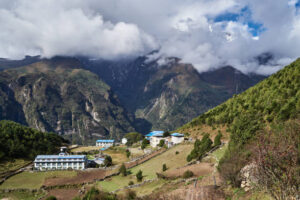
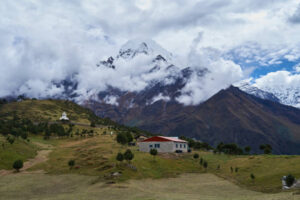
An hour’s climb above the busy lanes of Namche Bazaar, the noise fades away. The trail crosses a high, open ridge, passes a lonely airstrip, and then drops into a wide, peaceful valley. Below you lie two villages of stone houses with green roofs, potato fields edged by dry-stone walls, prayer flags fluttering over chortens, and the dark, sacred peak of Khumbila watching over it all. On a clear day, Everest, Lhotse and Ama Dablam rise into the sky behind you.
These are the twin villages of Khumjung and Khunde, two of the Khumbu’s oldest and largest Sherpa settlements. They are also where Sir Edmund Hillary, alongside the Sherpa people, began his life’s second great work: building schools, hospitals, and hope in the mountains. For trekkers on the Everest Base Camp Trek, a visit here is usually part of the acclimatisation day in Namche, but it deserves far more attention than a quick stop.
In this guide, our Sherpa team takes you through the history, culture and highlights of Khumjung village and Khunde: the Hillary School, the Khunde Hospital, the monastery with its famous yeti scalp, the views, the walks, and how to make the most of your time here.
Khumjung Village at a Glance
Here are the key facts about these two villages before we explore them in depth:
- Location: A high valley northwest of Namche Bazaar, inside Sagarmatha National Park in the Khumbu region of Solukhumbu District.
- Altitude: Khumjung village sits at about 3,790 m, and Khunde, just west of it, at about 3,840 m.
- Population: Khumjung is one of the largest Sherpa villages in the Khumbu, home to a few hundred households, with Khunde a little smaller.
- Sacred mountain: Khumbila, the Khumbu’s protective deity, rises directly above both villages at around 5,761 m.
- Famous for: The Hillary School, Khunde Hospital, the Khumjung monastery and its yeti scalp, traditional Sherpa life and superb Everest views.
- Distance from Namche: About a 1.5- to two-hour walk via Syangboche, or via the Hotel Everest View.
- Best for: An acclimatisation hike, cultural immersion and a quieter night away from the main trail.
If you are planning your first trek in the region, our guide to Namche Bazaar explains how these villages fit into your acclimatisation day.
The History of Khumjung and Khunde
Long before trekking and mountaineering arrived, Khumjung village and Khunde were centres of Sherpa life in the Khumbu.
Ancient Sherpa Settlements
Sherpa ancestors migrated from eastern Tibet over the Nangpa La pass several centuries ago, and Khumjung and Khunde became two of their earliest permanent villages. The wide, sunny valley offered good land for potatoes and barley, pasture for yaks and shelter from the harshest winds. Families built stone houses, monasteries and long mani walls, and the villages became important centres of farming, trade and faith. Many of the Khumbu’s most famous mountaineering families come from here.
Under the Protection of Khumbila
For the people of Khumjung village, Khumbila is far more than a mountain. It is home to Khumbu Yu Lha, the guardian deity of the whole Khumbu region, often depicted riding a white horse. Out of respect, no one has ever climbed the summit. Villagers offer the mountain god gifts for protection, good harvests, and safe travel, and many families keep his image in their household shrines. You can read more about the beliefs in our guide to Sherpa culture and traditions.
Sir Edmund Hillary and the Sherpa People
After his historic first ascent of Everest with Tenzing Norgay, Sir Edmund Hillary returned to the Khumbu again and again. He developed close friendships with Sherpa families and became deeply aware of the hardships they faced: no schools, very little medical care, and few opportunities beyond farming and portering.
“Our Children Have Eyes, But They Are Blind”
The story often told in the Khumbu is that a Sherpa elder from Khumjung village asked Hillary for help. He said, in essence, that the Sherpa children had eyes but could not see because they could not read or write. The village needed a school most. Hillary took the request to heart, and it changed the rest of his life.
The Himalayan Trust
To answer that request, Hillary founded the Himalayan Trust, a charity dedicated to improving life in the Solukhumbu. Working hand in hand with Sherpa communities, who contributed labour and materials, the Trust built dozens of schools, hospitals and clinics, along with bridges, water supply systems and the famous Lukla airstrip. Hillary later called this work the most worthwhile thing he ever did, more important to him than standing on Everest’s summit.
Today the Trust and its Nepali partner continue to support schools, teacher training, scholarships and health care in the region. Their work transformed the Khumbu, and its benefits show in the confidence and success of the region’s young people.
The Hillary School in Khumjung
The Khumjung School, known everywhere as the Hillary School, was the Himalayan Trust’s first project. Hillary’s team and local volunteers built it with just two classrooms from prefabricated aluminium panels, assembled in about a week. For the first time, Sherpa children in the Khumbu could receive a formal education close to home.
The School Today
Today the Hillary School is a large, busy campus serving hundreds of students from pre-school through secondary level. Children walk from Khumjung village, Khunde, Namche, and more distant hamlets, and some board at the school during term time. Many graduates have become teachers, doctors, pilots, engineers, business owners, and trekking company leaders, while others guide on the world’s highest mountains. Several members of our own team, and many guides you will meet on the trail, studied at schools built by the Trust.
Visiting the School
Trekkers are welcome to walk past the school and view it from the grounds, where a statue of Hillary stands nearby. Please remember that it is a working school: avoid disturbing classes, do not enter classrooms without permission, ask before photographing children, and keep noise down. If you would like to support education in the region, our team can advise on reputable ways to donate, rather than giving gifts directly to children.
Supporting education is close to our hearts too. Through our partnership with the Grace Educational Organisation, we support students and schools in rural Nepal, and travellers can visit a village school on our Chainpur Village Homestay Tour.
Khunde Hospital: Health Care at the Roof of the World
Just a short walk west of Khumjung village, in Khunde, stands the Khunde Hospital, another landmark of the Hillary legacy. Built by the Himalayan Trust, it was the first hospital in the Khumbu. For years, volunteer doctors from New Zealand and Canada staffed it, and later a Sherpa doctor educated through the Trust’s programmes ran it.
The hospital transformed health in the region. It provided vaccinations, maternity care, treatment for common illnesses and injuries, and help for altitude-related problems. Before it existed, a serious illness often meant days of carrying a patient down the valleys. Today it is managed locally and continues to serve both Sherpa communities and trekkers in need.
Medical Help for Trekkers in the Khumbu
For trekkers, it is reassuring to know that medical help exists in the region. In addition to the Khunde Hospital, health posts in Namche and Lukla, and the Himalayan Rescue Association aid post in Pheriche, operate during the main trekking seasons. Helicopter evacuation is available for emergencies, so high-altitude rescue insurance is essential for every trekker. Our Acute Mountain Sickness guide explains how to stay healthy at altitude, and our Everest Base Camp Trek difficulty guide covers how to prepare.
The Khumjung Monastery and the Yeti Scalp
No visit to Khumjung village is complete without stopping at the Khumjung monastery, a traditional Sherpa gompa at the village’s upper edge. Inside, among statues, murals, and butter lamps, the monastery keeps its most famous treasure: a conical, reddish-brown relic said to be a yeti scalp.
The Legend of the Yeti
The yeti, or “migoi,” is part of Sherpa folklore: a wild creature of the high forests and snowfields, sometimes feared, sometimes respected. Stories of yeti footprints and sightings have fascinated explorers for generations, and expeditions have even come to the Khumbu searching for evidence.
Scientific study has suggested the scalp was most likely made long ago from the hide of a Himalayan serow, a goat-antelope of the region. For the monastery, however, it remains a sacred object, carefully kept in a locked case and shown to visitors with good humour. Whether you believe in the yeti or not, seeing it is a memorable part of the visit.
Visiting the Monastery
The monastery is usually open to visitors during the day. A caretaker unlocks the case for visitors, and a small donation is expected to support the gompa’s upkeep. Remove your shoes before entering the prayer hall, walk clockwise and ask before taking photographs. Look out for the beautiful murals and the prayer wheels around the monastery walls.
Village Life in Khumjung and Khunde
Beyond its famous landmarks, Khumjung’s real charm is its everyday life. Compared with Namche, it feels traditional and unhurried.
Green Roofs and Stone Walls
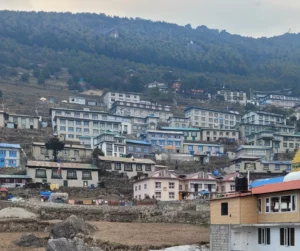
One of Khumjung’s most distinctive features is its many green-painted roofs, which give the village a uniform, cheerful look from above. Houses are built of local stone and timber, often tw storeys high, with family shrine rooms on the upper floor. Narrow paths wind between them, lined with stone walls that protect the fields from yaks and wind.
Potato Fields and Farming
The flat valley floor is filled with potato fields, the Khumbu’s staple food, along with barley and buckwheat. In spring, you may see families ploughing with yaks and planting; in autumn, they harvest and store potatoes in deep pits to keep them through the winter. Many lodges serve potatoes grown just outside their door; try them as riki kur, crispy potato pancakes, with yak butter or chilli sauce.
Chortens, Mani Walls and Prayer Flags
Religious monuments surround the village, including a large chorten at its entrance and long mani walls carved with prayers. Walk clockwise around them, as the Sherpas do. Our article on the Eight Great Stupas explains what they mean.
Quieter Lodges
Khumjung village has several comfortable family-run lodges and makes a wonderful alternative overnight stop to Namche. Staying here means quieter nights, more authentic hospitality and a chance to see village life in the early morning and evening, when families return from the fields and smoke rises from the kitchens.
The Views from Khumjung and Khunde
The setting of these villages is spectacular. From the ridge above, and from many points in the valley, you can see:
- Everest: The summit pyramid appears above the long ridge of Nuptse and Lhotse.
- Ama Dablam: One of the world’s most beautiful mountains, seen in perfect profile. Read our Ama Dablam guide for its story.
- Lhotse: The world’s fourth-highest peak, next to Everest.
- Thamserku and Kangtega: Dramatic, snowy peaks rising to the south-east above Namche.
- Khumbila: The sacred peak towering directly over the villages.
- Taboche and Cholatse: Sharp peaks visible further up the valley.
Early morning usually brings the clearest skies. Many trekkers combine the walk with tea on the terrace of Hotel Everest View, perched on a ridge above the villages at around 3,880 m, one of the world’s highest hotels and famous for its panorama of Everest and Ama Dablam.
Acclimatisation Hike: Namche to Khumjung and Khunde
The walk from Namche to Khumjung village and Khunde is one of the most popular acclimatisation hikes in the Everest region, and for good reason. It follows the golden rule of “climb high, sleep low,” taking you a few hundred metres above Namche before you return to sleep. That extra height helps your body adapt to the thinner air before you continue to Tengboche and Dingboche.
The Classic Loop
Here is the route our guides usually follow on the acclimatisation day:
- Namche to Syangboche: A steep climb up stone steps from the top of Namche to the Syangboche ridge, passing the small Syangboche airstrip, used mostly by helicopters and cargo flights.
- Syangboche to Hotel Everest View: A gentle walk through juniper and rhododendron to the hotel’s terrace for tea and the famous Everest panorama.
- Hotel Everest View to Khumjung: A short descent through forest into the valley of Khumjung, arriving near the large chorten and the Hillary School.
- Explore Khumjung: Visit the monastery and yeti scalp, the school grounds and the village lanes.
- Khumjung to Khunde: A short walk west to the neighbouring village and the Khunde Hospital.
- Return to Namche: Climb back over the ridge and descend steeply into Namche for lunch or the afternoon.
The whole loop takes about four to six hours, including stops. Walk slowly, drink plenty of water and don’t be surprised if you feel short of breath on the climb; your body is acclimatising.
Alternative Routes
Some trekkers return to Namche via a lower trail that contours around the hillside, with views of Ama Dablam and Thamserku. Others continue from Khumjung directly to Tengboche, joining the main trail near Kyangjuma, or north towards Mong La and Phortse on the way to the Gokyo Lakes Trek. Your guide will choose the best route for your itinerary and how you feel on the day.
Khumjung Village on Different Treks
Khumjung village features on many of the Everest region’s best treks:
- [Everest Base Camp Trek]: Visit on the acclimatisation day in Namche, with the full loop through Syangboche, Khumjung, and Khunde.
- [Everest View Trek]: A shorter trek built around Namche, Khumjung and Tengboche, perfect for families and first-time trekkers who want Everest views without high altitude.
- [Gokyo Lakes Trek]: Often passes through Khumjung on the way to Mong La and the Dudh Koshi Valley.
- [Everest 3 Pass Trek]: The longer circuit includes the Namche area villages before heading towards Thame and the Renjo La.
- [Ama Dablam Base Camp Trekking]: Includes the acclimatisation hike to Khumjung before heading to the base of Ama Dablam.
- [Jiri to Everest Trek]: The historic walk-in reaches Khumjung after a week in the Solu hills, many of which also benefited from Hillary’s schools.
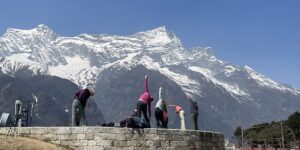
- [Everest Base Camp Yoga Trek]: Uses the acclimatisation day for a mindful walk through the villages.
For a full picture of the classic route, see our Everest Base Camp Trek itinerary.
Luxury and Helicopter Ways to Visit Khumjung
Khumjung village is easy to include in a luxury or short-on-time Everest journey:
- Luxury trekking: The Everest Base Camp Luxury Lodge Trek uses the best lodges in Namche and beyond and includes a relaxed acclimatisation walk to Khumjung.
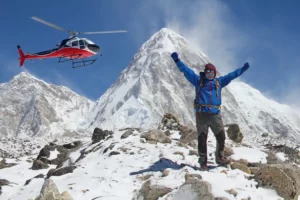
- Everest by helicopter: The Everest Helicopter Tour and Mt Everest by Helicopter Tour often land near Hotel Everest View for breakfast, with Everest views right above Khumjung.
- Helicopter and village walk: The Everest Heli Sherpa Village Walk combines a scenic flight with a guided walk through traditional Sherpa villages, a perfect way to see Khumbu culture in one day.
- Trek in, fly out: The Luxury Everest Base Camp Trek with Helicopter Return and Everest Elite Luxury Heli Trek offer premium ways to explore the region.
Note that flying directly to the altitude of Syangboche can cause altitude symptoms, so helicopter visits keep time on the ground short. Our blog on the Everest Base Camp helicopter tour explains how these flights work.
Best Time to Visit Khumjung and Khunde
Each season brings a different mood to the villages:
- Spring (March to May): Farmers plant potatoes, rhododendrons bloom on the slopes towards the Hotel Everest View, and the days are mild. Afternoons may be cloudy.
- Autumn (September to November): Clear skies, golden fields and the best mountain views. It is the busiest season on the trails, though Khumjung stays calmer than Namche.
- Winter (December to February): Cold but often crisp and clear, with snow on the fields and very few visitors. Some lodges may close.
- Monsoon (June to August): Green, misty and quiet. The fields are full of growing crops, but mountain views are limited.
In late spring or early summer, you may also catch the Dumje festival, celebrated in Khumjung and other Khumbu villages with prayers, masked dances and feasting.
Wildlife Around Khumjung
The forests and slopes around Khumjung village are part of Sagarmatha National Park and home to plenty of wildlife. Himalayan tahr often graze on the cliffs between Namche and Khumjung, Himalayan monals and blood pheasants feed in the forest near the Hotel Everest View, and lammergeiers circle overhead. Walk quietly in the early morning for the best sightings. Our guide to Sagarmatha National Park describes the region’s wildlife in detail.
From Summit to Schoolhouse: Hillary’s Story in the Khumbu
To understand why Khumjung village matters so much, it helps to know the journey that brought Hillary here. Before the Lukla airstrip existed, expeditions to Everest began with a long, several-week walk from the Kathmandu Valley, crossing the middle hills and climbing into the Khumbu. The historic Jiri to Everest Trek still follows much of that classic approach today.
Along the way, Hillary and his companions relied on Sherpa porters, cooks and climbers, and lived in Sherpa homes and monasteries. He was struck by the people’s warmth, humour, and strength, and by how little they had in terms of schools and medical care. His first ascent of Everest with Tenzing Norgay made him world-famous, but the friendships he formed in villages like Khumjung kept him coming back.
On those return visits, he worked side by side with villagers, mixing cement, carrying timber and helping assemble buildings. The Sherpas contributed land, labour, and local materials, while the Trust provided funds, equipment, and expertise. That spirit of partnership, rather than outside charity, is why the schools and hospitals have lasted.
Hillary also helped build the Lukla airstrip, partly to bring building materials for his projects into the mountains. Ironically, that airstrip opened the Khumbu to the trekking boom that now provides most of the region’s income. Today, nearly every visitor to Sagarmatha National Park lands at the airport he helped build.
Khumjung vs Namche Bazaar: Where Should You Stay?
Most trekkers spend two nights in Namche Bazaar to acclimatise and take a day hike to Khumjung village. However, some travellers prefer to stay a night in Khumjung. Here is how the two compare:
- Atmosphere: Namche is a lively trading town with bakeries, cafés, gear shops and bars. Khumjung is a quiet farming village where life moves with the seasons.
- Facilities: Namche has more lodges, shops, internet and services. Khumjung has fewer, simpler lodges, though several are comfortable and welcoming.
- Altitude: Khumjung sits a few hundred metres higher than Namche, which can help acclimatisation if you have already spent a night in Namche, but it shouldn’t be your first night above 3,400 m.
- Culture: Khumjung offers a more authentic view of Sherpa village life, with fields, monasteries and families going about their day.
- Routes: Khumjung is ideal if you are heading towards Gokyo via Mong La, or if you want to avoid retracing your steps through Namche.
Our team can build either option into your itinerary. For travellers who want comfort, the luxury lodges in Namche on our Everest Base Camp Luxury Lodge Trek make an excellent base for a day visit to Khumjung.
More Sherpa Villages Like Khumjung
If you love the peaceful, traditional feel of Khumjung village, the Khumbu has other villages that offer a similar experience away from the busiest trails:
- Thame: A remote village in the Bhote Koshi valley with a cliffside monastery, visited on the Everest 3 Pass Trek on the way to Renjo La. Tenzing Norgay spent his early years in the Thame area.
- Phortse: A sunny village across the valley from Tengboche, known for its relaxed wildlife and climbing heritage, on the alternative route to the Gokyo Lakes Trek.
- Pangboche: Home to the Khumbu’s oldest monastery and many famous mountaineers, on the main route to Everest Base Camp.
- Dingboche: A high summer settlement of stone-walled barley fields beneath Ama Dablam and Island Peak. Read our Dingboche guide for more.
Beyond the Khumbu, Nepal has many other traditional mountain communities to explore. The Tamang Heritage Trek and the Langtang Valley Trek visit Tamang villages near Kathmandu. Meanwhile, the Tsum Valley and Ganesh Himal Trek explore a sacred, hidden valley of Himalayan Buddhist culture.
Food and Lodges in Khumjung Village
Local families run most lodges in Khumjung Village, and meals are hearty and homely. Expect dal bhat, Sherpa stew, noodle soups, fried rice and plenty of potato dishes made with the village’s own harvest. Many lodges also serve pancakes, porridge and eggs for breakfast, and some bake bread and cakes. Butter tea and sweet milk tea are always available, and the dining room stove is the warm, sociable heart of each lodge in the evening.
Most lodges have simple twin rooms with shared bathrooms, while a few offer attached bathrooms and hot showers. As in all mountain villages, electricity often comes from small hydroelectric or solar systems, so charging may be limited. Bring a warm bag, as rooms are unheated and nights are cold for much of the year.
Respectful Travel in Khumjung and Khunde
These are living villages where families farm, worship and raise their children. A few simple habits help keep visits positive for everyone:
- Ask before photographing people, especially elders, monks and children.
- Walk clockwise around chortens, mani walls and the monastery.
- Stay on paths and do not walk through fields, even when they look empty.
- Do not give sweets, pens or money to children; support schools through reputable organisations instead.
- Leave a donation when visiting the monastery.
- Respect the school; do not enter classrooms or disturb lessons.
- Carry out your rubbish and use a refillable water bottle.
Our responsible tourism page explains how we work with communities and porters throughout the Khumbu.
Photography Tips for Khumjung and Khunde
Khumjung village is one of the most photogenic places in the Everest region, combining village life, sacred monuments and giant peaks in a single frame. These tips will help you capture it well:
- Shoot from the ridge: The trail between Hotel Everest View and Khumjung offers wide views of green roofs, with Ama Dablam and Everest behind them.
- Use morning light: Clouds often build by late morning, so plan your viewpoint stops early in the day.
- Frame with culture: Use chortens, prayer flags and mani walls in the foreground to add depth and meaning to mountain shots.
- Capture daily life respectfully: Fields, yaks and stone houses tell the story of the village. Always ask before photographing people, and respect a refusal.
- No flash, and no photos inside the monastery unless the caretaker allows it.
- Keep batteries warm: At almost 3,800 m, the cold drains batteries quickly; carry spares in an inside pocket.
For an aerial perspective of the villages beneath Khumbila, nothing beats a helicopter flight. The Sharing Everest Helicopter Tour with Kala Patthar Landing passes over the region on its way to the high Khumbu.
Practical Tips for Visiting Khumjung Village
To make the most of your visit, keep these tips in mind:
- Start early: Morning light gives the clearest Everest views from the Hotel Everest View and the ridge.
- Carry layers: The weather can change quickly, and the ridge above Syangboche is often windy.
- Bring cash: Useful for monastery donations, tea, snacks and local crafts. There are no ATMs in Khumjung.
- Consider staying overnight: A night in Khumjung offers a peaceful alternative to Namche.
- Pace yourself: At almost 3,800 m, take it slow and drink plenty of water.
- Talk to your guide: Many Sherpa guides have family links to these villages and know their stories well.
Before your trek, use our trekking equipment list to pack properly, and check our Nepal visa guide for entry requirements.
Getting to Khumjung Village
To reach Khumjung Village, most trekkers fly to Lukla, often via Manthali Airport in Ramechhap during peak season, then walk two days to Namche Bazaar. Our Ramechhap airport transfer service handles this leg. From Namche, Khumjung is an easy acclimatisation walk. Travellers who prefer to avoid flying can take the Everest Base Camp Trek by Road, which begins with a jeep drive to the lower Solukhumbu.
Hillary’s Legacy Beyond Khumjung
The schools and hospitals in Khumjung village and Khunde were only the beginning. The Himalayan Trust’s work spread across the Solukhumbu, and you can see its influence throughout your trek. With Hillary’s help, the Himalayan Trust built Lukla’s airstrip, opening the Khumbu to the world. Bridges across the Dudh Koshi made journeys safer. Schools in villages such as Pangboche, Thame and Junbesi educated thousands of children. Many of today’s Sherpa leaders, including doctors, pilots and owners of trekking companies, began their journeys in these classrooms.
Perhaps Hillary’s greatest legacy is the partnership itself: Sherpas and visitors working together, with respect, to build a better future in the mountains. Every trekker who chooses a responsible, locally owned company continues that tradition. To learn more about the people behind our treks, visit our Our Team page and read about our company.
Frequently Asked Questions About Khumjung Village
Where is Khumjung village?
Khumjung is a Sherpa village in Nepal’s Khumbu region, inside Sagarmatha National Park, about a 1.5- to 2-hour walk above Namche Bazaar.
What is the altitude of Khumjung?
Khumjung sits at about 3,790 m, and neighbouring Khunde is slightly higher at about 3,840 m.
What is the Hillary School?
The Hillary School in Khumjung was the first school built by Sir Edmund Hillary’s Himalayan Trust. It started with two classrooms and now serves hundreds of students from pre-school to secondary level.
Can I see the yeti scalp in Khumjung?
Yes. The Khumjung monastery displays the famous yeti scalp to visitors. A caretaker usually opens the case, and visitors make a small donation to support the monastery.
Is the yeti scalp real?
Scientific studies suggest it was most likely made from the hide of a Himalayan serow. For the monastery, it remains a sacred and treasured object.
What is Khunde Hospital?
Khunde Hospital was the first hospital in the Khumbu, built by the Himalayan Trust. It continues to provide health care to local people and trekkers.
How long does the hike from Namche to Khumjung take?
It takes about 1.5 to 2 hours one way. The full acclimatisation loop via Syangboche, the Hotel Everest View, Khumjung and Khunde takes four to six hours.
Can I stay overnight in Khumjung?
Yes. Khumjung has several family-run lodges and is a peaceful alternative to Namche, especially on the Gokyo route or a cultural itinerary.
Why is Khumbila mountain sacred?
Khumbila is believed to be the home of the Khumbu’s guardian deity. Out of respect for local beliefs, no one has ever climbed it.
Is Khumjung included on the Everest Base Camp trek?
Yes. Most Everest Base Camp itineraries, including ours, visit Khumjung and Khunde on the acclimatisation day in Namche Bazaar.
Final Thoughts: Where Hope Was Built in the Mountains
Khumjung village and Khunde are more than pretty stops on an acclimatisation walk. They are where Sherpa farmers asked for a school, where a famous mountaineer listened, and where a partnership began that changed the Khumbu forever. As you walk past the Hillary School, the green roofs and potato fields, with Everest and Ama Dablam on the horizon, you feel both the mountains’ beauty and the strength of the people who call them home.
Let our Sherpa team guide you through these special villages. Join our classic Everest Base Camp Trek, choose the shorter Everest View Trek, or travel in comfort on the Everest Base Camp Luxury Lodge Trek. Plan your trip or contact us today, and discover Hillary’s legacy in the heart of the Khumbu.
Quick Inquiry
