
Tengboche Monastery and the Mani Rimdu Festival

Tengboche Monastery and the Mani Rimdu Festival
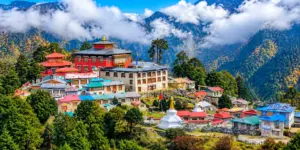
After the long climb from the Dudh Koshi River, the trail finally levels out on a broad, forested ridge. Prayer flags snap in the wind, a carved stone gate welcomes you, and there it is: a white-and-red monastery rising from a meadow, with Ama Dablam soaring behind it and the summit of Everest peeking over the Nuptse-Lhotse wall. Many trekkers stop here in silence. It is one of the most beautiful places in the Himalaya.
This is Tengboche Monastery, the largest monastery in the Khumbu and the spiritual heart of the Sherpa people. Almost every trekker on the Everest Base Camp Trek passes through it, yet few understand its story or the remarkable festival that brings it to life each autumn: Mani Rimdu.
In this guide, our Sherpa team shares the history and meaning of Tengboche Monastery, what you will see inside, how to join the daily prayers, and everything you need to know about the colourful Mani Rimdu festival, including how to plan your trek to see it.
Tengboche Monastery at a Glance
Before diving into history and ceremony, here are the essential facts about Tengboche Monastery:
- Location: On a ridge above the confluence of the Dudh Koshi and Imja Khola rivers in the Khumbu, inside Sagarmatha National Park.
- Altitude: About 3,867 m (12,687 ft).
- Buddhist tradition: The Nyingma school, the oldest lineage of Tibetan Buddhism.
- Significance: The largest monastery in the Khumbu and the region’s first celibate Nyingma monastery.
- Mother monastery: Rongbuk Monastery on the Tibetan side of Everest.
- Famous for: Views of Ama Dablam and Everest, daily prayers open to visitors, and the Mani Rimdu festival.
- Reaching it: Usually on the fourth or fifth day of a classic Everest Base Camp itinerary, after acclimatising in Namche Bazaar.
Read more about the village itself, its lodges, and viewpoints in our guide to Tengboche. This article focuses on the monastery and its living traditions.
The History of Tengboche Monastery
The story of Tengboche Monastery is one of faith, destruction, and rebirth, closely tied to the history of the Sherpa people.
A Sacred Site Before the Monastery
Long before any buildings stood here, the Tengboche ridge was considered holy. Sherpa legend tells of the saint Lama Sangwa Dorje, believed to have founded the old monastery at Pangboche, who meditated in the area and left his footprint on a rock. He is said to have foretold that a monastery would one day be built on this ridge.
Founding in the Early Twentieth Century
Lama Gulu, a Sherpa lama from Khumjung, founded the monastery in the early twentieth century. He received the blessing of Ngawang Tenzin Norbu, the great abbot of Rongbuk Monastery in Tibet, which became Tengboche’s mother monastery. Sherpas from across the Khumbu helped build it, carrying stone and timber up the ridge by hand. It became the region’s first celibate Nyingma monastery, home to monks who dedicated their lives to study and practice.
Earthquake and Rebuilding
Only a couple of decades after its founding, a powerful earthquake shook the region, destroyed the monastery, and killed Lama Gulu shortly afterwards. His successor led the community in rebuilding it, again with help from Sherpa families who provided labour, materials, and donations.
Fire and a Second Rebirth
Later in the century, disaster struck again. A fire caused by an electrical fault swept through the monastery and destroyed much of the main temple, along with ancient scriptures, statues, murals, and wood carvings. The loss was heartbreaking for the Sherpa community.
Under the guidance of the reincarnate abbot, Tengboche Rinpoche, recognised as the reincarnation of Lama Gulu, Sherpas, trekkers, mountaineers, and international donors, including Sir Edmund Hillary’s Himalayan Trust, rebuilt the monastery. The new temple was consecrated a few years later, and the building you see today reflects that remarkable effort.
Tengboche Monastery’s resilience mirrors the Sherpa people’s. When you visit, you see not just a beautiful building, but a symbol of a community’s faith.
What You Will See at Tengboche Monastery
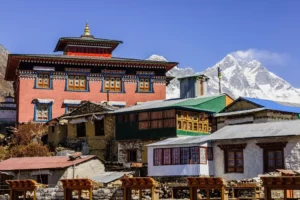
The monastery complex is arranged around a large stone courtyard, with the main temple, or dukhang, on one side and monks’ quarters and storerooms around it.
The Entrance Gate and Courtyard
You enter through a decorated gateway, or kani, painted with Buddhist symbols. Inside, the open courtyard hosts the Mani Rimdu masked dances. Notice the tall prayer flag pole in the centre and the carved wooden balconies around the edges, where monks and guests watch ceremonies.
The Main Prayer Hall
Climb the steps, remove your shoes and enter the main prayer hall. It is calm, dim and fragrant with incense and butter lamps. The centrepiece is a huge statue of Shakyamuni Buddha rising through two floors, flanked by Manjushri, the Bodhisattva of Wisdom, and Maitreya, the future Buddha. Bright murals cover the walls, depicting deities, protectors, and great teachers, including Guru Rinpoche, the founder of the Nyingma tradition. Our article on Guru Padmasambhava explains his importance across the Himalaya.
Rows of low cushions and benches line the hall where monks sit during prayers, with texts wrapped in cloth on the tables in front of them. Long horns, drums, cymbals and conch shells rest at the ends of the rows, ready for ceremonies.
Scriptures and Sacred Objects
The monastery keeps a library of Buddhist scriptures, including the Kangyur, the Buddha’s collected teachings. The fire destroyed many original texts, and the community has rebuilt the collection over the years. Thangka paintings, offering bowls and statues fill the altars.
The View
Step back outside and look around. From the courtyard and meadow, the view is among the finest on the trail: Ama Dablam dominates to the east, Everest rises behind Nuptse and Lhotse, and Thamserku and Kangtega stand to the south. Our Ama Dablam guide tells the story of the mountain that frames the monastery so perfectly.
Attending Daily Prayers at Tengboche Monastery
One of the most memorable experiences of any Everest trek is sitting quietly in Tengboche Monastery during the monks’ prayers. Visitors are generally welcome to observe.
When Prayers Take Place
Monks usually gather for prayers early in the morning and again in the afternoon. Most trekkers arrive at Tengboche around midday or early afternoon, so the afternoon session, often around three o’clock, is usually the easiest to attend. Times can change with the monastery’s schedule and ceremonies, so ask your guide or the monks when you arrive.
What Happens During Prayers
The monks file in wearing maroon robes and take their places along the rows. The chanting begins low and rhythmic, rising and falling in waves. At intervals, long horns called dungchen sound a deep, almost earthly note, joined by drums, cymbals, and the high wail of the gyaling, a reed instrument. Young monks may serve butter tea during the session. The sound fills the hall and seems to vibrate through your body.
How to Behave During Prayers
- Remove your shoes and hat before entering.
- Enter quietly and sit on the benches or floor at the side of the hall, not on the monks’ cushions.
- Do not point your feet towards the altar or the monks.
- Switch off your phone and do not talk.
- Photography and video are not allowed inside the prayer hall. Respect any signs and instructions.
- You may stay for part of the session and leave quietly if needed.
- Leave a donation in the box or offer it at the altar; it supports the monastery and its monks.
Many trekkers say that this hour of stillness, in the middle of a demanding trek, is the moment they remember most clearly.
Life of the Monks at Tengboche
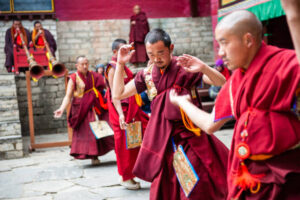
Tengboche Monastery is home to a community of dozens of monks, from young novices to elderly lamas. Many come from Sherpa families in the Khumbu and Solu, entering the monastery as boys to study Buddhist philosophy, ritual, chanting, music, painting and dance.
Their days follow a disciplined rhythm of prayers, study, meditation and work. Senior monks lead rituals for villages, bless homes and expeditions, and perform ceremonies for births, illnesses and funerals. Some monks undertake long retreats in meditation caves and hermitages above the monastery.
Like many monasteries in the Himalaya, Tengboche faces change. Fewer boys now choose monastic life, as many young Sherpas find work in trekking and mountaineering or study in Kathmandu and abroad. Respectful visits and donations help keep this important tradition alive. To learn more about how the faith shapes everyday life in the Khumbu, read our guide to Sherpa culture and traditions.
The Mani Rimdu Festival: An Introduction
Once a year, Tengboche Monastery hosts the Khumbu’s most important festival: Mani Rimdu. This sacred cycle of rituals, prayers, and masked dances celebrates Buddhism’s victory over evil forces and brings blessings to the whole community.
The Meaning of the Name
“Mani” comes from the mantra “Om Mani Padme Hum,” associated with Chenrezig, the Buddha of Compassion. “Rimdu” refers to the small red blessed pills, called mani rilwu, that are prepared and empowered during the festival and given to everyone who attends. Together, the name suggests “the pills blessed by the mantra of compassion.”
Origins of the Festival
Mani Rimdu came to the Khumbu from Rongbuk Monastery in Tibet, the mother monastery of Tengboche. Its rituals and dances trace back to the Mindroling Monastery in central Tibet, a major centre of the Nyingma tradition. The festival arrived at Tengboche in the monastery’s early years and has been celebrated there ever since. It is also held at Thame Monastery in the Bhote Koshi valley and at Chiwong Monastery in the Solu region.
When Mani Rimdu Takes Place
At Tengboche, Mani Rimdu follows the Tibetan lunar calendar and falls in the tenth lunar month, usually in late October or November. That makes it a wonderful bonus for autumn trekkers. At Thame Monastery, the festival is usually held in spring, around May, while Chiwong in Solu follows its own schedule. Because the dates move every year, always confirm them with our team before booking your trek.
The Mani Rimdu Festival Day by Day
The full ritual cycle lasts around nineteen days. Most of it happens privately inside the monastery, and only the final days are open to the public. Here is how it unfolds.
The Private Rituals and the Sand Mandala
The festival begins with days of intensive prayer and meditation. They construct a beautiful sand mandala, a detailed circular diagram of the celestial palace of the deities, made grain by grain from coloured sand. The mandala becomes the sacred focus of the ceremonies, and the monks invite the deities to reside in it. During this period, the monks also prepare and repeatedly bless the mani rilwu pills, chanting the mantra of compassion thousands of times.
Public Day One: Wang, the Empowerment
On the first public day, villagers from across the Khumbu arrive in their finest traditional clothes. The head lama gives the Wang, or empowerment, a blessing for long life, health and protection. People queue patiently to receive blessed water and red mani rilwu pills, which they treasure and keep for times of illness or danger. Trekkers are welcome to receive the blessing too; join the line respectfully and follow the example of those around you.
Public Day Two: Cham, the Masked Dances
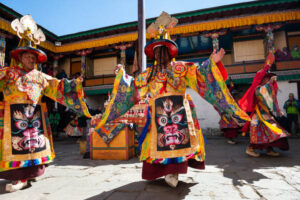
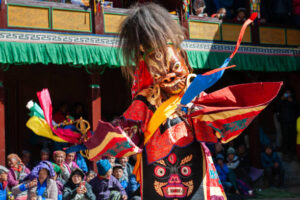
The second public day is the highlight. In the monastery courtyard, monks perform the Cham, a series of sacred masked dances accompanied by horns, drums and cymbals. Wearing heavy brocade costumes and carved, painted masks, they represent deities, protectors, demons and comic characters. The dances tell the story of how Guru Rinpoche subdued evil forces and established Buddhism in the Himalaya.
Some dances are slow, solemn and hypnotic. Others are fast, whirling and dramatic. Light-hearted interludes also feature clowns teasing the crowd and acting out funny scenes that make everyone laugh. The courtyard, balconies, and surrounding slopes fill with Sherpa families, monks, children, and trekkers, all watching as Ama Dablam towers above. It is a spectacle few travellers ever forget.
Public Day Three: Jinsak, the Fire Ceremony
On the final day, the monks perform the Jinsak, a fire offering in which they offer grains, butter, and other substances to the flames to remove obstacles and negative forces. The monks then ritually dismantle the sand mandala and offer the sand to a nearby stream or river, symbolising the impermanence of all things and spreading blessings to the wider world. The festival closes with final dances, prayers and celebration.
The Characters of the Cham Dances
Each mask and costume in the Cham has meaning. While performances vary, these are some of the figures you are likely to see:
- Guru Rinpoche and his manifestations: The central figure of the dances, appearing in peaceful and wrathful forms to tame demons and protect the teachings.
- Protector deities: Fierce, multi-eyed masks with crowns of skulls represent Buddhism’s guardians. They look frightening, but they symbolise the power to destroy ignorance and evil.
- Skeleton dancers (Durdag): Lords of the cremation ground, wearing skull masks and white costumes, reminding everyone of impermanence and death.
- Black hat dancers: Tantric masters in wide black hats, performing powerful ritual movements to purify the ground.
- Comic characters: Clowns and buffoons, sometimes playing an older man or a confused visitor, who entertain the crowd and show that humour has a place even in sacred ritual.
- Sacred animals: Masks of deer, yaks or other animals that appear in some dances as messengers and protectors.
Ask your guide to explain each dance as it begins. Many Sherpa guides grew up watching Mani Rimdu and love sharing its stories.
Planning Your Trek Around the Mani Rimdu Festival
Seeing Mani Rimdu at Tengboche Monastery takes some planning, but it is well worth the effort.
Choose the Right Itinerary
The simplest option is to time a classic Everest Base Camp Trek, so you pass Tengboche on the public festival days, either on the way up or back. Since you normally reach Tengboche about four days after landing in Lukla, our team works backwards from the festival dates to set your arrival. For a shorter, culture-focused trip, the Everest View Trek can also include Tengboche during the festival.
Book Early
Lodges in Tengboche and nearby Deboche are limited, and they fill quickly during Mani Rimdu. Booking well ahead ensures you have a room close to the monastery. Some trekkers stay in Deboche, a short walk away, or plan to spend two nights in the area to see more of the celebration.
Combine Festival Days with Acclimatisation
An extra night at Tengboche or Deboche during the festival can also serve as a useful acclimatisation day before heading higher to Dingboche. It is a perfect example of turning a rest day into a highlight.
Consider Luxury or Helicopter Options
If you would like to enjoy the festival in comfort, the Everest Base Camp Luxury Lodge Trek uses the finest available lodges. Time-poor travellers can explore private helicopter options, such as the Everest Heli Sherpa Village Walk, which our team can tailor to the region. Helicopter landings are subject to regulations, so read our guide to Everest helicopter tour restrictions and speak to our team about what is possible.
Prepare for the Cold
Late autumn nights at Tengboche are cold, often well below freezing, and you watch the dances outdoors for several hours. Bring a warm down jacket, hat, gloves and a sit pad. Our trekking equipment list covers everything you need.
Buddhist Symbols to Look For at Tengboche Monastery
Knowing a few symbols turns a visit to Tengboche Monastery from sightseeing into understanding. Look out for these as you explore the gate, courtyard and prayer hall:
- The Wheel of Life (Bhavachakra): Often painted near the entrance, this large circular image is held by a fierce figure representing impermanence. It shows the realms of existence and the causes of suffering, a teaching tool for monks and villagers alike.
- The Eight Auspicious Symbols: The parasol, golden fish, treasure vase, lotus, conch shell, endless knot, victory banner and Dharma wheel appear on walls, doors and textiles. Each represents a quality of the Buddha’s teachings.
- The Four Guardian Kings: Painted beside the main entrance, these colourful warrior figures protect the four directions and guard the temple from harm.
- The Dharma wheel and deer: Often seen on monastery roofs, they recall the Buddha’s first teaching in the deer park at Sarnath.
- Chortens: The whitewashed stupas around the monastery represent the Buddha’s enlightened mind. Our article on the Eight Great Stupas explains their different forms.
- Prayer wheels: Rows of cylinders filled with printed mantras line the monastery walls. Turn them clockwise as you walk past.
Your guide can point out these symbols and explain their stories. For a deeper introduction to the faith behind them, read our guides to Buddhism in Tibet and the life of the great yogi Milarepa, whose songs and teachings are loved across the Himalaya.
Tengboche Monastery and Everest Expeditions
Tengboche Monastery holds a special place in Himalayan mountaineering history. For generations, climbing expeditions heading to Everest, Lhotse, Ama Dablam and other peaks have stopped here to receive blessings from the Rinpoche before continuing to base camp. Climbers receive protection cords, called sungdi, and blessings for safety on the mountain. Many Sherpa climbers will not set foot on a mountain without this blessing.
The connection runs the other way, too. Expeditions and climbers have supported the monastery for decades, helping fund rebuilding after disaster and supporting the monastery’s school and maintenance. Visiting Tengboche reminds us that, in the Khumbu, climbing and spirituality are deeply connected.
If you plan to climb, our peak climbing trips follow the same tradition, often including a puja ceremony before the climb. Explore Island Peak Climbing, Lobuche Peak Climbing and Mera Peak Climbing, or read our Ama Dablam expedition guide for the mountain that towers over the monastery.
A Perfect Day at Tengboche
To make the most of your time at Tengboche Monastery, here is how our guides like to plan the day:
- Morning: Leave Namche after breakfast, enjoy the Everest views along the trail to Kyangjuma, and descend to Phunki Tenga for an early lunch by the river.
- Midday: Climb steadily through the forest to Tengboche, taking it slowly and watching for monals and musk deer.
- Early afternoon: Check in to your lodge, drink plenty of water and rest briefly.
- Mid-afternoon: Visit the monastery and sit quietly through the afternoon prayers.
- Late afternoon: Walk around the meadow and chortens, visit the small bakery, and watch the sunset light on Ama Dablam and Everest.
- Evening: Dinner by the warm stove, with stories from your guide about the monastery and Mani Rimdu.
- Next morning: Wake early for sunrise views, then continue to Deboche, Pangboche and Dingboche, or spend a second night if you are attending the festival.
From Dingboche, the trail continues to Lobuche, Gorakshep and the famous sunrise viewpoint of Kala Patthar. Trekkers on the Gokyo Lakes Trek can also include Tengboche by returning via Phortse, a quiet village across the valley.
Mani Rimdu Etiquette: How to Be a Respectful Guest
Mani Rimdu is a religious ceremony first and a spectacle second. These guidelines help you enjoy it respectfully:
- Arrive early to find a good spot, and sit or stand where the monks or locals direct you.
- Never walk across the dance area in the courtyard, even between dances.
- Keep the front rows for local families and elders, especially during the blessing.
- Photography rules vary. Photography is usually permitted in the courtyard during the dances, but never use flash or block others’ views. Do not photograph inside the prayer hall.
- No drones. Flying drones over the monastery or ceremony is disrespectful and restricted.
- Dress modestly and warmly, covering shoulders and legs.
- If you receive the blessing, follow the line respectfully and accept the pills and water with your right hand or both hands.
- Make an offering at the monastery to support the festival and the monks.
- Keep your voice low during rituals and prayers.
Exploring Around Tengboche Monastery
Whether you visit during Mani Rimdu or not, there is plenty to explore around Tengboche Monastery.
Deboche Nunnery
A short downhill walk through rhododendron and birch forest leads you to Deboche, home to a small Buddhist nunnery. It is a peaceful place with a very different atmosphere from the busy monastery, and the nuns welcome respectful visitors.
Pangboche Monastery
Further along the trail, the village of Pangboche has the Khumbu’s oldest monastery, legend says, linked to Lama Sangwa Dorje. It is a short detour from the main trail and offers a quieter, more intimate monastery visit.
Rhododendron Forests and Wildlife
The forests around Tengboche and Deboche are among the most beautiful in the Everest region, blooming red and pink in spring. They are also home to the Himalayan monal, blood pheasant and musk deer. Walk quietly in the early morning for the best chance of seeing them. Our guide to Sagarmatha National Park describes the region’s wildlife in detail.
Sunrise and Sunset Views
The monastery is at its most magical at sunrise and sunset, when the light paints Ama Dablam and Everest gold and pink. Wake early, grab a cup of tea and walk to the edge of the meadow.
Tengboche Monastery on Different Everest Treks
Tengboche Monastery appears on most treks in the Everest region, so you can visit it on the route that suits you best:
- [Everest Base Camp Trek](https://www.treknepalhimalayas.com/trip/everest-base-camp-trek/): The classic route passes Tengboche on the way up and again on the way down, giving you two chances to visit.
- [Everest View Trek](https://www.treknepalhimalayas.com/trip/everest-view-trek/): A shorter trek with Tengboche as one of its highlights.
- [Everest 3 Pass Trek](https://www.treknepalhimalayas.com/trip/everest-3-pass-trek/): The long circuit includes Tengboche on the approach to the high passes.
- [Ama Dablam Base Camp Trekking](https://www.treknepalhimalayas.com/trip/ama-dablam-base-camp-trekking/): Passes Tengboche on the way to the base of Ama Dablam.
- [Everest Base Camp Yoga Trek](https://www.treknepalhimalayas.com/trip/everest-base-camp-yoga-trek/): Combines yoga and meditation with time at Tengboche, a perfect match for the monastery’s peaceful atmosphere.
- [Jiri to Everest Trek](https://www.treknepalhimalayas.com/trip/jiri-to-everest-trek/): The historic walk-in route reaches Tengboche after a deep cultural journey through the Solu hills.
- [Everest Base Camp Luxury Lodge Trek](https://www.treknepalhimalayas.com/trip/everest-base-camp-luxury-lodge-trek/): Visits Tengboche while staying in the best lodges available.
- [Luxury Everest Base Camp Trek with Helicopter Return](https://www.treknepalhimalayas.com/trip/luxury-everest-base-camp-trek-with-helicopter-return/): Walks up through Tengboche and returns by helicopter.
For a detailed look at where Tengboche falls in the classic route, see our Everest Base Camp Trek itinerary and Everest Base Camp Trek distance guides.
Best Time to Visit Tengboche Monastery
Tengboche Monastery is open to visitors year-round, and each season brings a different atmosphere.
- Autumn (September to November): Clearer views of Ama Dablam and Everest, comfortable daytime temperatures, and the chance to see Mani Rimdu. It is also the busiest time, so book lodges early.
- Spring (March to May): The surrounding forest bursts into rhododendron bloom, birds are active, and expeditions pass through on their way to Everest Base Camp to receive blessings.
- Winter (December to February): Cold, quiet and often crystal clear. With fewer trekkers, you may have the prayer hall almost to yourself, though some lodges close and nights are very cold.
- Monsoon (June to August): Misty, green and peaceful, with frequent cloud and rain. Views are unreliable, but the monastery feels especially serene.
For most travellers, autumn and spring offer the best balance of views, comfort and cultural life. If you would like to see the monastery from the air, the Everest Helicopter Tour flies over the Tengboche ridge on its way to the high Khumbu.
Getting to Tengboche Monastery
Most trekkers reach Tengboche from Namche Bazaar in about five to six hours. The trail contours along the hillside with views of Everest and Ama Dablam, passes the village of Kyangjuma, then drops steeply to the river at Phunki Tenga, where a small water-powered prayer wheel stands. From there, a long, steady climb through forest leads up to the Tengboche ridge. It is one of the harder sections of the trek, so take it slowly and enjoy the forest.
To reach Namche, you first fly to Lukla, often from Manthali Airport in Ramechhap during the peak seasons, and walk for two days along the Dudh Koshi. Our Ramechhap airport transportation service handles the transfer. Alternatively, the Everest Base Camp Trek by Road avoids the flight altogether.
Altitude Considerations
At almost 3,900 m, Tengboche is high enough for altitude to matter. Most itineraries reach it after two nights in Namche, which gives your body time to adjust. If you get a headache or feel unusually tired, rest, drink water, and tell your guide. Our Acute Mountain Sickness guide explains the warning signs. Many trekkers prefer to sleep in Deboche, slightly lower and quieter, after visiting the monastery.
Other Monastery Festivals in the Himalaya
If Mani Rimdu inspires you, the Himalaya is full of colourful Buddhist festivals:
- Mani Rimdu at Thame: Usually in spring, in the quiet Thame valley, visited on the Everest 3 Pass Trek
- Tiji Festival in Upper Mustang: A three-day festival of masked dances in the walled city of Lo Manthang, described in our Tiji Festival guide and reachable on the Upper Mustang Trek.
- Bhutan’s Tshechu festivals: Spectacular masked dance festivals held across Bhutan, covered in our Bhutan festivals guide and experienced on our Luxury Bhutan Tour.
- Saga Dawa at Mount Kailash: The holy month pilgrims celebrate around the sacred mountain; explore it on our Mount Kailash Tour.
Frequently Asked Questions About Tengboche Monastery
Where is Tengboche Monastery?
Tengboche Monastery is in Nepal’s Khumbu region, inside Sagarmatha National Park, on a ridge at about 3,867 m on the main trail between Namche Bazaar and Dingboche.
Can tourists visit Tengboche Monastery?
Yes. Visitors are welcome to visit the monastery and observe prayers. Remove your shoes and hat, stay quiet, do not take photos inside the prayer hall and leave a small donation.
What time are prayers held at Tengboche Monastery?
Monks usually pray early in the morning and in the afternoon, often around three o’clock. Times can change, so ask your guide or the monks when you arrive.
When is the Mani Rimdu festival?
At Tengboche, Mani Rimdu falls in the tenth month of the Tibetan lunar calendar, usually in late October or November. The dates change every year, so check with our team before booking.
How long does Mani Rimdu last?
The full ritual cycle lasts about nineteen days, but only the final three days are public: the empowerment, the masked dances and the fire ceremony.
Can foreigners receive the Mani Rimdu blessing?
Yes. Visitors may join the line respectfully to receive the blessing and the red mani rilwu pills from the head lama.
Can I take photos at Mani Rimdu?
Photography is usually allowed in the courtyard during the dances, as long as you don’t use flash and don’t block others. Photos are not allowed inside the prayer hall. Always follow the monastery’s instructions.
Who founded Tengboche Monastery?
Lama Gulu founded it in the early twentieth century, with the blessing of the abbot of Rongbuk Monastery in Tibet, its mother monastery.
Why was Tengboche Monastery rebuilt?
A major earthquake destroyed the monastery soon after it was founded, and a later fire badly damaged it—the Sherpa community and supporters from around the world rebuilt it.
Is Tengboche Monastery on the Everest Base Camp trek?
Yes. The classic Everest Base Camp trek passes Tengboche both up and down, usually on the fourth or fifth day.
Final Thoughts: The Spiritual Heart of the Everest Trail
Many trekkers come to the Khumbu for Everest and leave remembering Tengboche Monastery. The monks’ chanting, the deep call of the horns, the masked dancers whirling in the courtyard, and the sight of Ama Dablam glowing above the golden roof touch something deeper than any summit view. Whether you visit on a quiet afternoon or during the vibrant Mani Rimdu festival, it stays with you.
Let our Sherpa team help you plan a trek that includes this sacred place at the perfect moment. Join our classic Everest Base Camp Trek, choose the comfort of the Everest Base Camp Luxury Lodge Trek, or ask us to time your journey for Mani Rimdu. Plan your trip or contact us today, and experience the spiritual heart of the Everest trail.
Quick Inquiry
Explore More


