Nepal · Trekking · Difficult
Everest Base Camp Trek with Helicopter Return
Trip overview
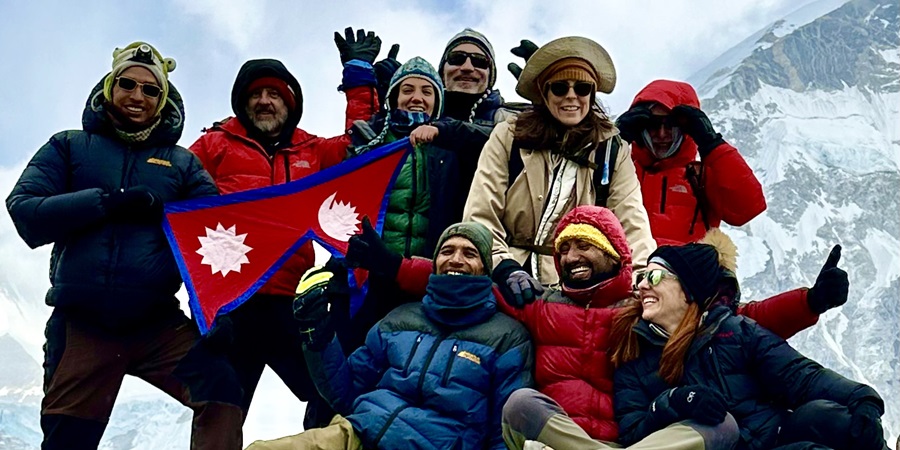
The Everest Base Camp Trek with Helicopter Return is an 11-day trip from Kathmandu: you walk the classic trail to Everest Base Camp at 5,364 m in eight days, climb Kala Patthar at dawn, and fly from Gorak Shep back to Kathmandu by helicopter the same morning. It saves the three-day walk down to Lukla and shows you the whole route again from the air.
It suits fit walkers who have about ten days of leave, and anyone whose knees dislike long descents. The walk up is exactly the same as on the standard trek, with both acclimatization days in place. Only the way back changes.
Our helicopter flies all the way to Kathmandu, not just to Lukla. Some trips with this name end with a short hop to Lukla and a fixed-wing flight the next day, which keeps you exposed to Lukla’s delays. Flying straight through means you are in a hotel shower by midday.
The hard part is the same as for every base camp trekker: eight days of walking to 5,164 m, cold nights above Dingboche, and a pre-dawn climb to 5,545 m. The helicopter adds one condition of its own. It flies only in clear weather, and at this altitude it lifts two passengers at a time for the first leg, so a group goes down in turns.
The reward is a full base camp trek with the best possible ending. In about an hour and a half you fly over the Khumbu Glacier, Ama Dablam, Tengboche and Namche, the country that took you eight days to cross on foot.
The Everest Base Camp Trek with Helicopter Return costs from US$ 2,049 per person for a group of ten or more and US$ 2,199 per person for two to four, with the Lukla flight, the shared helicopter to Kathmandu, permits, hotel, meals, guide and porters included. If you would rather walk both ways, see our 14-day Everest Base Camp Trek. If you only have a day, see the Everest Helicopter Tour.
Highlights
- Everest Base Camp: stand on the Khumbu Glacier at 5,364 m, below the Khumbu Icefall.
- Kala Patthar at sunrise: the classic view of Everest’s summit from 5,545 m.
- Helicopter to Kathmandu: a shared flight from Gorak Shep straight back to the city, about an hour and a half.
- The route from the air: the Khumbu Glacier, Ama Dablam, Tengboche and Namche, all seen on the way down.
- Full acclimatization: two nights at Namche and two at Dingboche, the same as on the 14-day trek.
- Three days saved: no walk back to Lukla and no second mountain flight.
- Tengboche Monastery: the largest monastery in the Khumbu, with Everest and Ama Dablam behind it.
- Sherpa villages: Namche Bazaar, Pangboche and Dingboche on the way up.
Itinerary
Route map
Each stop on the route with its altitude, from 1,400 m to 5,164 m.
On footBy airHighest point
Day 1Arrive in Kathmandu1400m
A driver from our office meets you at the exit of Tribhuvan International Airport, holding a board with your name. The transfer to your hotel in Thamel is 6 km and takes 20 to 40 minutes. You have a twin room with a private bathroom in a 3-star hotel.
The guide calls at the hotel in the late afternoon. This briefing has one extra item that other treks do not: the helicopter. He notes each person’s passport number and body weight for the flight manifest, explains how the pick-up at Gorak Shep works, and reminds you that the 15 kg baggage limit applies both on the plane to Lukla and on the helicopter back.
He then checks boots, gloves and warm layers, and hands over the duffel bag, with the down jacket and sleeping bag if you are borrowing ours. Anything you are missing can be bought or rented in Thamel this evening.
Dinner is your own choice. Pack before you sleep and leave spare clothes in a bag at the hotel. In the main spring and autumn months the flight to Lukla leaves from Manthali, and the car comes for you at about 1:00 am, so an early night is wise. There is no walking today. Kathmandu is at 1,400 m.
Day 2Fly to Lukla, Trek to Phakding2610m
The flight to Lukla takes about 35 minutes from Kathmandu, or 20 minutes from Manthali after a four to five hour drive. Either way you land in the mountains by mid-morning, on a short sloping runway at 2,860 m. This is the only time you will see Lukla, since the return is by helicopter.
The porters are waiting. While they tie the loads we have tea, and then walk out of the village under a stone gateway. The trail to Phakding is 8 km and takes three to four hours. It loses about 250 m, dropping gently towards the Dudh Koshi through fields of cabbage and potato.
You pass your first mani walls today, long piles of slate carved with prayers, and you walk to the left of each one. You also cross the first of many suspension bridges. They sway a little and are perfectly sound.
Phakding, 2,610 m, lies on both banks of the river. The lodge has twin rooms with attached bathrooms. Lunch is on the trail, and dinner is at the lodge. In the evening the guide takes an oxygen reading from everyone, the first entry in a record he keeps all the way to Gorak Shep.
Day 3Phakding to Namche Bazaar3440m
Namche is 11 km away and 830 m higher, and the walk takes about six hours. The first four are easy. The last two are the first real test of the trek.
We follow the river north through Toktok and Benkar, with the white peak of Thamserku appearing above the valley. At Monjo the guide registers our permits at the entrance to Sagarmatha National Park. We eat lunch soon after at Jorsalle, since there is no food between there and Namche.
After lunch the path runs beside the river for half an hour, climbs to the high Hillary Bridge, and then winds uphill through pine forest for 600 m. Go slowly. At this stage a steady pace matters more than strength, and the guide walks in front to hold the group back. A viewpoint halfway up gives a first distant sight of Everest in clear weather.
Namche Bazaar, 3,440 m, is built in tiers round a natural amphitheatre. It is the trading centre of the Khumbu, with shops, cafes, a bank and a weekly market. Your room has an attached bathroom and a hot shower. We stay two nights, and dinner is at the lodge.
Day 4Acclimatization Day in Namche Bazaar3440m
Everyone who goes to base camp spends a second night at Namche, and the helicopter return does not change that. The body needs the time. We help it along with a morning climb and an afternoon of rest.
After breakfast we walk up to the ridge above the town and on to the Everest View Hotel at 3,880 m, about two hours and 440 m above Namche. Its terrace looks straight up the valley to Everest, Lhotse and Ama Dablam. In a week you will fly back down this same valley, and from the air you will be able to pick out the hotel roof.
Those who want more can continue to Khumjung village and its school, founded by Edmund Hillary, before returning to Namche. The full loop is 8 km and takes four hours.
The afternoon is free. Use the hot shower, since the next one is in Kathmandu for most people. Charge batteries, buy any last snacks, and visit the small museum of Sherpa life near the park headquarters if you have the energy. The guide takes oxygen readings again in the evening. All meals are at the lodge.
Day 5Namche Bazaar to Tengboche3860m
Today’s stage is 10 km and five to six hours. It has three parts: a level walk, a descent and a climb.
The level part comes first, two hours on a wide path high above the river, with Ama Dablam in front the whole way. Many people call this the best morning of the trek. We stop for tea at Kyangjuma, where the lodge terrace faces the mountain.
The descent follows, 400 m down through pine and rhododendron to the bridge at Phunki Tenga, 3,250 m, where we have lunch. The climb is the afternoon’s work: 600 m up a dusty zigzag trail through forest, about two hours at an easy pace. Musk deer live in these woods and are sometimes seen at the edge of the path.
Tengboche, 3,860 m, is a broad saddle with the monastery at its centre. Monks hold prayers in the afternoon, and visitors may sit at the back in silence. Behind the building the view runs from Everest and Lhotse round to Ama Dablam. Lodges here have twin rooms and shared toilets. It is colder than Namche, and the dining room stove is lit before dark.
Day 6Tengboche to Dingboche4410m
We cross 4,000 m today. The walk is 11 km and five to six hours, with 550 m of gain spread evenly over the day.
The path drops through forest to Deboche and crosses the Imja Khola on a bridge above a narrow rock gorge. On the far side it climbs to Pangboche, 3,985 m, the highest village lived in all year. Its monastery is the oldest in the Khumbu. Ama Dablam is directly above the village, so close that the summit is hard to fit in a photograph.
After Pangboche there are no more trees, only juniper scrub, stone walls and wide grazing land. We eat lunch at Somare. In the afternoon the wind usually blows up the valley, so keep a windproof jacket handy.
Where the valley divides we cross the river and climb a short slope to Dingboche, 4,410 m. The village sits among walled fields under Lhotse and Island Peak. Rooms are twin with shared toilets. Tonight is the first night above 4,000 m, and from here the guide looks carefully at each oxygen reading and asks about sleep and appetite. We stay two nights. All meals are included.
Day 7Acclimatization Day in Dingboche4410m
This is the second of the two rest days, and the more important one. Tomorrow and the day after you sleep at 4,940 m and 5,164 m, and the body has to be ready for both.
In the morning we climb Nangkartshang, the ridge behind the village. The viewpoint with the prayer flags is at 5,083 m, 670 m above the lodges, and the round trip takes four to five hours. Go as high as feels comfortable. The guide sets a turnaround time, and reaching 4,800 m is enough to do the job.
From the ridge you can see Makalu to the east and, far below, the route of the last two days. If you reach the flags, you have already been higher than the lodge at Lobuche where you sleep tomorrow night.
We are back for lunch. In the afternoon rest, drink, and repack. From Dingboche upward it helps to keep the daypack ready with everything you would want on the helicopter: passport, camera, sunglasses and a warm jacket. At the evening check the guide decides, with each person, whether to go on. Anyone who needs another day can follow a day behind with a staff member, and we move the helicopter to match.
Day 8Dingboche to Lobuche4940m
Lobuche is 8 km up the valley and 530 m higher. The walk takes five hours, at the slow pace this altitude requires.
We climb to the ridge above Dingboche and follow a broad, gently rising shelf with Taboche and Cholatse across the valley. After two hours the trail drops to the stream at Dughla, 4,620 m, and we stop for an early lunch at its single lodge.
The hour after Dughla is the hard one: a steep climb of 250 m up the end moraine of the Khumbu Glacier. At the top is a wide platform covered in stone memorials and prayer flags for climbers and Sherpas who died on Everest and nearby peaks. Most groups stop here quietly for a few minutes.
Beyond the memorials the path levels out beside the glacier, with Pumori ahead. Lobuche, 4,940 m, is a row of lodges in a stony hollow. Rooms are small twins with shared toilets, and the night is cold. Dinner is early. Before bed the guide phones the helicopter office with the group’s position and the forecast for the day after tomorrow, the first of two confirmations.
Day 9Lobuche to Gorak Shep and Everest Base Camp5164m
This is the day you reach base camp. It is about 12 km and seven to eight hours in all, every step of it above 4,900 m.
We leave Lobuche by 7:00 am. The trail follows the trough beside the Khumbu Glacier, then crosses the jumbled moraine of the Changri Glacier, up and down over rock for an hour. Gorak Shep, 5,164 m, comes into view on the edge of a flat sandy basin, after about three hours. We check in, leave the bags, and have soup and an early lunch.
The walk to base camp follows the moraine crest north for two hours, with the Khumbu Icefall growing larger ahead. Everest Base Camp, 5,364 m, lies on the glacier. In spring it is crowded with expedition tents. In autumn it is empty ice and rock, with a flag-covered boulder that marks the spot. We stay half an hour and walk back.
You will pass the Gorak Shep helipad on the way in, a levelled circle of stones beside the lodges. Tonight the guide makes the second confirmation call and tells you the pick-up time. Pack the duffel before sleeping. This is the highest and coldest night of the trek, and the last one in the mountains.
Day 10Kala Patthar and Helicopter to Kathmandu1400m
We start for Kala Patthar by headlamp at about 4:30 am. The climb is 380 m and takes two hours on a steep, frozen path. At 5,545 m it is the highest point of the trek. The sun comes up behind Everest, and for the first time you see its summit clearly, above the South Col and the Khumbu Icefall. We are back at the lodge for breakfast by 8:00 am.
The helicopter arrives between 8:00 and 10:00 am if the sky is clear. Because of the altitude it takes two passengers at a time for the first leg, down to Pheriche or Lobuche. It shuttles until everyone is there, then flies on with the group. The ground crew and the guide tell you when to board.
The flight to Kathmandu takes about an hour and a half, with a stop at Lukla for fuel. You fly down the length of the Khumbu, past Ama Dablam, over Tengboche and Namche, and out along the foothills. Eight days of walking pass under the window in the first twenty minutes.
A car takes you from the airport to the hotel in Thamel, usually by midday. If cloud holds the helicopter, we walk down towards Pheriche and fly from there. In the evening we take you to a farewell dinner, where the guide hands over your trek completion certificate.
Day 11Departure from Kathmandu1400m
Breakfast is at the hotel, and the room is yours until noon. Our driver takes you to Tribhuvan International Airport three hours before your flight. The drive is 20 to 40 minutes.
We ask everyone on this trek to think carefully about this day before booking flights. The helicopter flies only in clear weather, and on some days cloud keeps it on the ground until the next morning. If your international flight is today and the helicopter was delayed yesterday, the timing becomes tight. One spare night in Kathmandu removes that worry, and we can add it at the hotel rate.
If you do have a free morning, Boudhanath Stupa is 20 minutes away by taxi and is the best place in the city to sit with a coffee and let the last ten days settle. Swayambhunath and the old squares of Patan and Kathmandu are also within reach.
Many people add a few days after the trek. A two-night stay in Chitwan National Park or some quiet days by the lake in Pokhara both suit tired legs, and we can arrange either at short notice.
Before you leave, please tell us how the trek and the flight went. Only breakfast is included today. We wish you a safe flight home.
What's included
Included in the price
- Airport transfers: pick-up and drop-off in Kathmandu for international and domestic flights, by private vehicle.
- Kathmandu hotel: 2 nights in a 3-star hotel in Thamel, twin sharing, with breakfast.
- Lukla flight: one-way flight to Lukla from Kathmandu or Manthali, with airport taxes.
- Manthali transfer: shared vehicle from Kathmandu to Manthali when flights run from there.
- Helicopter return: a seat on a shared helicopter from Gorak Shep to Kathmandu.
- Trek lodges: 8 nights in twin-sharing lodge rooms, with attached bathrooms in Phakding and Namche.
- Meals on the trek: 8 breakfasts, 8 lunches and 8 dinners, chosen from the lodge menu.
- Hot drinks: a cup of tea or coffee with each meal on the trek.
- Fruit: fresh seasonal fruit after dinner each evening.
- Guide: a government-licensed, English-speaking trek guide with first-aid training.
- Assistant guide: a second guide for groups of eight or more.
- Porters: one porter for every two trekkers, carrying up to 10 kg for each trekker.
- Staff costs: wages, insurance, meals, lodging, equipment and transport for all guides and porters.
- Permits: Sagarmatha National Park entry and the Khumbu Pasang Lhamu Rural Municipality permit.
- Gear on loan: a down jacket, a four-season sleeping bag and a duffel bag, returned after the trek.
- Safety kit: a first-aid kit and a pulse oximeter, with oxygen levels checked every day.
- Water treatment: purification tablets for the whole trek.
- Farewell dinner: a Nepali dinner in Kathmandu, with your trek completion certificate and a route map.
- Taxes: all government taxes and our service charge.
Not included
- International flights: airfare to and from Kathmandu.
- Nepal visa: the visa fee, paid on arrival at Kathmandu airport.
- Travel insurance: a policy that covers trekking to 6,000 m and helicopter evacuation is required.
- Kathmandu meals: lunch and dinner in the city, apart from the farewell dinner.
- Extra hotel nights: nights in Kathmandu beyond the two included.
- Private helicopter: a helicopter for your party alone, in place of the shared seat.
- Drinks: bottled or boiled water, soft drinks, alcohol and hot drinks beyond one cup with each meal.
- Lodge extras: hot showers above Namche, Wi-Fi, and battery charging.
- Single room: a room to yourself in Kathmandu or on the trek, at extra cost where lodges have space.
- Personal gear: clothing, boots, poles and other personal trekking equipment.
- Weather delays: extra nights and meals if the Lukla flight or the helicopter is delayed by weather.
- Tips: tips for the guide, porters and drivers.
Dates and price
A new group leaves every Saturday. Private dates are available on any day of the week.
| Starts | Ends | Status | Price | Book |
|---|---|---|---|---|
| Departs every Saturday. Book your Saturday | ||||
Trip information
Price by Group Size
The Everest Base Camp Trek with Helicopter Return costs from US$ 2,049 to US$ 2,199 per person, depending on how many people book together. The helicopter seat from Gorak Shep to Kathmandu is in the price.
| Group size | Price per person |
|---|---|
| 2 to 4 people | US$ 2,199 |
| 5 to 9 people | US$ 2,099 |
| 10 or more | US$ 2,049 |
To book: a 20% deposit holds your place. The balance is paid on arrival in Kathmandu, in cash or by card.
Joining alone: group departures leave every Saturday in season. A solo traveller can join one, share a twin room, and take a seat on the shared helicopter. Ask us for the price for one person on a private trek.
Private trek and private helicopter: any date can run privately for your own party at the same price per person with the shared helicopter. A helicopter for your party alone costs extra, and we quote it when you ask.
Not in the price: international flights, the Nepal visa, travel insurance, lunch and dinner in Kathmandu, drinks, lodge extras and tips. Allow US$ 15 to 20 a day for personal spending on the trail.
Best Time for the Trek and the Helicopter
The best time for the Everest Base Camp Trek with Helicopter Return is mid-March to mid-June in spring and mid-October to mid-December in autumn. These are also the months when helicopters fly most reliably from Gorak Shep.
Helicopters need clear air, and mornings are clearest. Our flight is planned for between 8:00 and 10:00 am, straight after Kala Patthar. Cloud usually rises up the valley from late morning, in every season.
Autumn has the most stable flying weather, especially from about 10 November, when the air is dry and the trail is quieter. In spring, haze and afternoon cloud are more common, and base camp is busy with expeditions in April and May. In December nights at Gorak Shep fall to minus 15°C or lower.
In the monsoon and in midwinter the helicopter is too often grounded for us to promise this trip. See our guide to the best trekking season in Nepal.
Difficulty and Fitness
We grade this trek as Difficult, the same as the standard base camp trek, because the walk up is identical. There are eight walking days of three to eight hours, and the last three nights are above 4,400 m.
The hardest day is from Lobuche to Gorak Shep and on to base camp, seven to eight hours at over 5,000 m. The climb to Kala Patthar the next morning is short but steep and very cold.
The helicopter removes about 60 km of downhill walking, which helps people with weak knees. It does not make the ascent any easier, and it must not be used to shorten acclimatization. If you can walk five to six hours in the hills on two days running, and train for two to three months, you can do this trek.
Food, Water and Dietary Needs
Three meals a day are included on the trek, ordered from the lodge menu: dal bhat, fried rice, noodle soup, potatoes, pasta, eggs, porridge and pancakes. Namche has bakeries and coffee shops at your own cost. Above Dingboche menus are shorter and appetite often falls, so eat what appeals and keep eating.
Vegetarian meals are available everywhere, and vegan or gluten-free diets can be managed with notice. We advise against meat above Namche, as it is carried up without refrigeration.
Carry two one-litre bottles and drink three to four litres a day. Treat lodge tap water with the tablets we provide, or buy boiled water.
Altitude, Health and Safety
The itinerary keeps the standard acclimatization: two nights at Namche, 3,440 m, and two at Dingboche, 4,410 m, each with a climb above the village on the second day. The guide checks oxygen levels with a pulse oximeter every day. Our page on acute mountain sickness explains the symptoms.
Flying out has one health benefit. You lose 3,700 m of height in under two hours, so any altitude headache is gone by the time you land.
How the helicopter works at this height: above 4,500 m the thin air limits the load, so the helicopter takes two passengers at a time from Gorak Shep down to Pheriche or Lobuche. When the group is together again it flies on, with a fuel stop at Lukla, to Kathmandu.
If the helicopter cannot fly: we walk down towards Lobuche and Pheriche, two to five hours, where helicopters can land in weather that closes Gorak Shep. If flying is impossible all day, we fly the next morning from wherever we have reached. Keep at least one spare day before your flight home.
Local Etiquette
The Khumbu is Sherpa country and Tibetan Buddhist. Pass mani stones, prayer wheels and chortens on their left side, walking clockwise. At Tengboche Monastery take off shoes and hats, and do not photograph inside.
Give way to yak and mule trains by standing on the uphill side of the trail. Ask before photographing people. Lodges cook to order on limited fuel, so order together where you can.
At the Gorak Shep helipad, follow the guide and the ground crew exactly. Approach the helicopter only from the front when signalled, keep hats and loose items in your bag, and keep your camera strap round your wrist. The landing is brief, so have your daypack packed before the aircraft arrives.
Visa, Permits and Documents
You need a passport valid for six months and a Nepal tourist visa, which most nationalities get on arrival at Kathmandu airport. Our Nepal visa information page has the current steps.
The trek needs the Sagarmatha National Park entry permit and the Khumbu Pasang Lhamu Rural Municipality permit. Both are in the price and we arrange them from a copy of your passport.
The helicopter operator needs each passenger’s full name, passport number and body weight a few days before the flight, and the guide collects these at the briefing. Carry your passport in your daypack on the flight day. Bring a printed copy of your insurance policy.
Transport, Money and Connectivity
The trek starts with a flight to Lukla. In the main spring and autumn months it leaves from Manthali, four to five hours from Kathmandu by road, and our vehicle leaves the hotel in the night. The baggage allowance is 15 kg in total, with 10 kg in the duffel and 5 kg in hand luggage. The same limit applies on the helicopter.
Your duffel travels with you on the helicopter, within the 15 kg limit. Pack it the evening before, because the porters carry it to the helipad while you are on Kala Patthar.
Namche has the last cash machines. Wi-Fi is sold in most lodges, and mobile signal now reaches most of the route. A full kit list is on our trekking equipment page.
Questions about this trip
How much does the Everest Base Camp Trek with Helicopter Return cost?
The Everest Base Camp Trek with Helicopter Return costs US$ 2,199 per person for two to four people, US$ 2,099 for five to nine, and US$ 2,049 for ten or more. That includes the Lukla flight, a shared helicopter seat from Gorak Shep to Kathmandu, two hotel nights, permits, lodges, meals on the trek, a guide and porters.
How many days is the Everest Base Camp Trek with Helicopter Return?
Our Everest Base Camp Trek with Helicopter Return takes 11 days from arrival in Kathmandu to departure: eight days walking up, a morning on Kala Patthar, and the flight back. The standard trek takes 14 days because it walks down to Lukla. Shorter 9-day versions leave out the arrival and departure days, not the acclimatization.
Where does the helicopter fly from and to on the EBC trek with helicopter return?
On our EBC trek with helicopter return the helicopter picks you up at Gorak Shep, 5,164 m, after the Kala Patthar climb, and flies to Kathmandu with a fuel stop at Lukla. Some operators fly only as far as Lukla and use a plane the next day. Ours goes all the way to the city.
Is the helicopter shared or private on the EBC trek with helicopter return?
The helicopter on our EBC trek with helicopter return is shared with other trekkers flying out that morning, and your seat is included in the price. A private helicopter for your own party can be booked at extra cost. Both follow the same route and the same weather rules.
How many people fit in the helicopter on the EBC trek with helicopter return?
The helicopter seats five passengers, but at Gorak Shep the thin air limits it to two at a time. On the EBC trek with helicopter return it carries people down in pairs to Pheriche or Lobuche, then flies on to Kathmandu with the group together. Kathmandu and Lukla sectors usually carry four passengers.
What if the helicopter cannot fly on the EBC trek with helicopter return?
If cloud or wind stops the helicopter on the EBC trek with helicopter return, we walk down towards Lobuche and Pheriche, where it can often land when Gorak Shep is closed. If it cannot fly all day, we fly the next morning. Extra lodge nights caused by weather are at your own cost, so keep a spare day in Kathmandu.
Does the helicopter land at Everest Base Camp on the EBC trek with helicopter return?
No. On the EBC trek with helicopter return you walk to Everest Base Camp the day before the flight. Helicopters do not normally land at base camp itself. The pick-up is from the helipad at Gorak Shep, the last lodge settlement, about two hours walk from base camp.
How difficult is the Everest Base Camp Trek with Helicopter Return?
The Everest Base Camp Trek with Helicopter Return is graded Difficult, the same as the standard trek, because the ascent is identical. You walk eight days to 5,164 m and climb Kala Patthar at 5,545 m. The helicopter removes three days of downhill walking, which helps knees, but it does not make the climb or the altitude easier.
Is the acclimatization the same on the EBC trek with helicopter return?
Yes. Our EBC trek with helicopter return keeps both acclimatization days, with two nights at Namche Bazaar and two at Dingboche. The time saved comes only from flying down. We do not offer versions that fly part of the way up, because gaining height by helicopter is the surest way to get altitude sickness.
What is the best time for the Everest Base Camp Trek with Helicopter Return?
The best time for the Everest Base Camp Trek with Helicopter Return is mid-March to mid-June and mid-October to mid-December. Helicopters need clear mornings, and these months have the most. The weeks after 10 November are the most settled. We do not run the trip in the monsoon or in midwinter.
What is the highest point on the Everest Base Camp Trek with Helicopter Return?
The highest point on the Everest Base Camp Trek with Helicopter Return is Kala Patthar at 5,545 m, climbed at dawn on the last morning. Everest Base Camp is at 5,364 m. The highest place you sleep is Gorak Shep at 5,164 m, for one night, and the helicopter leaves from there.
How much luggage can I take on the EBC trek with helicopter return?
On the EBC trek with helicopter return the limit is 15 kg per person: 10 kg in the duffel bag and 5 kg in a daypack. This applies to the Lukla flight and to the helicopter. The operator also needs your body weight in advance, since every flight at this altitude is loaded by weight.
What is included in the Everest Base Camp Trek with Helicopter Return price?
The Everest Base Camp Trek with Helicopter Return price includes airport transfers, two nights in a 3-star Kathmandu hotel with breakfast, the flight to Lukla, a shared helicopter seat from Gorak Shep to Kathmandu, both permits, eight lodge nights, three meals a day on the trek, a guide, porters, loaned down jacket and sleeping bag, and a farewell dinner.
Why does the EBC trek with helicopter return cost more than the standard trek?
The EBC trek with helicopter return costs more because of the helicopter. A flight from 5,164 m to Kathmandu uses a great deal of fuel and carries few people per trip, so each seat costs several hundred dollars. Against that, you save three days of lodges, meals and staff, and the return flight from Lukla.
Is the helicopter flight safe on the EBC trek with helicopter return?
Helicopter flights in the Khumbu are routine, with dozens most clear mornings in season. On the EBC trek with helicopter return the pilot decides whether to fly, and neither we nor you can overrule a decision to wait. Flights go only in good visibility and within strict weight limits, which is why passengers go down in pairs.
Which permits are needed for the Everest Base Camp Trek with Helicopter Return?
The Everest Base Camp Trek with Helicopter Return needs the Sagarmatha National Park entry permit and the Khumbu Pasang Lhamu Rural Municipality permit. Both are included in our price. No separate permit is needed for the helicopter, but the operator requires your passport details for the passenger list.
Can I join the Everest Base Camp Trek with Helicopter Return as a solo traveller?
Yes. A solo traveller can join a Saturday group departure on the Everest Base Camp Trek with Helicopter Return, share a twin room, and take a seat on the shared helicopter with the group. A private trek for one person is also possible. Write to us with your dates and we will send the price.
What are the lodges like on the Everest Base Camp Trek with Helicopter Return?
Lodges on the Everest Base Camp Trek with Helicopter Return have twin rooms with mattresses, pillows and blankets. Phakding and Namche have attached bathrooms and hot showers. From Tengboche upward toilets are shared and bedrooms are unheated, with a stove in the dining room. Lobuche and Gorak Shep are the most basic.
Do Lukla flights for the EBC trek with helicopter return leave from Kathmandu or Manthali?
In the main spring and autumn months the Lukla flight for the EBC trek with helicopter return leaves from Manthali, four to five hours from Kathmandu by road, and the transfer is included. At other times it leaves from Kathmandu. The helicopter return lands in Kathmandu itself, so there is no drive at the end.
How cold is it on the Everest Base Camp Trek with Helicopter Return?
On the Everest Base Camp Trek with Helicopter Return nights are below freezing from Dingboche upward. At Gorak Shep expect minus 10°C to minus 15°C in late autumn. The climb to Kala Patthar before sunrise is the coldest hour, often with wind. We lend a down jacket and four-season sleeping bag, and you need warm gloves and a hat.
What should I pack for the Everest Base Camp Trek with Helicopter Return?
For the Everest Base Camp Trek with Helicopter Return pack broken-in waterproof boots, thermal layers, a waterproof shell, warm gloves and a spare pair, a hat, sunglasses, a headlamp, trekking poles and two one-litre bottles. Keep within 15 kg in total. We lend the down jacket, sleeping bag and duffel bag.
What insurance do I need for the Everest Base Camp Trek with Helicopter Return?
For the Everest Base Camp Trek with Helicopter Return you need travel insurance that covers trekking to 6,000 m, medical treatment and emergency helicopter evacuation. The planned helicopter return is part of the trip and is not an insurance matter. Check that your policy does not exclude altitudes above 4,500 m.
Can I add a helicopter return to the standard Everest Base Camp Trek?
Yes. If you have booked our 14-day trek and decide on the trail that you would rather fly down, the guide can arrange a shared seat from Gorak Shep, Pheriche or Lukla when one is free. It is paid for separately, and the price depends on where you board and how many share the flight.
How is the EBC trek with helicopter return different from the Everest Helicopter Tour?
The EBC trek with helicopter return is a real trek: you walk eight days to base camp and fly only on the way back. The Everest Helicopter Tour is a half-day flight from Kathmandu with a short landing near Kala Patthar and no walking. The trek gives time to acclimatize and to stand at base camp itself.
Guides for this trip

Plan this trip
Ask us about the Everest Base Camp Trek with Helicopter Return
We reply from Kathmandu within 24 hours with available dates, your exact price and answers to your questions.
- 16 years guiding in the Himalaya
- Registered in Nepal, Reg. 187391
- Group departures of 12 travelers at most
- Private dates on any day
Call, WhatsApp or Viber