
Everest Base Camp Trek with Helicopter Return: Complete Guide

Everest Base Camp Trek with Helicopter Return: Complete Guide
The sun has just cleared the ridge of Nuptse, and you are standing on Kala Patthar with Everest glowing in front of you. Two hours later, after a hot breakfast in Gorakshep, you hear it: the distant beat of rotor blades echoing up the Khumbu Glacier. A small helicopter settles onto the helipad, the crew waves you over, and within minutes the trail that took you nine days to climb unrolls beneath the window: the glacier, Dingboche, Tengboche Monastery, Namche Bazaar, and the deep green gorge of the Dudh Koshi.
That is the magic of an Everest Base Camp Trek with Helicopter Return. You walk every step of the classic route to Everest Base Camp and Kala Patthar, acclimatising properly along the way, then fly back instead of retracing your steps for three long days. Our Luxury Everest Base Camp Trek with Helicopter Return combines this with the best lodges of the Khumbu.
In this complete guide, our Sherpa team explains how the helicopter return really works: the itinerary, where the helicopter picks you up, what happens on flight day, shared and private flights, baggage limits, the current helicopter rules in the Everest region, weather and backup plans, safety, insurance and who this way of trekking suits best.
The Short Answer: How Does an Everest Base Camp Trek with Helicopter Return Work?
An Everest Base Camp Trek with Helicopter Return follows the classic trail up to Everest Base Camp and Kala Patthar, with full acclimatisation, then flies you back by helicopter instead of walking three days down. Pickups are usually from Gorakshep after sunrise on Kala Patthar, with a refuelling stop in Lukla before Kathmandu. It saves two to three days.
The ascent stays exactly as safe as on the standard trek. The time you save comes entirely from the descent, which is the golden rule of every short Everest itinerary: save time on the way down, never on the way up.
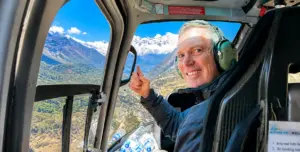
Everest Base Camp Trek with Helicopter Return at a Glance
- Duration: Usually 10 to 12 days from Kathmandu, compared with about 14 days for the walking trek.
- Route up: Lukla, Phakding, Namche Bazaar, Tengboche, Dingboche, Lobuche, Gorakshep and Everest Base Camp.
- Highest point: Kala Patthar, about 5,545 m, climbed at sunrise before the flight.
- Pickup point: Usually the helipad at Gorakshep, about 5,164 m; sometimes lower in the valley, depending on rules and conditions.
- Flight time: About 15 to 20 minutes from Gorakshep to Lukla and around 45 minutes from Lukla to Kathmandu.
- Descent saved: Around three days of walking and more than 2,300 m of downhill.
- Flight type: Shared seats with other trekkers, or a private charter.
- Baggage: Strict weight limits, often around 15 kg per person, including your daypack.
- Best seasons: Autumn and spring, when morning flying weather is most reliable.
- Our trek: The 12-day Luxury Everest Base Camp Trek with Helicopter Return.
Why Trek Up and Fly Back?
The classic Everest Base Camp Trek takes about two weeks: nine days up to Base Camp and Kala Patthar, with acclimatisation days in Namche and Dingboche, and three days back down to Lukla. The way up is where the magic happens: the mountains grow, the villages change, and your body slowly adapts to the altitude. The way down retraces the same trail, and after the trip’s high point, many trekkers find those last three days long and hard on the knees.
A helicopter return keeps everything that matters and removes what many trekkers would happily skip. You still stand at Everest Base Camp, still watch the sunrise from Kala Patthar and still earn every metre of altitude on foot. Then, instead of the descent, you enjoy one of the most spectacular flights on Earth and return to Kathmandu in time for a late lunch. Our guide to how many days the EBC trek takes compares all the trek lengths, and our guide to the Everest Base Camp Trek in 14 days describes the full walking itinerary.
A Typical 12-Day Itinerary
Here is how a typical 12-day Everest Base Camp Trek with Helicopter Return unfolds. Our trip page has the exact day-by-day plan for our departures, and your guide may adjust it for weather and the group’s pace.
- Day 1, arrive in Kathmandu (about 1,400 m): Airport welcome, hotel check-in and a trek briefing.
- Day 2, fly to Lukla and trek to Phakding (about 2,610 m): A thrilling mountain flight to Lukla, then a gentle walk along the Dudh Koshi to Phakding.
- Day 3: Trek to Namche Bazaar (about 3,440 m): Enter Sagarmatha National Park and climb the long hill to the Sherpa capital, Namche Bazaar.
- Day 4, acclimatisation in Namche: Hike to Hotel Everest View and the villages of Khumjung and Khunde.
- Day 5, trek to Tengboche or Deboche (about 3,860 m): Ama Dablam views and the great monastery of Tengboche.
- Day 6: Trek to Dingboche (about 4,410 m), past the old monastery village of Pangboche.
- Day 7, acclimatisation in Dingboche: Climb the ridge of Nangkartshang for views of Makalu, Lhotse, and Island Peak.
- Day 8, trek to Lobuche (about 4,910 m): Past the memorials of Thukla to Lobuche beside the Khumbu Glacier.
- Day 9, Gorakshep and Everest Base Camp (5,364 m): Walk to Gorakshep, visit Base Camp, then return to Gorakshep for the night.
- Day 10, Kala Patthar and the helicopter flight: Sunrise on Kala Patthar, breakfast, then the helicopter back to Kathmandu.
- Day 11, spare day in Kathmandu: A buffer for weather delays, or a day of rest and sightseeing.
- Day 12, departure: Transfer to the airport for your flight home.
Our Everest Base Camp Trek itinerary and Everest Base Camp Trek distance guides describe each stage of the trail in more detail.
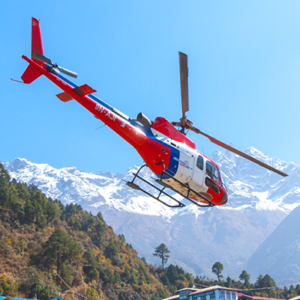
Getting to Lukla: The Flight In
Every Everest Base Camp Trek with Helicopter Return begins with the famous flight to Lukla. In the busy spring and autumn seasons, most Lukla flights leave from Manthali in Ramechhap instead of Kathmandu, after an early-morning drive arranged by our Ramechhap airport transportation team.
On some luxury itineraries, such as our Everest Base Camp Luxury Lodge Trek, a helicopter from Kathmandu replaces the drive and the plane. If you prefer to avoid the Lukla flight altogether, the Everest Base Camp Trek by Road and the historic Jiri to Everest Trek, described in our Jiri to Everest Base Camp guide, walk in from the lower hills, and a helicopter return makes these longer journeys easier to fit into your holiday.
Culture on the Way Up
Because the Everest Base Camp Trek with Helicopter Return keeps the whole ascent on foot, you do not miss the culture of the Khumbu. You pass prayer wheels, mani walls, and whitewashed chortens, explained in our article on chortens in Tibetan Buddhism, and visit the monastery described in our guide to Tengboche Monastery and the Mani Rimdu festival. In Sherpa tradition, the Khumbu is a sacred hidden valley blessed by Guru Padmasambhava, and the songs of the great yogi Milarepa are still loved here; our overview of Buddhism in Tibet explains the faith that shapes every village on the trail.
Helicopter Day, Step by Step
The flight day is the most memorable of the trek. Here is how it usually unfolds.
Sunrise on Kala Patthar
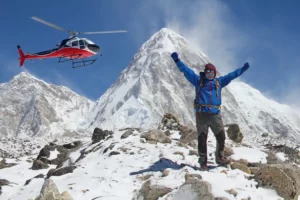
You leave Gorakshep before dawn with a headlamp and climb the dark slopes of Kala Patthar. As the light grows, Everest’se summit pyramid appears above its West Shoulder, with Nuptse beside it and the Khumbu Icefall below. It is the classic Everest view, and a fitting farewell to the mountains.
Breakfast, Bags and the Weigh-In
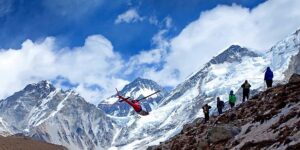
Back in Gorakshep, you enjoy a hot breakfast while your guide confirms the flight by radio or phone. Bags are packed and weighed, because every kilogram matters at this altitude. Keep your warm jacket, gloves, sunglasses and camera with you.
The Pickup at Gorakshep
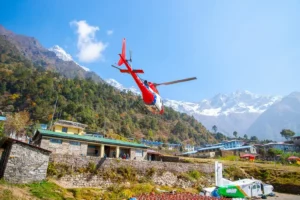
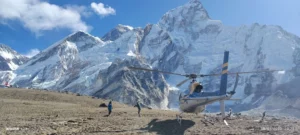
When the helicopter lands, the crew loads the bags quickly, and you board on their signal, keeping clear of the rotors and following every instruction. Because helicopters lose power in thin air, they can usually take off from such high landing sites with only two or three passengers at a time.
The Shuttle Down the Valley
For larger groups, the helicopter often shuttles passengers in stages: it flies the first group down to a lower landing site such as Pheriche, at about 4,240 m, then returns for the rest. Once everyone is lower, where the air is thicker, the helicopter can carry the whole group together.
Refuelling at Lukla
Most flights stop at Lukla to refuel and, sometimes, to change aircraft or combine passengers. From there, it is about 45 minutes to Kathmandu, over the green hills and terraced villages of the middle mountains.
Landing in Kathmandu
By late morning or midday, you’ll land at Kathmandu’s domestic airport, where our team will meet you and transfer you to your hotel. A hot shower, a soft bed and a celebration dinner are only a few hours away.
Where Does the Helicopter Pick You Up?
The usual pickup point is the helipad at Gorakshep, the last settlement below Everest Base Camp, after your Kala Patthar sunrise. Helicopters do not pick trekkers up at Everest Base Camp itself, which sits on the moving Khumbu Glacier and is reserved for expedition and rescue operations, as explained in our guide to whether a helicopter can land at Everest Base Camp.
Depending on the rules in force, the weather and the number of passengers, the pickup can also be lower in the valley, for example at Pheriche or Dingboche, or at Lukla. In that case, you walk down part of the way before flying. Our team confirms your pickup point before departure and again on the trail.
What You See From the Helicopter
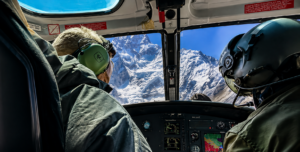
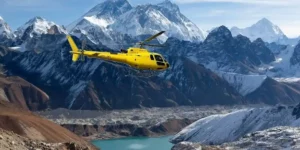
The return flight is a highlight in itself. In about twenty minutes, you see the whole trek in reverse:
- The Khumbu Glacier: A grey river of ice and rubble, with Pumori and Nuptse rising above.
- Everest and Lhotse: Glimpsed above the Nuptse ridge as you fly down the valley.
- Ama Dablam: Its elegant spire seen from angles trekkers never reach.
- Dingboche and Pangboche: Stone-walled fields and villages far below.
- Tengboche Monastery: Perched on its ridge, a tiny red roof among the forest.
- Namche Bazaar: The horseshoe-shaped town clinging to its hillside.
- The Dudh Koshi gorge: Suspension bridges, forests and the airstrip at Lukla.
After Lukla, the flight crosses ridges and rivers of the middle hills before the Kathmandu Valley opens up below.
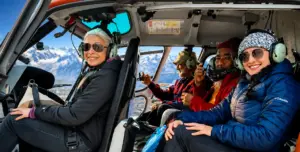
Shared or Private Helicopter Return?
You can fly back in two ways, and both are common.
- Shared seats: You share the helicopter with other trekkers returning that morning. It is a sensible, efficient choice, but the timing depends on coordinating with other passengers.
- Private charter: The helicopter is reserved for you, your family or your group. You have more flexibility with timing and can sometimes add a short scenic detour, such as a stop at the Hotel Everest View, within the rules in force.
Whichever you choose, the pilot has the final say on weight, passenger numbers and timing, because safety margins at high altitude are narrow.
Aircraft and Pilots: Who Flies You Home
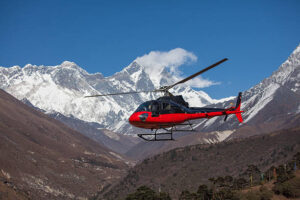
Return flights in the Khumbu usually fly in light, single-engine helicopters from the AS350 family, designed for high-altitude work, flown by pilots who fly in the Everest region every season. An aircraft of this family once famously landed on the summit of Everest during a record test flight.
Still, everyday operations are far more conservative: pilots calculate the load for each landing site, fly in calm morning air, and turn back whenever weather or wind makes a flight unsafe. We work only with established, registered operators and never ask a pilot to fly in marginal conditions.
Baggage and Weight Limits
Weight is the biggest practical difference between a helicopter return and a walking trek. Helicopter performance depends on altitude, temperature and the total load, so operators set strict limits, often around 15 kg per passenger including your daypack, and passengers’ body weight is also considered. Pack smart:
- Use a soft duffel bag: It fits more easily in the small luggage space.
- Travel light: Leave city clothes and extra items at your Kathmandu hotel.
- Keep valuables with you: Keep your passport, phone, camera, and medicines in your daypack.
- Wear your heaviest layers: Your down jacket and boots weigh nothing in the luggage if you wear them.
In some cases, heavier bags travel down the valley with porters or on a later flight and rejoin you in Kathmandu. Our Everest Base Camp Trek packing list helps you pack within the limits.
Helicopter Rules in the Everest Region: What Has Changed
Helicopter flights in the Khumbu have sparked important debate. In recent seasons, the local municipality and community groups moved to restrict commercial helicopter flights, citing noise over villages and monasteries, disturbance to wildlife and lost work for porters and lodges. For a time, flights were suspended, and after talks between local leaders, operators and the authorities, operations resumed under agreed conditions.
Rescue flights now follow medical procedures, with patients usually assessed by local health workers before a flight to Kathmandu unless the case is critical. Landing sites, passenger numbers and flight types for commercial flights depend on the rules in force at the time, which is why your pickup may be at Gorakshep or lower in the valley. Our guide to Everest helicopter tour restrictions explains the background, and our team checks the latest rules before every departure.
Weather, Delays and Backup Plans
Helicopters in the Himalaya fly mainly in the clear morning hours, before clouds build up and winds rise. Even in the best seasons, a cloudy morning can delay a flight. Here is what happens if the helicopter cannot come:
- Wait for a window: Often the weather clears later in the morning or the next day.
- Walk down: Your guide may lead you down to Pheriche or Dingboche, where flights are easier, and arrange a pickup there.
- Fly from Lukla: In longer spells of bad weather, you may walk down to Lukla and fly out by plane or helicopter.
- Use your spare day: That is why a buffer day in Kathmandu is built into a well-planned itinerary.
Never book your international flight for the day after the helicopter return. One or two spare days in Kathmandu protect your plans. Our guide to Lukla airport and flights explains how weather affects flights in the region.
Acclimatisation and Safety
A helicopter return does not change the ascent, which is why it is the safest way to shorten an Everest trek. You still spend acclimatisation days in Namche and Dingboche and climb gradually to Lobuche and Gorakshep. Never try to save time by cutting acclimatisation days on the way up; that is when altitude sickness strikes.
- Know the symptoms: Headache, nausea, dizziness, loss of appetite, unusual fatigue and poor sleep.
- Tell your guide early: Our guides check every trekker’s health daily, including oxygen levels.
- Descend if symptoms worsen: Descending is the most effective treatment, and an emergency flight is separate from your planned return.
- Choose experienced operators: We work only with established helicopter companies whose pilots fly in the Khumbu every season.
Read our Acute Mountain Sickness page and our guide to altitude sickness on the Everest Base Camp Trek before you go. The Himalayan Rescue Association aid post at Pheriche provides medical care in the main seasons.
Benefits of a Helicopter Return
- More time: Save two to three days for Kathmandu, Pokhara, a safari or your journey home.
- Easier on the knees: Skip more than 2,300 m of steep, repetitive descent.
- A flight to remember: See the whole Khumbu from the air in a single morning.
- The same achievement: Reach Base Camp and Kala Patthar on foot, exactly as on the classic trek.
- Faster recovery: You are back to warm showers, good food and thin air the same day.
- Flexibility: Works well for travellers with limited leave or tight schedules.
Drawbacks to Consider
- Weather dependence: Flights can be delayed, so you need spare days.
- Baggage limits: You must pack light.
- Less time in the villages: You miss the relaxed walk back through Namche and Phakding.
- Planning complexity: Pickup points and passenger numbers depend on the rules in force.
- A bigger footprint: Helicopters are noisy and fuel-hungry, so sharing flights and using them wisely matters.
For many trekkers, the benefits clearly outweigh the drawbacks, but if you love the slow rhythm of teahouse life and want to walk every step, the classic trek remains a wonderful choice.
Who Should Choose a Helicopter Return?
The Everest Base Camp Trek with Helicopter Return suits many kinds of travellers:
- Busy professionals: Reach Everest Base Camp and Kala Patthar in about ten to twelve days.
- Trekkers over 50: Less strain on the knees and more energy for the climb, as explained in our guide to the Everest Base Camp Trek over 50.
- First-time Himalayan trekkers: The full experience with a gentler finish; read our advice on the Everest Base Camp Trek for beginners.
- Couples and celebrations: A honeymoon or milestone birthday with a helicopter finale.
- Photographers: Aerial views of the Khumbu that walkers never see.
- Families: A shorter, more comfortable trip; see our guide to the Everest Base Camp Trek with kids for younger trekkers.
Helicopter Return vs Walking Back vs Helicopter Tour
It helps to compare the three main ways to experience Everest:
- Trek with helicopter return: Walk up to base camp and Kala Patthar with full acclimatisation, then fly back. About 10 to 12 days.
- Walking trek: Walk up and back down to Lukla, with more time in the villages—about 14 days.
- Helicopter tour: Fly from Kathmandu to the high Khumbu and back in a single morning, without staying at base camp.
Our detailed comparison of the helicopter tour vs trek with helicopter return, and our guides to the EBC trek or helicopter tour, will help you decide. If you only have a day, the Everest Helicopter Tour, the Mt Everest by Helicopter Tour and the Sharing Everest Helicopter Tour with Kala Patthar Landing bring you close to Everest, as described in our guides to the Everest Base Camp helicopter tour and the Kala Patthar landing.
Our Treks With a Helicopter Return
We offer several ways to combine trekking and flying, from comfortable to exclusive:
- Luxury Everest Base Camp Trek with Helicopter Return: Twelve days, walking up in comfort with the best available lodges and flying back after Kala Patthar.
- Everest Base Camp Helicopter Trek: A shorter trek with a helicopter finale, described in our guide to the short Everest Base Camp Trek.
- Everest Base Camp Luxury Lodge Trek: Eleven days, with helicopter flights in and out, explained in our guide to the luxury Everest Base Camp Trek.
- Everest Elite Luxury Heli Trek: Our most exclusive combination of fine lodges and helicopter flights.
- Everest Base Camp Yoga Trek: A slower, mindful journey that can also end with a flight, described in our guide to mindful trekking in the Himalayas.
On the luxury versions, you stay in the finest lodges of the lower Khumbu, compared village by village in our guide to the best luxury lodges in the Everest region, and in the best available teahouses higher up. Our guide to what you see at Everest Base Camp shows what awaits at the top.
Helicopter Returns on Other Everest Routes
The idea behind the Everest Base Camp Trek with Helicopter Return works on other routes too, within the rules in force. On the Gokyo route, a return flight can sometimes be arranged from the lakes after the climb of Gokyo Ri, described in our guide to Gokyo Ri and the Fifth Lake, and the Gokyo Lakes Helicopter Tour shows the valley from the air. After the high passes described in our Everest Three Passes Trek guide, or a climb of Chhukung Ri, a flight can save the long walk out.
Some climbers on Mera Peak Climbing fly out too; check the latest NMA peak permit updates and read our Ama Dablam expedition guide if bigger summits call. Families who cannot trek can join you in Kathmandu after an Everest Heli Sherpa Village Walk, with views of the giants described in our article on Nepal’s eight-thousand-metre peaks.
Best Time for a Trek With Helicopter Return
Because the return depends on flying weather, season matters even more than on the walking trek.
Autumn (Late September to November)
The best season, with the clearest skies and the most stable morning flying weather. Read our guide to the Everest Base Camp Trek in October.
Spring (March to May)
Also excellent, with warmer days and rhododendrons in bloom, though clouds build earlier in the day. See our guide to the Everest Base Camp Trek in April.
Winter (December to February:) Mornings are often clear and calm, but it’s very cold, with occasional snowstorms that can ground flights for days.
Monsoon (June to August)
Frequent cloud and rain make flights unreliable; we don’t recommend a helicopter return. Our guide to the Everest Base Camp Trek in the monsoon explains why.
Our month-by-month guide to the best time for Everest Base Camp Trek and our guide to the best seasons for an Everest helicopter tour cover every month.
What to Pack
You need the same trekking kit as on the classic trek, packed within the helicopter limits. Bring warm layers, a down jacket, a sleeping bag for the upper lodges, broken-in boots, trekking poles, sun protection and a water purification method. For the flight, keep these within reach:
- Warm jacket and gloves: Helicopter cabins can be cold at altitude.
- Sunglasses: The glare off snow and ice is intense.
- Camera or phone: Fully charged, with a spare battery kept warm.
- Passport and medicines: Always in your daypack.
Our trekking equipment page lists everything else you need.
Fitness and Training
A helicopter return makes the trek shorter, not easier on the way up. You still walk five to seven hours on most days, including long climbs at high altitude, so good preparation matters. Start training three to six months before your trek with long hikes, stair climbing, cardio, and leg-strength work. Our 12-week training plan is designed for exactly this trek, and our honest look at Everest Base Camp Trek difficulty explains the challenges.
Permits, Guides and Insurance
You need the same permits as on the classic trek, and our team arranges them: the Sagarmatha National Park entry permit and the Khumbu Pasang Lhamu Rural Municipality permit. Our guide to Everest Base Camp Trek permits explains how they work. Trekking rules in Nepal have changed in recent years, and many areas now require a licensed guide; rules vary by area and can change, so check before you travel, as explained in our article on Nepal’s mandatory guide rules.
Your travel insurance must cover trekking to the heights on your itinerary and emergency helicopter evacuation. The planned return flight is part of your trip, while a rescue flight is a separate emergency service. Check entry requirements for Nepal in our Nepal visa guide.
Photography From the Helicopter
- Ask about seating: Seats are allocated for balance and safety, but the crew will help where they can.
- Shoot through clean glass: Hold your lens close to the window to reduce reflections.
- Use a fast shutter speed: It freezes vibration and movement.
- Avoid polarising filters: They can create rainbow patterns on aircraft windows.
- Look both ways: Some of the best views are on the side you least expect.
- Put the camera down for a moment: Some views are best remembered with your own eyes.
After the Flight: Making the Most of Your Extra Days
The days you save are a gift. Spend them exploring the temples and stupas of the capital on our Kathmandu Day Tour, guided by our Kathmandu sightseeing tips, watching the Himalaya at sunrise on Nagarkot Hiking or relaxing by the lake in Pokhara, described in our Pokhara sightseeing guide, with Paragliding in Pokhara. Wildlife lovers can head to a Chitwan Jungle Safari, and the Classic Nepal Tour brings the country’s heritage together.
Further afield, the Luxury Bhutan Tour and the Luxury Nepal Bhutan Tour lead to the cliffside Tiger’s Nest Monastery, the Luxury Nepal Tibet Tour combines two Himalayan cultures in comfort, and the Lhasa to Everest Base Camp Overland Tour shows you the north face of Everest from Tibet, as explained in our Lhasa to Everest Base Camp guide.
Using Helicopters Responsibly
Helicopters bring real benefits to the Khumbu, from rescues to saving trekkers’ time, but they also bring noise and pressure on fragile valleys and on the porters and lodges whose livelihoods depend on trekkers. You can help by sharing flights where possible, avoiding unnecessary flights, spending generously in local lodges and shops on the way up and respecting the communities you pass through. Learn more on our responsible tourism page and in our guide to Sherpa culture and traditions.
More Everest Adventures
If you love the Khumbu, there is much more to explore. The Gokyo Lakes Trek, described in our Gokyo Lakes Trek guide, leads to turquoise lakes and the panorama of Gokyo Ri, compared in our guide to Gokyo Ri vs Kala Patthar. Experienced trekkers can take on the Everest 3 Pass Trek, crossing the Cho La Pass and the Renjo La Pass, while Ama Dablam Base Camp Trekking, introduced in our Ama Dablam Base Camp Trek guide, explores a quieter valley beneath Ama Dablam.
Climbers can add Island Peak Climbing, described in our Island Peak climbing guide, or Lobuche Peak Climbing, and a helicopter return after the summit is a popular way to finish. For a gentler visit, the Everest View Trek, described in our guide to the luxury Everest View Trek, and the one-hour Everest mountain flight show you Everest with far less effort. Browse our list of the top 50 treks in Nepal and our trekking in Nepal guide for more ideas.
Common Mistakes on a Trek With Helicopter Return
- Cutting acclimatisation to save even more time: Save time on the way down, never on the way up.
- No spare days: Weather can delay the flight by a day or more.
- Overpacking: Helicopters have strict weight limits.
- Assuming a pickup at base camp: Pickups are at Gorakshep or lower, never at base camp itself.
- Ignoring the rules: Landing sites and passenger numbers depend on current regulations.
- Skipping insurance checks: Make sure emergency evacuation is covered.
Frequently Asked Questions About the Everest Base Camp Trek with Helicopter Return
Where does the helicopter pick you up?
Usually at the helipad in Gorakshep after your Kala Patthar sunrise. Depending on the rules, weather and passenger numbers, the pickup can be lower in the valley, such as at Pheriche or Lukla.
Can the helicopter pick you up at Everest Base Camp?
No. Everest Base Camp sits on the moving Khumbu Glacier, and landings there are reserved for expedition and rescue operations.
How long is the flight back to Kathmandu?
About 15 to 20 minutes from Gorakshep to Lukla and around 45 minutes from Lukla to Kathmandu, plus time for refuelling and any shuttles.
How many days does the trek with helicopter return take?
Usually 10 to 12 days from Kathmandu. Our Luxury Everest Base Camp Trek with Helicopter Return takes 12 days from Kathmandu.
What happens if the helicopter cannot fly?
You wait for a weather window, or your guide leads you down to a lower village or to Lukla for a later flight. That is why spare days are essential.
Is the helicopter shared or private?
Both are possible. Shared seats are common, while a private charter gives you more flexibility with timing.
What is the baggage limit?
Limits are strict, often around 15 kg per person including your daypack, and passengers’ weight is also considered.
Are helicopter flights allowed in the Everest region now?
Yes, under conditions agreed after recent local restrictions. Pickup points and passenger numbers depend on the rules in force, which our team checks before every departure.
Is a helicopter return safe?
With experienced operators, good weather and pilots who decide on weight and timing, it is a well-established service. The ascent remains as safe as on the classic trek because acclimatisation is unchanged.
Is the helicopter return worth it?
For trekkers short on time, those who want to spare their knees and anyone who wants a once-in-a-lifetime flight, yes. If you love the walk itself, the classic trek is equally rewarding.
Final Thoughts: Walk to Everest, Fly Home
An Everest Base Camp Trek with Helicopter Return gives you the best of both worlds: the slow, life-changing journey on foot to the foot of the world’s highest mountain, and a breathtaking flight home over everything you have just walked through. You earn base camp and Kala Patthar step by step, and you save your knees and your time on the way back.
Join our 12-day Luxury Everest Base Camp Trek with Helicopter Return, or choose the shorter Everest Base Camp Helicopter Trek. Learn more about our company, meet our team, view our company registration and legal documents, then plan your trip or contact us today.
Quick Inquiry
Explore More


