Island Peak Climbing Guide: Nepal’s Most Popular Trekking Peak

Island Peak Climbing Guide: Nepal’s Most Popular Trekking Peak
It is one in the morning at Island Peak Base Camp. The stars are so bright they seem close enough to touch, and the only sounds are the hiss of a stove and boots crunching on frozen gravel. Headlamps bob up the rocky slope above camp, one by one, like a slow procession of fireflies. Hours later, clipped to a fixed rope on a steep wall of ice, you watch the first light turn the immense south face of Lhotse gold. Above you, a narrow snow ridge leads to the summit. This is the day you become a Himalayan climber.
Island Peak Climbing is the most popular way to move from trekking to mountaineering in Nepal. Rising to 6,189 m above the Chhukung valley in the Everest region, Island Peak, also known as Imja Tse, combines a classic Everest trek with a genuine alpine climb: a rocky ascent, a glacier crossing, a steep headwall on fixed ropes and an airy summit ridge with views of Lhotse, Makalu, Baruntse and Ama Dablam.
In this guide, our team explains everything you need to know about our Island Peak Climbing expedition: the history of the peak, the itinerary, the climb section by section, difficulty, training, acclimatisation, gear, permits, the best seasons, safety and how to combine the climb with Everest Base Camp and other peaks.
Island Peak at a Glance
- Height: 6,189 m, the most widely used summit figure; some sources cite slightly lower figures, around 6,160 m.
- Local name: Imja Tse.
- Location: The Chhukung valley in the Khumbu (Everest region), inside Sagarmatha National Park.
- Grade: Alpine PD+ (peu difficile plus): a non-extreme climb with some technical sections.
- Duration: Around 15 to 17 days from Kathmandu, including spare days.
- Base camp: About 5,087 m, beside the Imja Glacier.
- Summit day: Usually 10 to 12 hours return from base camp, with a gain of around 1,100 m.
- Technical sections: A glacier with crevasses, sometimes crossed on ladders, a steep snow and ice headwall of up to around 50 degrees on fixed ropes and an exposed summit ridge.
- Best seasons: Autumn (October to November) and spring (April to May).
- Permits: Island Peak climbing permit, Sagarmatha National Park entry permit and Khumbu Pasang Lhamu Rural Municipality permit.
Why Island Peak Is Nepal’s Most Popular Trekking Peak
Nepal has many trekking peaks, but none is climbed as often as Island Peak. Here is why:
- The perfect first Himalayan summit: It is high enough to be a real mountaineering challenge, yet accessible to fit trekkers with basic training.
- A classic Everest trek included: The approach follows the famous trail through Namche Bazaar, Tengboche and Dingboche.
- Real alpine climbing: Crampons, ice axe, fixed ropes and a glacier give you a genuine taste of mountaineering.
- Spectacular scenery: Lhotse’s south face rises directly above the summit, with Makalu, Baruntse, and Ama Dablam all around.
- Excellent support: Teahouses as far as Chhukung, an established base camp and experienced climbing guides.
- A stepping stone: Many climbers use Island Peak to prepare for bigger peaks such as Ama Dablam, Himlung, or even Everest.
The Story of Island Peak
British mountaineers named Island Peak on early Everest expeditions. From Dingboche, the mountain rises like an island from a sea of ice, surrounded by the glaciers of the upper Imja valley. The name stuck, although the peak was later officially renamed Imja Tse, after the valley and glacier below it.
The peak’s climbing history is closely linked with Everest. Members of the British Everest expedition first climbed its southwest summit as part of their training and acclimatisation, including Tenzing Norgay, who later reached Everest’s summit with Sir Edmund Hillary. A few years later, a Swiss climber and Sherpa companions reached the main summit. Since then, Island Peak has become a training ground for generations of climbers. Read more about Sherpa mountaineering heritage in our guide to Sherpa culture and traditions.
Our Island Peak Climbing Itinerary
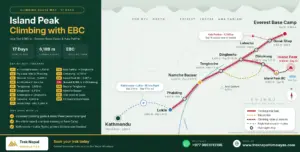
Here is how the expedition unfolds on our Island Peak Climbing itinerary. Walking times are approximate and depend on your pace, the weather and conditions on the mountain.
Day 1: Arrive in Kathmandu (about 1,400 m)
Our team meets you at the airport and transfers you to your hotel. You meet your climbing guide for a briefing and a check of your equipment.
Day 2: Fly to Lukla and Trek to Phakding (about 2,610 m)
Fly to Lukla, usually from Manthali in Ramechhap during the busy season, after an overnight drive arranged by our Ramechhap airport transportation team, then take an easy three- to four-hour trek to Phakding.
Day 3: Trek to Namche Bazaar (about 3,440 m)
Spend five to six hours crossing suspension bridges, entering Sagarmatha National Park, and climbing to Namche Bazaar, the Sherpa capital and the last place to easily buy or rent gear.
Day 4: Acclimatisation Day in Namche
Hike to the Hotel Everest View for views of Everest, Lhotse and Ama Dablam, perhaps continuing to Khumjung, then return to Namche to sleep.
Day 5: Trek to Tengboche (about 3,860 m)
Five to six hours to the famous monastery of Tengboche, where many climbers seek a blessing before their expedition. Read our guide to Tengboche Monastery and the Mani Rimdu festival.
Day 6: Trek to Dingboche (about 4,410 m)
Through Pangboche, with its ancient monastery, and into the Imja valley to Dingboche, from where Island Peak first appears like an island in a sea of ice.
Day 7: Acclimatisation Day in Dingboche
Climb the ridge of Nangkartshang, above 5,000 m, for views of Makalu, Lhotse and Island Peak itself, then return to Dingboche to sleep.
Day 8: Trek to Chhukung (about 4,730 m)
Take a short walk up the valley to Chhukung, the last village before base camp, with glaciers beneath the south face of Lhotse.
Day 9: Trek to Island Peak Base Camp (about 5,087 m)
Three to four hours along the moraine of the Imja and Lhotse glaciers to base camp, a tented camp on a grassy, rocky meadow beneath the mountain.
Day 10: Pre-Climb Training at Base Camp
Your climbing guide reviews crampon technique, ice axe handling, rope work, ascending fixed ropes with a jumar, and descending safely, then checks all equipment. Rest, eat well and go to bed early.
Day 11: Summit Day and Descent to Chhukung (Island Peak 6,189 m)
Start before dawn, climb about 1,100 m to the summit, then descend back to base camp and on to Chhukung—ten to twelve hours or more of effort, and the most rewarding day of the expedition. We describe the climb in detail below.
Days 12 to 14: Return to Namche, Lukla and Kathmandu
Walk down through Tengboche to Namche, then continue to Lukla to celebrate with your team, and fly back to Kathmandu.
Spare Days and Departure
Our itinerary includes spare days for mountain weather and Lukla flight delays, before your transfer to the airport for your flight home.
The Approach Trek: Villages, Monasteries and Mountains
One of the joys of Island Peak Climbing is that the approach is a classic Himalayan trek in its own right. You follow the Dudh Koshi through pine forests and Sherpa villages, climb to the bustling market of Namche Bazaar, visit the great monastery at Tengboche and walk beneath Ama Dablam to the stone-walled fields of Dingboche. The route is described in detail in our Everest Base Camp Trek itinerary and our guide to the Everest Base Camp Trek distance.
Along the way, mani walls, prayer wheels, and whitewashed chortens mark the trail, as explained in our article on chortens in Tibetan Buddhism. In Sherpa tradition, the Khumbu is a sacred hidden valley blessed by Guru Padmasambhava, and the region’s monasteries keep alive teachings traced in our overview of Buddhism in Tibet. Many climbers receive a blessing from a lama before heading to base camp, and expedition teams hold a puja ceremony at base camp to ask the mountain for safe passage. The songs of the great yogi Milarepa are still sung in the region’s monasteries.
The Climb, Section by Section
Summit day is the heart of Island Peak Climbing. Here is what to expect on each section of the standard route.
Base Camp to the Rocky Gully
Climbers usually leave base camp between midnight and 2 a.m. The first hours follow a steep trail up grassy and rocky slopes, then zigzag through a rocky gully and over boulders in the dark. Some teams use a high camp at around 5,500 m to shorten summit day, but most climb directly from base camp, which is easier to supply and better for sleep.
Crampon Point and the Glacier
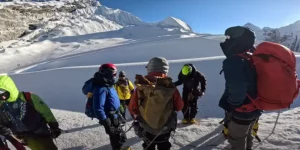
At the top of the rocky section, at around 5,700 m, you reach the crampon point, where the rock gives way to snow and ice. Here you put on crampons, rope up with your guide and step onto the glacier. The route weaves between crevasses, some of which climbing teams have crossed with aluminium ladders. Conditions change each season, so follow your guide’s lead exactly.
The Headwall
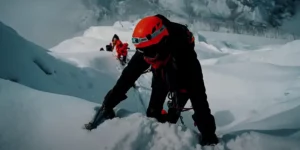
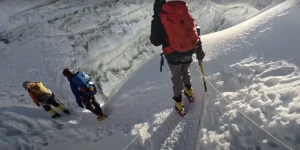
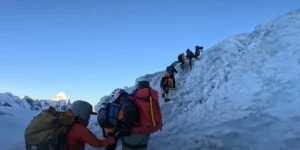
The crux of the climb is the headwall: a steep slope of snow and ice, rising at up to around 50 degrees, protected by fixed ropes. You clip your jumar to the rope and climb steadily, kicking your crampons into the slope and sliding the jumar up as you go, with your safety line always attached. It is tiring at this altitude, but technically straightforward for a well-prepared climber. As the light grows, Lhotse’s south face fills the sky above you.
The Summit Ridge
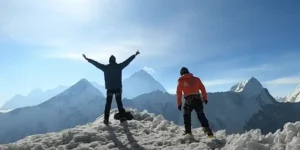
At the top of the headwall, a narrow, exposed snow ridge leads to the summit. Fixed ropes usually protect this section too. The summit is a small, airy platform at 6,189 m, often windy and bitterly cold, with a breathtaking panorama of Lhotse, Lhotse Shar, Makalu, Baruntse, Ama Dablam, and the glaciers of the upper Imja Valley.
The Descent
Most accidents happen on the way down, when climbers are tired. You descend the headwall carefully on the fixed ropes, abseiling or using an arm-wrap technique as your guide directs, then retrace the glacier route, crossing ladders again where needed, back to the crampon point and down the rocky gully to base camp. After a rest and a hot drink, you continue down to Chhukung to sleep at a lower altitude.
How Difficult Is Island Peak?
Island Peak is graded alpine PD+, meaning a moderate climb with some steeper sections. It isn’t extremely technical, but it is a serious high-altitude mountain and shouldn’t be underestimated. The main challenges are:
- Altitude: The summit is above 6,000 m, where each breath contains less than half the oxygen it does at sea level.
- A long summit day: Ten to twelve hours or more of sustained effort, beginning in the middle of the night.
- The headwall: Steep snow and ice, climbed with crampons and a jumar on fixed ropes.
- Cold: Pre-dawn mountain temperatures can be well below freezing, with wind chill on the ridge.
- Glacier travel: Crevasses, ladders and changing snow conditions.
Fit trekkers who prepare well, acclimatise properly, and listen to their guides have a strong chance of success. Our honest look at Everest Base Camp Trek difficulty explains the trekking part of the challenge.
Do You Need Climbing Experience?
You don’t need previous mountaineering experience to attempt Island Peak, which is part of its popularity. Your guide teaches the essential skills during the training day at base camp. However, previous experience of high-altitude trekking is essential, and some basic preparation will make a big difference:
- If possible, practise with crampons and an ice axe on a snow course or guided winter walk
- Learn to use a jumar and abseil at a climbing wall or with a local guide before your trip.
- Learn self-arrest with an ice axe in case you slip on snow.
- Get used to your boots and crampons by wearing them on long walks.
Climbers with a little alpine experience will feel more confident on the headwall and ridge, but mawith good training and support, ny first-time climbers reach the summit every season w
Acclimatisation: The Key to Success
Altitude, not technique, is the main reason climbers turn back on Island Peak. Our itinerary builds acclimatisation gradually, with rest days in Namche and Dingboche, a climb of Nangkartshang above 5,000 m, and nights in Chhukung and at base camp before summit day. This climb-high, sleep-low pattern gives your body the best chance to adapt.
Some climbers prefer to acclimatise further by trekking to Everest Base Camp and Kala Patthar before the climb, or by climbing Chhukung Ri, at about 5,550 m. Our extended itineraries combine Island Peak with the Everest Base Camp Trek for exactly this reason. Learn the warning signs of altitude sickness on our Acute Mountain Sickness page and in our Everest Base Camp Trek guide to altitude sickness.
Training and Fitness
We recommend starting your training three to four months before the expedition. Focus on:
- Cardio endurance: Running, cycling, swimming or stair climbing, building up to long sessions.
- Leg and core strength: Squats, lunges, step-ups and core exercises for stability on steep slopes.
- Long hikes with a pack: Back-to-back days of six to eight hours, ideally on hilly or mountainous terrain.
- Upper body: Pull-ups and rowing to help with jumaring on the headwall.
- Mental resilience: Practise long, uncomfortable days; summit day is as much mental as physical.
Our 12-week training plan is a good foundation; for Island Peak, add more strength work and longer days with a heavier pack. First-timers in the Himalaya should also read our guide to the Everest Base Camp Trek for beginners.
Gear for Island Peak
You need trekking gear for the approach and specialist mountaineering gear for the climb.
Technical Climbing Gear
- Mountaineering boots: Insulated double boots or high-altitude boots rated for around 6,000 m, compatible with crampons.
- Crampons: Fitted to your boots before the expedition.
- Ice axe: A general mountaineering axe.
- Climbing harness: With locking carabiners and slings.
- Ascender (jumar) and descender: For the fixed ropes on the headwall and ridge.
- Helmet: Protection against falling ice and rock.
Clothing and Personal Gear
- Layers: Thermal base layers, fleece, a heavy down jacket for summit day and a waterproof, windproof shell.
- Insulated climbing trousers: For the pre-dawn cold.
- Hands and head: Liner gloves plus heavy insulated mitts, a warm hat and a buff.
- Sleeping bag: Rated to around minus twenty degrees Celsius for base camp.
- Headlamp: Plus a spare, with lithium batteries that perform better in the cold.
- Eye and skin protection: Glacier glasses, sunscreen and lip balm.
You can rent much of the technical gear in Kathmandu or Namche; ask our team for advice. For trekking gear, see our Everest Base Camp Trek packing list and our trekking equipment page.
Best Time for Island Peak Climbing
The best seasons for Island Peak Climbing are the same as for trekking in the Everest region, but mountain conditions matter even more.
Autumn (October to November)
Clear, stable weather and excellent visibility make autumn a favourite season. It becomes colder towards late November. Read our guide to the Everest Base Camp Trek in October to get a feel for the season.
Spring (April to May)
Slightly warmer temperatures on summit day, good snow conditions and the lively atmosphere of the Everest climbing season. Afternoon cloud is more common than in autumn.
Winter and the Monsoon
Winter brings extreme cold and strong winds on the summit, while the monsoon brings cloud, rain at lower altitudes and heavy snow higher up. We recommend spring or autumn for almost all climbers. Our guide to the best time for Everest Base Camp Trek covers each month, and our guide on how many days the EBC trek takes explains how to plan buffer days around your Island Peak Climbing expedition.
Permits and Rules
Three permits are needed for the climb, and our team arranges them all:
- Island Peak climbing permit: Issued through the Nepal Mountaineering Association, which manages Nepal’s trekking peaks.
- Sagarmatha National Park entry permit: Checked at Monjo.
- Khumbu Pasang Lhamu Rural Municipality permit: For entry into the local municipality area.
Registered agencies organise climbs, and licensed climbing guides lead them. Climbers must follow waste and environmental protection rules, including any garbage deposit in force. The rules for trekking peaks are updated periodically; our article on NMA peak permit updates explains recent changes. You can view our company registration and legal documents online, and check entry requirements in our Nepal visa guide.
Life at Island Peak Base Camp
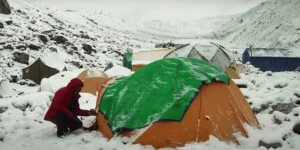
Island Peak Base Camp lies on a sandy, rocky meadow beside the Imja Glacier, with the mountain rising directly above. During climbing season, it is a lively tented village of teams from around the world. Our crew sets up sleeping tents, a dining tent, and a kitchen, and our cooks prepare hot, hearty meals to fuel your climb.
Nearby lies Imja Lake, one of Nepal’s most closely monitored glacial lakes, which grew rapidly as the glacier retreated; engineers have lowered its water level to reduce the risk of downstream flooding. It is a striking reminder of how quickly the Himalaya is changing. Nights at base camp are cold, so a warm sleeping bag and dry layers are essential.
Safety on Island Peak
Safety underpins every expedition we run. On Island Peak, it rests on:
- Experienced climbing guides: Licensed professionals who know the mountain and its conditions.
- Proper acclimatisation: A gradual itinerary and daily health checks, including oxygen levels.
- Training and equipment checks: At base camp before summit day.
- Turnaround times: If the team has not reached the summit by a set time, or conditions worsen, the guide will turn back. The mountain will always be there.
- Fixed ropes and safe technique: Stay clipped in on the headwall and ridge, especially on the descent.
- Cold protection: Keep moving your fingers and toes, and tell your guide immediately if you lose feeling.
- Insurance: Your policy must cover climbing up to around 6,500 m, helicopter evacuation and medical treatment.
In an emergency, helicopters can reach base camp and Chhukung in good weather, and medical help is available at the aid post in Pheriche.
Combining Island Peak With Everest Base Camp and Other Peaks
Many climbers combine the peak with other Khumbu highlights. Popular combinations include:
- Island Peak with Everest Base Camp: Around 17 days, adding Lobuche, Gorakshep, Everest Base Camp, and Kala Patthar before the climb for better acclimatisation.
- Island Peak and Lobuche Peak: Around 16 days, adding a second summit on Lobuche Peak.
- Island Peak, Lobuche Peak and Everest Base Camp: Around 18 days, the ultimate Khumbu climbing journey.
- The three passes: Fit climbers can link Island Peak with the Everest 3 Pass Trek, described in our Everest Three Passes Trek route guide, crossing passes such as the Cho La Pass.
- The Gokyo Valley: Add the turquoise lakes of the Gokyo Lakes Trek, explained in our Gokyo Lakes Trek.
How Island Peak Compares With Other Trekking Peaks
If you are choosing a first Himalayan summit, it helps to compare Island Peak Climbing with the other popular peaks in the region:
- Lobuche East: Slightly lower but generally considered more technical, with steeper and more sustained climbing on its upper slopes. It suits climbers with some alpine experience, often after Island Peak. See Lobuche Peak Climbing.
- Mera Peak: Higher, at around 6,400 m and more, but less technical, with a long glacier walk to a short final summit slope. The challenge is altitude and remoteness, not steep climbing. See Mera Peak Climbing.
- Island Peak: The balance of the three: a real but manageable technical section, excellent support and a classic Everest trek on the approach.
Many climbers start with Island Peak, then return for Lobuche East or Mera Peak, and eventually aim for a full expedition peak. Our article on NMA peak permit updates explains how trekking peak permits work.
After Island Peak: Bigger Goals
For many climbers, Island Peak is the beginning of a mountaineering journey. The next step might be Mera Peak Climbing, Nepal’s highest trekking peak, which is less technical but higher and more remote. Experienced climbers often aim next for Ama Dablam, one of the world’s most beautiful mountains. Read our Ama Dablam expedition guide, our answers to common questions about climbing Ama Dablam,a nd our article on Ama Dablam. The greatest dreamers look further still, to the giants described in our article on Nepal’s eight-thousand-metre peaks.
Not Ready to Climb? Treks in the Shadow of Island Peak
If a climb feels like too much, you can still enjoy the upper Khumbu on foot. The classic Everest Base Camp Trek passes Dingboche with superb views of Island Peak, and the Ama Dablam Base Camp Trekking route, described in our Ama Dablam Base Camp Trek guide, explores the valley’s quieter side. For a gentler pace, the Everest View Trek, the Everest Base Camp Yoga Trek and the Everest Base Camp Luxury Lodge Trek offer different ways to enjoy the region. Short on time? Our guide to the short Everest Base Camp Trek and the Everest Base Camp Helicopter Trek explains how to save days.
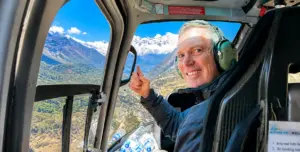
Helicopter Options and the Return Journey
After a successful climb, some climbers choose to fly back rather than walk down for three days. Depending on current rules, conditions and passenger numbers, a helicopter flight from the upper Khumbu can replace the final days of walking, as on the Luxury Everest Base Camp Trek with Helicopter Return and the Everest Elite Luxury Heli Trek. Friends and family who are not climbing can see the mountains on the Everest Helicopter Tour or the Sharing Everest Helicopter Tour with Kala Patthar Landing. Our guide to Everest helicopter tour restrictions explains the current situation.
Other scenic flights include the Mt Everest by Helicopter Tour, the Everest Heli Sherpa Village Walk and the Gokyo Lakes Helicopter Tour. To understand how helicopters operate in the region, read our guides to the Everest Base Camp helicopter tour, the Kala Patthar landing reopening, whether a helicopter can land at Everest Base Camp, the EBC trek or helicopter tour question, the helicopter tour vs trek with helicopter return and the best seasons for an Everest helicopter tour.
Photography on Island Peak
- Keep your camera or phone warm: Batteries drain fast in the pre-dawn cold; keep them in an inside pocket.
- Use a wrist strap: Dropping a phone on the headwall means losing it for good.
- Shoot at sunrise: The light on Lhotse and Makalu during the climb is unforgettable.
- Only take photos when safe: Never unclip or stop in an exposed place for a picture; your guide will tell you when it is safe.
- Capture the summit quickly: Time on top is short because of cold and wind.
Responsible Climbing
Island Peak is busy during climbing season, and the mountain and its base camp need care. Carry out everything you bring, including food packaging and batteries; follow your team’s waste management; respect the fixed ropes and other climbers; and keep the Imja Valley clean. Pack light so porter loads stay safe, and thank the guides, cooks and porters who make the climb possible. Learn more on our responsible tourism page.
Before and After the Expedition
Spend your spare days in Kathmandu exploring the city with our Kathmandu Day Tour or Kathmandu sightseeing guide, or relax in the hills with Nagarkot Hiking. After the climb, unwind in lakeside Pokhara, described in our Pokhara sightseeing guide, with Paragliding in Pokhara, or join a Chitwan Jungle Safari. Near Kathmandu, you can also walk the forest trails of Nagarjun Hiking or spend two days on the Chisapani Nagarkot Trek. At the same time, the Classic Nepal Tour brings together the country’s heritage highlights. Adventure lovers can add Trishuli River Rafting or a wildlife journey on the Bardia National Park Tour. For more ideas, browse our list of the top 50 treks in Nepal and our wider trekking in Nepal guide.
Beyond the Khumbu: More Himalayan Adventures
Once you have stood on a Himalayan summit, the rest of the range will call. Great treks in other regions include the Annapurna Circuit Trek, the Manaslu Circuit Trek over the Larke Pass, the Upper Mustang Trek, the Langtang Valley Trek and the remote Kanchenjunga Base Camp Trek. Further afield, Bhutan’s legendary Snowman Trek, compared in our guide to the Everest Base Camp Trek vs Snowman Trek, is one of the toughest treks on Earth. Meanwhile, the Luxury Bhutan Tour leads to the cliffside Tiger’s Nest Monastery. In Tibet, the Lhasa to Everest Base Camp Overland Tour, explained in our Lhasa to Everest Base Camp guide, shows Everest’s north face, and the Mount Kailash Tour circles the most sacred mountain in Asia.
Common Mistakes on Island Peak
- Rushing acclimatisation: The most common reason for turning back.
- Arriving with untested boots and crampons: Fit and test your gear before the expedition.
- Skipping the training day: Even experienced climbers benefit from practising on the fixed ropes.
- Dressing too lightly for summit day: The pre-dawn mountain cold is severe.
- Unclipping on the descent: Stay attached to the ropes until your guide says otherwise.
- Ignoring the turnaround time: A late summit often means a dangerous descent.
- No spare days: Weather can delay summit day or the flight from Lukla.
Frequently Asked Questions About Island Peak Climbing
How high is Island Peak?
The summit is usually listed as 6,189 m, though some sources cite slightly lower figures, around 6,160 m. Base camp lies at about 5,087 m.
How difficult is Island Peak?
It is graded alpine PD+, a moderately difficult climb with a glacier, a steep headwall up to about 50 degrees with fixed ropes,s and an exposed summit ridge. Altitude and the long summit day are the main challenges.
Can beginners climb Island Peak?
Yes, fit trekkers with high-altitude trekking experience can climb it after training at base camp. However, we strongly recommend practising with crampons, an ice axe, and a jumar beforehand.
How long does the Island Peak climb take?
Our Island Peak Climbing itinerary takes around 15 to 17 days from Kathmandu, including spare days. Summit day itself usually takes 10 to 12 hours from base camp.
What is the hardest part of the climb?
For most climbers, the headwall is the hardest part: a steep snow-and-ice slope climbed with a jumar on fixed ropes, at an altitude where every step takes effort.
Do I need a climbing permit?
Yes. You need an Island Peak climbing permit, issued through the Nepal Mountaineering Association, plus the Sagarmatha National Park and local municipality permits. Our team arranges them all.
What gear do I need?
Mountaineering boots, crampons, an ice axe, a harness, a jumar, a descender, a helmet and warm clothing for temperatures well below freezing. You can rent much of the technical gear.
When is the best time to climb Island Peak?
Autumn (October to November) and spring (April to May) offer the most stable weather and the best mountain conditions.
Can I combine Island Peak with Everest Base Camp?
Yes. Combining the two takes around 17 days and gives you better acclimatisation before the climb.
Why is it called Island Peak?
British mountaineers named it because, seen from Dingboche, it looks like an island rising from a sea of ice. Its local name is Imja Tse.
Final Thoughts: Your First Step Into the High Himalaya
Island Peak Climbing is one of Nepal’s great adventures: a classic trek through the Sherpa heartland, a night under the stars at base camp, a pre-dawn climb on rock, ice, and snow, and a summit ridge with the south face of Lhotse towering above you. It is a real mountain, and it demands respect, but with good preparation, proper acclimatisation and an experienced team, it is within reach of determined trekkers ready to become climbers.
Join our Island Peak Climbing expedition, add a second summit on Lobuche Peak Climbing, or start with the classic Everest Base Camp Trek. Meet our guides on our team page, learn more about our company, then plan your trip or contact us today. The summit is waiting.


