
Lukla Airport: Flights, Delays and Everything Everest Trekkers Should Know
Lukla Airport: Flights, Delays and Everything Everest Trekkers Should Know
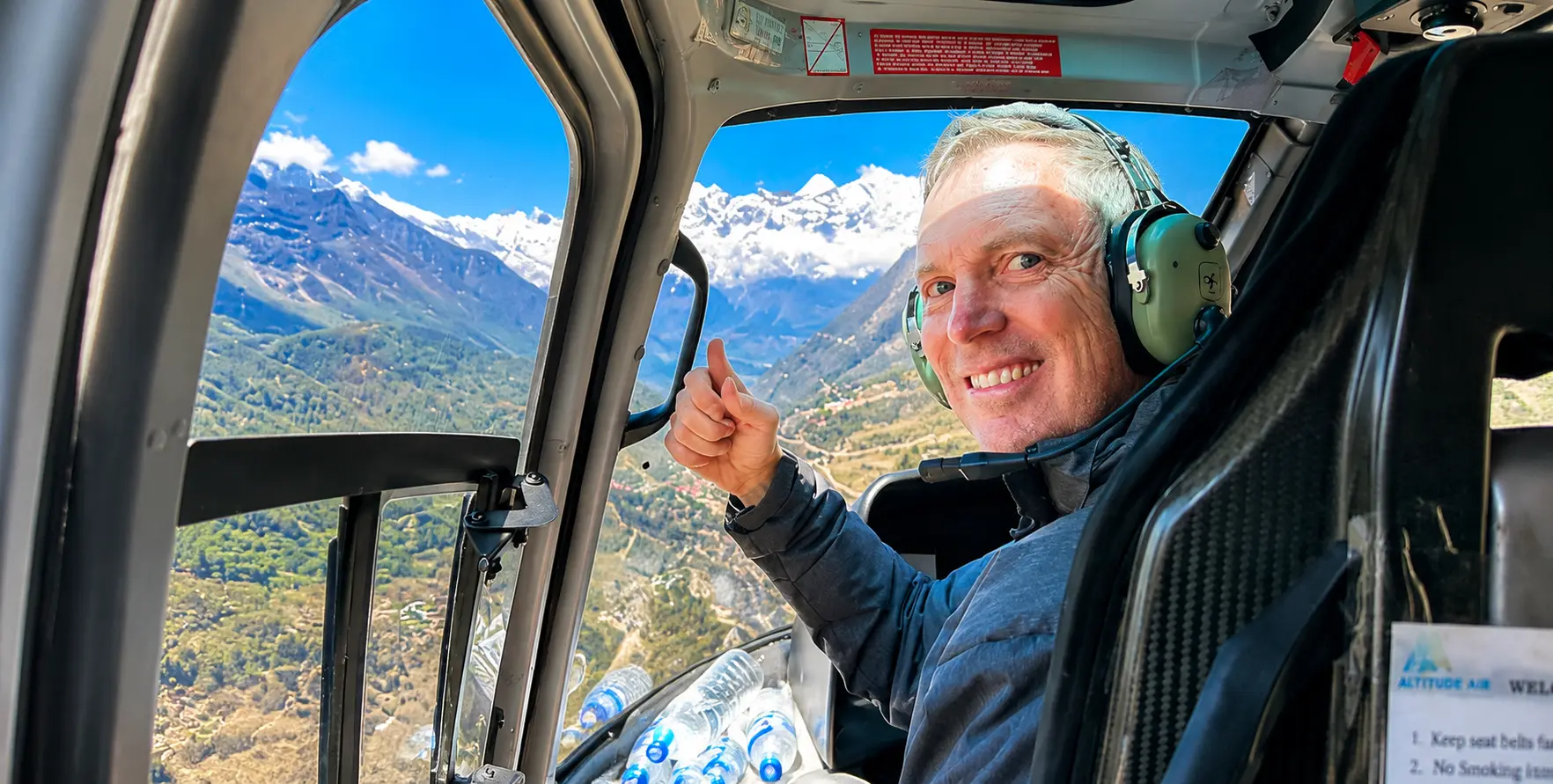
The engines roar, the small plane banks between forested ridges, and suddenly a short strip of tarmac appears, tilted up the side of a mountain and ending at a stone wall. Within seconds, the wheels touch down, the aircraft races uphill, slows sharply, and swings onto a tiny apron crowded with porters, trekkers, and prayer flags. Cheers and nervous laughter fill the cabin. You have just landed at one of the most famous airports in the world.
For almost every trekker heading to Everest, the journey begins at Lukla Airport, officially the Tenzing-Hillary Airport. The flight is short, spectacular and unforgettable, but it is also the part of the trip most affected by weather, delays and changing regulations. Understanding how it works makes your whole journey smoother.
In this guide, our team explains everything you need to know about Lukla Airport: its history, why it is so challenging, the airlines and aircraft, flights from Kathmandu and Ramechhap, baggage rules, delays and cancellations, helicopter options, road alternatives and our best tips. It is based on years of moving trekkers in and out of the Khumbu on our Everest Base Camp Trek.
Lukla Airport at a Glance
- Official name: Tenzing-Hillary Airport, named after the first climbers to reach Everest’s summit.
- Location: Lukla, in the Khumbu region of Solukhumbu District, north-eastern Nepal.
- Elevation: About 2,845 m (around 9,330 ft).
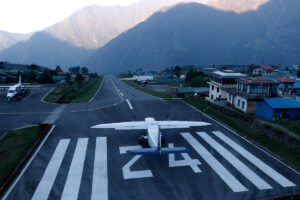
- Runway: A single short, narrow runway of roughly 527 m, with a steep uphill gradient of around 11 to 12 per cent.
- Operations: Visual flight rules only, mainly in the early morning when the weather is calmest.
- Aircraft: Small short-take-off-and-landing planes such as the Twin Otter, Dornier,r and Let L-410, plus helicopters.
- Departure points: Manthali Airport in Ramechhap during the busy spring and autumn seasons, and usually Kathmandu in winter and the monsoon.
- Flight time: About 30 to 35 minutes from Kathmandu, or about 15 to 20 minutes from Ramechhap.
- Baggage allowance: Usually around 10 kg checked and around 5 kg hand luggage per person.
The History of Lukla Airport
Before Lukla Airport existed, every expedition and trekker walked to the Khumbu from the lower hills, a journey of a week or more. That historic approach still exists today as the Jiri to Everest Trek, described in our Jiri to Everest Base Camp trek guide.
Sir Edmund Hillary oversaw the airstrip’s construction because he wanted a faster way to bring building materials for the schools and hospitals he was building with Sherpa communities. Local people helped level the land by hand, and according to a well-known story, Sherpa villagers stamped the Earth as they danced. The original strip was dirt and grass; later, they paved it, and the airport was eventually renamed in honour of Tenzing Norgay and Edmund Hillary. You can learn more about Hillary’s work in the region in our guide to Khumjung and Khunde.
The airport transformed the Khumbu. Trekking and mountaineering boomed, bringing income, schools and health care to Sherpa villages, and making the Everest region accessible to visitors from around the world. Our guide to Sherpa culture and traditions explores how life in the region has changed.
Why Lukla Is Called One of the World’s Most Thrilling Airports
Lukla Airport is often described as one of the most dramatic airports on Earth. Why:
- A very short runway: At around 527 m, the runway is a fraction of the length of runways at major airports.
- A steep slope: The runway climbs steeply uphill, helping aircraft slow down on landing and speed up on take-off as they roll downhill.
- Mountains on every side: A rock wall stands atA rock wall stands at the top of the runway; at the bottom, the ground drops steeply toward the valley. There is no room for a go-around once the pilot commits to landing.
- Visual flight only: There is no instrument landing system, so pilots must see the runway and terrain clearly. Cloud, fog or strong winds stop flights.
- High altitude: Thinner air at around 2,845 m affects aircraft performance.
Because of these challenges, only experienced pspecializedg specialised aircraft are permitted to operate here. Nepal’s aviation authority requires pilots to build significant short-take-off-and-landing experience and to complete supervised flights into Lukla before flying there independently. The airport has seen accidents over the decades, which is part of its reputation, but flights operate only when conditions are suitable. Thousands of passengers fly safely in and out every season.
Airlines and Aircraft at Lukla
A small number of Nepali domestic airlines operate scheduled flights to Lukla Airport with short-take-off-and-landing aircraft. In recent seasons, these have included Tara Air, Summit Air and Sita Air. Airline schedules and operators can change from season to season, and our team books with experienced operators based on current conditions.
The aircraft are small, usually carrying around 14 to 19 passengers:
- Twin Otter: A rugged, high-wing aircraft famous for short-field performance.
- Dornier 228: A twin-engine turboprop widely used in the Himalaya.
- Let L-410: A sturdy twin-engine aircraft built for short, rough runways.
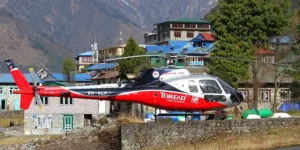
Helicopters also operate from Lukla daily, carrying passengers and cargo and, when needed, running rescue flights from higher in the Khumbu.
Kathmandu or Ramechhap? Where Lukla Flights Depart
One of the most important things to understand about Lukla Airport is where your flight actually leaves from.
Why Flights Move to Ramechhap
Kathmandu’s Tribhuvan International Airport is busy and congested, especially during peak trekking seasons. To reduce congestion and make better use of the short morning weather window, Nepal’s aviation authority (CAAN) has moved scheduled Lukla flights to Manthali Airport in Ramechhap during peak spring and autumn. In the busiest weeks, flights may not leave from Kathmandu at all. Authorities decide the exact dates based on how busy the season is, sometimes with only a few days’ notice, so our team always confirms the current departure point before your trip.
The Drive to Ramechhap
Manthali Airport is roughly 130 to 145 km from Kathmandu, a four- to five-hour drive, and sometimes longer when road repairs or traffic slow the highway. Because flights depart early in the morning, most trekkers leave Kathmandu between 1 and 3 a.m. It is a long, winding journey in the dark, but most trekkers sleep in the vehicle. Our Ramechhap airport transportation service handles the transfer, timing and coordination with the airline.
The Flight From Ramechhap
From Manthali, the flight to Lukla takes only about 15 to 20 minutes. Shorter flights mean aircraft can make more trips during the morning weather window, which helps clear passengers more efficiently. The airport itself is small, with basic facilities, so bring snacks, water and a warm layer for the wait.
Staying Overnight Near Ramechhap
Some trekkers prefer to drive to Ramechhap the afternoon before their flight and stay overnight in a simple hotel near the airport. This avoids the middle-of-the-night drive and can make the morning much calmer. Our team can arrange this to suit your itinerary.
Flights From Kathmandu
In winter, during the monsoon, and at other quieter times, flights usually depart directly from Kathmandu. These take about 30 to 35 minutes and offer beautiful views of the Himalaya on clear mornings. Flying from Kathmandu saves the long night drive, but the Lukla end of the journey is the same, so the same weather rules and need for patience apply.
A Typical Lukla Flight Day, Step by Step
Knowing how the day unfolds takes much of the stress out of it. Here is how a typical peak-season flight day runs on our Everest Base Camp Trek:
- Middle of the night: Your guide and driver collect you from your hotel in Kathmandu, usually between one and three in the morning, for the drive to Manthali. Our Ramechhap airport transportation team keeps in touch with the airline throughout the drive.
- Dawn at Manthali: You arrive as the sky lightens, have tea or a simple breakfast at a small café near the airport, and your guide checks in the group and the duffel bags.
- The wait: Flights leave in waves once the airline confirms clear weather at both ends. This can take minutes or several hours.
- The flight: A short, spectacular hop of about 15 to 20 minutes, with the snow peaks of the Rolwaling and Khumbu Himal rising on the left side of the aircraft.
- Landing in Lukla: You step out into thin, crisp mountain air at about 2,845 m. Your porters collect the bags while you warm up with tea.
- First steps on the trail: After permit formalities, you walk through the town, past the Pasang Lhamu Memorial Gate and down to Phakding, usually in about three to four hours. The next day continues to Namche Bazaar, the Sherpa capital.
When flights leave from Kathmandu, the day is the same but starts a little later, with a shorter drive to the domestic terminal instead of the long night journey.
The Flight Experience: What to Expect
Check-In
Arrive at the airport early, as your guide advises. Domestic check-in in Nepal can feel chaotic, with bags weighed by hand and boarding passes written or printed on the spot. Your guide handles most of the process and will keep your group together. Security checks are basic but thorough; lighters, gas canisters and some batteries may not be allowed in hand luggage.
Boarding and Seating
Seating is often unassigned. On the way to Lukla, many trekkers prefer the left side of the aircraft for the best views of the snow peaks; on the return flight, the right side offers similar views. Do not worry too much: the scenery is spectacular from almost any seat.
In the Air
The cabin is small and can be noisy. A flight attendant may hand out sweets and cotton wool for your ears. As the plane climbs, terraced hills and river valleys give way to forested ridges, and on clear days a line of snowy Himalayan peaks appears to the north.
The Landing
The final approach follows the Dudh Koshi valley before the runway suddenly appears ahead. The landing is quick and firm, and the aircraft slows dramatically on the uphill slope before turning onto the apron. Many passengers applaud; the pilots have done this hundreds of times.
Baggage Rules for Lukla Flights
Baggage allowances on Lukla flights are strict because small aircraft are sensitive to weight at altitude.
- Checked baggage: Usually around 10 kg per person, in a soft duffel bag. Hard suitcases are not suitable.
- Hand luggage: Usually around 5 kg in a small daypack that fits under your seat or on your lap.
- Trekking poles: Must normally go in your checked bag, not the cabin.
- Excess baggage: Can sometimes be carried for an extra charge, paid at the airport, but excess bags may be sent on a later flight if the aircraft is full.
- What to leave behind: Store city clothes and extra items at your Kathmandu hotel.
Our Everest Base Camp Trek packing list explains how to pack light and stay within the limits, and our trekking equipment page lists everything you need.
Porters, Baggage and Responsible Travel
The baggage limit matters on the trail as well as on the plane. From Lukla onward, a porter carries your duffel bag, and on many treks one porter carries trekkers’ bags. Packing light is therefore not only about the aircraft; it is also about the people who carry your gear up to Everest Base Camp. Responsible operators keep porter loads within safe limits, provide proper clothing and insurance, and make sure porters have food and shelter at every stop.
You can read how we look after our crews on our responsible tourism page and meet the guides and porters behind our treks on our team page. A small daypack for you and a well-packed duffel for your porter make the perfect combination, and our packing guide shows exactly how to split your gear between the two.
Arriving in Lukla
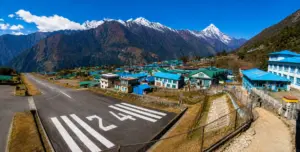
Lukla is a busy trekking town built around the airport, with lodges, cafés, bakeries, gear shops, small supermarkets, and usually one or two ATMs. However, machines aren’t always reliable, so carry enough cash from Kathmandu. No roads lead into Lukla, so there are no cars, taxis, or buses; everything arrives by air or on the backs of porters and pack animals. Your porters will usually meet you and will organise your bags while you have a hot drink. Many cafés overlook the runway, and watching the little planes land and take off is one of the town’s favourite pastimes.
Your guide issues the Khumbu Pasang Lhamu Rural Municipality entry permit at a check post in Lukla and checks the Sagarmatha National Park permit at the park entrance in Monjo; your guide takes care of both. At the edge of town stands the Pasang Lhamu Memorial Gate, which marks the official start of the trail. It honours Pasang Lhamu Sherpa, the first Nepali woman to climb Everest, after whom the local rural municipality is also named. Walking through the gate is the moment your Everest Base Camp Trek truly begins, and a fitting introduction to the mountaineering heritage explored in our guide to Sherpa culture.
From Lukla, the first day’s walk to Phakding is short and mostly downhill, which is gentle on your body after the flight. Read our guide to Phakding and Monjo for this first section of the trail.
At about 2,845 m, Lukla is high enough that some trekkers feel slightly breathless at first. Walk slowly, drink plenty of water and avoid alcohol on your first evening. Our guide to altitude sickness on the Everest Base Camp Trek helps you acclimatise safely.
Why Lukla Flights Get Delayed or Cancelled
Delays are part of life at Lukla Airport, even in the best seasons. Understanding why helps you stay patient and plan sensibly.
- Weather at both ends: Flights need clear conditions at the departure airport, along the route and at Lukla. Clear skies in Kathmandu do not guarantee clear skies in the Khumbu.
- Cloud and fog: Low cloud often fills the Dudh Koshi valley, especially in the monsoon and on unsettled days.
- Wind: By late morning, winds and cloud often build in the valleys, so most flights are scheduled for the early hours, and operations often wind down by midday.
- Visual flight rules: Without instrument landing systems, flights depend entirely on visibility.
- Backlogs: After a day or two of cancellations, hundreds of passengers may be waiting for seats, and airlines clear them in order.
- Aircraft rotations: Planes and crews sometimes need to return to Kathmandu for maintenance, which can affect schedules.
The Best Time of Year for Reliable Flights
Flight reliability follows the seasons:
- Autumn (late September to November): Generally the most reliable flying conditions, with clear, stable mornings. October is the busiest month. Read our guide to the Everest Base Camp Trek in October.
- Spring (March to May): Usually good, with clear mornings and more afternoon cloud. Late May can bring pre-monsoon cloud and more delays.
- Winter (December to February): Often clear, but occasional storms and cold can disrupt flights.
- Monsoon (June to August): The least reliable period, with frequent cloud and rain and many cancellations.
For a full month-by-month comparison, read our guide to the best time for Everest Base Camp Trek.
What Happens If Your Flight Is Delayed or Cancelled
If weather stops flights, here is what usually happens when you trek with our team:
- Waiting at the airport: Flights are often delayed, not cancelled. Your guide stays with you and keeps in touch with the airline.
- Rebooking: If flights are cancelled, our team rebooks you on the next available flight. Passengers whose flights are cancelled are generally prioritised when operations resume, though backlogs can take time to clear.
- Returning to your hotel: If flights from Kathmandu are cancelled, you return to your hotel. If flights from Ramechhap are cancelled, you may stay near the airport or return to Kathmandu, depending on the forecast.
- Helicopter option: When fixed-wing flights cannot operate, helicopters can sometimes still fly because they don’t need a runway and can follow lower routes through the valleys. They still need reasonable visibility, seseat availability dependsn weather and demand, and rescue flights always take priority.
- Adjusting the itinerary: If you lose a day at the start, our guides can sometimes adjust the trek by using a buffer day, combining sections or shortening side trips, always without compromising acclimatisation
Patience is essential; we choose the safest option.
Buffer Days: The Golden Rule of Everest Travel
The single most important tip for Lukla Airport is simple: always keep buffer days. We recommend at least one or two spare days at the end of your trip, between your return flight from Lukla and your international departure from Kathmandu. These days protect you from missing your flight home if weather delays the return from Lukla.
If you do not need them, buffer days are easy to enjoy. Explore Kathmandu on our Kathmandu Day Tour, read our Kathmandu sightseeing guide, take a short hike such as Nagarkot Hiking or Nagarjun Hiking, or relax after your adventure. With a few more days, continue to the lakeside city of Pokhara, described in our Pokhara sightseeing guide, join our Classic Nepal Tour, or experience rural life on the Chainpur Village Homestay Tour.
Helicopter Options to and From Lukla
Helicopters are an increasingly popular way to travel to and from the Khumbu, either by choice or when weather disrupts fixed-wing flights.
- Helicopter to Lukla: A charter or shared helicopter from Kathmandu or Ramechhap avoids the long drive and the uncertainty of scheduled flights. Seats must be requested in advance and depend on availability.
- Trek in, fly out: The Luxury Everest Base Camp Trek with Helicopter Return lets you walk to Everest Base Camp and fly back to Kathmandu by helicopter, avoiding both the long descent and the Lukla bottleneck.
- Heli trekking: The Everest Base Camp Helicopter Trek and the Everest Elite Luxury Heli Trek combine shorter walks with helicopter transfers.
- Everest in a day: The Everest Helicopter Tour, the Mt Everest by Helicopter Tour, the Sharing Everest Helicopter Tour with Kala Patthar Landing, and the Everest Heli Sherpa Village Walk often stop in Lukla to refuel before flying higher.
- Gokyo by air: The Gokyo Lakes Helicopter Tour flies over the turquoise lakes of the Gokyo valley.
Read our guides to the Everest Base Camp helicopter tour, the best seasons for an Everest helicopter tour and Everest helicopter tour restrictions to understand how helicopter travel in the Khumbu works.
Lukla for Luxury and Private Travellers
If comfort and certainty matter most, you can make the Lukla journey much smoother. A private helicopter from Kathmandu or Ramechhap carries a small group directly to Lukla, avoiding the night drive and the scheduled-flight queue, and can wait for the weather window that suits you. In Lukla, a handful of comfortable lodges offer warm rooms, some with en-suite bathrooms, good food, a nd quiet gardens, making the first and last nights of the trek far more relaxing.
Our Everest Base Camp Luxury Lodge Trek uses the best available lodges throughout the Khumbu. For the ultimate combination of walking and flying, the Everest Elite Luxury Heli Trek and the Luxury Everest Base Camp Trek with Helicopter Return reduce your dependence on scheduled Lukla flights at the end of the trip, when tight connections matter most. Travellers continuing to other Himalayan countries can extend their journey on the Luxury Nepal Tibet Tour or the Luxury Nepal Bhutan Tour.
Avoiding the Flight: Road and Walk-In Routes
If you would rather not fly, or want a back-up plan, there are excellent alternatives:
- By road: The Everest Base Camp Trek by Road begins with a long jeep drive into the Solukhumbu, joining the trail below Lukla. It adds a few days but removes flight uncertainty at the start.
- The historic walk-in: The Jiri to Everest Trek follows the route of the early expeditions, with acclimatisation in quiet villages.
- Motorcycle adventure: For riders, our Everest Base Camp on Motorcycle adventure offers a completely different way to reach the world’s highest mountain.
Many trekkers arrive by road or from Jiri and fly out of Lukla, combining the best of both: no flight uncertainty at the start and a quick return at the end.
Flying Out of Lukla at the End of Your Trek
The return flight from Lukla Airport depends on the weather just as much as the outward journey. Here is what to expect:
- The night before: Most trekkers celebrate their final evening in Lukla with their guides and porters. Your guide will confirm your flight time.
- Early start: Flights leave in the early morning, so you will usually be at the airport soon after dawn.
- Delays: If the weather is poor, you may wait at the airport or in your lodge. If flights are cancelled, you’ll stay another night in Lukla and try the next morning again.
- Backlogs: After several days of bad weather, many trekkers wait for seats. Our team works with airlines to get you out as soon as possible, and helicopters may be an option.
- Landing: Depending on the season, you may land in Kathmandu or at Manthali Airport in Ramechhap, then drive back to Kathmandu.
Practical Tips for a Smooth Lukla Flight
- Book through an experienced operator: Seats are limited, especially in October and April.
- Keep buffer days: At least one or two at the end of your trip.
- Pack light: Stay within the 10 kg and 5 kg limits.
- Carry essentials in your daypack: Warm layers, water, snacks, medication, documents and valuables.
- Dress in layers: Early mornings are cold at Ramechhap and Lukla.
- Charge your devices: Waiting times can be long.
- Bring patience: Delays are normal, and no one can control the weather.
- Keep your insurance details handy: Check whether your policy covers trip delays.
- Follow your guide’s instructions: They know the airport, the airlines and the people.
- Enjoy the view: If you can, ask for a left-side window seat on the way in.
Lukla Flights for Other Everest Treks and Climbs
Lukla Airport is the gateway to almost every adventure in the Everest region, not just the classic base camp route:
- Everest View Trek: A shorter trek to Namche, Khumjung and Tengboche, perfect for limited time.
- Gokyo Lakes Trek: A quieter valley of turquoise lakes, with a viewpoint we compare to Kala Patthar in our guide.
- Everest 3 Pass Trek: The ultimate Khumbu circuit, including the Cho La Pass.
- Ama Dablam Base Camp Trekking: A trek to the foot of one of the world’s most beautiful peaks.
- Everest Base Camp Luxury Lodge Trek: The classic route in the finest available lodges.
- Everest Base Camp Yoga Trek: A mindful journey with daily yoga.
- Everest Marathon: The famous high-altitude race.
- Peak climbing: Island Peak Climbing, Lobuche Peak Climbing and Mera Peak Climbing all begin with the flight to Lukla. Climbers should allow extra baggage for technical gear and check the latest NMA peak permit updates. Expedition climbers can read our Ama Dablam expedition guide and our answers to common Ama Dablam climbing questions.
From Lukla to Everest Base Camp: The Journey Ahead
Once you land, the adventure truly begins. The classBazaar, then climbsBazamatizationclimatization hike to the Hotel Everest View. It continues to Tengboche and its famous monastery, described in our guide to Tengboche Monastery and the Mani Rimdu festival, through the ancient village of Pangboche to Dingboche, past the Pheriche aid post to Lobuche and Gorakshep, and finally to Everest Base Camp and the sunrise viewpoint of Kala Patthar.
The whole journey passes through the protected landscapes of Sagarmatha National Park. For details, see our Everest Base Camp Trek itinerary, our Everest Base Camp Trek distance guide and our honest look at Everest Base Camp Trek difficulty.
Preparing for the Flight and the Trek
Good preparation makes the whole journey smoother, from the airport to base camp. First-time trekkers should read our Everest Base Camp Trek guide for beginners and follow our 12-week training plan. Check your visa requirements in our Nepal visa guide, learn about altitude on our Acute Mountain Sickness page, and make sure your travel insurance covers high-altitude trekking and helicopter evacuation.
Insurance, Permits and Paperwork
Lukla flights add a few practical paperwork points. Check that your travel insurance covers trekking at the altitudes you will reach, helicopter rescue, and, ideally, trip delays and missed connections caused by weather. Carry a copy of your policy and the insurer’s emergency number in your daypack, not in your checked duffel. Keep your passport with you on flight days, as airline and permit staff may ask to see it.
Trekking rules in Nepal have changed in recent years, and many trekking areas now require visitors to trek with a licensed guide. Rules vary by area and can change, so always check the current regulations before you travel; our article on Nepal’s mandatory guide rules explains how they work, and our trekking in Nepal guide covers the wider picture. Whatever the local rules, we strongly recommend a licensed guide for the Everest trek, especially to handle flights, delays, and permits. Always book with a registered operator; you can view our company registration and legal documents online, and our team will help you plan your trip from the first email to your final flight home.
Other Mountain Airports in the Himalaya
Lukla is Nepal’s most famous mountain airport, but not the only one. If you enjoy the thrill of mountain flying, you may experience others on different journeys:
- Jomsom: A windswept airstrip in the Kali Gandaki valley, gateway to the Jomsom Muktinath Trek and the Upper Mustang Trek. Flights here also operate only in the morning because of strong afternoon winds. Our Upper Mustang trekking guide explains the region.
- Juphal: The airstrip for Dolpo, used on the Lower Dolpo Trekking.
- Syangboche: A high airstrip above Namche, now used mainly by helicopters and cargo flights.
- Paro, Bhutan: One of the most famous mountain approaches in the world and the gateway for our Luxury Bhutan Tour and Luxury Nepal Bhutan Tour. Near the airport stand the famous Tiger’s Nest Monastery and Paro Dzong, and Bhutan is also home to the legendary Snowman Trek, compared with the Everest route in our guide to the Everest Base Camp Trek vs Snowman Trek.
- Lhasa, Tibet: The flight from Kathmandu to Lhasa crosses the main Himalayan range, with views of Everest on clear days. Explore Tibet on our Lhasa Tibet Tour.
Seeing Everest Without Lukla: The Tibet Side
Another way to reach the foot of Everest avoids a mountain airstrip altogether. On the Tibetan side, you can reach Everest’s north face by road across the high plateau. Our Lhasa to Everest Base Camp Overland Tour travels from Lhasa, past monasteries and high passes, to the Rongbuk Valley, with dramatic views of the mountain’s north face. Our Lhasa to Everest Base Camp guide explains the route, altitude and permits in detail.
Travel in Tibet requires a special, organised tour, so it suits travellers who want culture, monasteries and overland adventure rather than a walking trek. You can begin in Kathmandu on the Kathmandu to Lhasa Tour, combine three Himalayan countries on the Nepal Tibet Bhutan Tour, or continue west to sacred Mount Kailash on the Mount Kailash Tour, described in our guide to the Kailash Kora. The Nepali side remains the classic choice for trekkers, but the Tibetan side is a great alternative for anyone who prefers to keep both feet on the ground.
If Flights Are Disrupted for Days: Alternative Treks
Occasionally, especially in the monsoon or after major storms, Lukla flights can be disrupted for several days. If waiting is not an option, our team can help you switch to a trek that does not depend on mountain flights, so your holiday is not lost:
- Annapurna region: The Annapurna Base Camp Trek, the Ghorepani Poon Hill Trek, the Mardi Himal Trek, the Annapurna Base Camp, Poon Hill and Mardi Himal Trek and the Annapurna Circuit Trek are all reached by road. Our ultimate guide to the Annapurna Base Camp Trek is a great place to start.
- Langtang region: The Langtang Valley Trek, the Langtang Gosaikunda Trek and Tamang Heritage Trekking start just a day’s drive from Kathmandu.
- Manaslu and beyond: The Manaslu Circuit Trek and the Tsum Valley and Ganesh Himal Trek are reached by road and offer spectacular high-mountain scenery.
- Rain-shadow treks: In the monsoon, when Lukla flights are least reliable, rain-shadow regions such as the Upper Mustang Trek and the Nar Phu Trek stay much drier than the Khumbu.
- Short and easy: The Chisapani Nagarkot Trek or the Australian Camp Trek suit travellers with only a few days.
You can also fill unexpected free days with Paragliding in Pokhara, a Chitwan Jungle Safari, a wildlife journey on the Bardia National Park Tour, Trishuli River Rafting or Kali Gandaki Rafting. For more ideas, browse our list of the top 50 trekking routes in Nepal.
Common Mistakes Trekkers Make With Lukla Flights
- No buffer days: The most common and most stressful mistake.
- Booking international flights too tightly: Leave at least one or two days after your planned return from Lukla.
- Overpacking: Excess bags may be delayed or incur extra charges.
- Putting essentials in checked luggage: Keep medication, documents and warm layers in your daypack.
- Not knowing the departure airport: Confirm whether your flight leaves from Kathmandu or Ramechhap.
- Expecting precise timings: Mountain flights run when the weather allows, not always on schedule.
- Panicking at delays: Your guide and our team will manage the situation; stay patient and flexible.
Frequently Asked Questions About Lukla Airport
Where is Lukla Airport?
Lukla Airport, officially the Tenzing-Hillary Airport, is in the town of Lukla in the Khumbu region of north-eastern Nepal, at about 2,845 m. It is the gateway to the Everest region.
How long is the flight to Lukla?
About 30 to 35 minutes from Kathmandu, or about 15 to 20 minutes from Manthali Airport in Ramechhap.
Why do Lukla flights leave from Ramechhap?
To reduce congestion at Kathmandu’s airport during the busy spring and autumn seasons, authorities move scheduled Lukla flights to Manthali Airport in Ramechhap, usually about a four-to-five-hour drive from Kathmandu. In winter and the monsoon, flights usually operate from Kathmandu.
Is Lukla Airport dangerous?
It is one of the world’s most challenging airports because of its short, sloping runway and mountain terrain. Flights operate only in suitable weather, with specialised aircraft, and thousands of passengers fly each season safely.
What is the baggage limit for Lukla flights?
Usually around 10 kg of checked baggage and around 5 kg of hand luggage per person. Extra baggage may be available for a fee but may be delayed.
How often are Lukla flights delayed?
Delays are common, especially in the monsoon and on cloudy or windy days. Autumn and spring offer the most reliable conditions.
What happens if my Lukla flight is cancelled?
You are rebooked on the next available flight, usually the next morning. Helicopters may sometimes be an option. Buffer days protect your international flight home.
Can I take a helicopter to Lukla?
Yes. Charter and shared helicopters operate from Kathmandu and Ramechhap, subject to weather and availability.
Can I reach the Everest region without flying to Lukla?
Yes. The Everest Base Camp Trek by Road and the Jiri to Everest Trek avoid the Lukla flight at the start of the trek.
Which side of the plane should I sit on to Lukla?
Many trekkers prefer the left side on the way to Lukla and the right side on the return for the best mountain views, though the scenery is impressive from any seat.
Final Thoughts: The Most Exciting Start to Any Trek
Lukla Airport is more than a place to land. It is the gateway to the Khumbu, a symbol of Hillary’s partnership with the Sherpa people and the start of one of the greatest adventures on Earth. YEarthlights can be delayed, and yes, the landing will make your heart race. But with good planning, buffer days, light packing and an experienced team, the journey through Lukla becomes an unforgettable part of your Everest story.
Let our team handle the flights, transfers and logistics so you can focus on the mountains. Join our cEarthc Everest Base Camp Trek, travel in comfort on the Everest Base Camp Luxury Lodge Trek, or skip the descent with a helicopter return. Meet our guides on our Our Team page, learn more about our company, then plan your trip or contact us today, and take off for the adventure of a lifetime.
Quick Inquiry
Explore More


