Gokyo Ri vs Kala Patthar: Which Is the Best Everest Viewpoint?

Gokyo Ri vs Kala Patthar: Which Is the Best Everest Viewpoint?
It is four in the morning, and the cold is so sharp it feels solid. Your headlamp traces a narrow trail of loose rock and frozen earth, and every breath comes slowly. Then, as the sky turns from black to deep blue and finally to gold, the world’s highest mountain emerges from the darkness. Whether you are standing on a pile of dark rock above Gorakshep or on a grassy summit above a turquoise lake, this is the moment every Everest trekker dreams of.
Two summits compete for the title of the best Everest viewpoint in Nepal: Kala Patthar, the famous “black rock” above Everest Base Camp, and Gokyo Ri, the quieter peak above the sacred Gokyo Lakes. Both rise above 5,300 m, both reward an early start with an unforgettable panorama, and both are reachable without technical climbing. So which should you choose? The Gokyo Ri vs Kala Patthar debate is one of the most common questions our team hears from trekkers planning the Everest region.
In this guide, our Sherpa team compares Gokyo Ri vs Kala Patthar in depth: altitude, the climb, the views, the light, crowds, difficulty, the treks that lead to them and how to combine both. By the end, you will know which viewpoint suits you best, whether you choose our Gokyo Lakes Trek, the classic Everest Base Camp Trek, or a journey that includes both.
Gokyo Ri vs Kala Patthar: The Short Answer
If you only have a minute, here is the summary:
- Choose Kala Patthar for the closest, most dramatic view of Mount Everest, plus the iconic experience of reaching Everest Base Camp.
- Choose Gokyo Ri for the widest panorama in the Khumbu, with four of the world’s 8,000 m peaks, the turquoise Gokyo Lakes, and the vast Ngozumpa Glacier, on a quieter trail.
- Choose both if you have the time, fitness and experience to cross the Cho La pass, which links the two valleys.
There is no single winner. Kala Patthar wins for Everest close-up and symbolism; Gokyo Ri wins for panorama, lakes and peace. The rest of this guide explains why, so you can decide what matters most to you.
Gokyo Ri vs Kala Patthar at a Glance
Before diving into the details, here are the key facts side by side, presented as simple comparisons rather than a table.
Altitude
- Kala Patthar: About 5,545 m (around 18,192 ft). Some maps show slightly different figures because the true summit lies slightly above the usual viewpoint.
- Gokyo Ri: About 5,357 m (around 17,575 ft).
- The difference: Kala Patthar is roughly 190 m higher, but both are serious high-altitude summits.
Starting Point
- Kala Patthar: From Gorakshep, at about 5,164 m, the last settlement before Everest Base Camp.
- Gokyo Ri: From Gokyo village, at about 4,790 m, on the shore of the third Gokyo lake.
Height Gain on Summit Day
- Kala Patthar: Roughly 380 to 400 m from Gorakshep.
- Gokyo Ri: Roughly 550 to 600 m from Gokyo.
Climbing Time
- Kala Patthar: Usually one and a half to two and a half hours up, and about one hour down.
- Gokyo Ri: Usually two to three hours up, and one to one and a half hours down.
Signature View
- Kala Patthar: Everest’s south-west face up close, with Nuptse, Lhotse, Pumori, Changtse and the Khumbu Glacier and Icefall.
- Gokyo Ri: Everest, Lhotse, Makalu and Cho Oyu in one sweep, with the Gokyo Lakes, Ngozumpa Glacier and dozens of other peaks.
Trail Character
- Kala Patthar: On the busy classic Everest Base Camp route.
- Gokyo Ri: In the quieter Gokyo valley, with far fewer trekkers.
Kala Patthar: The Classic Everest Viewpoint
Kala Patthar means “black rock” in Nepali, a fitting name for the dark, crumbly ridge that rises above Gorakshep, beneath the snowy pyramid of Pumori. It is the highest point reached on the classic Everest Base Camp Trek, and it is famous for one reason: it offers the best close-up view of Mount Everest from the Nepal side.
Why Everest Base Camp Is Not Enough
Many first-time trekkers are surprised to learn that Everest’s summit is barely visible from Everest Base Camp itself. The camp sits so close beneath the mountain, among the rubble of the Khumbu Glacier, that the Nuptse ridge and the Icefall block the view. Kala Patthar solves this problem. By climbing a few hundred metres above Gorakshep, you rise high enough to see Everest’s summit pyramid over Nuptse’s shoulder. Read our Kala Patthar guide for more about the viewpoint itself.
The View from Kala Patthar
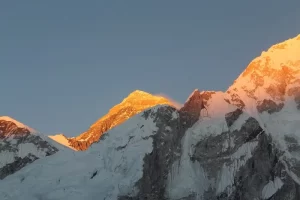
From the summit cairn, draped in prayer flags, Everest dominates the scene. You see its upper south-west face, the South Col and the summit, often with a plume of snow streaming from the top. Around it stand Nuptse’s long ridge, the tip of Lhotse, Changtse on the Tibetan side and, directly behind you, the elegant cone of Pumori. Below, the Khumbu Glacier twists down the valley, and on a clear day you can trace the route through the Khumbu Icefall where climbers begin their ascent. In spring, you may spot Everest Base Camp tents scattered across the glacier.
The Climb
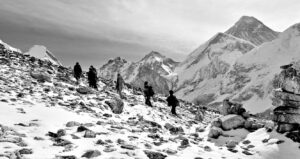
The trail leaves Gorakshep across a sandy, dry lakebed, then climbs steeply up a grassy and rocky slope. It zigzags upwards on loose, dusty ground, becoming rockier near the top. The final section involves scrambling over boulders to reach the summit cairn. There is no technical climbing, but the altitude makes every step slow and deliberate. Most trekkers reach the main viewpoint in 1.5-2.5 hours.
Sunrise or Sunset at Kala Patthar?
Most itineraries climb Kala Patthar before dawn for sunrise, then descend and continue down the valley. At sunrise, the sun rises behind Everest, so the mountain often appears as a dramatic dark silhouette against a glowing sky, while the surrounding peaks, especially Pumori and Nuptse, catch the first light.
Many photographers prefer sunset. In the late afternoon, the sun lights Everest’s southwest face directly, turning it gold, orange, and pink as it sets. The trade-off is a cold descent into the dark, with afternoon clouds more common in spring. Our guides choose the timing based on the weather, your energy and your itinerary.
Gorakshep: The Base for Kala Patthar
Gorakshep is the highest and coldest overnight stop on the classic route, at about 5,164 m. Sleeping here is often difficult, and the lodges are basic. The day before the climb, most trekkers walk from Lobuche to Gorakshep and then on to Everest Base Camp, a long, tiring day. Some itineraries climb Kala Patthar the same afternoon for sunset; others wait for sunrise the next morning.
Gokyo Ri: The Panoramic Everest Viewpoint
Gokyo Ri rises steeply above Gokyo village, on the eastern shore of the third Gokyo lake, known as Dudh Pokhari. It is the crowning viewpoint of the Gokyo Lakes Trek, and many experienced trekkers, guides and photographers consider it the finest panorama in the Everest region.
The View from Gokyo Ri
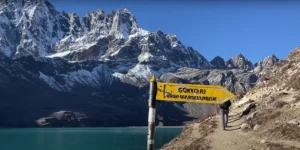
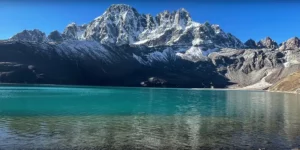
From the summit, festooned with prayer flags, the view opens in every direction. To the east, across the vast grey rubble of the Ngozumpa Glacier, stands Everest, with Lhotse and Nuptse beside it and Makalu, the world’s fifth-highest mountain, further to the right. To the north, Cho Oyu, the world’s sixth-highest peak, towers directly at the head of the valley. Below you, the turquoise waters of Dudh Pokhari and the other Gokyo Lakes shine in the morning light, with Gokyo village on the shore.
Few viewpoints anywhere offer four of the world’s fourteen 8,000 m peaks in a single view: Everest, Lhotse, Makalu and Cho Oyu. Add Gyachung Kang, Cholatse, Taboche, Kangtega, and Thamserku, and you get a sweeping Himalayan panorama many trekkers say is unmatched. For more about Nepal’s highest mountains, read our article on Nepal’s new eight-thousanders.
Everest from Gokyo Ri
Everest appears further away from Gokyo Ri than from Kala Patthar, rising above a ridge on the far side of the Ngozumpa Glacier. However, you see more of its northwest face, and the summit pyramid stands out clearly against the sky. It is less dominant in the frame, but it sits within a far broader and more varied scene.
The Climb
The trail leaves Gokyo, crosses the stream at the lake’s edge, and climbs steeply up the grassy, rocky slopes of Gokyo Ri. The path zigzags relentlessly with few flat sections, gaining around 550 to 600 m. It is a steady, sustained effort rather than a scramble, and most trekkers take two to three hours to reach the top. The lake below shrinks with every switchback, keeping you motivated as you climb.
Sunrise at Gokyo Ri
Most trekkers climb Gokyo Ri before dawn for sunrise. As the sun rises over the eastern ridges, light spreads across Cho Oyu, Gyachung Kang and the high peaks, while Everest and Makalu glow on the horizon. Below, the lakes shift from dark blue to brilliant turquoise as the sun hits them. Autumn mornings are usually clear, and our guides monitor the weather to choose the best day.
Gokyo: The Base for Gokyo Ri
Gokyo village, at about 4,790 m, sits on the shore of Dudh Pokhari, surrounded by mountains and the moraine of the Ngozumpa Glacier. Its lodges are comfortable by high-altitude standards, with sunny dining rooms facing the lake. Because Gokyo is about 370 m lower than Gorakshep, most trekkers sleep noticeably better here. That makes a big difference on summit morning.
The Views Compared: Which Is Better?
The heart of the Gokyo Ri vs Kala Patthar question is the view. Here is how they compare on the things trekkers care about most.
Everest Close-Up: Kala Patthar Wins
If you want Everest to fill your frame, Kala Patthar is the clear winner. The mountain is much closer; its south-west face rises directly above you, and the Khumbu Icefall leads the eye to the summit. This is the view on the cover of countless trekking books, and it carries the emotional weight of being next to Everest Base Camp.
Overall Panorama: Gokyo Ri Wins
For breadth and variety, Gokyo Ri is hard to beat. Four 8,000 m peaks, sparkling lakes, Nepal’s largest glacier, and endless ridges create a more complete, balanced landscape. Photographers often prefer it for wide-angle compositions and the contrast between turquoise water and white peaks.
Glaciers: A Draw
Kala Patthar overlooks the Khumbu Glacier and Icefall, famous from Everest expeditions. Gokyo Ri overlooks the Ngozumpa Glacier, Nepal’s longest glacier, a massive river of ice and rubble that stretches far down the valley. Both are spectacular in different ways.
Lakes: Gokyo Ri Wins
Kala Patthar has no lakes in view. Gokyo Ri overlooks several Gokyo Lakes, a system of high glacial lakes protected as a wetland of international importance. Their colour is one of the most memorable sights in the Himalaya.
The Emotional Factor
Kala Patthar is forever linked to the journey to Everest Base Camp, the goal of most trekkers in the region. Reaching base camp and standing there often feels like the triumphant end of a long journey. Gokyo Ri feels different: quieter, more contemplative and more about the landscape than the achievement.
Difficulty: Gokyo Ri vs Kala Patthar
Both climbs are non-technical but physically demanding because of altitude. Here is how they compare.
Altitude and Breathing
Kala Patthar is higher, and you start from Gorakshep, where sleep is often poor, and the air is very thin. Many trekkers find this climb harder simply because they are more tired and less rested. Gokyo Ri starts from a lower, more comfortable base, but it gains more elevation on the summit morning.
Steepness and Terrain
Gokyo Ri is a long, steady, steep climb on a clear trail, with relentless switchbacks. Kala Patthar is shorter but includes rougher, looser ground and some boulder scrambling near the top. Neither requires ropes or special equipment in normal conditions.
Fatigue from the Approach
Kala Patthar usually comes after the long day to Everest Base Camp, after more than a week of trekking. Gokyo Ri often comes after shorter, more gradual days up the Gokyo valley. For many trekkers, that difference in accumulated fatigue matters more than the small height difference.
Our Verdict on Difficulty
For most trekkers, Gokyo Ri feels slightly easier overall, thanks to better sleep and shorter approach days, even though the climb itself gains more height. Kala Patthar feels harder because of the extreme altitude and fatigue. In both cases, proper acclimatisation is the key to success. Read our guide to Everest Base Camp Trek difficulty for advice on preparing for high altitude.
Crowds and Atmosphere
Kala Patthar sits on the main Everest Base Camp route, one of the world’s most popular treks. On clear autumn and spring mornings, dozens of trekkers may climb it together, and the summit can feel busy. The atmosphere is lively and celebratory, full of trekkers from many countries sharing their achievement.
The Gokyo Valley sees far fewer trekkers. Even in peak season, Gokyo Ri is usually much quieter, and you may share the summit with only a handful of people. If solitude and peaceful reflection matter to you, Gokyo Ri has the edge.
The Treks That Lead to Each Viewpoint
Your choice of viewpoint is really a choice of trek. Here is how the two main routes compare.
Everest Base Camp Trek (Kala Patthar)
The classic route from Lukla follows the Dudh Koshi to Namche Bazaar, then continues through Tengboche, Pangboche, Dingboche, Lobuche and Gorakshep to Everest Base Camp and Kala Patthar. Rich in culture, with famous monasteries and Sherpa villages, it’s Nepal’s most iconic trek. It usually takes around 12 to 14 days. See our Everest Base Camp Trek and the detailed itinerary.
Gokyo Lakes Trek (Gokyo Ri)
The Gokyo route shares the first days to Namche Bazaar, then turns north up the Dudh Koshi valley through Dole and Machhermo to Gokyo. It is quieter and wilder, with beautiful forests, yak pastures, glacial lakes and the Ngozumpa Glacier. Our 12-day Gokyo Lakes Trek includes the climb to Gokyo Ri and a hike to the fourth lake.
Shared Highlights
Both treks begin with a flight to Lukla, a walk through Phakding and Monjo, and an acclimatisation day in Namche Bazaar, including hikes to Hotel Everest View and Khumjung and Khunde. Both pass through the protected landscapes of Sagarmatha National Park.
Highlights of the Gokyo Valley Beyond Gokyo Ri
Choosing Gokyo Ri also means experiencing the wider Gokyo Valley, which has many highlights of its own:
- The Gokyo Lakes: A chain of high glacial lakes, including Dudh Pokhari beside Gokyo village and Thonak Tsho, the largest, further north. The lakes are sacred to both Hindus and Buddhists, and some pilgrims bathe in them during the Janai Purnima festival.
- The fourth and fifth lakes: A beautiful walk north from Gokyo leads to the fourth lake and, further on, the fifth lake, with close views of Cho Oyu and the Ngozumpa Glacier.
- Ngozumpa Glacier: The longest glacier in Nepal, a vast river of ice covered in rock and dotted with meltwater ponds.
- Dole and Machhermo: Quiet villages surrounded by juniper, rhododendron and yak pastures. Machhermo has a small seasonal rescue post that offers altitude awareness talks, similar to the aid post in Pheriche on the classic route.
- Wildlife: The Gokyo Valley offers excellent wildlife viewing, including Himalayan tahr, musk deer, and the colourful Himalayan monal, Nepal’s national bird.
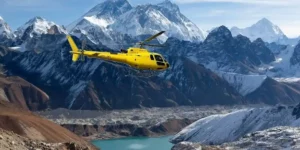
From the air, the Gokyo Valley is equally spectacular. The Gokyo Lakes Helicopter Tour flies over the lakes and glacier in a single day.
Highlights of the Classic Route Beyond Kala Patthar
Choosing Kala Patthar means following the classic route, with its own world-famous highlights:
- Everest Base Camp: Standing at the foot of the Khumbu Icefall, where Everest expeditions begin.
- Tengboche Monastery: The spiritual heart of the Khumbu. Read our guide to Tengboche Monastery and the Mani Rimdu festival.
- Pangboche: Home to the Khumbu’s oldest monastery. See our Pangboche
- Dingboche: A high village beneath Ama Dablam, with acclimatisation hikes to Nangkartshang. Read our Dingboche
- Thukla memorials: Stone memorials honouring climbers and Sherpas who lost their lives on Everest.
- Sherpa culture: Monasteries, mani walls and villages throughout. Learn more in our guide to Sherpa culture and traditions.
Can You Do Both? Combining Gokyo Ri and Kala Patthar
Yes, and for many trekkers it is the ultimate Everest experience. The two valleys are linked by the Cho La pass, at around 5,420 m, a glaciated pass between Dzongla on the Everest Base Camp side and Thangnak near Gokyo.
The Combined Route
A typical combined itinerary follows the classic route to Everest Base Camp and Kala Patthar, crosses the Cho La to Gokyo, climbs Gokyo Ri, and returns down the Gokyo Valley to Namche. It can also run in the opposite direction. The combined trek takes around 16 to 18 days, depending on acclimatisation and weather.
The Cho La Pass
The Cho La is more demanding than either viewpoint climb. The route crosses steep, rocky slopes and a small glacier near the top, which can be icy. Depending on conditions, you may need microspikes or crampons, and an experienced guide is essential. In poor weather or heavy snow, the pass may be closed.
The Three Passes
For experienced, fit trekkers, the Everest 3 Pass Trek visits Kala Patthar and Gokyo Ri and crosses Kongma La, Cho La, and Renjo La, with the latter offering another superb view over Gokyo and Everest. It is the most complete way to explore the Everest region.
Our team can design a combined route tailored to your experience and timeframe when you plan your trip.
Other Great Everest Viewpoints in the Khumbu
Gokyo Ri and Kala Patthar are the two most famous summits, but the Everest region has several other superb viewpoints worth knowing about:
- Renjo La (about 5,360 m): A high pass west of Gokyo with a stunning view back over the Gokyo Lakes, the Ngozumpa Glacier and Everest. It is crossed on the Everest 3 Pass Trek , and many consider its views equal to Gokyo Ri.
- Nangkartshang Peak (around 5,000 m): The acclimatisation summit above Dingboche, with views of Makalu, Lhotse, Ama Dablam and the Imja valley.
- Chhukung Ri (around 5,550 m): A rocky summit above Chhukung with close views of Lhotse’s huge south face, Island Peak and Ama Dablam.
- Hotel Everest View (about 3,880 m): The easiest viewpoint, reached on the acclimatisation day from Namche, with Everest framed beside Ama Dablam.
- Tengboche (about 3,867 m): Everest rising behind the famous monastery, with Ama Dablam towering to the east.
- Ama Dablam Base Camp (about 4,600 m): A beautiful meadow beneath the mountain’s west face, reached on our Ama Dablam Base Camp Trekking.
For climbers, peaks such as Island Peak and Lobuche Peak offer even higher perspectives on Everest and its neighbours. At the same time, the classic Jiri to Everest Base Camp trek gives you a distant first glimpse of Everest from the ridges above Junbesi.
Best Time to Visit Gokyo Ri and Kala Patthar
Season affects both viewpoints similarly, though there are subtle differences:
- Autumn (September to November): The best season for both, with the clearest skies and sharpest views after the monsoon. October and November are especially good for sunrise climbs. Nights are very cold, particularly at Gorakshep.
- Spring (March to May): Warmer, with rhododendrons blooming lower down and Everest Base Camp busy with expeditions. Afternoon clouds are more common, so sunrise climbs are usually better than sunset.
- Winter (December to February): Very cold but often crystal clear. Gokyo can be snowy, and the Cho La may be difficult or closed. Some lodges close.
- Monsoon (June to August): Clouds and rain usually hide the mountains, and flights to Lukla are often delayed. Not recommended for viewpoint climbs.
For both viewpoints, the earliest morning hours usually bring the clearest weather. Clouds often build by mid-morning, especially in spring. A Acclimatisationand Safety
Both Gokyo Ri and Kala Patthar rise above 5,300 m, where altitude sickness is a real risk. Safe ascent is far more important than the view.
- Follow a well-paced itinerary: Take acclimatisation days in Namche and either Dingboche or Machhermo.
- Sleep at the right altitude: Above 3,000 m, avoid gaining more than about 300 to 500 m in sleeping altitude per day.
- Start slowly on summit day: Walk at a pace that lets you breathe steadily. No one wins for arriving first.
- Know the warning signs: Headache, nausea, dizziness, and unusual fatigue can signal acute mountain sickness. Breathlessness at rest or confusion is an emergency.
- Turn back when needed: If you feel unwell, descend. The mountain will still be there.
- Carry insurance: Travel insurance covering high-altitude helicopter evacuation is essential.
Our Acute Mountain Sickness guide explains symptoms and prevention, and our guide to Pheriche and the HRA aid post describes the medical support available in the Khumbu.
What to Pack for a Sunrise Summit
Pre-dawn climbs above 5,300 m are bitterly cold, often well below freezing with strong wind chill. Pack these essentials for either summit:
- Warm layers: Thermal base layers, fleece, a down jacket and a windproof shell.
- Insulated gloves and liners: Hands get cold quickly, especially when using a camera.
- Warm hat and buff: Protect your head, face and throat from cold, dry air.
- Headlamp with spare batteries: Essential for the pre-dawn climb.
- Trekking poles: Helpful on the steep ascent and the descent.
- Water in an insulated bottle: Prevents freezing. Hot water or tea is ideal.
- Snacks: Energy bars, chocolate or nuts for quick fuel.
- Sunglasses and sunscreen: For the descent once the sun rises.
- Camera and spare batteries: Keep batteries warm in an inside pocket.
Our trekking equipment list covers everything you need for the whole trek.
Photography Tips for Gokyo Ri and Kala Patthar
Both summits are dream locations for photographers. These tips will help you make the most of them:
- At Kala Patthar: Use a moderate telephoto lens to capture Everest’s summit and the snow plume. Include prayer flags or the summit cairn for foreground interest. At sunset, Everest’s golden light is especially photogenic.
- At Gokyo Ri: Use a wide-angle lens to capture the lakes, glacier and mountains in one frame. A panorama works beautifully here. Arrive before sunrise to capture the peaks and lakes as the colours change.
- Protect your gear: Cold drains batteries fast. Carry spares and keep them warm.
- Shoot the light, not just the peaks: Alpenglow on Cho Oyu, Pumori or Nuptse can be as beautiful as Everest itself.
- Take a moment without the camera: Some of the best memories come from simply watching the sunrise.
Luxury and Helicopter Options
If you want to see these viewpoints with more comfort or less time, there are excellent options:
- Luxury lodges: The Everest Base Camp Luxury Lodge Trek uses the best lodges available, improving rest and recovery before your Kala Patthar climb.
- Trek up, fly down: The Luxury Everest Base Camp Trek with Helicopter Return lets you climb Kala Patthar and fly back from Gorakshep.
- Helicopter landing at Kala Patthar: The Sharing Everest Helicopter Tour with Kala Patthar Landing offers a short landing near the viewpoint, weather and regulations permitting.
- Gokyo by air: The Gokyo Lakes Helicopter Tour flies over the Gokyo Lakes and the Ngozumpa Glacier.
- Premium heli trekking: The Everest Elite Luxury Heli Trek combines short walks with helicopter transfers for a luxurious Everest experience.
Note that helicopter landings at high altitude are brief because of the risk of altitude sickness. Our blog on Everest helicopter tour restrictions explains current rules.
Common Mistakes When Choosing an Everest Viewpoint
Our guides often see trekkers make these avoidable mistakes:
- Expecting Everest views from Everest Base Camp: The summit is barely visible from base camp. Kala Patthar is where you see Everest properly.
- Choosing on altitude alone: Kala Patthar is higher, but the experience, crowds and views matter more than a couple of hundred metres.
- Skipping sunrise because of tiredness: Clouds often build later in the morning. The early start is usually worth it.
- Underestimating the cold: Pre-dawn temperatures at Gorakshep and Gokyo can be severe. Dress warmly.
- Rushing the itinerary to fit both: Combining routes is wonderful, but only if you have enough days for safe acclimatisation.
- Attempting the Cho La without experience or a guide: The pass can be icy and dangerous. Always cross with an experienced guide.
Which Viewpoint Is Right for You?
To decide between Gokyo Ri vs Kala Patthar, ask yourself these questions:
- Is standing at Everest Base Camp your main goal? Choose Kala Patthar.
- Do you want the closest possible view of Everest? Choose Kala Patthar.
- Do you love photography, lakes and wide panoramas? Choose Gokyo Ri.
- Do you prefer quiet trails and fewer trekkers? Choose Gokyo Ri.
- Do you sleep badly at high altitude? Gokyo Ri’s lower base may suit you better.
- Do you have more than two weeks and good experience? Do both via the Cho La or the Three Passes.
- Are you short on time? The Everest View Trek offers Everest views at lower altitude, and helicopter tours let you see both regions in a day.
Frequently Asked Questions About Gokyo Ri vs Kala Patthar
Which is higher, Gokyo Ri or Kala Patthar?
Kala Patthar is higher, at about 5,545 m, compared with Gokyo Ri at about 5,357 m. The difference is roughly 190 m.
Which has the better view of Everest?
Kala Patthar has the closest and most dramatic view of Everest itself. Gokyo Ri has a wider panorama that includes Everest, Lhotse, Makalu, Cho Oyu, the Gokyo Lakes and the Ngozumpa Glacier.
Is Gokyo Ri harder than Kala Patthar?
Gokyo Ri gains more height on summit day, but it starts from a lower, more comfortable base. Kala Patthar is higher and starts from Gorakshep, where sleep is often poor. Many trekkers find Kala Patthar harder overall because of altitude and fatigue.
How long does it take to climb Gokyo Ri?
Most trekkers take 2 to 3 hours to climb from Gokyo village to the summit and about 1 to 1.5 hours to descend.
How long does it take to climb Kala Patthar?
From Gorakshep, the climb usually takes 1.5 to 2.5 hours, and the descent takes about an hour.
Can you see Everest from Everest Base Camp?
Only partially. The Nuptse ridge and the Khumbu Icefall block most of the view of Everest’s summit from base camp. Kala Patthar offers a classic, unobstructed view.
Can I visit both Gokyo Ri and Kala Patthar on one trek?
Yes. You can link the two valleys by crossing the Cho La Pass, or do the Everest Three Passes Trek. Allow around 16 to 18 days for a combined trek.
Is sunrise or sunset better at Kala Patthar?
Sunrise is most common and shows Everest as a dramatic silhouette, while sunset lights Everest’s face with golden colours. Afternoon clouds can sometimes spoil sunset views.
Which viewpoint is less crowded?
Gokyo Ri is usually much quieter, because far fewer trekkers visit the Gokyo Valley than the classic Everest Base Camp route.
Do I need climbing experience for Gokyo Ri or Kala Patthar?
No. Both are non-technical trekking summits. You need good fitness, proper acclimatisation, and warm gear, but no ropes or climbing skills in normal conditions.
Final Thoughts: Two Summits, One Unforgettable Mountain
The Gokyo Ri vs Kala Patthar debate has no wrong answer. Kala Patthar brings you face to face with Everest at the end of the world’s most famous trek. Gokyo Ri unfolds a panorama of four 8,000 m giants above sacred turquoise lakes, in the peace of a quieter valley. Each offers a sunrise you will never forget.
Whichever you choose, our Sherpa team will guide you safely and help you time your climb for the best light and weather. Explore our Gokyo Lakes Trek, the classic Everest Base Camp Trek, or the comfort of the Everest Base Camp Luxury Lodge Trek. Plan your trip or contact us today, and choose your perfect Everest viewpoint.
Quick Inquiry
Explore More


