
Can a Helicopter Land at Everest Base Camp?
Can a Helicopter Land at Everest Base Camp?
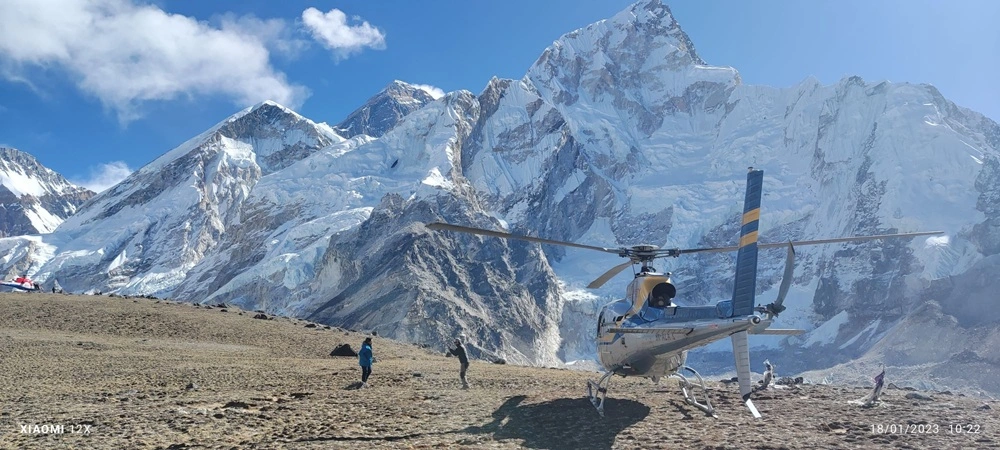
It is one of the most common questions we hear from travellers dreaming of Everest. They picture a helicopter settling gently among the yellow tents and prayer flags of base camp, the Khumbu Icefall glittering above, and stepping out onto the glacier at the foot of the world’s highest mountain. Is that really possible, and can you book it?
The honest answer is more interesting than a simple yes or no. Helicopters can and do land at Everest Base Camp, but rarely for sightseeing. Everest Base Camp helicopter landings are reserved mainly for rescues, medical evacuations, and expedition support. At the same time, tourist flights fly over the camp and land at nearby Kala Patthar, which offers a far better view of Everest anyway.
In this guide, our team explains who can land at base camp and why, the rules that govern helicopter flights in the Everest region, what helicopter tours do instead, how rescues work on Everest and how to choose the right helicopter experience, from our private Everest Helicopter Tour to the Sharing Everest Helicopter Tour with Kala Patthar Landing.
The Short Answer
- Physically, yes: Helicopters can land at Everest Base Camp, and in the climbing seasons they regularly do so for rescues and evacuations.
- For sightseeing, generally no: Tourist flights do not land at base camp. They fly over it and land elsewhere.
- Where tours land instead: At Kala Patthar, the famous viewpoint above Gorakshep, when rules, weather and weight allow, and at the Hotel Everest View for breakfast.
- Above base camp: Only rescue flights are normally allowed, with rare special exceptions for expedition logistics.
- The best way to reach base camp: On foot, via the classic Everest Base Camp Trek.
Everest Base Camp Helicopter Landing at a Glance
- Everest Base Camp (south side): About 5,364 m at the famous base camp marker, on the Khumbu Glacier in Nepal.
- Who lands there: Rescue and medical flights, expedition support with permission, and occasional official or special flights.
- Who flies over it: Sightseeing helicopter tours from Kathmandu and Lukla.
- Main tour landing sites: Kala Patthar at about 5,545 m, Pheriche as a shuttle point, the Hotel Everest View at about 3,880 m and Lukla for refuelling.
- Time on the ground at Kala Patthar: Usually around ten minutes.
- Highest helicopter landings on Everest: Rescue helicopters have landed in the Western Cwm at Camp 2, around 6,400 m, and long-line rescues have taken place even higher.
- North side in Tibet: You can reach the north base camp by road, and sightseeing helicopter flights aren’t part of the trip.
Where Exactly Is Everest Base Camp?
Everest Base Camp is not a village or a permanent building. It is a seasonal camp spread across the rubble-covered surface of the Khumbu Glacier, at the foot of the Khumbu Icefall, below the great walls of Everest, Lhotse and Nuptse. The well-known marker rock, decorated with prayer flags where trekkers take photos, sits at about 5,364 m.
In spring, the main climbing season, base camp becomes a tented town of expedition teams, with dining tents, communication tents, kitchens and even a seasonal medical clinic. In autumn and winter, it is almost empty, a quiet, windswept place of ice, rocks and meltwater pools. Because the glacier is constantly moving, the exact layout of the camp changes from year to year.
The nearest settlement is Gorakshep, at about 5,164 m, where trekkers sleep before and after their visit. Read our guide to Gorakshep to learn about this remote outpost, and our Everest Base Camp Trek itinerary to see how trekkers reach it.
A Short History of Helicopters in the Everest Region
Early Everest expeditions had no flights at all. Climbers and their loads walked for weeks from the lowlands, a journey still possible today on the Jiri to Everest Trek. Everything changed when Sir Edmund Hillary helped build the Lukla airstrip to bring materials for the schools and hospitals he founded with Sherpa communities, including the famous school at Khumjung. A second airstrip at Syangboche, above Namche, later served the Hotel Everest View.
Helicopters arrived first as rescue aircraft, carrying sick and injured climbers and trekkers to safety. As aircraft improved and more visitors arrived, they began carrying supplies, expedition teams, and, eventually, sightseeing passengers. Today they are part of daily life in the busy seasons, which is exactly why the rules on where they may land, and the debate over an Everest Base Camp helicopter landing, have become so important. Our guide to Sherpa culture and traditions explains how tourism has changed the Khumbu.
Why Landing at Everest Base Camp Is So Difficult
An Everest Base Camp helicopter landing is one of the more demanding operations in mountain aviation. Several factors make it challenging.
Thin Air
At about 5,300 m and above, the air holds roughly half the oxygen and density of sea level. A helicopter’s engine produces less power, and its rotors generate less lift so that it can carry only a fraction of its normal load. On warm afternoons, the air behaves as if it were even thinner, which is one reason why high flights are made in the cool early morning.
A Moving, Uneven Surface
Base camp sits on a glacier covered in loose rocks, ice and meltwater. As the glacier moves and melts, the surface shifts, and flat, stable landing spots are limited. In the climbing season, a landing area is kept clear for rescue flights, away from the tents.
Weather and Wind
Clouds can fill the upper Khumbu in minutes, and strong winds funnel down from the Icefall and the surrounding ridges. Pilots fly only in good visibility and calm conditions, usually before mid-morning.
People, Tents and Noise
In spring, hundreds of climbers and support staff live at base camp. Rotor downwash can blow away tents and equipment, and constant flights can disturb the people living there and preparing for their climbs. Climbers and Sherpas have also raised concerns about low flights near the Khumbu Icefall.
Who Does Land at Everest Base Camp?
Although sightseeing tours don’t land at base camp, helicopters are a regular sight there during the climbing season. They land for several key reasons.
Rescue and Medical Evacuation
The most important use of helicopters at base camp is saving lives. Climbers or staff suffering from serious altitude illness, injuries, or other emergencies can be flown quickly to lower altitudes or to a hospital in Kathmandu. In spring, a seasonal clinic at base camp, run by the Himalayan Rescue Association, treats climbers and staff and helps coordinate evacuations. At the same time, the association’s aid post at Pheriche serves trekkers lower down the valley.
Expedition Support
Helicopters carry supplies and people to and from base camp for expeditions, with the necessary permissions. Above base camp, flights are normally limited to rescue. In exceptional seasons, when dangerous conditions in the Khumbu Icefall delayed the route, the authorities have considered or allowed special one-time flights to carry supplies to Camp 2. Still, these are rare exceptions, not routine operations.
Official and Special Flights
Government officials, scientific teams and specialist projects occasionally fly to base camp with prior approval. These flights are planned and authorised individually.
The Rules: Who Decides Where Helicopters Land?
Several authorities and the communities who live there shape helicopter flights in the Everest region.
- Nepal’s aviation authority: Sets safety rules for mountain flying, including high-altitude landing and passenger-number limits. Tourist flights have long been barred from flying above base camp, where only rescue flights are normally allowed.
- Sagarmatha National Park: Controls landing permissions inside the park. Regular flights are limited to designated landing sites such as Lukla, Namche, and Syangboche, with special permission needed elsewhere.
- The local government and communities: In recent seasons, the Khumbu’s local authorities and youth groups have pushed to reduce commercial helicopter flights because of noise, disturbance to wildlife, and lost work for porters and lodges. Flights were suspended for a time and later resumed under agreed conditions.
The result is a set of rules that changes from season to season. Our guide to Everest helicopter tour restrictions explains the background in more detail, and our team checks the current rules before every flight.
What Helicopter Tours Do Instead
Since sightseeing tours cannot land at base camp, they follow a route designed to give you the best possible views and experiences:
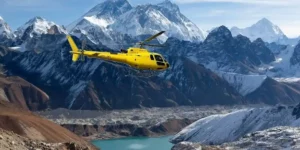
- Fly over Everest Base Camp: The helicopter flies up the Khumbu Glacier, past Gorakshep and over or alongside base camp and the Khumbu Icefall, keeping a safe distance from the mountain.
- Land at Kala Patthar: When rules, weather and weight allow, tours land on this rocky ridge above Gorakshep for a close-up view of Everest. On shared tours, passengers are now shuttled up from Pheriche two at a time, as explained in our guide to the Kala Patthar landing reopening.
- Breakfast at the Hotel Everest View: A relaxed stop on the ridge above Namche, with Everest and Ama Dablam in view. Read about it in our guide to the Hotel Everest View.
- Refuel at Lukla: A short stop at the famous mountain airstrip described in our Lukla Airport guide.
On our private Everest Helicopter Tour, the classic route flies over Everest Base Camp and lands for breakfast at the Hotel Everest View, with an optional Kala Patthar landing when conditions allow. Shorter flyovers also start from Lukla or villages higher in the Khumbu for trekkers already in the region.
Kala Patthar or Everest Base Camp: Which Is the Better Landing?
Many travellers are surprised to learn that Everest Base Camp is not the best place to see Everest. From most of the camp, the summit is hidden behind the mountain’s West Shoulder and the great wall of Nuptse. From base camp, you see the Khumbu Icefall, the surrounding ice walls, and the life of the expedition camp.
Kala Patthar, by contrast, faces Everest directly. From its rocky ridge, the summit pyramid rises clearly above the Khumbu Glacier, with Nuptse, Lhotse, Pumori and Changtse around it and base camp itself visible below. That is why trekkers climb it for sunrise and why helicopter tours choose it as their landing site. Read more in our guide to Kala Patthar and in our comparison of Gokyo Ri vs Kala Patthar.
If your dream is to stand at base camp itself, among the boulders and prayer flags beside the Icefall, the only way is to walk. If your dream is to see Everest up close in a single morning, our Sharing Everest Helicopter Tour with Kala Patthar Landing gets you as close as you can get by helicopter.
Helicopter Rescues on Everest
Helicopters have transformed safety in the Everest region. Before them, a seriously ill or injured climber had to be carried down by teams of Sherpas, a slow and dangerous process. Today, rescue helicopters can reach base camp and even higher on the mountain in good weather.
- Base camp and below: Helicopters regularly evacuate climbers, trekkers and staff with serious altitude illness or injuries from base camp, Gorakshep, Lobuche, Pheriche and Dingboche.
- The Western Cwm: Rescue helicopters have landed at Camp 2, at around 6,400 m, to pick up injured or ill climbers.
- Long-line rescues: Above the highest landing points, specially trained crews have rescued climbers by lowering a long line beneath the helicopter, with record rescues taking place at around 7,800 m.
These operations push helicopters and pilots to their limits and depend entirely on the weather. For trekkers, the lesson is simple: make sure your travel insurance covers helicopter evacuation at the altitudes you will reach, and follow your guide’s advice on acclimatisation so that you never need it. Our Acute Mountain Sickness page and our guide to altitude sickness on the Everest Base Camp Trek explain how.
A Word About Fake Rescues
In the past, some unscrupulous operators encouraged trekkers to call unnecessary helicopter “rescues” and bill them to their insurance. Nepal’s authorities have cracked down on this practice. A genuine emergency is always a reason to fly, but a planned flight home must be booked and paid for as a planned flight, never claimed as a rescue.
Has a Helicopter Ever Landed on the Summit of Everest?
Yes, once. A helicopter from the AS350 family, the same type commonly used for Everest tours and rescues, briefly landed on the summit of Everest during a record-setting test flight by a highly experienced test pilot. It remains one of aviation’s most extraordinary achievements.
That flight was a carefully prepared, one-off record attempt in perfect conditions. It does not mean that tours can fly to the summit. Everest’s summit, at 8,848.86 m, is far above the altitudes at which sightseeing helicopters operate, and tourist flights are not allowed above base camp. On a tour, you see the summit from Kala Patthar and from the air, a few kilometres away, which is spectacular enough.
Can Trekkers Fly Out From Everest Base Camp?
Trekkers who want to save time on the descent often ask whether a helicopter can pick them up at base camp. In normal circumstances, the answer is no. Planned return flights pick up from the helipad at Gorakshep after the Kala Patthar sunrise or, depending on current rules, passenger numbers and conditions, from lower in the valley, such as at Pheriche.
This trek-up, fly-back approach is the heart of our Everest Base Camp Helicopter Trek and the Luxury Everest Base Camp Trek with Helicopter Return. It saves two to three days of walking while keeping the full, acclimatised ascent. Our guide to the short Everest Base Camp Trek explains how it works and how to plan it safely.
What a Helicopter Flight Over Everest Base Camp Is Like
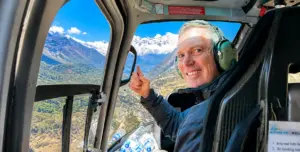
Even without landing at base camp, flying over it is unforgettable. After leaving Kathmandu at dawn and refuelling at Lukla, the helicopter climbs the Dudh Koshi Valley past Phakding, Namche Bazaar, and the Tengboche monastery, with Ama Dablam towering to the east. It follows the Imja and Khumbu valleys past Pangboche, Dingboche, and Lobuche, then flies up the Khumbu Glacier toward the great amphitheatre of Everest, Lhotse, and Nuptse.
Below you, the tents of base camp, in season, look like a scattering of coloured beads on the grey glacier, and the Khumbu Icefall tumbles from the Western Cwm like a frozen waterfall. Most passengers fall completely silent at this moment. Then the helicopter turns, either to land at Kala Patthar or to head down the valley for breakfast with a view.
Altitude: What Happens to Your Body
Whether you land at Kala Patthar or fly over base camp, a helicopter tour takes you from about 1,400 m in Kathmandu to well above 5,000 m in under two hours, with no time to acclimatise. During a short landing at Kala Patthar, you may feel breathless, light-headed or slightly headachy, especially if you move quickly.
- Move slowly and breathe deeply when you step out.
- Keep the stay short, as the crew directs.
- Tell the crew if you feel unwell; helicopters carry an oxygen cylinder for emergencies.
- Consult a doctor first if you have heart or lung conditions, high blood pressure, anaemia, are pregnant or have had recent surgery.
For most healthy travellers, the short visit is perfectly manageable, and the effects ease quickly as the helicopter descends.
How Weather and Weight Decide Every Landing
Even where landings are allowed, nothing about high-altitude flying is automatic. On the morning of every flight, the pilot checks the weather at Lukla, along the valley and at the landing sites, and calculates how much weight the helicopter can safely carry at each altitude. If clouds build at Gorakshep, winds are strong on the ridge of Kala Patthar, or the load is too heavy, the plan changes: the helicopter may wait, shuttle fewer passengers, land lower, or fly over the area and return.
That is why every operator asks for passengers’ body weights in advance, why passengers are weighed again at check-in and why luggage is kept to a small bag. It is also why no honest company can promise a landing at any particular site. The same logic explains why Everest Base Camp helicopter landings are reserved for missions where the benefit, saving a life or supporting an expedition, justifies the operation’s demands. For passengers, the best approach is patience: a delayed or modified flight is always better than a risky one, and the mountains will still be there tomorrow morning.
Best Time for an Everest Helicopter Flight
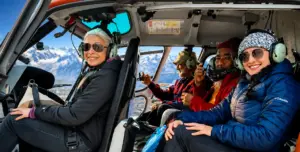
Helicopters need clear skies and calm winds, so timing is everything. Autumn, from late September to November, offers the clearest and most stable weather. Spring, from March to May, brings warmer days and a colourful base camp. Winter can be beautifully clear but cold and windy, and the monsoon months from June to early September bring frequent cloud. Flights usually depart at dawn and return to Kathmandu by late morning or midday. Our article on the best seasons for an Everest helicopter tour explains each month in detail.
Choosing Your Everest Helicopter Experience
There are several ways to see Everest by helicopter, depending on your time, group and interests:
- Everest Helicopter Tour: A private flight over Everest Base Camp with breakfast at the Hotel Everest View and an optional Kala Patthar landing when conditions allow.
- Sharing Everest Helicopter Tour with Kala Patthar Landing: Ideal for solo travellers and couples, with seats on a shared helicopter and the Pheriche shuttle to Kala Patthar.
- Mt Everest by Helicopter Tour: Another way to fly through the heart of the Khumbu and see Everest up close.
- Everest Heli Sherpa Village Walk: Adds a guided walk in Khumjung, with its monastery and the school founded by Sir Edmund Hillary.
- Gokyo Lakes Helicopter Tour: Flies over the turquoise lakes and glaciers of the neighbouring Gokyo valley.
Our guide compares these options, and our comparison of the EBC trek or helicopter tour helps you decide whether to fly or walk.
What You See at Everest Base Camp on Foot
Trekkers who reach base camp experience something no helicopter passenger can. You stand beside the marker rock wrapped in prayer flags, with the shattered seracs of the Khumbu Icefall rising directly above you and the ice walls of Nuptse and the West Shoulder of Everest towering around the camp. Pumori, Lingtren and Khumbutse frame the skyline to the west and north.
In spring, the camp hums with life: Sherpa climbers check ropes and oxygen, cooks prepare meals for entire expeditions, and the occasional helicopter arrives on a rescue or supply flight. In autumn, it is silent and empty, a wild and beautiful place of ice and stone. Either way, being at the foot of the world’s highest mountain is overwhelming, and for most trekkers it is the emotional high point of the journey, rivalled only by the sunrise from Kala Patthar the next morning. Read about the great peaks around you in our article on Nepal’s eight-thousand-metre peaks.
Walking to Everest Base Camp: The Only Way to Stand There
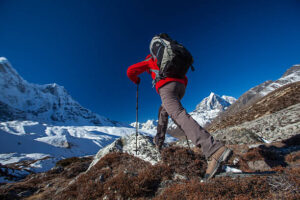
If standing at base camp is your dream, walking is the way. The classic Everest Base Camp Trek takes about 12 to 14 days from Kathmandu, through Sherpa villages, forests, monasteries and glacial valleys. It is non-technical but physically demanding; our guides to Everest Base Camp Trek difficulty, the Everest Base Camp Trek for beginners, the Everest Base Camp Trek distance and our 12-week training plan will help you prepare. Plan your season with our guides to the best time for the Everest Base Camp Trek and the Everest Base Camp Trek in October, pack with our Everest Base Camp Trek packing list and trekking equipment page, and read our trekking in Nepal guide and our article on Nepal’s mandatory guide rules for wider advice. During busy seasons, trekkers usually fly to Lukla from Manthali after an overnight drive arranged by our Ramechhap airport transportation team, while helicopter tours depart directly from Kathmandu.
There are many ways to make the journey your own:
- More comfort: The Everest Base Camp Luxury Lodge Trek and the Everest Elite Luxury Heli Trek.
- More adventure: The Gokyo Lakes Trek and the Everest 3 Pass Trek, crossing the Cho La Pass.
- More history: The Jiri to Everest Trek, following the early expeditions, as described in our Jiri to Everest Base Camp trek guide, or the Everest Base Camp Trek by Road.
- More mindfulness: The Everest Base Camp Yoga Trek, explained in our guide to mindful trekking in the Himalayas.
- Less altitude: The Everest View Trek or the Ama Dablam Base Camp Trekking route, described in our Ama Dablam Base Camp Trek
Whichever route you choose, you will pass through Sagarmatha National Park and the living culture explored in our guide to Sherpa culture and traditions, and you may hear the monks chant at Tengboche Monastery.
The North Side: Everest Base Camp in Tibet
Everest has two famous base camps. You can reach the south base camp in Nepal on foot or see it by helicopter. The north base camp in Tibet, below the mountain’s North Face, is reached by road across the Tibetan plateau, with the famous Rongbuk Monastery nearby. Sightseeing helicopter flights are not available on the Tibetan side.
Our Lhasa to Everest Base Camp Overland Tour takes you there by road, as explained in our Lhasa to Everest Base Camp guide. You can combine it with the Lhasa Tibet Tour, the Kathmandu to Lhasa Tour or the Luxury Nepal Tibet Tour to see Everest from both sides.
Combine Everest With Bhutan, Tibet or Kailash
Many travellers who fly over Everest are on a wider Himalayan journey. Because a helicopter tour takes only a morning, it fits easily into a multi-country trip. In Bhutan, the 7 Day Bhutan Tour, the Luxury Bhutan Tour and the Luxury Nepal Bhutan Tour lead to the cliffside Tiger’s Nest Monastery. The Nepal Tibet Bhutan Tour links three Himalayan countries, and pilgrims can continue to sacred Mount Kailash on the Mount Kailash Tour, described in our guide to the Kailash Kora.
Short Escapes Near Kathmandu and Pokhara
With your helicopter flight finished by midday, you will still have time to explore. Near Kathmandu, watch the sunrise over the Himalaya on the Nagarkot Hiking trek, walk the forest trails of the Nagarjun Hiking trek, or spend two days on the Chisapani Nagarkot Trek. Further west, Pokhara, described in our Pokhara sightseeing guide, offers paragliding and short treks such as the Ghorepani Poon Hill Trek and the Australian Camp Trek. For wildlife, join a Chitwan Jungle Safari; for the country’s heritage highlights, take the Classic Nepal Tour.
Myths and Facts About Everest Helicopter Flights
Misunderstandings about an Everest Base Camp helicopter landing are common, so here are the facts:
- Myth: Tours land at Everest Base Camp. Fact: Sightseeing tours fly over base camp and land at Kala Patthar or the Hotel Everest View.
- Myth: Base camp has the best view of Everest. Fact: The summit is hidden from most of base camp; Kala Patthar has the classic view.
- Myth: A helicopter tour avoids altitude effects. Fact: The visit is short, but you still rise to more than 5,000 m without acclimatisation.
- Myth: Helicopters can take you to the summit. Fact: Tourist flights are not allowed above base camp; the only summit landing was a special test flight.
- Myth: Flights always run on schedule. Fact: Weather and the rules in force decide when and where helicopters fly.
- Myth: Any helicopter return is a rescue. Fact: Planned flights are booked as such; only genuine emergencies are rescues.
Responsible Flying in the Khumbu
The Khumbu is home to Sherpa communities that have welcomed visitors for generations, and growing helicopter traffic has raised genuine concerns about noise, wildlife, and local livelihoods. If you choose to fly, book with a licensed operator that follows the agreed rules, keep landings short and quiet, and consider spending time on the ground in the villages, for example on a village walk or a short trek. Learn more on our responsible tourism page, and read about the stupas and monasteries you fly over in our article on the chorten in Tibetan Buddhism, our overview of Buddhism in Tibet and our story of Guru Padmasambhava, the teacher revered across the Sherpa homeland.
Practical Tips for Booking an Everest Helicopter Flight
Whether you hope for a Kala Patthar landing or simply a flight over base camp, a little planning goes a long way:
- Book early for October, November, April and May.
- Send your passport details and weight in advance for flight planning.
- Keep a spare morning in case weather delays the flight.
- Dress for winter: down jacket, hat, gloves,s and sunglasses.
- Ask about the current landing rules for Kala Patthar before you fly.
- Choose a registered operator; you can view our company registration and legal documents, as well as our payment options.
- Check your entry requirements in our Nepal visa guide
- Most of the afternoon, explore the city on our Kathmandu Day Tour or with our Kathmandu sightseeing.
Other Helicopter Journeys in Nepal
Everest is not the only place to experience the Himalaya from the air. The Annapurna Helicopter Tour lands in the Annapurna Sanctuary, which you can also reach on foot via the Annapurna Base Camp Trek described in our ultimate guide to the Annapurna Base Camp Trek. The Langtang Helicopter Tour visits the Langtang Valley, and the Muktinath Yatra by Helicopter takes pilgrims to the sacred temple of Muktinath, also reached on the Jomsom Muktinath Trek.
Climbers can see Everest from their own summits on Island Peak Climbing, Lobuche Peak Climbing and Mera Peak Climbing; check the latest NMA peak permit updates and read about the region’s great peaks in our Ama Dablam expedition guide. Runners can even race down from base camp on the Everest Marathon. For more inspiration, browse our list of the top 50 treks in Nepal.
Frequently Asked Questions About Helicopter Landings at Everest Base Camp
Can a helicopter land at Everest Base Camp?
Yes, helicopters can land at Everest Base Camp for rescues, medical evacuations, and permitted expedition support. Sightseeing tours, however, fly over base camp and land elsewhere.
Why don’t helicopter tours land at Everest Base Camp?
Landing permissions in the national park are restricted, base camp sits on a moving glacier crowded with expedition tents in season, and the thin air limits what helicopters can safely carry. Kala Patthar also offers a much better view of Everest.
Where do Everest helicopter tours land?
Usually at Lukla for refuelling, at Kala Patthar when rules, weather and weight allow, at Pheriche as a shuttle point on sharing tours and at the Hotel Everest View for breakfast.
Can I land at Kala Patthar on a sharing tour?
Yes. Kala Patthar landings have resumed on sharing tours using a shuttle from Pheriche, carrying two passengers at a time for around ten minutes, subject to conditions on the day.
How close does a helicopter tour get to Everest?
The helicopter flies over or alongside base camp and lands at Kala Patthar, a few kilometres from the summit, with a clear, close-up view of the summit pyramid.
Has a helicopter ever landed on Everest’s summit?
Yes, once, during a special record-setting test flight. Tourist flights are not allowed above base camp, so tours cannot fly to the summit.
Can a helicopter rescue climbers from high on Everest?
Yes. Rescue helicopters have landed at Camp 2, around 6,400 m, and long-line rescues have been carried out even higher, depending on the weather.
Can trekkers be picked up by helicopter at Everest Base Camp?
Not for planned return flights. These usually pick up at Gorakshep or lower in the valley. Base camp pickups are for genuine emergencies.
Can you fly to the north base camp in Tibet?
No. You reach the north base camp by road, and sightseeing helicopter flights aren’t part of travel on the Tibetan side.
What is the best way to get to Everest Base Camp?
Walking. The Everest Base Camp Trek takes you to base camp on foot, or you can trek up and fly back to save time on the descent.
Final Thoughts: Over Base Camp, Onto Kala Patthar
So, can a helicopter land at Everest Base Camp? Yes, but for sightseeing, it is not where you would want to land anyway. Everest Base Camp helicopter landings are rightly reserved for rescues and the climbers who depend on them, while tour passengers fly over the camp, step out onto Kala Patthar for the classic view of Everest, and enjoy breakfast with a view above Namche. For those who want to stand among the prayer flags at base camp itself, the trail is waiting.
Book our private Everest Helicopter Tour, take a seat on our shared Everest Helicopter Tour with Kala Patthar Landing, or walk the full Everest Base Camp Trek. Meet our guides on our team page, learn more about our company, then plan your trip or contact us today. Everest is waiting, no matter how you choose to arrive.
Quick Inquiry
Explore More


