
Phakding and Monjo: First Stops on the Everest Trail

Phakding and Monjo: First Stops on the Everest Trail
Your plane has just landed at Lukla, heart still racing from one of the most dramatic airport approaches on Earth. You meet your porters, adjust your daypack, and take your first steps on the world’s most famous trekking trail. Within minutes, the airstrip noise fades. The path drops towards the glacier-fed Dudh Koshi River, passing carved mani stones, spinning prayer wheels and fields of potatoes and greens. By afternoon, you reach a riverside village where rushing water lulls you to sleep. Welcome to Phakding.
Phakding and its neighbour Monjo are the first overnight stops for most trekkers on the Everest Base Camp Trek. Many treat them as simple stepping stones to Namche Bazaar and the high mountains. Still, these villages have their own character, history, and beauty: ancient monasteries, roaring waterfalls, swaying suspension bridges, and the official gateway to Sagarmatha National Park.
In this guide, our Sherpa team walks you through the first days of the Everest trail, from Lukla to Phakding, then on to Monjo and the park entrance, and finally to the foot of Namche Hill. You will learn what to expect, where to stay, what to see and how to make these early days a strong start to your adventure.
Phakding and Monjo at a Glance
Here are the key facts about the first section of the trail:
- Lukla: About 2,860 m. Your arrival point and the start of the trek, home to Tenzing-Hillary Airport.
- Phakding: About 2,610 m. A riverside village on the Dudh Koshi, usually the first night’s stop, roughly three to four hours from Lukla.
- Monjo: About 2,835 m. A small village just below the entrance gate of Sagarmatha National Park, about two to three hours beyond Phakding.
- Jorsalle: About 2,740 m. The last village before the steep climb to Namche Bazaar.
- Namche Bazaar: About 3,440 m. The Sherpa capital, reached after the long climb from the Hillary Bridge.
- Distance: Roughly 8 km from Lukla to Phakding, and roughly 10 to 12 km from Phakding to Namche.
For a stage-by-stage breakdown of the full route, see our guide to the Everest Base Camp Trek distance.
Arriving in Lukla: The Gateway to the Khumbu
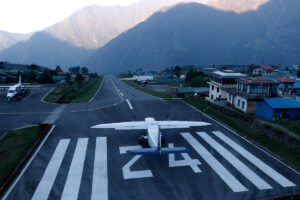
Every journey to Phakding begins in Lukla. The flight lands on a short, sloping runway carved into the mountainside, one of the most thrilling landings anywhere. During the busy spring and autumn seasons, most Lukla flights depart from Manthali Airport in Ramechhap rather than Kathmandu, which means a very early drive before your flight. Our Ramechhap airport transfer service handles the drive smoothly.
In Lukla, you meet your trekking crew, have a hot drink and organise your bags. Your porter carries your main duffel, and you carry a light daypack with water, snacks, layers, sunscreen and a camera. We check the Khumbu Pasang Lhamu Rural Municipality permit near the start of the trail, and our team handles all the paperwork.
If you would rather avoid the flight altogether, the Everest Base Camp Trek by Road starts with a jeep drive to the lower Solukhumbu and joins the main trail below Lukla. Meanwhile, the historic Jiri to Everest Trek follows the old expedition route on foot.
Lukla to Phakding: Your First Day on the Trail
The walk from Lukla to Phakding is one of the gentlest days of the whole trek. It is mostly downhill or level, with a few short climbs, which makes it perfect for easing into trekking after the flight. It also helps acclimatisation, because Phakding sits slightly lower than Lukla, giving your body a gentle introduction to altitude.
Leaving Lukla
The trail leaves Lukla’s northern end through a stone gateway and passes a large prayer wheel and the memorial gate. Lodges, bakeries and small shops line the first stretch. Soon, the path descends through fields and forest toward the Dudh Koshi valley.
Chheplung
After about thirty to forty-five minutes, you reach Chheplung, a small village where a trail branches off towards the lower Solu region. Here you begin to see classic Sherpa village features: mani walls carved with “Om Mani Padme Hum,” prayer flags, and simple stone houses. Walk to the left of the mani walls, keeping them on your right.
Thado Koshi and Ghat
The trail continues along the hillside to Thado Koshi, where you cross a tributary river on a suspension bridge and catch views of the snowy peak of Kusum Kanguru, around 6,367 m, rising to the east. From there, the path leads to Ghat, a charming village with a long row of prayer wheels, large mani stones and a small gompa. Ghat is one of the prettiest spots on day one, and many trekkers stop to spin the prayer wheels and take photos.
Arriving in Phakding
A short walk from Ghat brings you to Phakding, spread along both banks of the Dudh Koshi and linked by a long suspension bridge. Depending on your pace and how long you stop for photos and tea, the walk from Lukla takes about three to four hours. Most trekkers arrive by early afternoon, leaving plenty of time to rest and explore.
Exploring Phakding
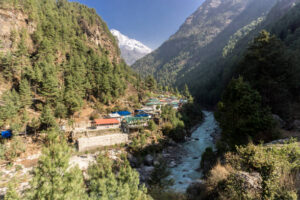
Phakding is a lively trekking village of lodges, teahouses, small shops and bakeries, set on terraces above the rushing river. It is greener and warmer than the villages higher up, with pine forest on the slopes and vegetable gardens beside many lodges.
Rimijung and the Pema Choling Monastery
High on the hillside across the river from Phakding sits the village of Rimijung, home to the Pema Choling Monastery, one of the area’s oldest monasteries, believed to be around three and a half centuries old. The climb takes about an hour from Phakding and is an excellent short acclimatisation hike on your first afternoon. The monastery is quiet and atmospheric, with wonderful views over the Dudh Koshi valley. Ask your guide to accompany you, and remember to leave a small donation.
The Village Monastery
A small monastery sits above the village, a short climb from the main trail. Visiting it in the late afternoon, when the light softens over the valley, is a peaceful way to end your first day of trekking.
Riverside Walks
If you prefer to stay low, wander along the river, cross the suspension bridges, and watch yak and dzo trains pass through with loads for the villages above. The thundering Dudh Koshi, milky with glacial silt, gives the river its name, meaning “Milk River.”
Cafés and Bakeries
Phakding has a few bakeries and cafés where you can enjoy fresh coffee, cinnamon rolls or apple pie. Enjoy them; as you climb higher, such treats become rarer. Some lodges even have small bars, but we recommend keeping alcohol to a minimum in the early days to help your body adapt to altitude.
Lodges and Food in Phakding
Phakding has a wide choice of accommodation, from simple teahouses to comfortable lodges with attached bathrooms, hot showers and pleasant gardens. Because it is at a lower altitude, rooms are warmer here than later in the trek, and electricity and Wi-Fi are generally reliable.
Lodge menus are varied: dal bhat, momos, noodles, fried rice, pasta, pizza, soups and plenty of potato dishes. Many lodges grow their own vegetables, so salads and greens may be available here, though our guides generally recommend sticking to cooked food on the trail for safety.
If you want to begin your trek in comfort, the Everest Base Camp Luxury Lodge Trek uses premium lodges in Phakding and beyond, with better rooms, heating in the dining areas and excellent food.
Phakding to Monjo: Bridges, Waterfalls and Forests
The second day follows the river to Monjo and the national park entrance. Most trekkers continue through Monjo to Namche Bazaar the same day, but some itineraries stop in Monjo for the night to break up the climb.
Leaving Phakding
After breakfast, the trail crosses back over the river and continues north along the Dudh Koshi through blue pine and rhododendron forest. In spring, the rhododendrons bloom in red and pink, and magnolias add white flowers to the forest.
Toktok and Benkar
The path passes the small settlement of Toktok, then Benkar, where a beautiful waterfall tumbles down the cliffs beside the trail. Benkar is also known for roadside stalls selling fresh yak cheese and local products. Look east for views of the snowy peak of Thamserku (around 6,608 m), which will tower above you for the next few days.
Chumoa and Monjo
Beyond Benkar, the trail crosses the river again on suspension bridges and passes Chumoa before climbing gently to Monjo at about 2,835 m. The walk from Phakding to Monjo takes around two to three hours. Monjo is a small, friendly village with several lodges, potato and green fields, and good views back down the valley.
Monjo: The Gateway to Sagarmatha National Park
Just above Monjo stands the entrance gate of Sagarmatha National Park, the protected area that includes Mount Everest and the entire high Khumbu. This is one of the most important checkpoints on your trek.
The Park Entrance and Permit Check
At the gate, park officials check your Sagarmatha National Park entry permit and record your details. If you are trekking with us, our team will already have arranged your permit, and your guide will handle the check. There is also a small information centre with displays about the park’s geography, wildlife and culture, worth a few minutes of your time.
The park covers more than a thousand square kilometres of mountains, glaciers, forests and Sherpa villages, and it is a UNESCO World Heritage Site. Our guide to Sagarmatha National Park explains what makes it so special, from its wildlife to its forests.
Why Stay in Monjo?
Most itineraries trek from Phakding to Namche in one day, but staying overnight in Monjo has real advantages:
- Better acclimatisation: Breaking the climb to Namche into two shorter days helps your body adjust more gradually.
- A gentler Namche day: You arrive in Namche earlier and less tired.
- Quieter nights: Monjo is smaller and quieter than Phakding.
- Good for slower trekkers: Ideal for older trekkers, families and anyone who prefers a relaxed pace.
Our team can build an overnight in Monjo into your itinerary when you plan your trip.
Monjo to Namche Bazaar: The Hillary Bridge and the Namche Hill
From Monjo, the trail drops through the park gate to Jorsalle, the last village before Namche. This is a good place for lunch, as there are no proper lodges on the climb ahead.
The Hillary Bridge
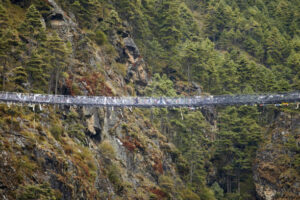
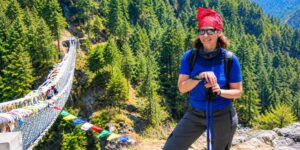
Beyond Jorsalle, the trail follows the river to where the Dudh Koshi and Bhote Koshi meet. Here, high above the gorge, the famous Hillary Suspension Bridge hangs, draped with prayer flags. Crossing it is one of the trek’s most iconic moments, with the river thundering far below. The bridge is strong and safe, but if you are nervous about heights, keep your eyes on the far side and walk steadily. When yaks are crossing, wait for them to pass before stepping on.
The Namche Hill
After the bridge, the real climb begins. The trail rises steeply for around 600 m through pine forest, with zigzags, stone steps and dusty sections. It is the first serious test of your fitness and the first place where you may feel the altitude. Halfway up, at a viewpoint, you may catch your first glimpse of Everest on a clear day, peeking over the Nuptse-Lhotse ridge. Take your time, drink water and walk slowly.
Finally, the trail rounds a corner and reveals Namche Bazaar, a horseshoe of colourful buildings clinging to the mountainside. You have arrived in the Sherpa capital. From Phakding, the whole day to Namche takes around five to seven hours.
Mountains of the Lower Khumbu: Kusum Kanguru and Thamserku
You will not see Everest from Phakding, but the lower Khumbu has its own impressive peaks that accompany you on the first days of the trek.
Kusum Kanguru
Kusum Kanguru, around 6,367 m, rises to the east above the trail between Lukla and Phakding. Its name is often translated as “three snow-white gods,” a reference to its three summits. It is considered one of Nepal’s more difficult trekking peaks, with steep rock and ice on all sides, and climbing it is a serious undertaking. From the trail near Thado Koshi and Ghat, its snowy ridges appear framed by pine forest.
Thamserku and Kangtega
Further up the valley, Thamserku, around 6,608 m, dominates the view from Benkar, Monjo and later Namche. Its sharp, glaciated face is one of the most photographed sights on the lower trail. Its neighbour, Kangtega, rises higher, and together they form a stunning backdrop to Namche Bazaar and the trail to Tengboche.
The First Glimpse of Everest
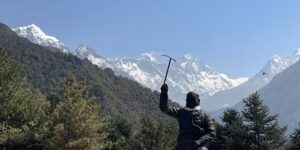
Your first view of the giants comes on the climb to Namche, when Everest, Lhotse, and Nuptse may briefly appear through the trees. From Namche onwards, the views grow day by day, culminating in the close-up panorama from Kala Patthar. For more about the region’s great peaks, read our guides to Ama Dablam and Nepal’s new eight-thousanders.
Sample Plan for the First Three Days
Here is how our team usually plans the first section of the trek, with an optional slower version for trekkers who prefer a gentler pace:
- Day 1, standard plan: Fly or drive and fly to Lukla, then trek three to four hours to Phakding. Afternoon hike to Rimijung and the Pema Choling Monastery if you feel well.
- Day 2, standard plan: Trek from Phakding through Benkar, Monjo and Jorsalle, cross the Hillary Bridge and climb to Namche Bazaar, a day of five to seven hours.
- Day 3 (standard plan): Acclimatisation day in Namche, with a hike to Hotel Everest View, Khumjung, and Khunde.
- Slower alternative: Spend the second night in Monjo instead of Namche, then climb to Namche on day three, arriving early and fresh. Use day four for acclimatisation.
The slower plan adds a day but makes the climb to Namche much easier and improves acclimatisation. It is a good choice for first-time trekkers, families and anyone over sixty. Our team can tailor either version when you contact us.
Photography Tips for the First Days of the Trek
The lower Dudh Koshi valley is full of photo opportunities, though the light and steep valleys bring their own challenges:
- Capture the bridges: Suspension bridges draped in prayer flags make striking images, especially with the river below. Stand safely to the side and never block the bridge for others.
- Shoot the prayer wheels in Ghat: The long row of prayer wheels with mountains behind is one of the best scenes of the first day.
- Photograph the Benkar waterfall: A slower shutter speed or your phone’s long-exposure setting turns the falling water silky.
- Look for Thamserku: Frame the peak with pine trees, chortens or lodges for depth.
- Ask before photographing people, especially porters carrying heavy loads and families in their homes.
- Protect your camera from dust and rain, depending on the season.
Beyond Phakding: What Comes Next on the Trail
After Phakding and Monjo, the trail climbs into the heart of the Khumbu, and each day brings new highlights:
- Namche Bazaar: The Sherpa capital, with markets, bakeries, the Sherpa Culture Museum and the first big mountain views.
- Khumjung and Khunde: Twin villages above Namche, home to the Hillary School, Khunde Hospital and the monastery with its yeti scalp. Read our guide to Khumjung and Khunde.
- Tengboche: The largest monastery in the Khumbu, with views of Ama Dablam and Everest. Learn more in our guide to Tengboche Monastery and the Mani Rimdu festival.
- Pangboche: The oldest monastery village in the Khumbu, at the foot of Ama Dablam. See our Pangboche
- Dingboche and beyond: Your second acclimatisation stop, followed by Dingboche, Lobuche, Gorakshep and Everest Base Camp.
Altitude in the First Days
The section from Lukla to Phakding is low enough that altitude sickness is rarely a problem, but it is a good time to build good habits. The climb from Jorsalle to Namche, gaining about 700 m in a few hours, is where many trekkers first notice the thinner air.
- Start slowly: Pace yourself so you can talk while walking.
- Drink plenty of water: Aim for three to four litres a day.
- Eat well: Carbohydrate-rich meals fuel your body for the climb.
- Avoid alcohol: Especially in Lukla and Phakding, where the temptation to celebrate is strong.
- Listen to your body: Tell your guide about any headache, nausea or unusual tiredness.
Read our Acute Mountain Sickness guide for more advice, and our Everest Base Camp Trek difficulty guide for an honest look at what lies ahead.
Culture Along the First Section of the Trail
Although many trekkers see the first days only as a walk to Namche, the villages between Lukla and Monjo are full of culture.
Mani Walls, Chortens and Prayer Wheels
Every village has mani walls carved with prayers, and chortens that mark entrances and bridges. Ghat’s line of prayer wheels and the large painted mani stones along the trail are some of the finest on the whole route. Walk clockwise around them and spin prayer wheels with your right hand. Our article on the Eight Great Stupas explains what these monuments mean.
Sherpa Hospitality
Sherpa families run lodges in Phakding and Monjo, many of whom have farmed in the valley for generations. Their warmth and hospitality will be a highlight of your trek. Learn more about their traditions in our guide to Sherpa culture.
Porters and Pack Animals
You will share the trail with porters carrying huge loads and with trains of yaks, dzos, and mules. The lower valleys are home mostly to dzos,s yak-cow crossbreeds better suited to lower altitudes than pure yaks. Always step to the uphill side of the trail when animals pass. Our responsible tourism page explains how we care for our porters.
Nature and Wildlife Between Lukla and Monjo
The lower Dudh Koshi valley is the greenest part of the Everest trail. Blue pine, hemlock, oak, and rhododendron forests cover the slopes, with ferns and mosses in shaded gullies. In spring, rhododendron and magnolia blossoms brighten the trail.
Birds are plentiful, from laughingthrushes and tits to the colourful Himalayan monal higher up. Himalayan tahr sometimes appear on the cliffs above Jorsalle, and langur monkeys can occasionally be seen in the forests. Keep your eyes open, especially in the early morning.
Lukla, Phakding and Monjo Compared
Each of the first villages plays a different role on the trek. Understanding them helps you plan where to rest, eat and spend your time:
- Lukla: A busy hub around the airstrip, with many lodges, cafés, gear shops and the trek’s last reliable services before Namche. It is mainly a place for arrivals, departures and the final celebration with your crew.
- Phakding: The classic first overnight stop. It is lower and warmer than Lukla, with a wide choice of lodges along the river and side trips to the monasteries of Rimijung and the village above. It is lively in the evenings during the trekking seasons.
- Monjo: Smaller and quieter, perched just below the national park gate. It is the best choice if you want to shorten the climb to Namche or prefer a calm night away from the crowds.
- Jorsalle: A cluster of lodges and teahouses inside the park, mainly used as a lunch stop before the Namche Hill. A few trekkers stay here to split the climb even further.
There is no wrong choice, only the one that suits your pace and preferences. Many trekkers stay in Phakding on the way up and Monjo or Phakding again on the way down, enjoying both villages. Our guides will recommend the best option based on your fitness, interests, and how you feel that day.
Weather in Phakding and Monjo
Thanks to their lower altitude, Phakding and Monjo enjoy a milder climate than the villages above Namche. In spring and autumn, daytime temperatures are often pleasant for walking in a light layer, while mornings and evenings are cool. Nights can drop to around freezing in late autumn and winter, but rarely reach the bitter cold of Lobuche or Gorakshep. Clouds often build in the valley during the afternoon, so start early for the clearest views of Kusum Kanguru and Thamserku. In the monsoon, expect regular rain, muddy trails and lush green forests.
Best Time to Trek Through Phakding and Monjo
Each season brings a different experience to the lower Khumbu:
- Spring (March to May): Rhododendrons and magnolias bloom, the weather is mild, and trekkers and expeditions keep the trails busy.
- Autumn (September to November): Clear skies, fresh air after the monsoon and great mountain views. This is the busiest season.
- Winter (December to February): Cool days, cold nights and quiet trails. The lower valleys are pleasant, though higher villages are very cold.
- Monsoon (June to August): Lush and green, but rainy, with leeches in the forests and frequent flight delays at Lukla.
Spring and autumn offer the best balance of weather and views for most trekkers.
Common Mistakes in the First Days
The first days of the trek seem easy, but how you treat them can shape the rest of your journey. Avoid these common mistakes:
- Walking too fast: Feeling strong on day one often leads to headaches on day four. Pace yourself.
- Overpacking your daypack: Carry only essentials; your porter has the rest.
- Wearing new boots: Blisters on day one can ruin the trek. Break in your boots before you come.
- Skipping water and food: Even at low altitude, staying hydrated and fuelled is crucial.
- Celebrating too hard in Lukla or Phakding: Alcohol dehydrates you and slows acclimatisation.
- Don’t skip the afternoon hike: A short uphill walk in the afternoon, such as to Rimijung, helps your body adapt.
Use our trekking equipment list to pack the right gear, from layers to trekking poles.
Phakding and Monjo on Different Everest Treks
Phakding and Monjo are part of almost every trek in the Everest region:
- Everest Base Camp Trek: You usually spend the first night in Phakding, then the next in Namche.
- Everest View Trek: A shorter trek that passes through Phakding and Monjo on the way to Namche and Tengboche.
- Gokyo Lakes Trek: Begins with the same route to Namche before heading up the Gokyo Valley.
- Everest 3 Pass Trek: The long circuit starts and ends through Phakding.
- Ama Dablam Base Camp Trekking: Follows the main trail through Phakding and Monjo.
- Everest Base Camp Yoga Trek: The riverside lodges of Phakding are a peaceful setting for the first yoga session.
- Peak climbing: Island Peak Climbing and Lobuche Peak Climbing also begin on this trail.
For the full day-by-day plan, see our Everest Base Camp Trek itinerary.
Luxury and Helicopter Options
Travellers who want more comfort or less time on the trail have several options:
- Luxury lodges: The Everest Base Camp Luxury Lodge Trek stays in the finest lodges in Phakding, Monjo and Namche.
- Helicopter to Lukla: If you want to avoid the long drive to Ramechhap, you can arrange a helicopter from Kathmandu to Lukla.
- Trek in, fly out: The Luxury Everest Base Camp Trek with Helicopter Return walks up through Phakding and Monjo, then returns by helicopter.
- Premium heli trekking: The Everest Elite Luxury Heli Trek and Everest Base Camp Helicopter Trek combine walking with helicopter transfers.
- Everest in a day: The Everest Helicopter Tour flies over the Dudh Koshi valley, past Phakding and Monjo, to the high Khumbu.
The Return Journey Through Phakding
At the end of your trek, you pass through Monjo and Phakding again on the way back to Lukla. After two weeks at high altitude, the lower valley feels lush and warm, and the air seems thick with oxygen. Many trekkers find this return walk one of the most enjoyable days, full of reflection and celebration.
The final day from Namche to Lukla is long, around six to seven hours, and ends with a final uphill climb into Lukla. That evening, it’s Khumbu tradition to celebrate with your guides and porters, share stories, and thank the team who made the journey possible. The next morning, weather permitting, you fly back to Kathmandu.
Always keep one or two buffer days in Kathmandu at the end of your trip, as weather often delays Lukla flights. Use any spare time for Kathmandu sightseeing or a day tour.
Practical Tips for Phakding and Monjo
- Carry cash: Lukla and Namche have ATMs, but they are not always reliable. Bring enough Nepali rupees from Kathmandu.
- Charge devices early: Phakding usually has reliable electricity, so charge your devices and power banks here.
- Stock up on snacks in Lukla or Phakding: Options get limited as you climb higher.
- Use refillable bottles: Purify water with tablets or a filter rather than buying plastic bottles.
- Respect the permit checks: Keep your passport handy for the checkpoints.
- Get to know your crew: The first day is a great time to learn your guide’s and porter’s names and stories. Meet our team on our Our Team page.
- Check your visa: Most nationalities can get a Nepal visa on arrival; see our Nepal visa guide.
Frequently Asked Questions About Phakding
What is the altitude of Phakding?
Phakding sits at about 2,610 m, slightly lower than Lukla (about 2,860 m).
How long is the walk from Lukla to Phakding?
It is about 8 km and usually takes three to four hours, mostly downhill or level along the Dudh Koshi River.
How far is it from Phakding to Namche Bazaar?
It is roughly 10 to 12 km and usually takes five to seven hours, including the steep climb from the Hillary Bridge to Namche.
Where is the entrance to Sagarmatha National Park?
The park entrance gate and permit checkpoint are just above the village of Monjo, at about 2,835 m.
Should I stay overnight in Monjo instead of Phakding?
Most trekkers stay in Phakding, but staying in Monjo shortens the climb to Namche and can help acclimatisation, especially for slower trekkers.
Is there anything to do in Phakding?
Yes. You can hike to the Pema Choling Monastery in Rimijung, visit the village monastery, walk along the river and enjoy the bakeries and cafés.
Will I get altitude sickness in Phakding?
Altitude sickness is rare at Phakding’s altitude, but it is important to walk slowly, drink plenty of water and avoid alcohol to prepare for the higher sections ahead.
Is there Wi-Fi and electricity in Phakding?
Yes. Most lodges in Phakding offer electricity for charging and Wi-Fi, often for a small fee.
What is the Hillary Bridge?
The Hillary Suspension Bridge is a high bridge over the Dudh Koshi gorge beyond Jorsalle, draped in prayer flags. It marks the start of the steep climb to Namche Bazaar.
Can I see Everest from Phakding?
No. Everest is not visible from Phakding. You’ll usually see it on the climb to Namche Bazaar, weather permitting.
Final Thoughts: A Gentle Start to a Great Adventure
Phakding and Monjo may not have the fame of Namche, Tengboche or Kala Patthar, but they set the tone for your entire Everest adventure. Here you cross your first suspension bridges, spin your first prayer wheels, meet your crew and enter the protected world of Sagarmatha National Park. Taking these days slowly and mindfully lays the foundation for a safe and successful trek.
Let our Sherpa team guide you from your very first step out of Lukla. Join our classic Everest Base Camp Trek, start in comfort with the Everest Base Camp Luxury Lodge Trek, or choose the shorter Everest View Trek. Plan your trip or contact us today, and begin your journey on the most famous trail in the Himalaya.
Quick Inquiry
Explore More


