Gokyo Lakes Helicopter Tour: Turquoise Lakes from the Air

Gokyo Lakes Helicopter Tour: Turquoise Lakes from the Air
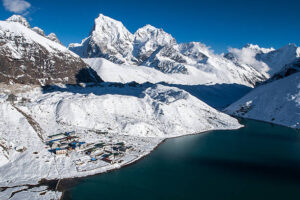
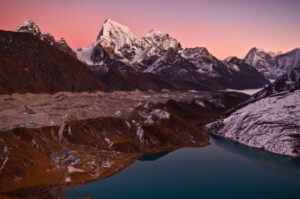
The helicopter banks over a ridge, and suddenly the valley opens beneath you. A grey river of ice and rubble winds north towards the vast white wall of Cho Oyu, and beside it, one after another, lie lakes of an impossible color: turquoise, jade and sapphire, glittering in the morning sun. A cluster of stone lodges sits on the shore of the third lake, and far to the east, above the ridges, Everest’s dark summit watches over it all. This is the Gokyo valley, and you have reached it before breakfast.
A Gokyo helicopter tour is one of the most beautiful flights in the Himalaya. While most helicopter visitors head for Everest Base Camp, the quieter Gokyo Valley offers something different: a chain of sacred glacial lakes, the Ngozumpa, often described as the longest glacier in Nepal, and close-up views of Cho Oyu, the sixth-highest mountain on Earth. Our Gokyo Lakes Helicopter Tour brings this hidden world within reach in a single morning.
In this guide, our team explains everything you need to know: how the flight unfolds, what you see from the air, which lakes you pass, what is possible when landing near Gokyo, how to combine Gokyo with Everest and breakfast at the Hotel Everest View, the best season for turquoise lakes, altitude and safety, the current rules, and how to choose the right tour.
The Short Answer: What Is a Gokyo Helicopter Tour?
A Gokyo helicopter tour is a half-day flight from Kathmandu via Lukla into the Gokyo valley, over the six turquoise Gokyo Lakes and the Ngozumpa Glacier beneath Cho Oyu, with a short landing near the lakes when rules and weather allow. Many flights add Everest or breakfast at the Hotel Everest View before returning.
It needs no trekking and no acclimatization, takes around four to five hours from your hotel and back, and shows you in one morning a valley that trekkers take a week to reach on foot.
Gokyo Helicopter Tour at a Glance
- Duration: About four to five hours, from hotel pickup to drop-off.
- Route: Kathmandu, Lukla, the Dudh Koshi and Gokyo valleys, the Gokyo Lakes and back, often with Everest or the Hotel Everest View added.
- Highlights: The six main Gokyo Lakes, the Ngozumpa Glacier, Gokyo village, Cho Oyu and distant Everest.
- Altitude: Gokyo village sits at about 4,790 m, beside lakes between roughly 4,690 and 5,000 m.
- Landing: A short stop near the lakes when rules, weather, and passenger weight allow; otherwise, a scenic loop over the valley.
- Helicopter: A light, high-altitude helicopter carrying up to five passengers on the lower legs, and fewer at high landing sites.
- Best seasons: Autumn and spring for turquoise lakes; winter for frozen white lakes and clear skies.
- Who it suits: Non-trekkers, photographers, families, returning trekkers and anyone short on time.
- Our tour: The Gokyo Lakes Helicopter Tour.
Why See the Gokyo Lakes From the Air?
The Gokyo Valley lies just west of the main Everest Base Camp route, separated from it by a high ridge and the great Ngozumpa Glacier. On foot, it takes about a week to reach Gokyo from Lukla, with careful acclimatization along the way, as described in our Gokyo Lakes Trek guide. From the air, you see the whole valley in a single sweep: the lakes, the glacier, the village and the giants above them.
The view from above also reveals something walkers rarely see: the landscape’s shape. You can follow the Ngozumpa Glacier from its source beneath Cho Oyu, see how the lakes sit in a line between the glacier’s moraine and the mountainside, and understand how ice carved the whole valley. For photographers and lovers of wild places, a Gokyo helicopter tour is a different kind of Everest experience, quieter and more colorful than the classic flight to base camp.
The Gokyo Valley in Brief
The Gokyo Valley is the upper valley of the Dudh Koshi, running north from the ridge of Mong La and the village of Phortse toward the Tibetan border and the massif of Cho Oyu. A chain of glacial lakes lines its western side, while the eastern side is filled by the Ngozumpa Glacier, often described as the longest glacier in Nepal. The lakes and their wetlands are protected as a Ramsar Site, a wetland of international importance, inside Sagarmatha National Park.
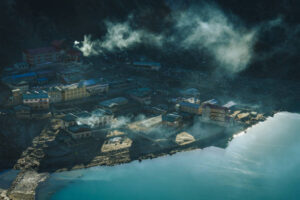
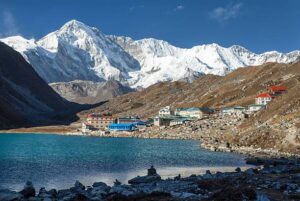
Gokyo village, at about 4,790 m, is a small cluster of lodges on the eastern shore of the third lake, beneath the rounded summit of Gokyo Ri, about 5,357 m. To the west, the trail over Renjo La Pass leads to the Thame valley; to the east, the Cho La Pass crosses to the Everest Base Camp side. The lakes are sacred to both Buddhists and Hindus, and every summer pilgrims come to bathe in their waters during the full-moon festival of Janai Purnima.
The Six Gokyo Lakes From Above
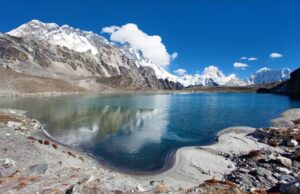
Six main lakes are usually counted along the valley, part of a wider system of smaller lakes and ponds. From the helicopter, you can often pick them out one after another:
- First lake, Longponga (about 4,690 m): The smallest of the main lakes, near the southern end of the chain.
- Second lake, Taujung (about 4,710 m): A deep blue lake beside the trekking trail.
- Third lake, Dudh Pokhari (about 4,750 m): The famous turquoise lake with Gokyo village on its shore and Gokyo Ri above.
- Fourth lake, Thonak (about 4,840 m): The largest and deepest lake in the system, with Cho Oyu rising beyond.
- Fifth lake, Ngozumpa (about 4,980 m): A remote lake near the glacier’s edge, close to the viewpoint known as Scoundrel’s Viewpoint.
- Sixth lake, Gyazumpa (around 5,000 m): The most remote, towards the head of the valley and the walls of Cho Oyu.
Our guide to Gokyo Ri and the Fifth Lake describes the upper lakes in detail.
Cho Oyu, the Turquoise Goddess
It is fitting that the mountain at the head of the turquoise lakes is named Cho Oyu, a name usually translated from Tibetan as “Turquoise Goddess”. At 8,188 m, it is the world’s sixth-highest mountain, straddling the border between Nepal and Tibet, and it was first climbed in the mid-twentieth century. Its vast southern walls fill the view from the upper Gokyo Valley, and from the helicopter you can see how its glaciers feed the Ngozumpa Ice, which shapes the whole valley.
For the Sherpa people, the mountains of the Khumbu are sacred, and Cho Oyu, like Khumbila and Everest itself, is part of a spiritual landscape explained in our overview of Buddhism in Tibet. Climbers who dream of the big peaks can read our Ama Dablam expedition guide and the latest NMA peak permit updates.
Gokyo Ri: The Viewpoint Above the Lakes
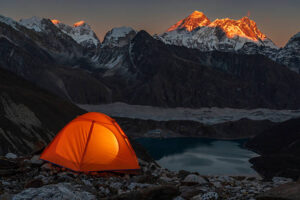
From the air, you will see the rounded brown summit of Gokyo Ri rising above the third lake. Trekkers climb it at sunrise for one of the finest panoramas in the Himalaya, with Everest, Lhotse, Makalu and Cho Oyu above the lakes and the glacier. It is often compared with Kala Patthar, the classic viewpoint above Everest Base Camp, and with the climb of Chhukung Ri in the Imja valley. A helicopter cannot take you to its summit, but flying past it shows you exactly why trekkers spend a week walking here.
Your Gokyo Helicopter Tour, Step by Step
Times vary with the weather, the day’s rules, and the number of passengers, but a typical flight unfolds like this.
Early Morning: Pickup in Kathmandu
Our team collects you from your hotel around dawn and drives you to the domestic terminal for check-in, weighing, and a safety briefing. Bring your passport and dress warmly.
Kathmandu to Lukla
The helicopter lifts off over the city and flies east for about 45 minutes to an hour, with the snow peaks of the Himalaya lining the northern horizon on clear mornings. At Lukla, it lands briefly to refuel.
Up the Dudh Koshi
From Lukla, the helicopter follows the Dudh Koshi upstream over Phakding and thetrail’s suspension bridges to Namche Bazaar, then past the twin villages of Khumjung and Khunde beneath the sacred peak of Khumbila. To the east, you may glimpse the monastery ridge of Tengboche beneath the spire of Ama Dablam.
Into the Gokyo Valley
Instead of turning east towards Everest, the helicopter heads north into the Gokyo Valley, over the summer pastures of Dole and Machhermo. The valley narrows, the glacier appears, and the first lakes come into view, each a different shade of blue.
Over the Lakes and Gokyo Village
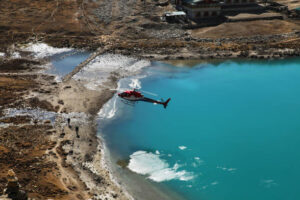
The helicopter flies along the chain of lakes to Gokyo Village and Dudh Pokhari, with Cho Oyu filling the windscreen ahead and Everest visible above the eastern ridges. When conditions allow, it lands near the lakes for a short stop, usually about ten to fifteen minutes; otherwise, it makes a scenic loop over the lakes and the glacier.
Everest or Breakfast on the Way Back
Depending on your tour, the helicopter may continue to the Khumbu Valley for views of Everest, or fly down to the Syangboche ridge for breakfast at the Hotel Everest View, facing Everest, Lhotse,e and Ama Dablam.
Back to Kathmandu
After a final refueling stop in Lukla, the helicopter returns to Kathmandu, where our team drives you back to your hotel, usually by late morning or around midday.
Landing Near Gokyo: What Is Possible
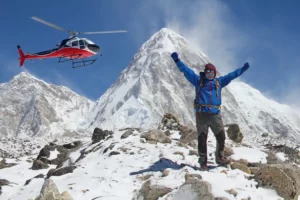
Landing near the Gokyo Lakes is a highlight, but it is never guaranteed. At about 4,800 m, the air is thin, and helicopters can usually take off with only two or three passengers at a time, so larger groups may be shuttled in stages. Landings depend on the rules in force othatday, the weather, ,and the total weight on board, and the pilot always has the final say.
Because you arrive from Kathmandu without acclimatization, the stop near the lakes is kept short. There is time to step out, breathe the cold air, photograph the turquoise water and Cho Oyu, and take in the silence, but not to hike. Climbing Gokyo Ri, for example, takes two to three hours from the village and is only possible for acclimatized trekkers, as explained in our guide to Gokyo Ri vs Kala Patthar.
What You See From the Air
A Gokyo helicopter tour packs an extraordinary range of sights into one morning:
- The Dudh Koshi gorge: Forests, suspension bridges and the trail to Everest far below.
- Namche Bazaar: The horseshoe-shaped Sherpa capital on its hillside.
- Khumbila: The sacred mountain of the Khumbu, home of the region’s protector deity in Sherpa belief.
- Phortse: A quiet village of stone-walled fields across the valley.
- The Ngozumpa Glacier: A huge river of rubble-covered ice, with grey cliffs and pale green meltwater ponds.
- The Gokyo Lakes: Turquoise and blue in autumn and spring, frozen white in midwinter.
- Cho Oyu (8,188 m): The great mountain at the head of the valley, on the border with Tibet.
- Gyachung Kang (7,952 m): One of the highest peaks below eight thousand meters, between Cho Oyu and Everest.
- Everest, Lhotse and Makalu: Rising above the eastern ridges, seen across the glacier.
- Cholatse and Taboche: Sharp ice peaks above the Cho La route.
Our article on Nepal’s eight-thousand-meter peaks introduces the giants on the horizon.
Combining Gokyo and Everest in One Flight
Many travelers want both valleys, and a Gokyo helicopter tour can include both. A combined flight can visit Gokyo Lake,d then cross to the Khumbu Valley for views of Everest Base Camp and the Khumbu Icefall, with a landing at Kala Patthar when permitted, before breakfast at the Hotel Everest View. Because of the extra flying and the altitude limits on passenger numbers, combined flights are often best arranged as a private charter.
For the Everest side, see our Mt Everest by Helicopter Tour, the Everest Helicopter Tour and the Sharing Everest Helicopter Tour with Kala Patthar Landing, and read our guides to the Everest helicopter tour with breakfast, the Kala Patthar landing and what you see at Everest Base Camp. Helicopter tours do not land at Everest Base Camp itself, as explained in our guide to whether a helicopter can land at Everest Base Camp.
Gokyo or Everest Helicopter Tour: Which Is Better?
Both flights are spectacular, but they offer different experiences:
- Gokyo: Turquoise lakes, the Ngozumpa Glacier, and Cho Oyu up close, in a quieter valley with fewer flights.
- Everest: The Khumbu Icefall, Everest Base Camp and the classic close-up of Everest from Kala Patthar.
- Altitude: The landing area near Gokyo is lower than Kala Patthar, although both are high enough to require care.
- Color: Gokyo’s lakes give the flight a unique palette, especially in autumn sunshine.
- Fame: Everest is the world’s most famous mountain; Gokyo is one of the Himalaya’s best-kept secrets.
If you can, combine them. If you must choose, pick Everest for the icon and Gokyo for the beauty. If you are also weighing a trek, our comparisons of the EBC trek or helicopter tour and the helicopter tour vs trek with helicopter return will help. Our guide to the Everest Base Camp helicopter tour describes the Everest flight in detail.
When Are the Lakes Most Turquoise? Best Time for a Gokyo Helicopter Tour
The color of the Gokyo Lakes changes with the seasons and the light, so timing matters.
Autumn (Late September to November)
The best season, with clear skies, stable flying weather, and the lakes at their most vivid turquoise in the morning sun. Read our guide to the Everest Base Camp Trek in October to get a feel for the season.
Spring (March to May)
Warmer and greener lower down, with rhododendrons in the forests. The lakes thaw as spring advances, and clouds build earlier in the day, so early flights are best. See our guide to the Everest Base Camp Trek in April.
Winter (December to February)
Often the clearest skies of the year, with the lakes frozen white and dusted with snow, a magical sight of a very different kind. It is very cold at Gokyo, and snowstorms can ground flights.
Monsoon (June to August)
Cloud and rain make flights less reliable and views uncertain, though the valley is green and the occasional clear morning can be stunning. Our guide to the Everest Base Camp Trek in the monsoon explains the season.
Our guide to the best seasons for an Everest helicopter tour covers every month, and our best time for Everest Base Camp Trek guide explains the region’s weather in detail.
Altitude and Safety
A Gokyo helicopter tour takes you from about 1,400 m in Kathmandu to almost 4,800 m in under two hours, far faster than your body can adapt. Short stops are key to safety, and most healthy passengers feel only mild effects, such as breathlessness when moving, lightheadedness, or a faster heartbeat, which ease quickly as you descend.
- Move slowly on the ground: Walk gently and avoid running or jumping for photos.
- Drink water: Stay hydrated, and avoid alcohol before the flight.
- Tell the crew if you feel unwell: Helicopters on these tours usually carry supplementary oxygen.
- Check with your doctor: Especially if you have heart or lung conditions, are pregnant,t or have had recent surgery.
- Do not plan to stay overnight: Sleeping at Gokyo straight off a helicopter from Kathmandu invites altitude sickness.
Our Acute Mountain Sickness page and our guide to altitude sickness on the Everest Base Camp Trek explain the warning signs.
Helicopter Safety, Weather and Delays
Gokyo flights use light, single-engine helicopters from the AS350 and H125 family, designed for high-altitude work, flown by pilots who know the Khumbu well. Passengers and bags are weighed before departure, because weight decides how many people can land at each site, and pilots fly only in good visibility and calm air, usually in the morning. If the weather is poor, the flight may be delayed, shortened, or moved to another morning, so we recommend booking it early in your stay in Nepal rather than on your last day. We work only with established, registered operators and never ask a pilot to fly in marginal conditions.
Private Charter or Sharing a Seat?
Because fewer travelers fly to Gokyo than to Everest, Gokyo flights are most often arranged as a private charter for your family or group, which gives you flexibility with timing and the flight plan. Depending on demand, it may sometimes be possible to share a flight with other travelers; ask our team about upcoming departures. If you are traveling alone and mainly want Everest, the Sharing Everest Helicopter Tour with Kala Patthar Landing is designed for individual seats.
Rules and Permits
Helicopter flights in the Everest region have sparked important debate. In recent seasons, local authorities and communities in the Khumbu moved to restrict commercial helicopter flights, citing noise over villages and monasteries, disturbance to wildlife, and lost work for porters and lodges. Flights later resumed under agreed conditions, and landing sites, passenger numbers and time on the ground now follow the rules in force on the day. Our guide to Everest helicopter tour restrictions explains the background, and our team confirms the latest arrangements before every flight.
Because the tour flies and may land inside Sagarmatha National Park, park and local entry requirements apply, and our team arranges the necessary paperwork and explains it when you book. Our guide to Everest Base Camp Trek permits explains how the region’s permits work, and our Nepal visa guide covers entry to Nepal.
What to Wear and Bring
- Warm layers: A thermal top, a fleece and a down jacket; it can be well below freezing at Gokyo.
- Hat and gloves: The wind off the glacier is bitter.
- Comfortable shoes: Trainers or light hiking shoes with good grip.
- Sunglasses and sunscreen: The glare from snow, ice, and water is intense.
- Camera or phone: Fully charged, with a spare battery in an inside pocket.
- Small daypack and passport: Space and weight are limited, and you need your passport at the airport.
Our trekking equipment page and Everest Base Camp Trek packing list offer more ideas for cold-weather clothing.
Photographing the Gokyo Lakes From the Air
- Wait for the sun: The turquoise color is strongest when sunlight reaches the water, usually from mid-morning.
- Shoot through clean glass: Hold your lens close to the window to cut reflections.
- Avoid polarising filters on windows: They create rainbow patterns on aircraft windows; use one only on the ground to deepen the lake colors.
- Include the glacier for scale: The grey ice beside the bright lakes tells the story of the valley.
- Use a fast shutter speed: It freezes vibration and movement.
- Look both ways: Cho Oyu, Everest and the lakes may appear on different sides of the aircraft.
Who Is the Gokyo Helicopter Tour For?
- Non-trekkers: See one of the Himalaya’s most beautiful valleys without a week of walking.
- Returning Everest trekkers: See the valley you did not have time to visit on foot.
- Photographers: Colors and perspectives impossible to capture from the trail.
- Families and older travelers: No trekking fitness needed, with short stops at altitude.
- Travelers short on time: The whole experience fits into one morning.
- Families of trekkers: Fly in to see the lakes your loved one is walking to.
Walking to Gokyo: The Gokyo Lakes Trek
If the flight inspires you to return on foot, the Gokyo Lakes Trek takes about twelve days from Kathmandu, climbing gently through Namche, Dole and Machhermo to the lakes and the summit of Gokyo Ri. Experienced trekkers can link Gokyo with Everest Base Camp over the Cho La or take on the full Everest 3 Pass Trek, described in our Everest Three Passes Trek guide, which ends over Renjo La with one of the finest views in the Khumbu. Our Everest Base Camp Trek itinerary guide explains the main route to base camp, which shares its first days with the Gokyo trail. Climbers can add Island Peak Climbing, described in our Island Peak climbing guide, or Lobuche Peak Climbing.
Quieter alternatives include Ama Dablam Base Camp Trekking, introduced in our Ama Dablam Base Camp Trek guide, and the historic Jiri to Everest Trek. For the classic route to base camp, the Everest Base Camp Trek follows the main valley, as described in our guide to how many days the EBC trek takes, our guides to Everest Base Camp Trek difficulty, the Everest Base Camp Trek for beginners, and our 12-week training plan, which also helps you prepare.
Trek and Fly: Comfort Options in the Khumbu
Many travelers combine walking with flying. The Everest Base Camp Luxury Lodge Trek, the Luxury Everest Base Camp Trek with Helicopter Return, the Everest Base Camp Helicopter Trek and the Everest Elite Luxury Heli Trek let you walk up and fly out, as explained in our guide to the Everest Base Camp Trek with helicopter return. For comfort on the trail, our guide to the best luxury lodges in the Everest region compares every option, and the Everest View Trek, described in our guide to the luxury Everest View Trek, offers big views at gentler altitudes.
Families, Couples and Celebrations
A Gokyo helicopter tour is a wonderful way to share the Himalaya with people who cannot trek for two weeks. Families with children, grandparents, and friends can all see the lakes together, although healthy younger children and older travelers should still take altitude seriously; our guides on the Everest Base Camp Trek with kids and the Everest Base Camp Trek over 50 explain how altitude affects different ages. Couples often choose a private flight to celebrate a honeymoon, anniversary, or proposal beside the lakes, and our team is happy to help make the moment special.
Planning Your Nepal Trip Around the Flight
Because the flight depends on morning weather, plan it early in your stay and keep the following days flexible. Gentle activities that are easy to move include sunrise over the Himalaya on Nagarkot Hiking, forest walks on Nagarjun Hiking, two days on the Chisapani Nagarkot Trek, or the heritage highlights of the Classic Nepal Tour. After the mountains, you could raft the Trishuli River Rafting route or look for tigers and rhinos on the Bardia National Park Tour.
Other Great Lakes of the Himalaya
If the Gokyo Lakes capture your heart, the Himalaya has other unforgettable high lakes. The Tilicho Lake Trek visits one of the world’s highest large lakes beneath the Annapurnas, the Langtang Gosaikunda Trek climbs to the sacred Gosaikunda lakes, and Lower Dolpo Trekking reaches the deep blue waters of Phoksundo. In Tibet, the Mount Kailash Tour passes the holy Mansarovar Lake on the way to the Kailash kora.
Sacred Waters: Respecting the Gokyo Lakes
The Gokyo Lakes are holy. Sherpa Buddhists honor them as the dwelling places of protective deities, and Hindu pilgrims walk for days to bathe in them at Janai Purnima. Our guide to Sherpa culture and traditions, our article on the chorten in Tibetan Buddhism, and our stories of Guru Padmasambhava and Milarepa explain the valley’s faith.
During a landing, never touch, wash in, or throw anything into the lakes; keep noise low, leave no litter, and respect the prayer flags and cairns along the shore. Choose licensed operators who follow the agreed rules, and support the valley by trekking and staying in its lodges when you can. Learn more on our responsible tourism page.
Wildlife and Nature of the Gokyo Valley
The Gokyo Valley is a high-altitude wilderness. Herds of Himalayan tahr graze the steep slopes, ruddy shelducks are often seen on the lakes in the warmer seasons, and huge lammergeiers ride the air currents above the glacier. Lower down, the forests near Phortse and Dole shelter musk deer and the colorful Himalayan monal, Nepal’s national bird, and the elusive snow leopard roams the high valleys, though very few people ever see one. From the air, look out for yaks grazing on the summer pastures and for the pale green meltwater ponds scattered across the Ngozumpa Glacier, signs of a landscape that is changing fast.
More Helicopter Journeys and Nepal Adventures
If you love flying in the Himalaya, Nepal has more to offer. The Everest Heli Sherpa Village Walk combines a flight with time in the Sherpa villages, the Annapurna Helicopter Tour flies into the Annapurna Sanctuary, the Langtang Helicopter Tour visits the valley north of Kathmandu, and the Muktinath Yatra by Helicopter flies pilgrims to the sacred temple of Muktinath. For the widest view of the range, the one-hour Everest mountain flight leaves from Kathmandu every clear morning in season.
Around your flight, explore the capital on our Kathmandu Day Tour and, with our Kathmandu sightseeing tips, relax by the lake with our Pokhara sightseeing guide and Paragliding in Pokhara, or head south for a Chitwan Jungle Safari. Further afield, the Luxury Bhutan Tour leads to the Tiger’s Nest Monastery, and the Lhasa to Everest Base Camp Overland Tour shows you Everest from Tibet. Browse our list of the top 50 treks in Nepal for more ideas.
Why Fly to Gokyo With Our Team
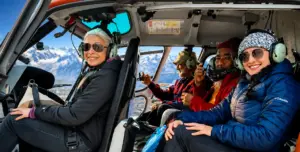
Flying in the high Himalaya takes judgment. Our Kathmandu team works only with established, registered helicopter operators, checks the latest landing rules before every flight, watches the morning weather closely, and keeps you informed from the evening before until you are back at your hotel. We can tailor your Gokyo Lakes Helicopter Tour with an Everest extension or a breakfast stop, combine it with a trek or a Kathmandu stay, and arrange everything from hotel transfers to permits. You can read about our payment options and our responsible tourism commitments before you book.
Common Mistakes to Avoid
- Booking on your last day in Nepal: Leave room to reschedule if the weather is poor.
- Expecting a guaranteed landing: Landings depend on rules, weather, and weight; a scenic loop is the alternative.
- Planning a hike at Gokyo: Stops are short, and climbing Gokyo Ri needs acclimatization.
- Dressing for Kathmandu: It can be well below freezing beside the lakes.
- Rushing at altitude: Move slowly on the ground, even for photos.
- Bringing heavy bags: Weight limits are strict, so travel light.
Frequently Asked Questions About the Gokyo Helicopter Tour
Can you land at the Gokyo Lakes by helicopter?
Often, yes. Short landings near the lakes are possible when rules, weather, and passenger weight allow; otherwise, the helicopter makes a scenic loop over the valley.
How long is the Gokyo helicopter tour?
About four to five hours from hotel pickup to drop-off, including refueling at Lukla and any landings or breakfast stop.
How long can you stay at Gokyo?
Usually around ten to fifteen minutes, because you arrive without acclimatization at nearly 4,800 m.
Can you combine Gokyo and Everest in one flight?
Yes. A combined flight can add Everest views, a Kala Patthar landing when permitted and breakfast at the Hotel Everest View, usually as a private charter.
Will I see Everest on a Gokyo flight?
On clear days, yes. Everest, Lhotse and Makalu rise above the eastern ridges, and Cho Oyu dominates the head of the Gokyo valley.
Which Gokyo lake is the largest?
Thonak, the fourth lake, is the largest and deepest in the system; Dudh Pokhari, the third lake beside Gokyo village, is the most famous.
When are the lakes most turquoise?
In autumn and late spring, in mid-morning sunshine. In midwinter, they are usually frozen white.
Is the Gokyo helicopter tour safe?
With experienced pilots, good weather, and short stops at altitude, it is a well-established tour. Consult your doctor first if you have heart or lung conditions or are pregnant.
Is the tour private or shared?
Gokyo flights are usually private charters, though shared flights may be possible depending on demand.
Which tour should I book?
Our Gokyo Lakes Helicopter Tour visits the lakes in a single morning, and our team can add Everest or breakfast at the Hotel Everest View on request.
Final Thoughts: Turquoise Lakes Beneath Cho Oyu
A Gokyo helicopter tour shows you a side of the Everest region that most visitors never see: a line of sacred turquoise lakes beside the Ngozumpa, often called the longest glacier in Nepal, beneath the vast wall of Cho Oyu, with Everest watching from across the ridges. In a single morning, you see what trekkers walk a week to reach, and you return to Kathmandu with images you will treasure for the rest of your life.
Book our Gokyo Lakes Helicopter Tour and let our team handle every detail, from the hotel pickup to the latest landing rules. Learn more about our company, meet our team, view our company registration and legal documents, then plan your trip or contact us today.
Quick Inquiry
Explore More


