
Lobuche East Peak Climbing: Complete Guide
Lobuche East Peak Climbing: Complete Guide
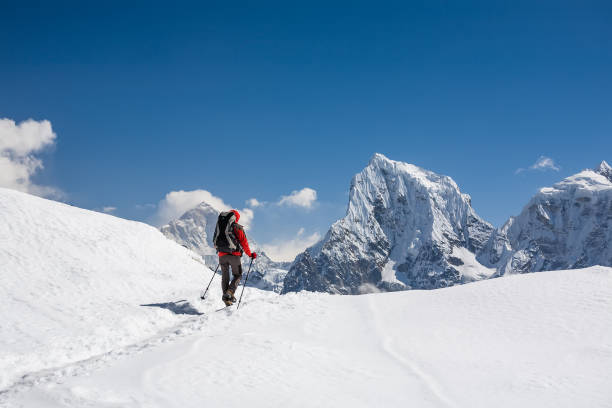
It is three o’clock in the morning at high camp, and the only sounds are the crunch of frozen gravel and the hiss of your breath. Headlamps bob up the rock slabs above you. Hours later, as you clip your ascender onto the fixed rope and kick your crampons into the last steep slope, the sky turns from black to violet to gold, and there it is: Everest, close enough to feel within reach, with Lhotse and Nuptse beside it and the Khumbu Glacier curling far below.
Lobuche East Peak Climbing is one of the most rewarding adventures in the Himalaya. At 6,119 m, Lobuche East rises directly above the Khumbu Glacier and the trail to Everest Base Camp, offering real alpine climbing on rock, snow and ice and one of the finest summit views in Nepal. It is a natural step up for trekkers who want their first serious Himalayan peak, and the climb at the heart of our Lobuche Peak Climbing expedition.
In this complete guide, our Sherpa climbing team explains everything you need to know: where the peak is, its history, a typical itinerary, base camp and high camp, summit day section by section, the true and false summits, difficulty, how it compares with Island Peak, skills and training, gear, the best season, permits, safety and how to prepare.
The Short Answer: What Is Lobuche East Peak Climbing?
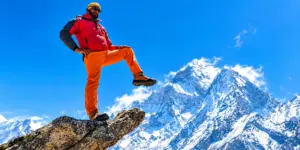
Lobuche East Peak Climbing takes you to a 6,119 m trekking peak above the Khumbu Glacier, graded PD+, via rocky slabs, a 45–50° snow and ice slope on fixed ropes and an exposed summit ridge. Most itineraries take 17 to 18 days, including Everest Base Camp for acclimatisation, with a climbing permit and licensed guide.
You don’t need to be an experienced mountaineer, but you do need excellent fitness, good acclimatisation, basic training in crampons, ice axe, and fixed ropes, and a head for heights on the final ridge.
Lobuche East at a Glance
- Summit altitude: 6,119 m (20,075 ft); some maps show slightly lower figures.
- Location: Above Lobuche village and the Khumbu Glacier, in Sagarmatha National Park.
- Grade: Usually PD+ on the Alpine scale, more technical than Island Peak.
- Standard route: The South-East Ridge.
- Base camp: Around 4,950 to 5,000 m, on the slopes above Lobuche.
- High camp: Around 5,300 to 5,600 m, on rocky ground below the slabs.
- Summit day: Usually 8 to 12 hours, starting in the early hours.
- Technical sections: Rock slabs, a glacier, a steep snow and ice slope on fixed ropes and an exposed ridge.
- Duration: Around 17 to 18 days from Kathmandu, including Everest Base Camp and Kala Patthar.
- Best seasons: Spring (April to May) and autumn (October to November).
- Permits: A climbing permit, the Sagarmatha National Park permit and the local municipality permit.
- Our expedition: Lobuche Peak Climbing.
Where Is Lobuche East?
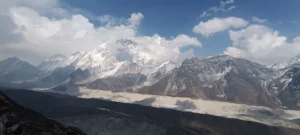
Lobuche East stands in the Khumbu Himal, on the western side of the Khumbu Glacier, south-west of Pumori and directly above the trekking village of Lobuche, at about 4,910 m. Every trekker on the Everest Base Camp Trek walks beneath its rocky flanks on the way to Gorakshep, and its snowy summit ridge is clearly visible from the trail near Thukla and Dughla.
The mountain has two main summits along the same ridge system: Lobuche East, the popular trekking peak, and Lobuche West, a separate, more difficult expedition peak. When climbers talk about climbing Lobuche, they almost always mean Lobuche East.
Lobuche East vs Lobuche West
- Lobuche East (6,119 m): A trekking peak with a well-established route on the South-East Ridge, climbed by guided teams every season.
- Lobuche West (around 6,145 m): A separate expedition peak, reached along a long, exposed and serious ridge, rarely climbed and requiring a different permit.
This guide focuses entirely on Lobuche East, the peak climbed on our expedition.
A Short History of Lobuche East
Lobuche East was first climbed in the late twentieth century by the American climber Laurence Nielson and Ang Gyalzen Sherpa, via the South-East Ridge that most teams still follow today. Since then, it has become one of Nepal’s most popular trekking peaks, valued for its technical interest, its accessible location on the Everest trail, and its extraordinary summit views.
In spring, many Everest expeditions also use Lobuche East as an acclimatisation climb, sleeping high on its slopes instead of making extra trips through the Khumbu Icefall so that the route can be busy in April. Our article on Nepal’s eight-thousand-metre peaks introduces the giants that surround it.
Why Climb Lobuche East?
- A real alpine climb: Rock, snow, ice, fixed ropes and an exposed ridge, a true taste of Himalayan mountaineering.
- One of the finest summit views in Nepal: Everest, Lhotse, Nuptse, Ama Dablam and Pumori surround you.
- A step up from trekking: Ideal for strong trekkers ready for their first technical summit.
- Built-in acclimatisation: The approach follows the Everest Base Camp trail, with Kala Patthar before the climb.
- Preparation for bigger goals: A training ground for expedition peaks such as Ama Dablam and, for some, the eight-thousanders.
A Typical Lobuche East Itinerary
Here is how a typical 17- to 18-day Lobuche East Peak Climbing itinerary unfolds. Our trip page has the exact day-by-day plan for our departures, and our team can adapt it to your experience and the season.
- Day 1, arrive in Kathmandu (about 1,400 m): Airport welcome, gear check and briefing.
- Day 2, fly to Lukla and trek to Phakding: Fly to Lukla, then take an easy walk to Phakding.
- Day 3, trek to Namche Bazaar (about 3,440 m): Up the Dudh Koshi to Namche Bazaar.
- Day 4, acclimatisation in Namche: Hike to Hotel Everest View and Khumjung.
- Day 5, trek to Tengboche (about 3,860 m): To the great Tengboche monastery.
- Day 6: Trek to Dingboche (about 4,410 m), past Pangboche to Dingboche.
- Day 7, acclimatisation in Dingboche: Climb Nangkartshang for views of Makalu and Island Peak.
- Day 8, trek to Lobuche (about 4,910 m): Past the Thukla memorials to Lobuche.
- Day 9, Gorakshep and Everest Base Camp: Trek to Gorakshep and Everest Base Camp, then return to Gorakshep.
- Day 10, Kala Patthar and Lobuche Base Camp: Sunrise on Kala Patthar, then down to Lobuche and up to Everest Base Camp.
- Day 11, training and move to high camp: Skills practice, then the climb to high camp.
- Day 12, summit day: Climb to the summit, then descend to base camp or Lobuche.
- Day 13, reserve day: A spare day for weather or a second summit attempt.
- Days 14 to 16, trek down to Lukla: Via Pheriche, Pangboche, and Namche.
- Day 17, fly to Kathmandu: Celebrate with a dinner after the expedition.
- Day 18, departure: Transfer to the airport.
Our Everest Base Camp Trek itinerary and Everest Base Camp Trek distance describe the approach in more detail.
The Approach Trek
The first week of the expedition is the classic Everest trek, and it is far more than a warm-up. You walk through Sherpa villages and pine forests, cross high suspension bridges, visit monasteries, and gradually gain altitude with acclimatisation days in Namche and Dingboche. Highlights include the monastery at Tengboche, described in our guide to Tengboche Monastery, the Mani Rimdu festival, and views of Ama Dablam; our guide to Sherpa culture and traditions also explains the people who make the Khumbu so special.
Visiting Everest Base Camp and climbing Kala Patthar before the peak gives your body time at over 5,000 m, which greatly improves your chances on summit day. If you have more time, walking in from the lower hills on the Jiri to Everest Trek or the Everest Base Camp Trek by Road adds even more gradual acclimatisation. Our guide to what you see at Everest Base Camp shows what awaits.
Who Can Climb Lobuche East?
Lobuche East Peak Climbing suits a wide range of determined adventurers:
- Strong trekkers ready for a first technical peak: Especially those who have already trekked above 5,000 m.
- Island Peak summiteers: Looking for a more technical second summit.
- Future expedition climbers: Preparing for peaks such as Ama Dablam or an eight-thousander.
- Older climbers: Fit climbers in their fifties and sixties can reach the summit with good preparation; our guide to the Everest Base Camp Trek over 50 has useful advice on altitude and recovery.
- Groups of friends: Who want a shared challenge beyond the classic trek.
It is not suitable for children or for anyone with serious heart or lung conditions, and everyone should see a doctor before booking. Our guide to how many days the EBC trek takes explains why extra days on the approach improve your chances.
Food, Water and Camp Life
Life on a Lobuche East Peak Climbing expedition combines comfortable teahouse nights on the approach with a few nights under canvas at base camp and high camp. In the lodges, you eat hearty dal bhat, noodle soups, potatoes and Tibetan bread; at the camps, our cooks prepare hot, filling meals and endless tea and soup, which matter at altitude, where appetite often drops. Drink three to four litres of treated water a day, eat even when you are not hungry and keep your water bottles inside your sleeping bag at night so they do not freeze. Before the climb, some teams hold a short puja ceremony at base camp, asking the mountain for safe passage, a tradition rooted in the faith described in our overview of Buddhism in Tibet and the teachings of masters such as Milarepa.
Lobuche Base Camp and High Camp
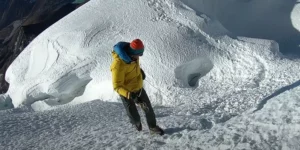
Lobuche Base Camp lies on grassy, rocky slopes above Lobuche village, around 4,950 to 5,000 m, with views across the Khumbu Glacier. Our crew sets up sleeping tents, a dining tent and a kitchen, and the cooks prepare hot, hearty meals.
From base camp, a steep trail over boulders and moraine climbs to high camp, at around 5,300 to 5,600 m, on rocky ground below the slabs. It is a cold, windy place with limited space, so camp is simple: tents, warm food and an early night before the alpine start. Some itineraries go directly from Lobuche village to high camp, depending on conditions and the group.
Summit Day, Section by Section
Summit day is long and demanding, usually 8 to 12 hours from high camp to the summit and back down. Here is how it usually unfolds on the South-East Ridge.
The Alpine Start
You wake around midnight to two o’clock, drink hot tea, eat a light breakfast and leave high camp by headlamp. Starting early means firmer snow, less risk of rockfall and time to return before the afternoon wind and cloud.
The Rock Slabs
The route begins on broad, steepening rock slabs and mixed ground, sometimes covered in snow or ice. You scramble with care, using your hands in places, and in icy conditions your guide may rope the team together.
The Crampon Point and the Glacier
At the top of the rock, usually around 5,800 m, you put on crampons and continue onto snow and a short glacier section, roped to your guide and following the route line.
The Snow and Ice Slope
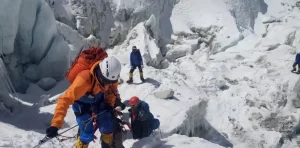
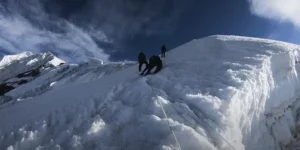
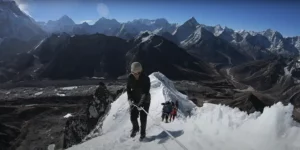
The crux of the climb is a steep snow and ice slope of around 45 to 50 degrees, climbed on fixed ropes with an ascender, or jumar, clipped to the line. It is strenuous at this altitude, and steady breathing, small steps and good crampon technique are the key.
The Summit Ridge
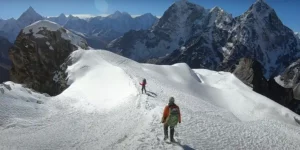
Above the slope, an exposed, sometimes corniced ridge leads towards the summit. The views open in every direction, but this is where concentration matters most: stay clipped in, follow your guide and take your time.
The Descent
The descent follows the same route, abseiling or arm-wrapping down the steep slope on the fixed ropes, then carefully down the slabs to high camp. Many accidents happen on the way down, when climbers are tired, so it demands as much attention as the ascent. After a rest, you continue to base camp or Lobuche.
True Summit or False Summit?
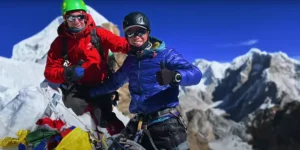
Lobuche East has a false summit and a true summit, a short distance apart along the ridge. Reaching the true summit means descending into an exposed notch and crossing a narrow, often corniced section of ridge, which adds time, technical difficulty and risk. For that reason, many guided teams make the false summit their high point, especially in deep snow, strong wind or late in the day, while others continue to the true summit when conditions, time and the team’s skills allow. Your guide makes the final decision on the day, based on safety.
The View From the Top
The summit view is one of the main reasons climbers choose Lobuche East. On a clear morning, you see:
- Everest (8,849 m): Directly ahead across the Khumbu Glacier, with its summit pyramid clearly visible.
- Lhotse and Nuptse: The great wall of the Everest massif.
- Makalu: The world’s fifth-highest mountain, on the eastern horizon.
- Ama Dablam: The elegant spire above the Imja valley.
- Pumori: The beautiful pyramid above Kala Patthar.
- Cholatse and Taboche: Sharp ice peaks close at hand.
- The Khumbu Glacier: A grey river of ice winding down to Everest Base Camp and the Khumbu Icefall.
Many climbers say the view rivals or surpasses Kala Patthar and Gokyo Ri, the Khumbu’s two classic viewpoints.
How Difficult Is Lobuche East?
Lobuche East Peak Climbing is usually graded PD+ on the Alpine scale, meaning a fairly difficult climb with real technical sections, and some operators rate it slightly higher in icy conditions. The challenges combine:
- Altitude: Above 6,000 m, there is less than half the oxygen of sea level, and every step is slow.
- Technical terrain: Rock slabs, a steep snow and ice slope and an exposed ridge.
- Exposure: The summit ridge has big drops on both sides.
- Length: A long summit day, often in extreme cold before sunrise.
- Weather: Wind and fresh snow can make the route much harder or force a turnaround.
It is more technical than Island Peak and far more technical than the Khumbu trekking routes, but it is well within reach for fit, well-acclimatised climbers with good basic skills and an experienced guide. Our honest look at Everest Base Camp Trek difficulty explains the trekking part of the challenge.
Lobuche East vs Island Peak
Island Peak and Lobuche East are the two most popular trekking peaks in the Everest region. Here is how they compare:
- Altitude: Island Peak is slightly higher, at about 6,189 m; Lobuche East is about 6,119 m.
- Technical difficulty: Lobuche East is generally more technical, with rock slabs and a more exposed ridge; Island Peak has a steep headwall and crevasses crossed by ladders.
- Views: Lobuche East looks straight at Everest across the Khumbu Glacier; Island Peak faces the giant south face of Lhotse.
- Approach: Lobuche East is climbed from the Everest Base Camp trail; Island Peak from the quieter Imja valley via Chhukung.
- Experience: Many climbers climb Island Peak first, then return for Lobuche East.
Our Island Peak climbing guide and our Island Peak Climbing expedition explain the alternative, and strong climbers can combine both peaks in one trip.
Do You Need Climbing Experience?
You do not need to be an experienced mountaineer to climb Lobuche East, but previous experience helps a great deal. Ideally, you will have:
- High-altitude trekking experience: Such as the Everest Base Camp Trek or a trek over 5,000 m.
- Basic mountaineering skills: Walking in crampons, using an ice axe and climbing on fixed ropes.
- Comfort with exposure: A steady head on steep, airy terrain.
- Excellent fitness: The stamina for long, cold, high days.
If you have never used crampons or an ice axe, take a basic mountaineering course or a few days of winter climbing at home before you travel. First-time Himalayan trekkers should read our guide to the Everest Base Camp Trek for beginners.
Pre-Climb Training at Base Camp
Before the summit push, your climbing guide runs a training session at base camp or high camp to practise the skills you will need:
- Fitting and walking in crampons: On snow, ice and rock.
- Using an ice axe: For balance and self-arrest.
- Climbing on fixed ropes: Clipping in, moving the ascender and passing anchors.
- Abseiling: Using a descender or arm-wrap technique on steep ground.
- Knots and safety checks: Harness, carabiners and buddy checks.
Even experienced climbers benefit from this practice, because the cold, the altitude and bulky gloves make familiar skills harder.
Acclimatisation: The Key to the Summit
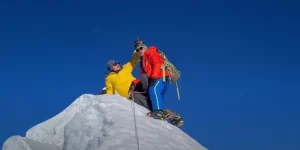
Most failed summit attempts on Lobuche East are caused by altitude, not technical difficulty. A good itinerary climbs gradually, with acclimatisation days in Namche and Dingboche, and visits Everest Base Camp and Kala Patthar at over 5,000 m before the climb. By the time you reach high camp, your body should have spent more than a week adapting.
Tell your guide early about headaches, nausea, dizziness or unusual tiredness; our guides check every climber’s health daily, including oxygen levels. Read our Acute Mountain Sickness page and our guide to altitude sickness on the Everest Base Camp Trek before you go.
Training and Fitness at Home
Start preparing at least four to six months before your expedition. Build endurance with long hikes on hilly terrain carrying a loaded pack, stair climbing, cardio such as running, cycling or swimming, and strength training for your legs and core. If you can, practise using crampons and an ice axe, and do some scrambling to get comfortable on rock. Our 12-week training plan is a good foundation; extend it and add heavier loads and longer days for the climb.
Gear for Lobuche East
You need full mountaineering equipment, much of which you can rent in Kathmandu or Namche. Your guide will check everything before the climb.
- Mountaineering boots: Insulated double boots suitable for 6,000 m, compatible with crampons.
- Crampons: Fitted to your boots before the trek.
- Ice axe: A general mountaineering axe.
- Harness: With locking carabiners and slings.
- Ascender and descender: For the fixed ropes and abseils.
- Helmet: For rockfall and falling ice.
- Warm layers: Thermal base layers, fleece, a heavy down jacket and a windproof, waterproof shell.
- Gloves and mitts: Liner gloves plus warm insulated mitts.
- Headlamp: With spare batteries; lithium batteries last longer in the cold.
- Glacier glasses and goggles: Essential against glare and wind.
- Sleeping bag: Rated to around minus twenty degrees Celsius for base camp and high camp.
For the trekking part of the trip, see our Everest Base Camp Trek packing list and our trekking equipment page.
Best Time to Climb Lobuche East
Spring (April to May)
The most popular season, with warmer temperatures and stable weather. The route can be busy in April, when Everest expeditions use it for acclimatisation. Read our guide to the Everest Base Camp Trek in April.
Autumn (October to November)
Clear skies and excellent views, but colder nights and summit days, especially in November. Read our guide to the Everest Base Camp Trek in October.
Winter and Monsoon
Winter brings extreme cold and wind, and the monsoon brings clouds, rain at lower altitudes and fresh snow higher up, so neither is recommended for a first climb. Our guide to the Everest Base Camp Trek in the monsoon explains the summer season, and our best time for Everest Base Camp Trek guide covers every month.
Permits and Rules
Three permits are needed, and our team arranges them all:
- Lobuche East climbing permit: Issued under Nepal’s trekking-peak system.
- Sagarmatha National Park entry permit: Checked at Monjo.
- Khumbu Pasang Lhamu Rural Municipality permit: Required to enter the local municipality area.
Climbs are organised through registered agencies and led by licensed climbing guides; solo climbing is not allowed. Climbers must follow waste and environmental protection rules, including any garbage deposit in force. Rules for trekking peaks are updated from time to time, so read our article on NMA peak permit updates, our guide to Everest Base Camp Trek permits and our Nepal visa guide. You can view our company registration and legal documents online.
Safety on Lobuche East
Safety underpins every expedition we run. On Lobuche East, it rests on:
- Experienced climbing guides: Licensed professionals who know the route and its conditions.
- Proper acclimatisation: A gradual itinerary and daily health checks.
- Training and equipment checks: Before summit day.
- Turnaround times: If the team has not reached the top by a set time, or conditions worsen, the guide will turn back.
- Fixed ropes and safe technique: Stay clipped in on the slope and ridge, especially on the descent.
- Rockfall awareness: Wear your helmet on the slabs and move quickly through exposed sections.
- Cold protection: Keep your fingers and toes moving, and tell your guide immediately if you lose feeling.
Our Lobuche Peak Climbing expedition is led by licensed climbing guides who know this route in every season. In an emergency, helicopters can reach Lobuche and Pheriche in good weather, and medical help is available at the Pheriche aid post. Our guide to helicopter rescue in the Everest region explains how evacuation works.
Insurance for Lobuche East
Your travel insurance must cover mountaineering on a trekking peak to at least 6,500 m, helicopter evacuation and medical treatment. Many standard travel policies exclude climbing with ropes, ice axes and crampons, so check the wording carefully and carry your policy number and the insurer’s 24-hour assistance number. Share them with your guide before the trek.
Combining Lobuche East With Other Adventures
Lobuche East fits beautifully into a longer Khumbu journey:
- Island Peak and Lobuche East: Two summits in one expedition, combining Island Peak Climbing with Lobuche, often with the Kongma La pass in between, described in our guide to Chhukung Ri and the Chhukung valley.
- Gokyo and the Cho La: Add the turquoise lakes of the Gokyo Lakes Trek and cross the Cho La Pass to Lobuche.
- The three passes: Experienced climbers can link the peak with the Everest 3 Pass Trek, described in our Everest Three Passes Trek guide, and end at Renjo La Pass.
- A helicopter return: Fly back after the summit instead of walking down, as explained in our Everest Base Camp Trek with helicopter return guide.
After Lobuche East: Bigger Goals
For many climbers, Lobuche East is a stepping stone. The next step might be Mera Peak Climbing, Nepal’s highest trekking peak, which is less technical but higher and more remote. Experienced climbers often aim next for Ama Dablam, one of the world’s most beautiful mountains. Read our Ama Dablam expedition guide and our answers to common questions about climbing Ama Dablam. Trekkers who want to see Ama Dablam up close without climbing can choose Ama Dablam Base Camp Trekking, described in our Ama Dablam Base Camp Trek guide.
Helicopter and Comfort Options
A Lobuche East Peak Climbing expedition can be made more comfortable or shorter. On the approach, the best lodges of the lower Khumbu offer en-suite rooms and warm beds, as described in our guide to the luxury Everest Base Camp Trek. After the summit, a helicopter flight back to Kathmandu, when weather and the rules in force allow, saves three days of walking; our Luxury Everest Base Camp Trek with Helicopter Return, Everest Base Camp Helicopter Trek and Everest Elite Luxury Heli Trek show how trekking and flying combine. Read about Everest helicopter tour restrictions, the best seasons for an Everest helicopter tour and the Kala Patthar landing to understand how flights in the region work today.
Other Climbs and High Passes in Nepal
Nepal is full of challenges for climbers and trekkers who love high places. Around the Annapurnas, the Annapurna Circuit Trek crosses Thorong La, and the Tilicho Lake Trek visits one of the world’s highest large lakes. The Manaslu Circuit Trek crosses the Larke Pass, the Kanchenjunga Base Camp Trek explores the far east, and the Upper Mustang Trek leads to the old kingdom of Lo. Beyond Nepal, Bhutan’s Snowman Trek is one of the toughest treks on Earth, as we compare it to the Everest Base Camp Trek in our guide. Guide and permit rules vary by region, as explained in our article on Nepal’s mandatory guide rules.
Photography on Lobuche East
- Sunrise on the ridge: The best light often arrives as you reach the ridge; keep your camera or phone in an inside pocket and ready.
- Stay safe first: Only take photos where you are clipped in and stable.
- Keep batteries warm: The cold drains them quickly; lithium batteries help.
- Shoot the Khumbu Glacier: Its curves make a stunning foreground for Everest.
- Capture base camp life: Tents, prayer flags and your crew make memorable images.
Responsible Climbing
The Khumbu is a fragile, sacred landscape. Carry all rubbish back down, use toilets at camps, respect the prayer flags and cairns on the route and follow the garbage rules for trekking peaks. Our porters and climbing staff carry fair loads, are properly equipped and are insured. Learn more on our responsible tourism page, and read about the region’s faith in our articles on the chorten in Tibetan Buddhism and Guru Padmasambhava.
Not Ready to Climb? Treks in the Shadow of Lobuche
If a technical peak is not right for you yet, the Khumbu offers wonderful treks with similar views. The classic Everest Base Camp Trek passes beneath Lobuche East, the Everest View Trek offers Everest views at gentler altitudes, and the Everest Base Camp Luxury Lodge Trek adds comfort to the journey, as described in our guide to the luxury lodges in the Everest region. For an aerial view, the Mt Everest by Helicopter Tour, the Everest Helicopter Tour, the Gokyo Lakes Helicopter Tour, and the Everest mountain flight show you the high Himalaya in the morning.
Before and After the Expedition
Before or after the climb, explore Kathmandu on our Kathmandu Day Tour, guided by our Kathmandu sightseeing tips, relax by the lake with our Pokhara sightseeing guide and Paragliding in Pokhara, or recover in the lowlands on a Chitwan Jungle Safari or the Bardia National Park Tour. Gentle options near the capital include Nagarkot Hiking, and the Classic Nepal Tour brings together the country’s heritage. Further afield, the Luxury Bhutan Tour leads to the Tiger’s Nest Monastery, and the Lhasa to Everest Base Camp Overland Tour shows you Everest from Tibet. Browse our list of the top 50 treks in Nepal and our trekking in Nepal guide for more ideas.
Common Mistakes on Lobuche East
- Rushing acclimatisation: Most failed attempts stem from altitude, not technique.
- Arriving without basic skills: Practise crampons, ice axe and fixed ropes before you travel.
- Untested boots: Break in your mountaineering boots and fit your crampons before the trek.
- Cold hands and feet: Pack warm mitts and spare socks, and tell your guide if you lose feeling.
- Ignoring the turnaround time: The summit is optional; getting down is mandatory.
- Wrong insurance: Make sure your policy covers climbing to 6,500 m and helicopter rescue.
Frequently Asked Questions About Lobuche East Peak Climbing
How high is Lobuche East?
About 6,119 m (20,075 ft), although some maps show slightly lower figures.
How difficult is Lobuche East?
It is usually graded PD+ on the Alpine scale, with rock slabs, a 45–50° snow and ice slope on fixed ropes and an exposed ridge. It is more technical than Island Peak.
Do I need climbing experience?
Previous high-altitude trekking and basic crampon, ice axe and fixed-rope skills are strongly recommended. Your guide runs training before the climb.
What is the false summit?
A high point on the ridge a short distance before the true summit. Many teams turn back there because reaching the true summit involves an exposed, corniced section of ridge.
Which is harder, Lobuche East or Island Peak?
Lobuche East is generally more technical, with rock slabs and a more exposed ridge, while Island Peak is slightly higher.
How many days does the climb take?
Around 17 to 18 days from Kathmandu, including the trek to Everest Base Camp and Kala Patthar for acclimatisation.
What is the best time to climb Lobuche East?
Spring, especially April and May, and autumn, especially October and November.
Do I need a permit and a guide?
Yes. You need a climbing permit, the Sagarmatha National Park permit and the local municipality permit, and you must climb with a licensed guide through a registered agency.
Can I rent climbing gear?
Yes. You can rent boots, crampons, harnesses, and other gear in Kathmandu or Namche. Fit them before the trek.
Which expedition should I book?
Our Lobuche Peak Climbing expedition includes the Everest Base Camp approach, training, licensed climbing guides and full camp support.
Final Thoughts: Your First Taste of Himalayan Alpinism
Lobuche East Peak Climbing offers something special: a genuine alpine climb on rock, snow, and ice; a summit ridge facing Everest; and the satisfaction of standing above 6,000 m with the whole Khumbu at your feet. It demands fitness, patience and respect for the mountain, and it rewards you with one of the finest views in the Himalaya and a new confidence for bigger goals.
Join our Lobuche Peak Climbing expedition and let our experienced Sherpa climbing guides lead you safely to the summit. Learn more about our company, meet our team, then plan your trip or contact us today.
Quick Inquiry
Explore More


