
Everest Helicopter Tour with Breakfast at Everest View
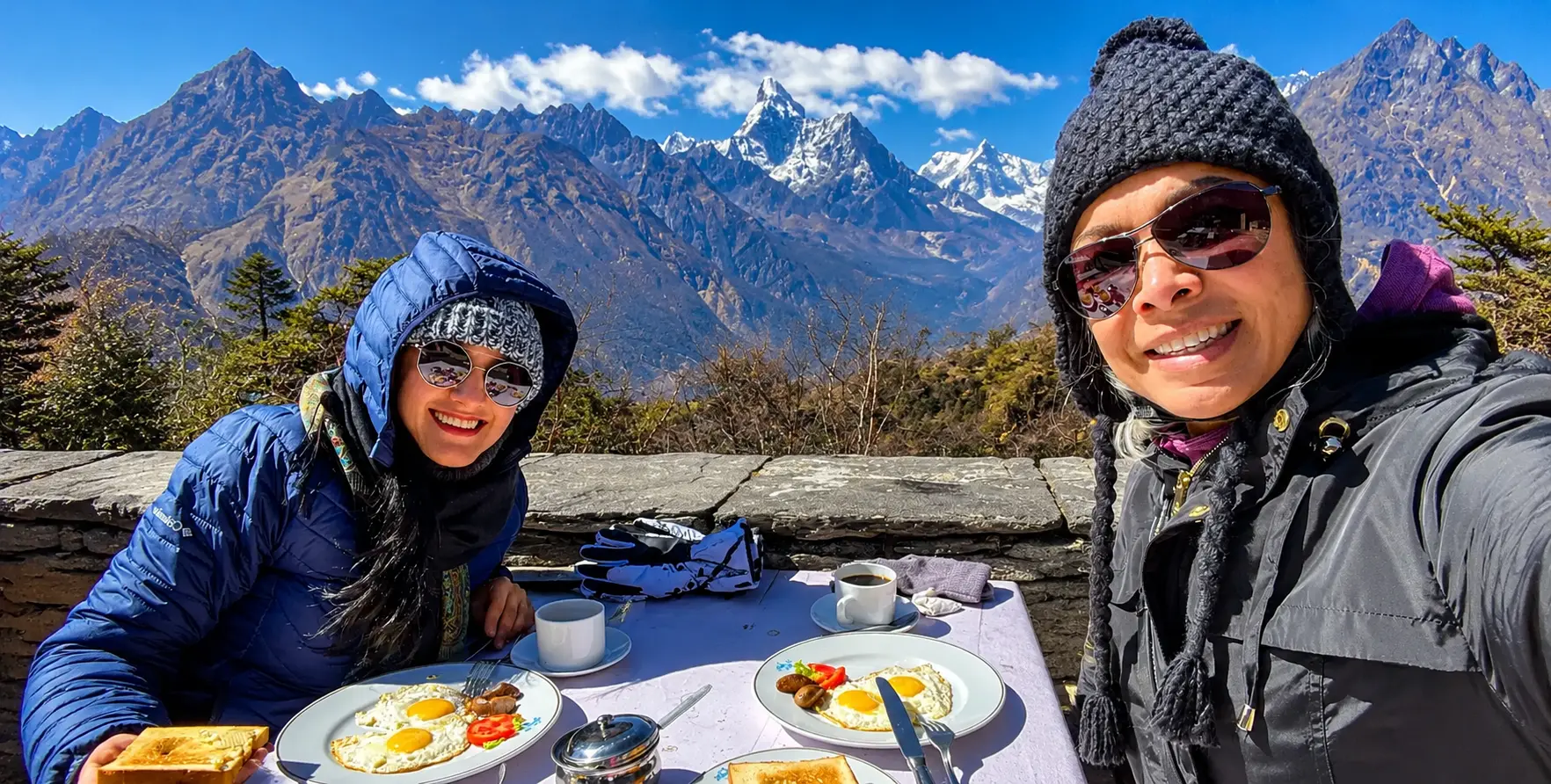
The coffee is hot, the air is crisp, and the sun is warming the stone terrace. Across the valley, framed by the long ridge of Nuptse and Lhotse, Everest’s dark summit trails a plume of snow into a deep blue sky. To your right, the elegant spire of Ama Dablam catches the light. Just over two hours ago, you left Kathmandu. By lunchtime, you will be back. In between, you’ll have breakfast with the world’s highest mountain.
An Everest Helicopter Tour with Breakfast at Everest View at the Hotel Everest View is the most spectacular morning you can spend in Nepal. In a few hours, without trekking a single day, you fly up the Khumbu Valley past Namche Bazaar and Tengboche, see the Khumbu Icefall and Everest at close range, land at the famous viewpoint of Kala Patthar when permitted, and then sit down to breakfast at one of the most famous hotels in the Himalaya. It is the heart of our Mt Everest by Helicopter Tour.
In this guide, our team explains everything you need to know: how the day unfolds hour by hour, what you see from the air and from the breakfast terrace, how the Kala Patthar landing works, private and sharing options, altitude and safety, the current rules, the best season, what to wear and how to make the most of a morning above the clouds.
The Short Answer: What Is an Everest Helicopter Tour with Breakfast?
An Everest Helicopter Tour with Breakfast is a half-day flight from Kathmandu into the Khumbu: via Lukla to Kala Patthar, landing when permitted, or over Everest Base Camp, then breakfast on the terrace of the Hotel Everest View at about 3,880 m, facing Everest and Ama Dablam. You return to Kathmandu around midday.
It requires no trekking and no acclimatization, suits most healthy travelers of any age, and offers the closest views of Everest you can get in a single morning.
Everest Helicopter Tour with Breakfast at a Glance
- Duration: About four to five hours, from hotel pickup to drop-off.
- Departure: Early morning from the domestic terminal of Kathmandu Airport.
- Route: Kathmandu, Lukla, the Khumbu Valley, Kala Patthar or an overflight of Everest Base Camp, the Hotel Everest View, and back.
- Highest landing: Kala Patthar, about 5,545 m, for around ten minutes when weather and rules permit.
- Breakfast stop: The Hotel Everest View on the Syangboche ridge, about 3,880 m, usually for thirty minutes to an hour.
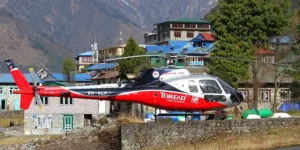
- Helicopter: A light, high-altitude helicopter carrying up to five passengers on the lower legs, and fewer at the highest landing sites.
- Options: Your own private helicopter or a seat on a shared tour.
- Best seasons: Autumn and spring, with good flying weather in winter mornings too.
- Who it suits: Non-trekkers, families, older travelers, photographers, and anyone short on time.
- Our tour: The Mt Everest Helicopter Tour.
What Is the Everest Helicopter Tour with Breakfast?
For most travelers, reaching the high Khumbu means a two-week walk on the Everest Base Camp Trek. A helicopter tour turns that journey into a morning. You fly from Kathmandu to Lukla, refuel, then follow the trekking trail up the Dudh Koshi and Imja valleys to the foot of Everest, before landing for breakfast at the Hotel Everest View on your way back down.
The breakfast stop is what makes this tour special. Instead of a quick touch-down, you have time to sit, eat, drink coffee an, and soak in the mountains you have just flown past, from one of the most celebrated terraces in the Himalaya. It gives the morning a rhythm: the excitement of the high flight, then a calm, unforgettable meal with Everest on the horizon.
The Hotel Everest View: Breakfast in a Legend
Perched on the Syangboche ridge above Namche Bazaar and the Sherpa villages of Khumjung and Khunde, the Hotel Everest View is one of the most famous mountain hotels. A Japanese entrepreneur dreamed of a comfortable hotel where visitors could enjoy the world’s highest mountain, and Sherpa porters carried its materials in at a time when the region had almost no tourist accommodation. Guinness World Records once listed it as the highest-placed hotel in the world.
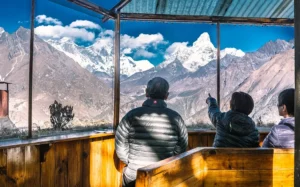
Today, its wood-paneled lounge, wide windows and stone terrace still face Everest across the valley. Trekkers walk up from Namche for tea on their acclimatization day, a smaller number of guests stay overnight, and helicopter visitors arrive for breakfast. Our guide to the Hotel Everest View tells its full story and describes the classic hike from Namche.
Your Day, Hour by Hour
Times vary with the weather, the day’s rules, and the number of passengers, but a typical Everest Helicopter Tour with Breakfast unfolds like this.
Around 5:30 am: Hotel Pickup
Our team collects you from your hotel in Kathmandu and drives you to the domestic terminal for check-in, weighing, and a short safety briefing. Bring your passport.
Around 6:30 am: Takeoff From Kathmandu
The helicopter lifts off over the waking city and heads east. On a clear morning, the snow peaks of the Himalaya line the northern horizon as you cross the green hills and river valleys of the middle mountains.
Around 7:20 am: Refueling at Lukla
After about 45 minutes to an hour, you land at Lukla, the gateway to the Everest region, for a short refueling stop of around ten to fifteen minutes. This is the moment many trekkers’ adventures begin; yours is about to fly far beyond it.
Around 7:40 am: Up the Khumbu Valley
The helicopter follows the Dudh Koshi upstream past Phakding, Namche Bazaar, Tengboche and Pangboche, with Ama Dablam towering beside you, then flies up towards Pheriche and the Khumbu Glacier.
Around 8:00 am: Kala Patthar or Base Camp
When weather and rules allow, the helicopter lands at Kala Patthar, the black rocky ridge above Gorakshep, facing the Everest summit. Because helicopters lose power in thin air, operators often fly larger groups from Pheriche two at a time. You spend around ten minutes at the viewpoint before descending. If a landing is not possible, the helicopter flies over Everest Base Camp and the Khumbu Icefall instead.
Around 8:45 am: Breakfast at the Hotel Everest View
The helicopter flies back down the valley and lands on the Syangboche ridge, close to the hotel. Breakfast is served with a view, on the terrace on sunny mornings or in the warm dining room on cold ones, and you usually have thirty minutes to an hour to eat, take photographs and enjoy the panorama.
Around 10:00 am: Return to Kathmandu
After breakfast, the helicopter flies back to Lukla to refuel, then on to Kathmandu, where our team meets you and drives you back to your hotel, usually by late morning or around midday.
What’s for Breakfast?
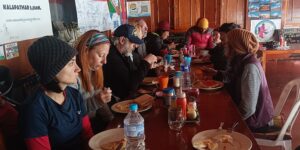
Breakfast at the Hotel Everest View is a simple, hearty mountain breakfast rather than a banquet, but few meals anywhere come with a better view. Expect hot tea and coffee, toast, eggs, potatoes or pancakes, and often fruit, with Nepali dishes sometimes available. Tell us about vegetarian, vegan, or other dietary needs when you book, and we will pass them on.
At 3,880 m, even a short climb of stairs can leave you breathless, so eat slowly, drink plenty of water, and avoid alcohol. If it is cold or windy on the terrace, the dining room’s big windows offer almost the same view in warmth.
What You See From the Air
Every minute of the flight is filled with extraordinary sights:
- The Himalayan range: On clear mornings, a long line of snow peaks to the north as you fly east from Kathmandu.
- Lukla: The famous sloping airstrip clinging to its hillside.
- The Dudh Koshi gorge: Suspension bridges, forests, and the trail to Everest far below.
- Namche Bazaar: The horseshoe-shaped Sherpa capital on its hillside.
- Tengboche Monastery: A red roof on a forested ridge, beneath Ama Dablam.
- Dingboche and Pheriche: Stone-walled fields and the high pastures of the upper valley, described in our guide to Dingboche.
- The Khumbu Glacier: A grey river of ice and rubble leading to the Khumbu Icefall.
- Everest, Lhotse and Nuptse: The great wall of the Everest massif, with Pumori and Changtse beside it.
Our guide to what you see at Everest Base Camp explains the Icefall, Nuptse and the other giants you fly past.
The View From the Breakfast Terrace
The Hotel Everest View terrace faces the Dudh Koshi and Imja valleys, so the whole Everest skyline lies out before you. On a clear morning, you see:
- Everest (8,849 m): Its dark summit pyramid rising above the long ridge of Nuptse.
- Lhotse (8,516 m): The world’s fourth-highest mountain, just to Everest’s right.
- Nuptse (7,861 m): The great wall in front of Everest.
- Ama Dablam (6,812 m): Often called the most beautiful mountain in the world, close and dramatic.
- Thamserku and Kangtega: Glittering ice peaks rising across the valley above Namche.
- Tengboche: The monastery ridge, far below the peaks.
Read more about these mountains in our article on Nepal’s eight-thousand-meter peaks and our story of Ama Dablam.
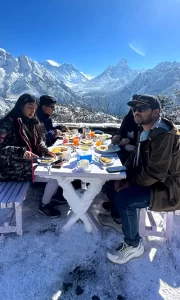
Trekkers and the Hotel Everest View: Walking to Breakfast
Trekkers reach the same terrace in a very different way. On the classic route described in our Everest Base Camp Trek itinerary, they spend an acclimatization day in Namche and climb about 440 m to the Hotel Everest View for tea before returning to sleep lower down. Comparing the two experiences shows what the helicopter gives you and what it cannot: in one morning, you see the same view without the effort, but you miss the slow build-up of villages, monasteries, and mountains that makes the trek so moving.
Many of our guests do both, flying first and trekking later, or trekking and then returning with family by helicopter. If you are curious about Everest Base Camp Trek difficulty, the Everest Base Camp Trek for beginners, our 12-week training plan, how many days the EBC trek takes, or the short Everest Base Camp Trek, we’ll explain what the journey on foot involves.
Kala Patthar Landing: Ten Minutes at 5,545. For many passengers, the highlight of the flight is landing at Kala Patthar, the classic viewpoint above Gorakshep. From here, Everest’s summit pyramid rises clearly above its West Shoulder, with the Khumbu Icefall and Everest Base Camp below you. Our guide to Kala Patthar describes the viewpoint in detail.
Landing above 5,500 m is one of aviation’s most demanding operations. The air is so thin that the helicopter can carry only a few people at a time, and your body has had no time to adjust, which is why the stop lasts only about ten minutes. Shared tours now use a shuttle system from Pheriche, as explained in our guide to the Kala Patthar landing. Helicopter tours do not land at Everest Base Camp itself, as explained in our guide to whether a helicopter can land at Everest Base Camp.
Private Charter or Sharing Tour?
There are two ways to enjoy an Everest Helicopter Tour with Breakfast:
- Your own helicopter: You can book our Mt Everest by Helicopter Tour or Everest Helicopter Tour for your family or group, with flexible timing and a seat for everyone in your party.
- A seat on a sharing tour: The Sharing Everest Helicopter Tour with Kala Patthar Landing lets solo travelers and couples join other passengers on the same flight.
For a longer day on the ground, the Everest Heli Sherpa Village Walk adds a walk through Sherpa villages, and the Gokyo Lakes Helicopter Tour flies to the turquoise lakes beneath Cho Oyu. Our guide to the Everest Base Camp helicopter tour compares the options.
Altitude and Health: Is It Safe?
A helicopter tour takes you from about 1,400 m in Kathmandu to as high as 5,545 m in under two hours, far faster than your body can adapt. Short stays are the key to safety: about ten minutes at Kala Patthar and up to an hour at the Hotel Everest View, which sits at a much lower altitude. Most healthy passengers feel only mild effects, such as breathlessness when moving, a light head, or a faster heartbeat, and these usually ease quickly as you descend.
- Move slowly at the landings: Walk gently and avoid running or jumping for photos.
- Drink water: Stay hydrated and avoid alcohol before and during the tour.
- Tell the crew if you feel unwell: Helicopters on these tours usually carry supplementary oxygen.
- Check with your doctor: Especially if you have heart or lung conditions, are pregnant, or have had recent surgery.
- Do not sleep high straight away: Never plan to spend the night at the Hotel Everest View straight off a helicopter from Kathmandu; in the hotel’s early days, some guests who did so suffered from altitude sickness.
Our Acute Mountain Sickness page and our guide to altitude sickness on the Everest Base Camp Trek explain the warning signs.
Helicopter Safety: Aircraft and Pilots
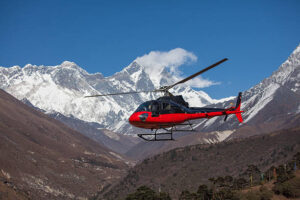
Everest tours fly light, single-engine helicopters from the AS350 and H125 family, designed for high-altitude work and flown by pilots who fly in the Khumbu every season. Before each flight, passengers and bags are weighed, because weight decides how many people can land at each site. Pilots fly only in good visibility and calm air, usually in the morning, and the pilot always has the final say on landings and timing. We work only with established, registered operators and never ask a pilot to fly in marginal conditions.
Weather, Delays and Cancellations
Mountain weather decides everything. Flights leave early because mornings are usually the clearest and calmest part of the day, while clouds and wind often build from late morning. If the weather is bad, the flight may be delayed, shortened, or postponed to another morning. For that reason, we recommend planning the tour early in your stay in Nepal, so there is time to reschedule, and never on the last day before your flight home. Your guide or our office will keep you informed on the morning of the flight.
Best Time for an Everest Helicopter Tour with Breakfast
Helicopters can fly in every season, but some months are far more reliable than others.
Autumn (Late September to November)
The best season, with the clearest skies, crisp air,r and the most reliable flying weather. October and November are outstanding. Read our guide to the Everest Base Camp Trek in October for the season’s atmosphere.
Spring (March to May)
Warm days and rhododendrons in bloom in the lower valleys, with base camp and expedition tents visible from the air in April and May. Clouds build earlier in the day, so early flights matter. See our guide to the Everest Base Camp Trek in April.
Winter (December to February)
Mornings are often clear and calm, with snow-covered landscapes and quiet skies, but it’s very cold at Kala Patthar and on the terrace.
Monsoon (June to August)
Frequent cloud and rain make flights less reliable and views uncertain, though occasional clear mornings can be magical. Our guide to the Everest Base Camp Trek in the monsoon explains the season.
Our guide to the best seasons for an Everest helicopter tour covers every month in detail.
Rules, Permits and Paperwork
Helicopter flights in the Everest region have sparked important debate. In recent seasons, local authorities and communities in the Khumbu moved to restrict commercial helicopter flights, citing noise, disturbance to wildlife and the loss of work for porters and lodges. Flights later resumed under agreed conditions, and landing sites, passenger numbers, and time on the ground follow the rules in force on your flight day. Our guide to Everest helicopter tour restrictions explains the background, and our team confirms the latest arrangements before every tour.
Because the tour lands inside Sagarmatha National Park, park and local entry requirements apply, and our team arranges the necessary paperwork and explains it when you book; our guide to Everest Base Camp Trek permits explains how the region’s permits work. Bring your passport for the domestic terminal, and check Nepal’s entry requirements in our Nepal visa guide.
What to Wear and Bring
Even on a sunny morning, it can be well below freezing at Kala Patthar and chilly on the terrace. Dress in layers you can add or remove:
- Warm layers: A thermal top, a fleece and a down jacket.
- Hat and gloves: The wind at 5,545 m is bitter.
- Comfortable shoes: Trainers or light hiking shoes with good grip on rocky ground.
- Sunglasses and sunscreen: Snow and ice glare is intense.
- Camera or phone: Fully charged, with a spare battery in an inside pocket.
- Small daypack: Space and weight are limited, so keep it light.
- Passport: Needed at the domestic terminal.
Our trekking equipment page and our Everest Base Camp Trek packing list offer more ideas for cold-weather clothing.
Photography Tips
- Shoot through clean glass: Hold your lens close to the window to cut reflections.
- Use a fast shutter speed: It freezes the helicopter’s vibration.
- Avoid polarising filters: They can create rainbow patterns on aircraft windows.
- Be ready on the ground: At Kala Patthar, you have only about ten minutes, so know which shots you want.
- Capture the terrace: Everest framed by the terrace railings, steaming coffee in the foreground, makes a classic picture.
- Look both ways: Some of the best views appear on the side you least expect.
Seats are allocated for balance and safety, but the crew will help everyone see the mountains.
Who Is This Tour For?
The Everest Helicopter Tour with Breakfast suits a wide range of travelers:
- Non-trekkers: See Everest up close without a two-week trek.
- Travelers short on time: The whole experience fits into one morning.
- Families and older travelers: No trekking fitness required, though our Everest Base Camp Trek with Kids and Everest Base Camp Trek over 50 are worth reading if you hope to trek one day.
- Trekkers’ friends and families: Fly in to share the view while your loved one walks.
- Returning trekkers: Revisit the Khumbu from the air years after your trek.
- Photographers: Get aerial angles walkers never see.
Celebrating at the Top of the World
Many of our helicopter guests are marking something special: a proposal on Kala Patthar, an anniversary breakfast with Everest, a milestone birthday or a retirement gift. A private helicopter gives you the time and privacy to make the moment your own. Please tell us what you are celebrating, and our team will do its best to add a special touch.
Helicopter Tour vs Mountain Flight vs Trek
There are three main ways to see Everest, and each offers something different:
- Everest Helicopter Tour with Breakfast: Close-up views, a landing near Everest when permitted, and breakfast at the Hotel Everest View, in about four to five hours.
- Everest mountain flight: A one-hour sightseeing flight along the Himalaya from Kathmandu, without landing; read our guide to the Everest mountain flight.
- Everest Base Camp Trek: Two weeks on foot to Base Camp and Kala Patthar, with the culture, effort, and achievement of the full journey.
Our comparisons of the EBC trek or helicopter tour and the helicopter tour vs trek with helicopter return help you choose, and our guide to the Everest Base Camp Trek with helicopter return explains how to trek up and fly back.
Combine the Tour With a Trek or Holiday
The helicopter tour fits beautifully into a longer Nepal journey. Before or after your flight, explore the capital on our Kathmandu Day Tour, guided by our Kathmandu sightseeing tips, watch the sun rise over the Himalaya on Nagarkot Hiking, or relax by the lake in Pokhara, described in our Pokhara sightseeing guide, with Paragliding in Pokhara. Wildlife lovers can head south for a Chitwan Jungle Safari, and the Classic Nepal Tour brings together the country’s heritage highlights.
If the flight inspires you to walk among the mountains, the Everest View Trek, described in our guide to the luxury Everest View Trek, leads to the same terrace on foot. For comfort on the trail, the Everest Base Camp Luxury Lodge Trek, the Luxury Everest Base Camp Trek with Helicopter Return, the Everest Base Camp Helicopter Trek and the Everest Elite Luxury Heli Trek combine walking and flying, with the finest lodges described in our guide to the luxury lodges in the Everest region.
Further afield, the Luxury Bhutan Tour leads to the cliffside Tiger’s Nest Monastery, and the Lhasa to Everest Base Camp Overland Tour shows you the north face of Everest from Tibet, as described in our Lhasa to Everest Base Camp guide. The Annapurna Helicopter Tour and Langtang Helicopter Tour bring other great ranges within a morning’s reach.
Planning Your Stay in Kathmandu Around the Flight
The Everest Helicopter Tour with Breakfast usually returns to Kathmandu around midday, leaving the afternoon free. Many guests rest after the early start and celebrate with dinner. Because weather can postpone the flight, schedule it early in your stay and keep other activities flexible: a heritage day on our Kathmandu Day Tour, a forest walk on Nagarjun Hiking, or two days of gentle walking on the Chisapani Nagarkot Trek can easily move to another day if the helicopter needs a weather window.
If the Flight Inspires You to Trek
For many guests, the helicopter tour is the beginning of a love affair with the Khumbu. When you return, there are wonderful treks to choose from:
- Gokyo Lakes Trek: Turquoise lakes and the panorama of Gokyo Ri, described in our Gokyo Lakes Trek guide and our comparison of Gokyo Ri vs Kala Patthar.
- Everest 3 Pass Trek: The great circuit over the Cho La Pass and the Renjo La Pass, explained in our Everest Three Passes Trek
- Ama Dablam Base Camp Trekking: A quieter valley beneath the mountain you saw from the terrace, introduced in our Ama Dablam Base Camp Trek guide.
- Jiri to Everest Trek: The historic approach of the first expeditions, or begin by road on the Everest Base Camp Trek by Road.
- Everest Base Camp Yoga Trek: A slower, mindful journey, described in our guide to mindful trekking in the Himalayas.
- Island Peak Climbing: A first Himalayan summit, described in our Island Peak climbing guide, or Lobuche Peak Climbing above the Khumbu Glacier.
Browse our list of the top 50 treks in Nepal and our trekking in Nepal guide for more ideas.
Other Great Helicopter Journeys in Nepal
If you love the idea of an Everest Helicopter Tour with Breakfast, Nepal offers other unforgettable flights. The Muktinath Yatra by Helicopter flies pilgrims and travelers to the sacred temple of Muktinath beyond the Annapurnas, near the walled kingdom visited on the Upper Mustang Trek and described in our guide to trekking in Upper Mustang. Across the border in Tibet, the Mount Kailash Tour leads to the sacred mountain and the Kailash kora, a different kind of high-altitude pilgrimage.
The Sherpa World Beneath You
The villages you fly over are home to the Sherpa people, whose faith and hospitality shape every corner of the Khumbu. From the air, you can spot monasteries, mani walls, and whitewashed chortens, as explained in our article on Tibetan Buddhism and in our guide to Tengboche Monastery and the Mani Rimdu festival. Our guide to Sherpa culture and traditions and our overview of Buddhism in Tibet introduce the valley’s people and beliefs, and our Sagarmatha National Park guide explains the protected landscape you fly through.
Responsible Helicopter Tourism
Helicopters bring real benefits to the Khumbu, from rescues to tourism, but they also add noise and pressure on fragile valleys and the communities who live there. You can help by choosing licensed operators who follow the agreed rules, sharing flights where possible, respecting the time limits at landing sites, and leaving nothing behind. Learn more on our responsible tourism page.
Booking Tips for Your Helicopter Breakfast Tour
- Book early in your stay: A spare morning or two lets you reschedule if the weather is poor.
- Share accurate weights: Passenger and bag weights decide how many people can land at each site, so honest figures keep everyone safe.
- Confirm the landing plan: Ask whether your flight includes a Kala Patthar landing when permitted or an overflight of base camp.
- Check what is included: Confirm hotel transfers, breakfast, permits, and the flight plan before you fly.
- Choose a private helicopter for special occasions: It gives families and groups of four or five complete flexibility.
- Review your insurance: Make sure your travel insurance covers helicopter flights and medical care.
- Keep your phone on the evening before: Our team confirms the pickup time once the morning weather forecast is in.
Helicopters in the Everest Region: A Short History
Helicopters have transformed life in the Khumbu. For decades, they have flown injured climbers, sick trekkers and local people to hospital, and countless lives have been saved by rescue pilots working at the very limits of their aircraft. A helicopter of the AS350 family even landed on the summit of Everest during a famous record flight, proving what these machines can do in thin air.
Sightseeing tours grew alongside rescue work, and today the Everest helicopter tour is one of Nepal’s most popular experiences. The recent debate over flight numbers, noise, and local livelihoods has led to agreed conditions on where and how tours can land, and the tour you take today reflects that balance between access, safety, and respect for the people of the valley.
Common Mistakes to Avoid
- Booking on your last day in Nepal: Leave room to reschedule if the weather is bad.
- Dressing for Kathmandu: It can be well below freezing at Kala Patthar.
- Rushing at altitude: Move slowly at the landings, especially at 5,545 m.
- Expecting a landing at Everest Base Camp: Tours fly over base camp; when permitted, landings are at Kala Patthar.
- Bringing heavy bags: Weight limits are strict, so travel light.
- Planning a night at the hotel straight from Kathmandu: Sleeping at 3,880 m without acclimatization invites altitude sickness.
Frequently Asked Questions About the Everest Helicopter Tour with Breakfast
How long is the Everest helicopter tour with breakfast?
About four to five hours from hotel pickup to drop-off, including refueling stops, the Kala Patthar landing when permitted, and breakfast at the Hotel Everest View.
Where do you have breakfast?
At the Hotel Everest View on the Syangboche ridge, about 3,880 m, on the terrace or in the dining room, facing Everest, Lhotse and Ama Dablam.
Do you land at Everest Base Camp?
No. Tours fly over base camp and the Khumbu Icefall, and land at Kala Patthar when weather and rules permit.
How long do you stay at Kala Patthar?
Around ten minutes, because of the altitude and the aircraft’s performance in thin air.
What is served for breakfast?
A hearty mountain breakfast, typically tea or coffee, toast, eggs, potatoes or pancakes, and often fruit. Tell us about dietary needs in advance.
Is the tour safe?
With experienced pilots, good weather, and short stays at altitude, it is a well-established tour. Consult your doctor first if you have heart or lung conditions or are pregnant.
Can children join?
Healthy children regularly join helicopter tours with their families, but talk to your doctor and our team about very young children and the altitude at Kala Patthar.
Is the tour private or shared?
Both are possible. You can book our Mt Everest by Helicopter Tour for your own group, or individual travelers can book a shared tour.
What happens if the weather is bad?
The flight may be delayed, shortened, or moved to another morning, so we recommend booking early in your stay.
Which tour includes breakfast at the Hotel Everest View?
Our Mt Everest by Helicopter Tour includes a breakfast stop at Hotel Everest View, along with a Kala Patthar landing when permitted.
Final Thoughts: Breakfast With Everest
Few mornings anywhere compare with an Everest Helicopter Tour with Breakfast. You rise before dawn in Kathmandu, fly up the valley of the Sherpas, stand for a few breathless minutes facing the summit of Everest, and then sit down to coffee on one of the most famous terraces in the Himalaya, all before most people have finished their morning emails.
Book your seat on our Mt Everest by Helicopter Tour and let our team handle every detail, from the hotel pickup to the latest landing rules. Learn more about our company, meet our team, view our company registration and legal documents, then plan your trip or contact us today.
Quick Inquiry
Explore More


