Mera Peak Climbing Guide : Nepal’s Highest Trekking Peak

Mera Peak Climbing Guide: Nepal’s Highest Trekking Peak
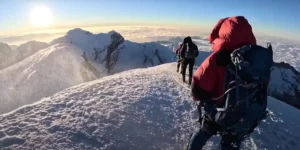
It is two o’clock in the morning at high camp, almost 5,800 m above the sea, and the glacier glows faintly under a sky crowded with stars. You clip into the rope behind your Sherpa guide, crampons squeaking on the frozen snow, and settle into a slow rhythm: step, breathe, step. Hours later, the eastern sky turns from black to violet to gold, and one by one the giants appear. Makalu catches the light first, then Everest and Lhotse, then Cho Oyu far to the north-west and Kangchenjunga floating on the eastern edge of the world.
Mera Peak rises at the head of the remote Hinku valley, south of Everest, and is popularly known as Nepal’s highest trekking peak. At 6,476 m at its true summit, it is higher than Island Peak and Lobuche East, yet its standard route is one of the least technical in the Himalaya: a long, steady glacier climb to a short, steep summit dome. That rare combination of height, simplicity and a summit view over five of the six highest mountains on Earth is why so many trekkers choose it as their first big peak, and it is the climb at the heart of our Mera Peak Climbing expedition.
In this guide, our Sherpa climbing team explains everything you need to know: why the mountain has several heights, whether it really is the highest trekking peak, the two approach routes over the Zatrwa La and through the southern Hinku, a typical itinerary, Khare, the Mera La and high camp, summit day section by section, difficulty, training, gear, the best season, permits, safety and the adventures that can follow. If you are new to the Himalaya, our complete guide to trekking in Nepal is a good place to start.
The Short Answer: What Is Mera Peak?
Mera Peak is a 6,476 m trekking peak at the head of the Hinku Valley, south of Everest, and is widely known as Nepal’s highest trekking peak. Its standard route, graded F to PD, is a long glacier walk with one short fixed-rope summit slope, and most expeditions take 16 to 20 days from Kathmandu.
Most guided teams stop at Mera Central (6,461 m), just 15 m below the true northern summit, and on a clear morning the view takes in five of the six highest mountains on Earth: Everest, Kangchenjunga, Lhotse, Makalu and Cho Oyu. You don’t need to be a mountaineer to climb it, but you do need excellent fitness, careful acclimatisation, and basic training in crampons, ice axe, and fixed ropes, which our guides provide at Khare before the climb.
Mera Peak at a Glance
- Height: 6,476 m (21,247 ft) at Mera North, the true summit; Mera Central is 6,461 m and Mera South 6,065 m.
- Location: The head of the Hinku Valley, in the Makalu Barun National Park, south of Everest and east of Lukla.
- Grade: F to PD on the Alpine scale: mostly glacier walking, with a short steep section near the top.
- Standard route: From Khare up the Mera Glacier and over the Mera La to high camp and the summit.
- Key points: Khare (about 5,045 m), the Mera La (about 5,415 m) and high camp (about 5,780 m).
- Summit day: Usually 8 to 12 hours, with about 700 m of ascent and about 1,400 m of descent to Khare.
- Approach routes: Over the Zatrwa La (4,610 m) from Lukla, or the longer southern Hinku route via Paiya and Panggom.
- Duration: Around 16 to 20 days from Kathmandu.
- Best seasons: Autumn (October to November) and spring (April to May).
- Permits: A climbing permit, the Makalu Barun National Park permit and the local municipality permit.
- Our expedition: Mera Peak Climbing.
Mera Peak Height: Why You See Different Numbers
Ask five people how high Mera Peak is, and you may hear five different answers. The confusion is understandable, because the mountain is not a single sharp point but a broad, glaciated massif with three summits, and its name was once attached to the wrong mountain altogether.
Mera North, Mera Central and Mera South
The true summit is Mera North, at 6,476 m, the figure usually quoted for the mountain. Roughly half a kilometre away along the summit ridge stands Mera Central, at 6,461 m, and further south is Mera South, at 6,065 m, which is rarely climbed. The two higher tops are so close in height that some maps disagree about which is higher, but GPS readings from both summits confirm that the northern top is about 15 m higher.
Almost all guided teams climb to Mera Central. Teams climb its final snow dome on fixed ropes; the route is well known and offers the same extraordinary panorama. Reaching Mera North means a longer traverse on ground that changes from season to season, and it is only attempted by strong, experienced teams in good conditions. Your guide will explain on the day which top is safe and realistic.
The Peak 41 Mix-Up
You will also see a height of 6,654 m in older books, lists and many websites. That figure belongs to a different, more difficult mountain north of the Mera La, now known as Peak 41, which was mistakenly given the name Mera in an early list of Himalayan peaks. The mountain trekkers climb kept the name Mera, while its higher neighbour became Peak 41. Today, the measured heights of 6,476 m for Mera North and 6,461 m for Mera Central are the ones to trust.
Is Mera Peak Really Nepal’s Highest Trekking Peak?
In Nepal, a trekking peak is a permit category, not a description of difficulty. The Nepal Mountaineering Association administers a list of peaks below 7,000 m that can be climbed with a simpler climbing permit, ranging from easy snow climbs to serious technical mountains. Our article on NMA peak permit updates explains how the system works.
Mera earned its title partly because of the old 6,654 m figure. With modern measurements, a few peaks on some lists are quoted slightly higher, such as Chulu East in the Annapurna region and Singu Chuli, also called Fluted Peak, in the Annapurna Sanctuary. However, heights vary by source, and both are climbed far less often. In practice, Mera remains the highest trekking peak that fit trekkers climb in large numbers on a non-technical route, and that is what climbers and guides mean when they call it Nepal’s highest trekking peak.
Whatever the record books say, standing above 6,400 m on a peak you climbed with crampons and an ice axe, with Everest in front of you, is an experience few adventures can match.
Where Is Mera Peak?
Mera stands in the Mahalangur Himal, at the head of the Hinku valley, south of Everest and directly east of Lukla. The Hinku runs parallel to the Khumbu, the valley of the classic Everest Base Camp Trek. Still, it is separated from it by a high wall of peaks that includes Kusum Kanguru, so it feels a world away from the busy trail to Namche Bazaar. East of Mera lies the even wilder Hongu valley, reached over the Mera La, and beyond it rise Chamlang, Baruntse and Makalu.
The upper Hinku and Hongu valleys lie within the Makalu Barun National Park, the neighbour of the Sagarmatha National Park that protects Everest. Most climbers reach the region by flying to Lukla (2,860 m), the same gateway used by Everest trekkers, then turning east instead of north. In busy seasons, flights to Lukla often leave from Ramechhap, a few hours’ drive from Kathmandu, and our team can arrange the Ramechhap airport transfer for you.
A Short History of Mera Peak
The first ascent of Mera Peak is tied to the most famous climb of all. In the same spring that Everest was first climbed, Colonel Jimmy Roberts, a British Gurkha officer who had organised porters and supplies for the Everest expedition, used the weeks after his duties ended to explore the Hinku and Hongu valleys with Sen Tenzing, a Sherpa veteran of the early British Everest expeditions. Crossing the Zatrwa La above Lukla, they followed the Hinku to the Mera La and climbed to the central summit, just days before Hillary and Tenzing Norgay stood on top of Everest.
Roberts described Mera as a rambling mountain full of false summits, but he had also spotted a straightforward way up its glacier. He later founded one of Nepal’s first trekking companies and is remembered as the grandfather of trekking in Nepal, so in a sense the guided Himalayan treks in our list of the 50 best treks in Nepal grew from journeys like this one. The Sherpa traditions that shaped those early expeditions live on in the guides who lead you today, as described in our guide to Sherpa culture and traditions.
A French team is believed to have reached the true northern summit later, and hard technical routes have since been climbed on Mera’s steep south and west faces. The standard route, though, still follows the glacier line from the Mera La that Roberts first saw. Gurkha veteran Hari Budha Magar, the first double above-knee amputee to summit a peak above 6,000 m, has also climbed Mera, a reminder of what determination and good support can achieve.
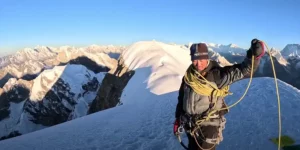
Why Climb Mera Peak?
- The highest summit most trekkers will ever reach: Over 6,400 m on a route that does not demand advanced technical skills.
- One of the greatest views in the Himalaya: Five of the six highest mountains on Earth from a single summit.
- A gentle introduction to mountaineering: Crampons, ice axe, rope work and fixed lines, learned and used under expert guidance.
- A wild, quiet valley: The Hinku has few lodges, forests where red pandas live and none of the crowds of the Khumbu.
- A stepping stone to bigger peaks: Real experience above 6,000 m for future goals such as Ama Dablam or one of Nepal’s eight-thousand-metre peaks.
- A true expedition atmosphere: Teahouse nights on the approach, tents on the glacier, a team around you and a summit earned step by step.
Two Ways to Reach the Hinku: The Zatrwa La or the Southern Route
Every Mera expedition must cross the wall of hills between Lukla and the Hinku Valley, and there are two main ways to do it. Your choice affects how many days you need and, above all, how well you acclimatise.
The Zatrwa La Route
The quicker route climbs steeply east from Lukla to the lodges of Chutanga, then crosses Zatrwa La, a broad pass at about 4,610 m marked with cairns and prayer flags, before descending to Thuli Kharka at about 4,300 m, then down through rhododendron and pine forest to Kothe in the Hinku Valley. On a clear day, the pass gives wide views back across the Dudh Koshi valley and ahead to the peaks of the Hinku.
The danger is speed. Crossing a 4,600 m pass only a day or two after flying in from Kathmandu is a big, fast altitude gain, especially for anyone new to the Himalaya. A careful itinerary sleeps at Chutanga, adds an acclimatisation day or a higher hike before the crossing, and never rushes the pass. Snow can also make the crossing slippery or block it after storms, so our guides watch conditions closely and choose the right day to go.
The Southern Hinku Route
The longer route drops south from Lukla to Paiya, crosses the small Kari La and continues through the hill villages of Panggom and Ningsow, then climbs through deep forest past Chhatra Khola to join the main trail at Kothe. It adds a day or two to the walk-in, with plenty of ups and downs, but it gains height far more gradually, passes terraced fields, bamboo and rhododendron forest and quiet villages, and gives your body time to adapt. Many experienced guides consider it the better choice for first-timers, and you can still return over the Zatrwa La after the climb, when you are fully acclimatised.
Starting in the Khumbu or Leaving Over the Amphu Labtsa
Some climbers acclimatise first in the Khumbu, trekking to Namche or even Everest Base Camp before returning towards Lukla and crossing the Zatrwa La. Others start lower in the hills, as on our Everest Base Camp Trek by Road or the historic Jiri to Everest Trek, described in our Jiri to Everest Base Camp guide. Experienced teams can also finish Mera by crossing the Mera La into the Hongu valley and climbing over the Amphu Labtsa, a steep, technical pass of about 5,845 m, into the Imja valley, an adventure we describe below.
A Typical Mera Peak Itinerary
Here is how a typical 18-day Mera Peak itinerary via the Zatrwa La unfolds, with built-in acclimatisation and a reserve day. Our Mera Peak Climbing trip page has the exact day-by-day plan for our departures, and our team can adapt it to your experience, the season and the route you prefer.
- Day 1, arrive in Kathmandu (about 1,400 m): Airport welcome, hotel check-in and a trip briefing.
- Day 2, preparation day in Kathmandu: Permits, a gear check with your climbing guide and time for Kathmandu sightseeing.
- Day 3, fly to Lukla (2,860 m) and trek to Chutanga: A steady climb through forest to the lodges below the Zatrwa La after the mountain flight.
- Day 4, acclimatisation at Chutanga: Hike higher toward the pass, then back down to sleep.
- Day 5, cross Zatrwa La (4,610 m) to Thuli Kharka (about 4,300 m): A long climb to the pass, then a short descent to the lodges beyond.
- Day 6, trek to Kothe (about 3,600 m): Down through forest into the Hinku valley.
- Day 7, trek to Thangnak (about 4,350 m): Up the valley beside the Hinku River, past a small gompa.
- Day 8, acclimatisation at Thangnak: A hike onto the moraines towards Sabai Tsho, the glacial lake beneath Kyashar.
- Day 9, trek to Khare (about 5,045 m): A short, steep climb to the last lodges below the Mera Glacier.
- Day 10, training and acclimatisation at Khare: Practice with crampons, ice axe, harness, and fixed ropes.
- Day 11, climb to high camp (about 5,780 m): Onto the glacier, over the Mera La and up to the rocky perch of high camp.
- Day 12, summit day: Climb to the summit, then descend to Khare.
- Day 13, reserve day: A spare day for bad weather or a second attempt.
- Day 14, trek to Kothe: Down the Hinku valley.
- Day 15, trek to Thuli Kharka: Back up through the forest towards the pass.
- Day 16, cross the Zatrwa La to Lukla: A last big day, with a celebration in Lukla.
- Day 17, fly to Kathmandu: Time to rest and celebrate.
- Day 18, departure: Transfer to the airport.
If you choose the southern Hinku route, add a day or two to the walk-in. Lukla flights depend on the weather, so we recommend keeping an extra day in Kathmandu at the end, as our guide to the Everest Base Camp Trek itinerary also advises for Everest trekkers.
The Hinku Valley: Forests, Herders and Glaciers
For many climbers, the walk through the Hinku is as memorable as the summit. Below Kothe, the trail winds through forests of rhododendron, fir, pine and bamboo above the Hinku River, which runs milky turquoise with glacial water. Kothe itself, at about 3,600 m, is a small settlement of lodges in a clearing by the river, with the upper valley peaks rising ahead.
Above Kothe, the trees thin out into open yak pastures. Thangnak, at about 4,350 m, sits on a broad meadow beneath the soaring peaks of the upper valley, including Kyashar, and a small gompa stands nearby with statues of Avalokiteshvara, Amitabha, and Padmasambhava, the great teacher remembered in our article on Guru Padmasambhava and Maratika. Prayer flags, mani stones, and small chortens along the trail remind us of the faith described in our overview of Buddhism in Tibet.
Near Thangnak, a short hike leads onto the moraines of Sabai Tsho, a glacial lake beneath Kyashar. An outburst from this lake once sent a powerful flood down the valley, and the scoured riverbed below Thangnak still shows its scars, a vivid reminder of how the Himalayan landscape keeps changing. The final stage climbs steeply to Khare, at about 5,045 m, the last lodges below the Mera Glacier, with Mera’s ice and snow filling the view.
Wildlife of the Hinku
The Hinku’s forests are part of one of Nepal’s richest protected areas. Red pandas live in the bamboo thickets, Himalayan black bears and musk deer roam the lower forest, Himalayan thar graze the cliffs, and the danphe, Nepal’s dazzling national bird, may burst from the rhododendrons as you pass. Sightings of the rarer mammals are a matter of luck, but the birdlife, the forest and the silence are reward enough. If wildlife is a passion, our Chitwan Jungle Safari is a wonderful way to end your trip.
Lodges, Food and Camp Life
Teahouses on the Mera route are simpler than those on the Everest trail, but they are warm and welcoming. Rooms are basic twin rooms with foam mattresses and blankets, and evenings are spent around the stove in the dining room. Menus are shorter than in the Khumbu, and dal bhat, noodle soup, potatoes, eggs, porridge and Tibetan bread are the staples. Above Khare, you sleep in tents, where our crew melts snow for water, cooks hot meals and keeps the tea coming.
Drink three to four litres of treated water a day, eat even when you are not hungry and keep your water bottles inside your sleeping bag at night so they do not freeze. If you would like more comfort before or after the climb, our guide to the luxury lodges in the Everest region explains the options in the Khumbu.
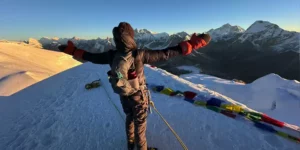
Khare, the Mera La and High Camp
Khare is the base for the climb. Here, your climbing guide checks your gear, fits your crampons to your boots, and runs a training session on the nearby slopes, practising walking in crampons, using the ice axe, moving roped together, and climbing and descending fixed ropes with a jumar and abseil device. It is also a crucial acclimatisation stop, and most itineraries spend two nights here.
From Khare, a steep trail climbs over boulders and moraine to the edge of the Mera Glacier at about 5,300 m, the area often called Mera Base Camp, where you put on crampons and rope up. The route then climbs gentle glacier slopes to the Mera La, at about 5,415 m, the broad pass between the Hinku and Hongu valleys, and continues up the glacier to high camp, at about 5,780 m, perched on a rocky outcrop above the ice. The climb from Khare usually takes five to seven hours, and some itineraries break it with a night near the Mera La to help with acclimatisation.
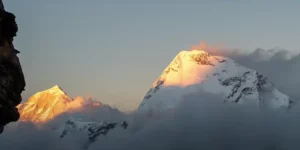
High camp is one of the most spectacular campsites in the Himalaya. As the sun sets, the snows of Everest, Lhotse, Makalu and Chamlang turn gold and pink while the glaciers below fall into shadow. It is also cold, windy, and thin-aired, with temperatures that can fall to minus 20°C or lower at night, so eat early, drink plenty, and try to sleep before the alpine start.
Summit Day on Mera Peak, Section by Section
Summit day is the longest and hardest day of the expedition, usually 8 to 12 hours from high camp to the summit and back down to Khare. Here is how it usually unfolds on the standard route.
The Alpine Start
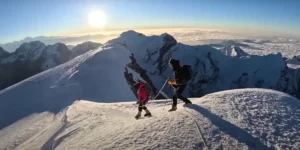
You wake around one o’clock, force down hot tea, porridge, or noodles, pull on every layer, and leave high camp by headlamp around two. Starting early means firm snow, safer crevasse bridges and time to return before the afternoon wind and cloud. Your team moves roped together, with your guide in front choosing the line.
The Long Glacier Climb
Most of the climb is a steady walk up wide glacier slopes, rarely steeper than about 30 degrees, weaving between crevasses. It is not technically hard, but above 6,000 m every step is an effort, and the cold before dawn is intense. The secret is rhythm: small steps, steady breathing, short breaks to drink and eat, and never stopping long enough to get cold. Your guide watches each climber closely for signs of exhaustion or altitude sickness.
Sunrise Over Five Eight-Thousanders
As you climb, the sky slowly lightens behind Makalu and Kangchenjunga, and the first sunlight spills across the glacier. This is the moment many climbers remember most: the whole eastern Himalaya glowing, the summit dome finally in sight and the warmth of the sun returning to frozen fingers and toes.
The Summit Dome
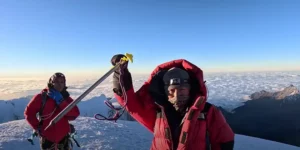
The only technical section of Mera Peak comes at the very end. Below Mera Central, a short, steep snow dome, roughly 30 to 50 m high and often 45 to 50 degrees or steeper, guards the top. Our Sherpa team fixes a rope here, and you clip in your jumar and safety line and climb carefully to the small summit, where the panorama suddenly opens in every direction. Summit conditions change with the season, and large crevasses sometimes open near the top, so your guide decides on the spot how far it is safe to go.
The Long Descent
After photos and a few minutes to take it all in, you descend the dome on the fixed rope, abseiling or using an arm-wrap technique as your guide directs, then retrace the glacier to high camp for a hot drink and a short rest. Most teams then continue down over the Mera La and the glacier to Khare, a long, tiring descent of about 1,400 m. Many accidents happen on the way down, when climbers are tired, so stay focused until you are off the glacier.
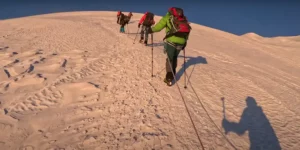
The View From the Summit of Mera Peak
On a clear morning, the summit offers one of the finest panoramas in the Himalaya, with five of the six highest mountains on Earth in a single sweep:
- Everest (8,849 m): To the north, its famous summit pyramid rising above the wall of Lhotse and Nuptse; our guide to what you see at Everest Base Camp shows the same mountain from below.
- Lhotse (8,516 m) and Nuptse (7,861 m): The great wall beside Everest, which trekkers see up close from Dingboche.
- Makalu (8,485 m): The fifth-highest mountain on Earth, a dark granite pyramid towering above the Barun valley to the north-east.
- Cho Oyu (8,188 m): Far to the north-west, the giant that dominates the Gokyo Lakes Trek.
- Kangchenjunga (8,586 m): The third-highest mountain on Earth, floating on the far eastern horizon above the valleys of our Kanchenjunga Base Camp Trek.
- Chamlang (7,319 m) and Baruntse (7,129 m): Massive neighbours across the Hongu valley.
- Ama Dablam (6,812 m), Kangtega, Thamserku and Kusum Kanguru: The beautiful peaks of the lower Khumbu, seen from an unusual angle; our article on Ama Dablam tells the story of its most elegant.
Only K2, the second-highest mountain on Earth, is missing from the six; it lies far away in the Karakoram. Our comparison of Gokyo Ri vs Kala Patthar describes two great Everest viewpoints for trekkers who are not climbing.
How Difficult Is Mera Peak?
Mera Peak is graded F to PD on the Alpine scale, meaning easy to slightly difficult in technical terms. Most of the route is a glacier walk on snow slopes of up to about 30 degrees, and the only steep climbing is the short summit dome on a fixed rope. That does not make it easy. The real challenges are:
- Altitude: Above 6,400 m, each breath holds less than half the oxygen it would at sea level, so acclimatisation is the key to success.
- Cold and wind: Temperatures before dawn can drop to minus 20°C or colder, and wind makes summit day feel even colder.
- A very long summit day: 8 to 12 hours of effort, much of it in the dark, followed by a long descent.
- Remoteness: The Hinku is far from roads and hospitals, so evacuation depends on helicopters and good weather.
- Glacier hazards: Hidden crevasses, whiteouts and changing snow conditions demand roped travel and experienced guides.
Our guide to Everest Base Camp Trek difficulty explains how altitude affects the body on a trek; on Mera, those effects are stronger because the summit is around 1,100 m higher than Everest Base Camp.
Mera Peak vs Island Peak vs Lobuche East
- Mera Peak (6,476 m, F to PD): The highest of the three but the least technical, with a long glacier climb to a short fixed-rope summit dome. Altitude, cold and a remote approach are the main challenges.
- Island Peak (6,189 m, PD+): A rocky ascent, a crevassed glacier sometimes crossed on ladders, a headwall of up to around 50 degrees on fixed ropes and an exposed summit ridge, approached via the Everest trail on our Island Peak Climbing
- Lobuche East (6,119 m, PD+): Rock slabs, a steep snow and ice slope on fixed ropes and an exposed ridge above the Khumbu Glacier, climbed on our Lobuche Peak Climbing.
In short, Island Peak and Lobuche East test your technique, while Mera tests your stamina and your body’s ability to cope with altitude. Many climbers start with Mera, then return for a more technical peak; others do it the other way round.
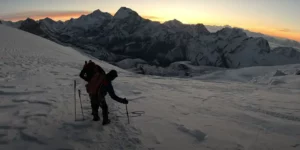
Who Can Climb Mera Peak?
Mera is one of the most accessible high peaks in the world for fit, determined trekkers. It suits:
- Strong trekkers ready for their first summit: Especially those who have already trekked above 5,000 m on routes such as the 14-day Everest Base Camp Trek.
- First-time climbers: No mountaineering experience is required, as we teach the skills at Khare; our advice for Everest Base Camp beginners also applies to the walk-in.
- High-altitude hikers: Anyone who has climbed a high non-technical mountain elsewhere, such as Kilimanjaro, has useful experience of altitude and early starts.
- Older climbers: Fit climbers in their fifties and sixties can reach the summit with good preparation; our guide to the Everest Base Camp Trek over 50 has useful advice on altitude and recovery.
- Future expedition climbers: Test how their bodies cope above 6,000 m before bigger peaks.
Mera is not suitable for children or for anyone with serious heart or lung conditions, and everyone should see a doctor before booking. Families with younger children will find gentler adventures in our guide to the Everest Base Camp Trek with kids.
Skills Training at Khare
You do not need to arrive as a mountaineer, but you must be comfortable with the basic techniques before summit day. At Khare, your climbing guide teaches and practises:
- Fitting and walking in crampons: On flat ice, slopes and mixed ground.
- Using the ice axe: For balance and for self-arrest if you slip.
- Moving roped together: Keeping the rope tight and the spacing right on the glacier.
- Climbing fixed ropes with a jumar: Clip in, slide the jumar, and pass anchors safely.
- Descending fixed ropes: Abseiling with a figure-of-eight or using an arm wrap.
- Knots and safety checks: Checking your harness, karabiners and partner every time.
If you can, take a short winter skills or alpine course before you travel. It will make the training at Khare easier and your summit day safer.
Acclimatisation and Altitude Sickness on Mera
Acclimatisation is the single biggest factor in reaching the summit of Mera, and the fast gain over the Zatrwa La makes it even more important here than on many treks. The golden rules are simple: climb slowly, sleep low where you can, drink plenty and never ignore symptoms.
- Know the signs: Headache, nausea, loss of appetite, dizziness, unusual fatigue, and poor sleep are early signs of acute mountain sickness, explained in our acute mountain sickness articles. article
- Watch for danger signs: Breathlessness at rest, a wet cough, confusion or loss of coordination can signal HAPE or HACE, which need immediate descent.
- Never go up with symptoms: Rest at the same altitude until you feel better, and descend if they worsen.
- Use your acclimatisation days well: Take a gentle hike higher, then return to sleep.
- Talk to your doctor: Ask about preventive medication such as acetazolamide before you travel.
Our detailed guide to altitude sickness on the Everest Base Camp trek explains prevention and treatment in more depth, and the same principles apply in the Hinku. Our guide to how many days the EBC trek takes shows why extra days on any approach improve your chances.
Training and Fitness at Home
Mera rewards endurance more than technical skill, so start training at least three to six months before your trip. Build up to long hill walks of six to eight hours with a loaded pack, add stair climbing or step-ups for leg strength, and include two or three sessions a week of running, cycling or swimming for cardiovascular fitness. Core and leg strength help on the steep summit dome and the long descent, and practising in your boots and crampons on a snowy hill is ideal if you can. Our Everest Base Camp Trek training plan gives a week-by-week programme you can extend for Mera.
Mental strength matters as much. Summit day is long, cold, and repetitive, and the climbers who succeed are usually those who stay calm, patient, and positive; eat and drink when told; and keep moving steadily.
Gear for Mera Peak
Good gear keeps you warm and safe on a cold, high mountain. Essentials include:
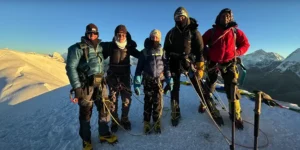
- Double mountaineering boots: Insulated boots suitable for 6,000 m and compatible with crampons; ordinary trekking boots are not enough.
- Crampons and ice axe: Twelve-point crampons fitted to your boots and a walking ice axe.
- Harness and hardware: A climbing harness, a jumar, locking karabiners, slings and a figure-of-eight or belay device.
- Helmet: Recommended on the glacier and the summit dome.
- Down jacket or down suit: A heavy expedition-weight layer for summit day and high camp.
- Layering system: Thermal base layers, fleece, insulated trousers and a waterproof, windproof shell.
- Hands and feet: Liner gloves, insulated gloves, heavy mittens, warm socks and gaiters.
- Eye protection: Category 4 glacier glasses and ski goggles for wind and snow.
- Sleeping bag: Rated to at least-20°C.
- Headlamp and spare batteries: For the alpine start, with batteries kept warm.
- Sun protection and lip balm: The sun on the glacier is ferocious.
- Water bottles with insulated covers: So your water does not freeze.
You can rent much of the climbing gear in Kathmandu, but make sure your boots fit well and test them before the trek. Our trekking equipment page and the Everest Base Camp Trek packing list cover the essentials for the walk-in.
Best Time to Climb Mera Peak
The best time to climb Mera Peak is in the two main climbing seasons, when the weather is most settled and the skies are clearest.
Autumn (October to November)
Autumn is the classic season. After the monsoon, the air is washed clean, and the views are at their sharpest, with crisp, settled weather and many clear summit mornings. October is the busiest month; November is colder but quieter, with superb visibility. Our guide to the Everest Base Camp Trek in October describes what to expect in the region.
Spring (April to May)
Spring is warmer, with longer days, rhododendrons blooming in the forests of the lower Hinku and a lively atmosphere in the mountains. Afternoon cloud and snow showers are more common, and there can be more snow on the glacier, but summit mornings are often clear. Our guide to the Everest Base Camp Trek in April has more on spring conditions.
Winter and Monsoon
Winter, from December to February, brings bitter cold and deep snow on the Zatrwa La and the glacier, and some lodges close, so it suits only very experienced, well-equipped teams. The monsoon, from June to September, brings cloud, rain, leeches in the forests and frequent flight delays, and is not recommended for climbing. Early March and late September can work for flexible climbers, with fewer people but more changeable weather. Our guides to the best time for the Everest Base Camp trek and the Everest Base Camp Trek in monsoon explain the seasons in more detail.
Permits and Rules
To climb Mera, you need:
- A climbing permit: Issued by the Nepal Mountaineering Association for Mera Peak and arranged through a registered agency.
- The Makalu Barun National Park entry permit: Because the Hinku and Hongu valleys lie within the park.
- The Khumbu Pasang Lhamu Rural Municipality permit: For entering the region via Lukla.
- The Sagarmatha National Park permit: Only if your route also enters the Khumbu, for example over the Amphu Labtsa.
You must climb trekking peaks in Nepal through a registered agency with a licensed guide, in line with the wider rules on licensed guides for trekkers. Our team arranges all permits for you and carries them on the trail, where they may be checked. Our guide to Everest Base Camp Trek permits explains the regional permits in more detail, our Nepal visa information page covers your entry to Nepal, and our NMA peak permit updates cover the latest climbing permit rules.
Safety, Rescue and Insurance
Our expeditions are led by experienced Sherpa climbing guides who know the Hinku, the glacier and the summit route well; you can meet them on our team page. On the mountain, you travel roped together on the glacier, fixed ropes protect the summit dome, and your guide checks the weather, the snow and every climber’s condition before making decisions. We would always rather turn back and try again than take an unnecessary risk.
The Hinku is remote. The nearest hospitals are in Lukla and Kathmandu, and evacuation depends on helicopters, which can only fly in daylight and good weather. In an emergency, the first treatment is usually descent, and helicopters can land at Khare and other flat sites when conditions allow. Our guide to helicopter rescue in the Everest region explains how evacuations work.
Your travel insurance must cover climbing on a trekking peak to at least 6,500 m, including helicopter evacuation and medical treatment. Many standard policies exclude climbing with ropes, ice axes and crampons, so check the wording carefully and carry your policy details with you. We also ask every climber to share their medical history and to see a doctor before the trip.
Helicopter and Comfort Options
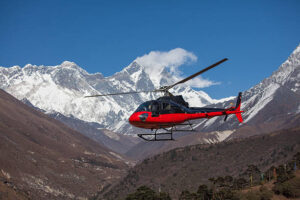
Mera is a true expedition, but a helicopter can still make the journey easier. When clouds close Lukla, a helicopter flight can save days of waiting, and some climbers choose to fly out from the Hinku after the summit, skipping the long walk back over the Zatrwa La. Flights like these are arranged in advance and depend on the weather and the rules in force, as explained in our article on Everest helicopter tour restrictions.
If you would like some comfort before or after the climb, you can recover in style in the Khumbu on our Everest Base Camp Luxury Lodge Trek, described in our Luxury Everest Base Camp Trek guide, or on the shorter Luxury Everest View Trek. The Everest Elite Luxury Heli Trek and the Everest Base Camp Helicopter Trek combine walking with flights, and our guide to the Everest Base Camp Trek with helicopter return explains how the flight home works on the Luxury Everest Base Camp Trek with Helicopter Return.
Partners and friends who do not want to climb can still see the giants you climbed among. The Mt Everest by Helicopter Tour, described in our guide to the Everest helicopter tour with breakfast, the Everest Helicopter Tour, the Sharing Everest Helicopter Tour with Kala Patthar Landing, explained in our Kala Patthar landing guide, and the Gokyo Lakes Helicopter Tour, covered in our Gokyo helicopter tour guide, all fly over the high Himalaya in a single morning. The Full-Day Everest Helicopter Tour with Village Walk adds time on the ground among Sherpa villages.
If you are weighing walking against flying, our comparisons of an EBC helicopter tour vs heli trek and the EBC trek or helicopter tour will help; our article on whether a helicopter can land at Everest Base Camp answers a common question, and our guides to the Everest Base Camp helicopter tour and the best seasons for an Everest helicopter tour help you plan. For a simpler sightseeing flight from Kathmandu, see our Everest mountain flight guide.
Combining Mera Peak With Other Adventures
Mera combines beautifully with other routes in the Everest region:
- Mera and Island Peak: The classic double. After Mera, experienced teams cross the Mera La into the Hongu Valley, past the lakes of Panch Pokhari, and climb over the Amphu Labtsa into the Imja Valley near Chhukung, then climb Island Peak already well acclimatised.
- Mera and Everest Base Camp: From the Imja Valley, continue to Lobuche, Gorakshep and Kala Patthar, following our guide to the Everest Base Camp Trek distance.
- Mera and Lobuche East: A third summit above the Khumbu Glacier, for climbers who want a more technical peak.
- Mera and the high passes: Continue over the Cho La and the Renjo La on the Everest 3 Pass Trek, described in our Everest Three Passes Trek guide, with a climb of Gokyo Ri and a visit to the fifth lake, as covered in our Gokyo Lakes Trek guide.
Crossing the Amphu Labtsa is a serious undertaking, with steep snow and ice, fixed ropes and abseils, and a long, remote stretch with no lodges in the upper Khumbu, so it is only for fit, experienced teams with full camping support. Once you descend into the Khumbu, the Pheriche aid post is close by, and the trail home passes Pangboche, Tengboche, with its monastery described in our guide to Tengboche Monastery and the Mani Rimdu festival, the villages of Khumjung and Khunde, the Hotel Everest View and the riverside trail through Phakding and Monjo.
After Mera Peak: Bigger Goals
For many climbers, Mera is the first step on a longer mountaineering journey. Having proven that your body copes well above 6,000 m, you might next try a more technical trekking peak, then an expedition peak such as Baruntse or Ama Dablam; our answers to common questions about climbing Ama Dablam show what that step involves. Some climbers eventually aim for one of Nepal’s eight-thousanders, and the experience you gain on Mera, from moving on a glacier to managing the cold, is the foundation for all of it.
Not Ready to Climb? Treks With Big Mountain Views
If a 6,000 m summit feels like too big a step, Nepal has wonderful treks that bring you close to the same giants. The classic Everest Base Camp Trek leads to the foot of the world’s highest mountain, while our 10-day Everest Base Camp Trek suits shorter schedules. The Everest View Trek offers a gentle route with big views, and the Ama Dablam Base Camp Trekking, described in our Ama Dablam Base Camp Trek guide, takes you beneath the most beautiful peak of the Khumbu.
Beyond the Everest region, the Annapurna Base Camp Trek, described in our ultimate guide to Annapurna Base Camp, the Annapurna Circuit Trek, the Manaslu Circuit Trek over the Larke Pass, the Upper Mustang Trek, described in our guide to trekking in Upper Mustang, and the Langtang Valley Trek all offer high mountain adventures without a summit climb. Our comparison of Everest Base Camp vs the Snowman Trek shows how Bhutan’s hardest trek measures up.
Photography on Mera Peak
- High camp at sunset: The light on Everest, Makalu and Chamlang is unforgettable, so be ready before the sun drops.
- Summit panoramas: Take a slow, overlapping series of shots or use your phone’s panorama mode, then put the camera away and look.
- Keep batteries warm: Cold drains them fast, so carry spares in an inside pocket.
- Use liner gloves: Thin touchscreen liners let you work a camera without exposing bare skin.
- Watch the glare: Snow fools camera meters, so adjust the exposure and protect your eyes.
- Respect people and places: Ask before photographing people, and be respectful in gompas.
- Leave the drone at home: Drones need special permission in national parks.
Responsible Climbing
The Hinku is a fragile, little-visited valley, and we want it to stay that way. Carry all your rubbish back down, use the toilets at lodges and camps, avoid single-use plastic by treating your own water and stay on established trails to protect the alpine meadows. Respect local customs: walk clockwise around mani walls and chortens, ask before entering gompas and support local lodges and shops. The mani stones carry the mantra Om Mani Padme Hum, and monasteries across the Himalaya tell the stories of yogis such as Milarepa.
Our porters and crew are the backbone of every expedition, and we look after them with proper equipment and fair loads. Read more on our responsible tourism page.
Before and After the Expedition
Your journey begins and ends in Kathmandu, where you can explore the great stupas of Boudhanath and Swayambhunath, the temples of Pashupatinath and the old royal squares on our Kathmandu Day Tour. After the climb, many climbers relax in Pokhara, enjoying the lakeside, Pokhara sightseeing and paragliding in Pokhara, or head west for wildlife on the Bardia National Park Tour.
Others extend their journey to Bhutan on our Luxury Bhutan Tour, with a hike to the Tiger’s Nest Monastery, or to Tibet on the Lhasa to Everest Base Camp Overland Tour, described in our Lhasa to Everest Base Camp guide, to see Everest from the north.
Common Mistakes on Mera Peak
- Rushing the Zatrwa La: Crossing the pass too soon after Lukla often causes altitude problems on this route.
- Underestimating the cold: Poor boots, mittens or sleeping bags lead to frostbite and failed attempts.
- Skipping training: Arriving unfit makes the long summit day dangerous and miserable.
- Ignoring symptoms: Hiding a headache to keep up with the group can turn mild altitude sickness into an emergency.
- Not drinking enough: Dehydration worsens altitude sickness and fatigue.
- Wearing new boots: Break in your boots before the trip and test them with crampons.
- Leaving no spare days: Lukla weather often delays flights, so build in a buffer.
- Wrong insurance: Make sure your policy covers climbing to 6,500 m and helicopter rescue.
- Treating the summit as the finish line: Save energy for the long descent to Khare.
Frequently Asked Questions About Mera Peak
How high is Mera Peak?
The true summit, Mera North, is 6,476 m, and Mera Central, where most guided teams stand, is 6,461 m. Mera South is 6,065 m. The 6,654 m figure seen in some older sources belongs to a different mountain, now called Peak 41.
Is Mera Peak really Nepal’s highest trekking peak?
It is widely known as Nepal’s highest trekking peak. Some official lists quote a few peaks slightly higher, but Mera is the highest trekking peak regularly climbed by fit trekkers on a non-technical route.
How difficult is Mera Peak?
It is graded F to PD: technically easy apart from a short fixed-rope summit dome, but physically very demanding because of the altitude, the cold and a summit day of 8 to 12 hours.
Can beginners climb Mera Peak?
Yes, if they are very fit and well acclimatised. No mountaineering experience is required, as our guides teach crampon, ice axe and fixed-rope skills at Khare, but previous high-altitude trekking experience helps a great deal.
How many days does it take to climb Mera Peak?
Most itineraries take 16 to 20 days from Kathmandu, depending on whether you cross the Zatrwa La or take the longer southern route, and on how many acclimatisation and reserve days are included.
Which route is better, the Zatrwa La or the southern Hinku route?
The Zatrwa La route is shorter but gains height quickly; the southern route through Paiya and Panggom is a day or two longer but gentler for acclimatisation. Many climbers enter via the southern route and return over Zatrwa La.
What is the best time to climb Mera Peak?
Autumn, especially October and November, offers clear, settled weather, and spring, especially April and May, offers warmer days and flowering rhododendron forests.
Do I need a permit and a guide?
Yes. You need a climbing permit from the Nepal Mountaineering Association, the Makalu Barun National Park permit and the local municipality permit, and you must climb with a licensed guide through a registered agency.
Do I need supplementary oxygen on Mera Peak?
No. Supplementary oxygen is not normally used on Mera. Careful acclimatisation, a sensible itinerary, and a steady pace get climbers to the summit.
Which expedition should I book?
Our Mera Peak Climbing expedition is built around the approach trek, acclimatisation days, skills training at Khare and licensed climbing guides. The trip page shows the full itinerary and what is included.
Final Thoughts: Standing Above the Hinku
Mera Peak is a rare mountain: high enough to feel like a true Himalayan summit, gentle enough for determined trekkers and set in a valley wild enough to feel like a real expedition. It asks for fitness, patience and respect for the altitude, and it rewards you with a sunrise over five of the six highest mountains on Earth and the quiet pride of having climbed Nepal’s highest trekking peak.
Join our Mera Peak Climbing expedition and let our experienced Sherpa climbing guides lead you safely from the forests of the Hinku to the summit snows, then unwind in comfort on the Everest Base Camp Luxury Lodge Trek if you have time to spare. Learn more about our company, see our legal documents, then plan your trip or contact us today.


