Kala Patthar Sunrise Hike
At four in the morning, Gorak Shep is silent except for the hiss of a stove in the lodge kitchen. You pull on every layer you own, sip hot tea that cools before you finish it, and step outside into air so cold it hurts to breathe. Above you, the stars are impossibly bright, and the ghostly white pyramid of Pumori fills half the sky. A line of headtorches is already zigzagging up the dark slope ahead.
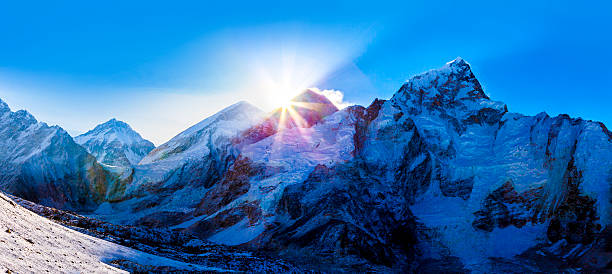
Two hours later, you stand among prayer flags at about 5,545 m, watching the sky behind Everest turn from black to violet, orange, and gold. The Kala Patthar sunrise hike is the high point of the Everest Base Camp Trek, literally and emotionally, and for many trekkers it is the most unforgettable morning of their lives.
In this guide, our Sherpa team explains everything you need to know: when the sun actually rises, what time to leave Gorak Shep, how hard the climb is, what you see from the top, how to stay warm and safe, and how to photograph the moment. For an overview of the hill itself, read our Kala Patthar guide as well.
The Short Answer: What Is the Kala Patthar Sunrise Hike?
The Kala Patthar sunrise hike is a pre-dawn climb of about 400 m from Gorak Shep (5,164 m) to the Kala Patthar viewpoint at about 5,545 m, the best place on the trek to see Everest. It takes 1.5 to 2 hours by headtorch, and you watch the sun rise behind Everest, Nuptse, and Lhotse.
Most trekkers do it on the morning after visiting Everest Base Camp, then return to Gorak Shep for breakfast and descend the valley the same day.
Kala Patthar Sunrise Hike at a Glance
- Start: Gorak Shep, about 5,164 m, the highest lodges on the Everest Base Camp route.
- Finish: The Kala Patthar viewpoint, about 5,545 m, with a higher top near 5,640 m a short scramble further on.
- Climb: About 400 m of ascent over roughly 2 km of zigzagging path.
- Time: 1.5 to 2 hours up for most trekkers, and about an hour down.
- Start time: Usually between about 4 and 5 am in autumn, earlier in late spring and later in midwinter.
- Temperature at dawn: Often between minus 10 and minus 20°C in autumn, a little milder in late spring and colder in winter, before wind chill.
- Difficulty: Not technical, but steep, dark, cold, and very high.
- Highlights: Everest, Nuptse, Lhotse, Changtse, Pumori, the Khumbu Icefall and the Khumbu Glacier in the first light.
- Our trek: Day 10 of the 14-day Everest Base Camp Trek, followed by the descent to Pheriche.
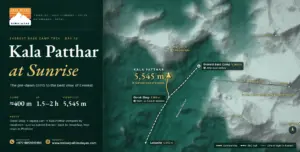
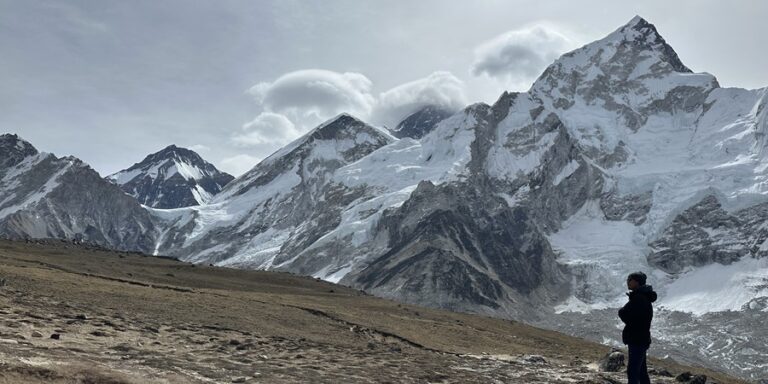
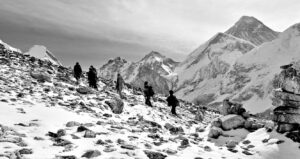
The Kala Patthar sunrise hike from Gorak Shep, with a view of Everest from about 9.5 km away, and the trail to Everest Base Camp.
Where the Kala Patthar Sunrise Hike Fits in Your Trek
The Kala Patthar sunrise hike comes at the very top of a carefully paced itinerary. On our 14-day Everest Base Camp Trek, you fly to Lukla, acclimatize in Namche Bazaar and Dingboche, and reach Lobuche on Day 8.
- Day 9: Walk from Lobuche to Gorak Shep, then visit Everest Base Camp in the afternoon and sleep at Gorak Shep.
- Day 10: Sunrise climb of Kala Patthar, breakfast at Gorak Shep, and the long descent to Pheriche(about 15 to 17 km and seven to eight hours in total).
Our guides to Lobuche to Gorak Shep, the Everest Base Camp trek in 14 days, and the Everest Base Camp trek itinerary describe the days around it, and our Gorak Shep guide explains what the night before is like.
How to Prepare in the Days Before the Climb
A good Kala Patthar sunrise hike starts long before the alarm goes off at Gorakshep. The acclimatization days lower down make the biggest difference to how you feel on the summit morning.
- Use your rest days: In Namche, choose an acclimatization walk from our list of things to do in Namche Bazaar, such as the loop through Khumjung and Khunde, and in Dingboche climb the ridge above the village or walk towards Chhukung.
- Walk slowly from the start: From Phakding and Monjo onwards, a gentle pace helps your body adapt. Our guide to how many days the EBC trek takes explains why rushing is risky, and our 10-day short Everest Base Camp trek guide shows why faster plans need extra care.
- Enjoy the monasteries on the way: Afternoon prayers at Tengboche and the old gompa of Pangboche are restful, inspiring stops, described in our guide to Tengboche Monastery and Mani Rimdu.
- Build in a buffer: Flights to Lukla can be delayed, as our guide to Lukla flight delays and cancellations Many flights leave from Ramechhap in the busy seasons, and our Ramechhap airport transfer gets you there, while the Kathmandu to Lukla helicopter is a useful backup.
- Sort your paperwork early: Your Everest Base Camp trek permits are checked on the way into the national park, and our team can arrange them for you.
On the night before the climb, eat a good dinner at Gorak Shep, drink plenty of warm fluids, lay out your clothes and go to bed early, even if sleep comes slowly at this height.
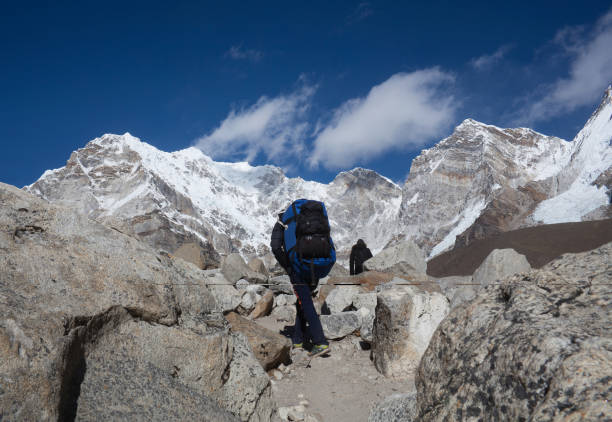
Kala Patthar: The Black Rock Below Pumori
Kala Patthar means “black rock” in Nepali, a perfect name for the dark, crumbly hump Pumori’s south ridge, directly above Gorak Shep. It is not really a mountain at all, more a high shoulder of a much bigger peak, but its position makes it famous.
From most of the upper valley, the great wall of Nuptse hides Everest or shows only its very tip. From Kala Patthar, you look straight across the Khumbu Glacier to the whole upper pyramid of the world’s highest mountain, about 9.5 km away, with Nuptse, Changtse and the Khumbu Icefall laid out around it. Everest Base Camp itself has no view of the summit, which is why the sunrise climb matters so much.
Why You See Two Different Heights
You will see Kala Patthar listed at about 5,545 m and at around 5,640 m. The lower figure is the traditional height of the main viewpoint, while GPS readings at the higher top a little further along the ridge come out close to 5,644 m. Most trekkers stop at the first viewpoint; strong, well-acclimatized walkers sometimes scramble on to the higher point. Either way, it is the highest place most trekkers will ever stand.
Kala Patthar has even featured in climate politics: Nepal’s cabinet once met near its base to draw the world’s attention to the melting Himalaya.
When Does the Sun Rise at Kala Patthar?
The official sunrise time is only part of the story at Kala Patthar. These are approximate official sunrise times for the Everest region, based on a flat horizon:
- Late September: Around 5:45 am.
- Mid-October: Around 6:00 am.
- Mid-November: Around 6:20 am.
- December and January: Around 6:40-6:50 am.
- Mid-February: Around 6:35 am.
- Mid-March: Around 6:10 am.
- Mid-April: Around 5:35 am.
- Mid-May: Around 5:10 am.
Why the Sun Appears Later Than the Clock Says
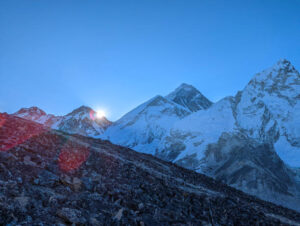
From Kala Patthar, the eastern horizon is not flat. It is the wall of Everest, Lhotse and Nuptse, rising to about 20 degrees above the viewpoint. The sun usually rises somewhere behind that massif, so it often appears over the ridge roughly an hour after the official sunrise, and later still in autumn and winter, when it rises further south behind Lhotse and Nuptse.
That is good news for photographers. The most magical colors come before the sun appears: the sky glowing behind Everest’s dark summit, and the first pink and gold light touching Pumori and the tops of the surrounding peaks. It also means the viewpoint itself stays in deep, freezing shade for a while, so dress for a long wait.
 Related tripEverest Base Camp Trek14 Days · Moderate · from US$ 2450View trip
What Time to Start the Kala Patthar Sunrise Hike
The goal is to reach the viewpoint by the official sunrise time, ideally a little before, so you watch the sky change color from the top. Allow 1.5 to 2 hours from Gorak Shep, and a little more if you are slow or feeling the altitude.
- October: Leave between about 4 and 4:30 am.
- November: Leave between about 4:15 and 4:45 am.
- December and January: Leave between about 4:45 and 5:15 am.
- March: Leave between about 4 and 4:30 am.
- April: Leave between about 3:45 and 4:15 am.
- May: Leave between about 3:15 and 3:45 am.
Your guide will set the exact time the evening before, based on the season, the weather and how everyone is feeling. Some groups deliberately leave a little later and arrive just as the sun clears the ridge, trading the pre-dawn colors for a shorter wait in the cold. Both work; what matters is a steady pace and getting back down safely.
The Trail From Gorak Shep, Step by Step
Crossing the Lakebed
From the lodges, the path crosses the flat, sandy lakebed of Gorak Shep, often frozen hard and crunchy underfoot in the early morning. Keep your headtorch on a low beam so you do not dazzle others, and follow your guide closely, as several faint paths cross the sand.
The Zigzags
The real climb starts at the foot of the slope. A dusty, well-worn path zigzags up grassy and gravelly ground, with no flat sections and no shelter from the wind. This is where the altitude hits hardest. Take tiny steps, breathe deeply and rhythmically, and resist the urge to keep up with faster groups. Looking back, you will see a string of headtorches below you and the lights of Gorak Shep getting smaller.
The Upper Slopes
Higher up, the path becomes rockier and steeper, and the sky to the east begins to lighten behind Everest and Nuptse. Many trekkers stop at a broad shoulder below the top, where the view is already superb; if you are struggling, this is a perfectly good place to watch the sunrise.
The Final Scramble to the Prayer Flags
The last section climbs over large, loose boulders to the summit area, a jumble of rocks festooned with prayer flags. Use your hands for balance, watch your footing and keep away from the drop on the far side. Find a sheltered spot among the rocks, put on your warmest layers immediately and turn to face Everest.
Distance, Time and Elevation
The numbers for the Kala Patthar sunrise hike look modest, but every meter counts above 5,000 m.
- Distance: About 2 km each way along the zigzagging path.
- Elevation gain: About 380-400 m to the main viewpoint, and about 480 m to the higher top.
- Time up: 1.5 to 2 hours for most trekkers, up to 2.5 hours for slower walkers.
- Time down: About an hour back to Gorak Shep.
- Time at the top: Usually 30 to 45 minutes, depending on the cold and the light.
Add the descent to Pheriche after breakfast, and Day 10 becomes one of the longest of the trek. Our article on Everest Base Camp trek difficulty puts it in context, and our Everest Base Camp trek distance guide covers the whole route.
What You See at Sunrise
Before Dawn: Stars and Silhouettes
On a clear morning, the sky above Gorak Shep is filled with stars, and the snow peaks glow faintly in the starlight. As you climb, Everest’s black outline takes shape against a sky that slowly turns deep blue.
First Light: Alpenglow on the Giants
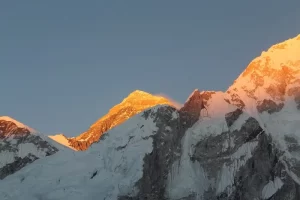
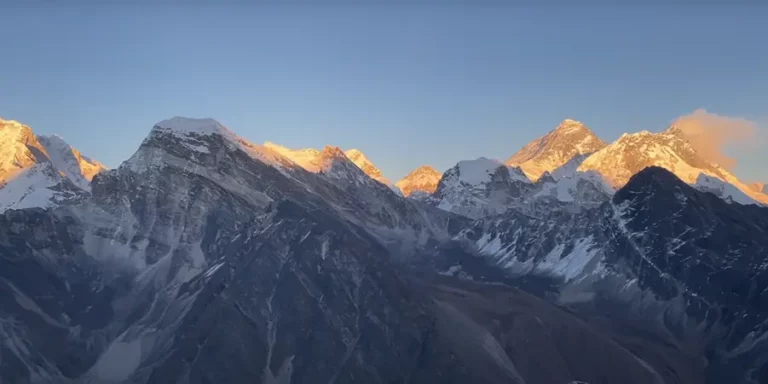
Just before the official sunrise, the high peaks begin to catch the light. Pumori, right above you, often turns a soft pink, an effect known as alpenglow, and the first light picks out the snowy tops of the surrounding peaks one by one. The sky behind Everest blazes orange and gold, and the edges of its summit pyramid seem to burn.
The Full Panorama
- Mount Everest (8,849 m): The summit pyramid and South-West Face, often with a plume of snow blowing from the top.
- Nuptse (7,861 m): The huge fluted wall to the right of Everest, which hides the summit from most of the valley.
- Lhotse (8,516 m): The world’s fourth-highest peak, glimpsed beyond Nuptse.
- Changtse (7,543 m): Everest’s northern neighbour in Tibet, to the left of the summit.
- Pumori (7,161 m): The elegant peak directly behind and above you.
- Lingtren and Khumbutse: The border peaks between Pumori and Everest.
- The Khumbu Icefall and Glacier: The tumbling icefall below Everest and the long glacier winding down past base camp.
- Looking south: Ama Dablam, Taboche, Cholatse and Lobuche East above the valley you have climbed.
Our guide to what you see at Everest Base Camp explains the expedition world below the icefall, and our comparison of Gokyo Ri vs Kala Patthar shows how this view compares with the Gokyo valley.
Why Everest Looks Dark at Sunrise
At sunrise, the sun is behind Everest, so you are looking at its shaded side. The mountain often appears as a dramatic dark silhouette against a glowing sky, while the peaks around and behind you light up first. Everest’s face is best lit in the late afternoon, which is why some photographers prefer sunset.
PHOTO SLOT (add your own photo here): Everest, Nuptse and the prayer flags on the summit rocks at sunrise. File name: everest-from-kala-patthar-at-sunrise. webp. Alt text: Everest at sunrise from Kala Patthar with prayer flags. Caption: Everest and Nuptse at sunrise from the prayer flags at the top of Kala Patthar
Sunrise or Sunset on Kala Patthar?
Both are spectacular, and your guide will choose based on the weather and your itinerary.
- Sunrise: Usually clearer and calmer, with the dramatic silhouette of Everest and alpenglow on the surrounding peaks. It is the coldest option, and you climb in the dark.
- Sunset: Warm, golden light directly on Everest’s face, and a warmer climb. Afternoon clouds and wind are more common, especially in spring, and you descend in the dark.
On our treks, we usually visit Everest Base Camp on the afternoon of Day 9 and climb Kala Patthar at sunrise on Day 10. If the forecast suggests a clear evening and a cloudy morning, your guide may switch the order. Do not try to do both sunset and sunrise; one climb at this altitude is plenty.
How Cold Is It? Temperatures and Wind at Dawn
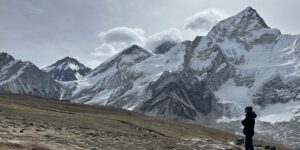
Dawn on Kala Patthar is one of the coldest experiences of the trek. Before sunrise, temperatures are often between minus 10 and minus 20°C in autumn, a little milder in late spring and colder in winter, and the wind that often blows across the summit can make it feel far colder still. Because the sun stays hidden behind the Everest massif for a while, you may wait in the shade for some time.
- Layer up before you are cold: Put on your down jacket the moment you stop.
- Protect your hands: Wear liner gloves under warm mittens, and take off your mittens only briefly for photos.
- Cover your face: A buff or balaclava protects your nose and cheeks from frostnip.
- Keep moving: Gentle movement keeps the blood flowing while you wait.
- Warm drinks: A flask of hot tea or ginger lemon honey is worth its weight in gold.
Who the Kala Patthar Sunrise Hike Suits
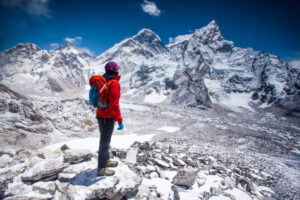
The Kala Patthar sunrise hike suits almost anyone who has reached Gorak Shep feeling well, whatever their age or experience.
- First-time trekkers: You do not need climbing skills, only good acclimatization, warm clothes, and patience.
- Older trekkers: Many trekkers in their fifties, sixties and beyond reach the top every season; see our advice on the Everest Base Camp trek over 50.
- Families: Well-acclimatized teenagers often love it, but children need extra care with cold and altitude; read our guide to the Everest Base Camp trek with kids.
- Solo travelers: Walk with a guide or a group, never alone in the dark; our guide to the Everest Base Camp trek solo explains how to stay safe.
- Yoga and mindfulness lovers: Sunrise here is a natural moment for quiet reflection, and the breathing practice on our Everest Base Camp Yoga Trek can make the slow climb feel calmer, as our Everest yoga trek guide explains
 Related tripEverest Helicopter Tour6 Hours · Easy · from US$ 1450View trip
How Hard Is the Kala Patthar Sunrise Hike?
The Kala Patthar sunrise hike involves no ropes or technical climbing, but it is the hardest short walk of the trek.
- Altitude: At over 5,000 m, you have about half the oxygen in each breath that you would at sea level.
- Steepness: The path is relentlessly uphill, ending in a rocky stretch.
- Darkness: You climb by headtorch, which makes uneven ground harder to judge.
- Cold: Freezing temperatures sap energy and slow every task.
- Fatigue: Most trekkers sleep badly at Gorak Shep, and the previous day included Everest Base Camp.
With good acclimatization and a slow pace, most trekkers manage it well. Our guides to the Everest Base Camp trek for beginners and the Everest Base Camp trek training plan help you prepare at home.
Altitude Safety: When to Turn Back
Kala Patthar is the highest point of the trek, and pushing on while unwell is dangerous. Mild symptoms such as a headache or poor sleep are common at Gorak Shep, but some signs mean the climb is off.
- Do not start if you have a severe headache, vomiting, unusual breathlessness at rest, confusion, or difficulty walking in a straight line.
- Turn back if you feel dizzy, extremely exhausted, confused or unable to keep warm.
- Descend if symptoms are serious, going down towards Lobuche and Pheriche with a companion as soon as possible.
Our guides carry a first-aid kit, are experienced in recognizing altitude sickness, and will never push you to the top if you are unwell. There is no shame in watching the sunrise from the lower shoulder, or from Gorak Shep itself. Medical help is limited this high, so our guides to Everest Base Camp trek medical clinics and helicopter rescue in the Everest region explain what is available; make sure your travel insurance covers trekking to at least 6,000 m and helicopter rescue, which flies only in daylight.
Read our altitude sickness guide for Everest Base Camp, our advice on what to do if you feel sick above 4,000 m, and our page on acute mountain sickness.
What to Wear and Pack
- Insulated layers: A warm base layer, fleece, down jacket and windproof shell, plus insulated or windproof trousers.
- Hands, head and face: Liner gloves, warm mittens, a thick hat and a buff or balaclava.
- Feet: Warm, dry socks and broken-in trekking boots; microspikes if the path is icy.
- Headtorch: With fresh or spare batteries, kept warm in an inside pocket.
- Water and a flask: Insulated bottles and a flask of hot drink, as water freezes quickly.
- Snacks: Chocolate, nuts and energy bars for quick energy.
- Sunglasses and sunscreen: For the walk down, when the sun is strong, and the snow glare is intense.
- Hand and toe warmers: Small but very welcome while you wait.
- Trekking poles: Helpful on the zigzags and on the descent.
Our Everest Base Camp trek packing list and trekking equipment page cover every item in detail.
Photography Tips for Sunrise at 5,545 m
The Kala Patthar sunrise hike is a dream for photographers, but the cold and altitude make it tricky.
- Keep batteries warm: Carry spares in an inside pocket and swap them often. Phones can shut down in the cold, so keep yours close to your body.
- Shoot the colors, not just the sun: The best light is the glow behind Everest and the alpenglow on Pumori, before the sun appears.
- Expose for the sky: Bracket your exposures or use your phone’s night or HDR mode, as the contrast between the bright sky and the dark mountain is extreme.
- Use a zoom: A short telephoto lens isolates Everest’s summit and its snow plume.
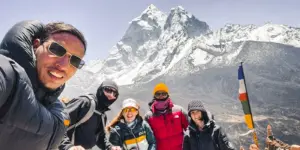
- Add foreground: Prayer flags, rocks, or your companions give scale and story.
- Turn around: Pumori glowing pink behind you is often the best photograph of the morning.
- Avoid fogged lenses: Let your camera cool gradually and avoid breathing on it.
Flying a drone in the national park requires permission from the authorities, so leave it packed unless your permits allow it.

10 Best Tips for the Kala Patthar Sunrise Hike
These are the tips our guides share with every group the evening before the Kala Patthar sunrise hike.
- Sleep in your clothes: Lay out tomorrow’s layers in your sleeping bag so they are warm when you put them on.
- Fill a flask the night before: Lodge kitchens may not be open when you leave, so ask for hot water or tea in advance.
- Eat something before you go: A biscuit, chocolate bar or bowl of porridge gives you energy for the climb.
- Start slowly: The first 20 minutes set the rhythm for the whole climb; go slower than feels necessary.
- Use the rest step: Pause to catch your breath between steps on the steepest sections.
- Keep your headtorch low: Point it at the ground, not at other trekkers’ eyes.
- Layer up at the top: Put on your down jacket immediately, before the cold sets in.
- Stay as long as you are warm, not longer: Thirty to forty-five minutes is usually enough.
- Turn back if unwell: The view from the lower shoulder is still superb.
- Save energy for the descent: The day continues with the long walk down to Pheriche.
After Sunrise: Back to Gorak Shep and Down to Pheriche
After the sunrise, most groups descend to Gorak Shep in about an hour, warming up as the sun finally floods the valley. Breakfast tastes better than ever, and then it is time to pack and start the long walk down.
The descent passes Lobuche and the memorials at Thukla, then drops into the wide valley of Pheriche, about 1,300 m lower than Kala Patthar. With every step down, the air feels thicker, appetites return, and headaches fade. In the main seasons, the Himalayan Rescue Association aid post at Pheriche offers medical care and altitude advice, as our guide to the Pheriche HRA aid post explains.
From Pheriche, the trek continues down to Namche and Lukla. If you would rather fly from the high valley, our Luxury Everest Base Camp Trek with Helicopter Return and the Everest Base Camp helicopter return guide explain how it works. Back in Kathmandu, a Kathmandu Day Tour of the city’s temples and stupas is a relaxing way to end the journey, and our Kathmandu sightseeing guide has more ideas.
The Kala Patthar Sunrise Hike in Every Season
- Spring (March to May): Milder temperatures and early sunrises, with base camp full of expedition tents below you. Afternoon cloud is common, so sunrise is usually the better choice. See our guide to the Everest Base Camp trek in April.
- Autumn (late September to November): The clearest skies and sharpest views, but very cold mornings. Read our guides to the Everest Base Camp trek in October and the Everest Base Camp trek in November.
- Winter (December to February): Brutally cold and windy, with later sunrises and snow on the path, but often crystal-clear skies and almost no crowds.
- Monsoon (June to September): Clouds often hide the peaks, though early mornings sometimes bring brief clear spells. Our guide to the Everest Base Camp trek in monsoon explains what to expect.
Our guide to the best time for the Everest Base Camp trek compares the seasons in detail.
 Related tripEverest View Trek9 Days · Moderate · from US$ 1650View trip
Alternatives If You Cannot Make the Climb
Not everyone can or should climb Kala Patthar, and there are still wonderful ways to see Everest.
- The lower shoulder: Even partway up, the view of Everest and Nuptse is superb.
- Gokyo Ri: On the Everest Gokyo Lakes Trek, the climb to Gokyo Ri and the fifth lake offers a vast panorama of Everest, Cho Oyu and the Ngozumpa Glacier, as our Gokyo Lakes trek guide describes
- Lower viewpoints: The Hotel Everest View above Namche and the Everest View Trek show Everest from much lower altitude, as our Luxury Everest View Trek guide describes.
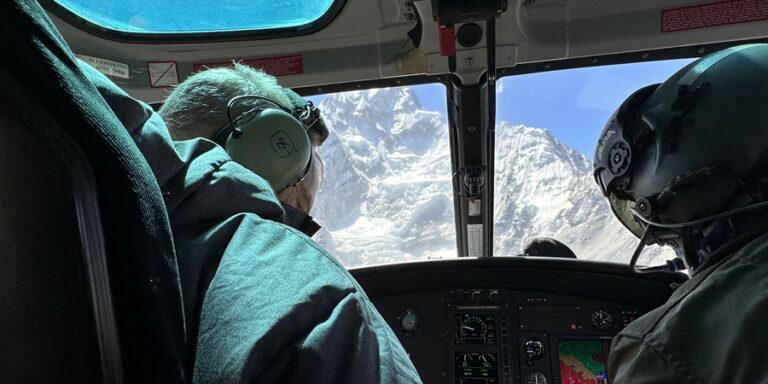
- By helicopter: The Sharing Everest Helicopter Tour with Kala Patthar Landing lands near the viewpoint, as explained in our Kala Patthar landing sharing tour
- From the air: An Everest mountain flight from Kathmandu shows the whole range in an hour.

Luxury and Helicopter Options
Gorak Shep’s lodges are simple for everyone, but the rest of your trek can be far more comfortable. The Everest Base Camp Luxury Lodge Trek uses the region’s finest lodges, and the Everest Base Camp Helicopter Trek and Everest Elite Luxury Heli Trek combine trekking with helicopter flights. Our guides to luxury lodges in the Everest region and the luxury Everest Base Camp trek explain the options.
For a shorter experience, the Everest Helicopter Tour and Mt Everest by Helicopter Tour fly over Kala Patthar and the Khumbu Glacier, and our Everest base camp helicopter tour article and comparison of the EBC trek or helicopter tour help you choose, along with our comparison of the EBC helicopter tour vs heli trek. Many tours stop for breakfast with an Everest view, as described in our guide to the Everest helicopter tour with breakfast, and the Everest Heli Sherpa Village Walk adds a walk through a Sherpa village.
Landings in the Khumbu follow local rules, as described in our article on Everest helicopter tour restrictions, and our guide to the best seasons for an Everest helicopter tour explains when flights are most reliable. An article on whether a helicopter can land at Everest Base Camp covers the high landing sites, and our Gokyo helicopter tour guide describes the Gokyo Lakes Helicopter Tour, which visits the neighboring valley.
Responsible Trekking on Kala Patthar
Kala Patthar lies in Sagarmatha National Park, a UNESCO World Heritage Site, and the summit is sacred to many Sherpas.
- Respect the prayer flags: Do not climb on them, tear them, or take them as souvenirs.
- Leave nothing behind: Carry down wrappers, used hand warmers, batteries, and tissues.
- Keep the peace: Many people come here for a quiet, emotional moment, so keep music and noise to a minimum.
- Stay on the path: Short cuts on the zigzags cause erosion on the fragile slopes.
- Look after your porters and guides: Make sure your team is properly equipped for the cold.
Our responsible tourism page explains how we work, and our guide to Sherpa culture and traditions explains why these mountains are sacred.
Common Mistakes on the Kala Patthar Sunrise Hike
Most problems on the Kala Patthar sunrise hike come from a few avoidable mistakes.
- Starting too fast: Rushing the first zigzags leaves you exhausted halfway up.
- Under-dressing: It is far colder at the top than at Gorak Shep, and you will be standing still.
- Forgetting spare batteries: Cold kills batteries fast, and a dead headtorch on the descent is dangerous.
- Ignoring symptoms: Climbing with worsening altitude sickness is never worth the view.
- Staying too long: An hour at minus 15°C in the wind leads to numb fingers and exhaustion.
- Trying to do sunset and sunrise: Two climbs in less than a day is too much for most people.
- Forgetting the rest of the day: The descent to Pheriche is long, so save some energy.
Beyond Kala Patthar: Your Next Himalayan Goals
Standing on Kala Patthar often sparks the next adventure. Trekking peaks such as Island Peak, Lobuche Peak and Mera Peak take you higher still, as our guides to Island Peak climbing, Lobuche East and Mera Peak, the highest trekking peak, explain.
The Everest 3 Pass Trek, described in our Everest Three Passes trek guide, adds the Kongma La, Cho La and Renjo La to the Everest experience. The side trip to Ama Dablam Base Camp, also offered as our Ama Dablam Base Camp Trek, takes you beneath Ama Dablam, the elegant peak you can spot far down the valley from Kala Patthar.
For a deeper approach to Everest, the Jiri to Everest Trek, described in our Jiri to Everest Base Camp trek guide, and the Everest Base Camp Trek by Road add days in the middle hills, so you arrive even better acclimatized. Beyond th Khumbu, the Annapurna Circuit Trek, Manaslu Circuit Trek and Kanchenjunga Base Camp Trek offer equally unforgettable mornings, as does the sunrise over the Annapurna Sanctuary on the Annapurna Base Camp Trek. For a far longer challenge, compare Everest Base Camp vs the Snowman Trek, and for more ideas, browse our 50 best treks in Nepal and our trekking in Nepal guide.
Frequently Asked Questions About the Kala Patthar Sunrise Hike
How long is the Kala Patthar sunrise hike?
The Kala Patthar sunrise hike takes 1.5 to 2 hours up from Gorak Shep and about an hour down, covering roughly 2 km each way with about 400 m of ascent.
What time should I leave Gorak Shep for sunrise?
In autumn, usually between about 4 and 5 am. Leave earlier in April and May, when the sun rises between about 5:10 and 5:35 am, and a little later in midwinter.
How high is Kala Patthar?
The main viewpoint is usually given as about 5,545 m. GPS readings at the hi her top a little further along the ridge come out close to 5,644 m.
Is the Kala Patthar sunrise hike difficult?
It is not technical, but it is steep, cold, dark, and very high. A slow, steady pace and good acclimatization make it manageable for most trekkers.
Can you see Everest from Kala Patthar?
Yes. It offers the best close-up view of Everest on the trek, about 9.5 km away, along with Nuptse, Lhotse, Changtse, and the Khumbu Icefall.
Why does Everest look dark at sunrise?
The sun rises behind the Everest massif, so you see the mountain’s shaded side as a silhouette. The peaks around you, especially Pumori, light up first.
How cold is Kala Patthar at sunrise?
Before sunrise, it is often between minus 10 and minus 20°C in autumn, a little milder in late spring and colder in winter, and the wind can make it feel much colder.
Is sunrise or sunset better on Kala Patthar?
Sunrise is usually clearer and calmer, while sunset lights Everest’s face but is more often cloudy. We usually plan for sunrise and adjust to the weather.
Do I need a guide for the Kala Patthar sunrise hike?
A guide is strongly recommended for navigating in the dark, judging the weather, and spotting altitude sickness. Our article on the E erest Base Camp trek without a guide explains the rules.
Which day of the Everest Base Camp Trek is the Kala Patthar sunrise?
On our 14-day Everest Base Camp Trek, it is Day 10, after visiting base camp on Day 9.
Final Thoughts: Your Sunrise Above the Clouds
Few travel moments compare with standing on Kala Patthar as the sky ignites behind Everest. The cold, the darkness, and the thin air are all part of the story, and they make the reward even sweeter. With a sensible pace, the right gear,r and a guide who knows the mountain, the Kala Patthar sunrise hike becomes the morning you will talk about for the rest of your life.
Ready to see it for yourself? Join our 14-day Everest Base Camp Trek with experienced Sherpa guides, or choose the Everest Base Camp Luxury Lodge Trek for more comfort. Meet our team, learn more about Trek Nepal Himalayas and our legal documents, check our Nepal visa information, start on our Plan Your Trip page, or contact us, and we will help you plan every step to the top of Kala Patthar.